Opening the book…
Reading Questions
- When graphing a polar equation, what does the variable \(r\) represent at each angle \(\theta\)?
- Explain why the graph of \(r = 2\sin(\theta)\) for \(0 \le \theta \le 2\pi\) traces the circle twice.
- What is the general shape of the polar graph for an equation of the form \(r = a\sin(n\theta)\) when \(n\) is an integer?
- How do you determine the number of petals for a rose curve \(r = a\cos(n\theta)\)?
- What is the difference between the graph of a cardioid and a limaçon with a dent?
- What is the general strategy for finding the points of intersection of two polar graphs, \(r = f(\theta)\) and \(r = g(\theta)\)?
- Why must you check for an intersection at the pole separately from solving the equation \(f(\theta) = g(\theta)\)?
- What is the shape of the graph for the polar equation \(r = k\), where \(k\) is a constant?
- What is the shape of the graph for the polar equation \(\theta = k\), where \(k\) is a constant?
- In the equation for a limaçon, \(r = a + b\cos(\theta)\), what condition on \(a\) and \(b\) results in a cardioid? What condition results in a limaçon with an inner loop?
Skills Refresher
Review the following skills you will need for this section.
Solve each equation. Give two solutions, \(0 \leq \theta \leq 2 \pi\).
-
\(\cos\left( \theta \right) = \dfrac{\sqrt{3}}{2}\)
-
\(\sin\left( \theta \right) = \dfrac{1}{\sqrt{2}}\)
-
\(\tan\left( \theta \right) = \sqrt{3}\)
-
\(\tan\left( \theta \right) = \dfrac{1}{\sqrt{3}}\)
-
\(\sin\left( \theta \right) = \dfrac{11}{\sqrt{2}}\)
-
\(\cos\left( \theta \right) = \dfrac{-1}{2}\)
-
\(\tan\left( \theta \right) = -1\)
-
\(\cos\left( \theta \right) = 0\)
- Answers
-
-
\(\dfrac{\pi}{6}, \dfrac{11\pi}{6}\)
-
\(\dfrac{\pi}{4}, \dfrac{3\pi}{4}\)
-
\(\dfrac{\pi}{3}, \dfrac{4\pi}{3}\)
-
\(\dfrac{\pi}{6}, \dfrac{7\pi}{6}\)
-
\(\dfrac{5\pi}{4}, \dfrac{7\pi}{4}\)
-
\(\dfrac{2\pi}{3}, \dfrac{4\pi}{3}\)
-
\(\dfrac{3\pi}{4}, \dfrac{7\pi}{4}\)
-
\(\dfrac{\pi}{2}, \dfrac{3\pi}{2}\)
-
Homework
Concept Check
-
Mike says that the graph of \(r=2 \sin\left( \theta \right)\) in the Example \( \PageIndex{ 1 } \) cannot be correct because there are no points on the graph for angles between \(\pi\) and \(2 \pi\). How do you respond?
-
Is it possible to have a rose with only two petals? What would its equation be?
-
Linda says that a circle of the form \(r=2 a \cos\left( \theta \right)\) is a special case of a limaçon. Support or refute her statement.
-
There are no points on the graph of \(r^2=4 \cos\left( 2 \theta \right)\) for angles between \(\frac{\pi}{4}\) and \(\frac{3 \pi}{4}\) Why is that?
Basic Skills
For the following exercises, use your calculator to graph the equation.
-
-
Graph \(r=k\), for \(k=1,2,3\). How do these graphs change for different values of \(k\)?
-
Write a Cartesian equation for each graph in part (a).
-
-
-
Graph \(r=k\), for \(k=-1,-2,-3\). How do these graphs compare to the graphs in Problem 5?
-
Write a Cartesian equation for each graph in part (a).
-
-
-
Graph \(\theta=k\), for \(k=\dfrac{\pi}{6}, \dfrac{\pi}{3}, \dfrac{2 \pi}{3}, \dfrac{5 \pi}{6}\). How do the graphs change for different values of \(k\)?
-
Write a Cartesian equation for each graph in part (a).
-
-
-
Graph \(\theta=k\), for \(k=\dfrac{7 \pi}{6}, \dfrac{5 \pi}{3}, \dfrac{7 \pi}{3}, \dfrac{11 \pi}{6}\). How do the graphs change for different values of \(k\)?
-
Write a Cartesian equation for each graph in part (a).
-
-
Complete the table of values for each equation. Plot the points in order of increasing \(\theta\). What is different about the two graphs?
-
\(r = 2\)
\(\theta\) 0 \(\dfrac{\pi}{4}\) \(\dfrac{\pi}{2}\) \(\dfrac{3\pi}{4}\) \(\pi\) \(\dfrac{5\pi}{4}\) \(\dfrac{3\pi}{2}\) \(\dfrac{7\pi}{4}\) \(r=2\) -
\(r = −2\)
\(\theta\) 0 \(\dfrac{\pi}{4}\) \(\dfrac{\pi}{2}\) \(\dfrac{3\pi}{4}\) \(\pi\) \(\dfrac{5\pi}{4}\) \(\dfrac{3\pi}{2}\) \(\dfrac{7\pi}{4}\) \(r=-2\)
-
-
Graph each line and label the points with their coordinates. How are the points on the two lines related?
-
\(\theta = \dfrac{\pi}{4}\)
\(\theta = \dfrac{\pi}{4}\) \(\dfrac{\pi}{4}\) \(\dfrac{\pi}{4}\) \(\dfrac{\pi}{4}\) \(\dfrac{\pi}{4}\) \(\dfrac{\pi}{4}\) \(r\) -2 -1 0 1 2 -
\(\theta = \dfrac{5\pi}{4}\)
\(\theta = \dfrac{5\pi}{4}\) \(\dfrac{5\pi}{4}\) \(\dfrac{5\pi}{4}\) \(\dfrac{5\pi}{4}\) \(\dfrac{5\pi}{4}\) \(\dfrac{5\pi}{4}\) \(r\) -2 -1 0 1 2
-
-
-
Graph the circle \(r = 4 \cos\left( \theta \right)\). Label the points corresponding to \(\theta = 0, \dfrac{\pi}{4}, \dfrac{\pi}{2}, \dfrac{3\pi}{4}\), and \(\pi\).
-
Complete the table of values. What happens to the graph as \(\theta\) increases from \(\pi\) to \(2\pi\)?
\(\theta\) \(\pi\) \(\dfrac{5\pi}{4}\) \(\dfrac{3\pi}{2}\) \(\dfrac{7\pi}{4}\) \(2\pi\) \(r\) -
Find the center and radius of the circle.
-
Give the Cartesian equation of the circle.
-
-
-
Graph the circle \(r = 4 \sin\left( \theta \right)\). Label the points corresponding to \(\theta = 0, \dfrac{\pi}{4}, \dfrac{\pi}{2}, \dfrac{3\pi}{4}\), and \(\pi\).
-
Complete the table of values. What happens to the graph as \(\theta\) increases from \(\pi\) to \(2\pi\)?
\(\theta\) \(\pi\) \(\dfrac{5\pi}{4}\) \(\dfrac{3\pi}{2}\) \(\dfrac{7\pi}{4}\) \(2\pi\) \(r\) -
Find the center and radius of the circle.
-
Give the Cartesian equation of the circle.
-
-
-
Graph \(r=2 a \sin\left( \theta \right)\) for \(a=-2,-1,1,2\).
-
How do the graphs change for different values of \(a\)?
-
-
-
Graph \(r=2 a \cos\left( \theta \right)\) for \(a=-2,-1,1,2\).
-
How do the graphs change for different values of \(a\)?
-
-
Complete the table of values for each cardioid and graph the equation.
\(\theta\) 0 \(\dfrac{\pi}{2}\) \(\pi\) \(\dfrac{3\pi}{2}\) \(2\pi\) \(r\) -
\(r=1+\sin\left( \theta \right)\)
-
\(r=-1+\sin\left( \theta \right)\)
-
\(r=1-\sin\left( \theta \right)\)
-
\(r=-1-\sin\left( \theta \right)\)
-
-
Complete the table of values for each cardioid and graph the equation.
\(\theta\) 0 \(\dfrac{\pi}{2}\) \(\pi\) \(\dfrac{3\pi}{2}\) \(2\pi\) \(r\) -
\(r=1+\cos\left( \theta \right)\)
-
\(r=-1+\cos\left( \theta \right)\)
-
c \(r=1-\cos\left( \theta \right)\)
-
\(r=-1-\cos\left( \theta \right)\)
-
-
Complete the table of values for each limaçon and graph the equation.
\(\theta\) 0 \(\dfrac{\pi}{2}\) \(\pi\) \(\dfrac{3\pi}{2}\) \(2\pi\) \(r\) -
\(r=2+\cos\left( \theta \right)\)
-
\(r=2-\cos\left( \theta \right)\)
-
\(r=1+2 \cos\left( \theta \right)\)
-
\(r=1-2 \cos\left( \theta \right)\)
-
-
Complete the table of values for each limaçon and graph the equation.
\(\theta\) 0 \(\dfrac{\pi}{2}\) \(\pi\) \(\dfrac{3\pi}{2}\) \(2\pi\) \(r\) -
\(r=2+\sin\left( \theta \right)\)
-
\(r=2-\sin\left( \theta \right)\)
-
\(r=1+2 \sin\left( \theta \right)\)
-
\(r=1-2 \sin\left( \theta \right)\)
-
-
-
Graph the following roses and compare. How is the number of petals related to the value of \(n\) in the equation \(r=a \sin n \theta\)?\[ r=\sin\left( 2 \theta \right), \quad r=\sin\left( 3 \theta \right), \quad r=\sin\left( 4 \theta \right), \quad r=\sin\left( 5 \theta \right)\) \nonumber \]
-
For each graph above, list the values of \(\theta\) where the tips of the petals occur.
-
Graph \(r=a \sin\left( 3 \theta \right)\) for \(a=1\), \(2\), and \(3\). How does the value of \(a\) affect the graph?
-
-
-
Graph the following roses and compare. How is the number of petals related to the value of \(n\) in the equation \(r=a \cos n \theta\)?\[ r=\cos\left( 2 \theta \right), \quad r=\cos\left( 3 \theta \right), \quad r=\cos\left( 4 \theta \right), \quad r=\cos\left( 5 \theta \right) \nonumber \]
-
For each graph above, list the values of \(\theta\) where the tips of the petals occur.
-
Graph \(r=a \cos\left( 3 \theta \right)\) for \(a=1,2\), and 3 . How does the value of \(a\) affect the graph?
-
-
-
Solve \(r^2=9 \cos\left( 2 \theta \right)\) for \(r\). (You should get two equations for \(r\).)
-
Graph both equations together. Change the \(\theta\) step to 0.02 to see the whole graph.
-
How does the value of \(a\) affect the graph of \(r^2=a^2 \cos\left( 2 \theta \right)\)?
-
-
-
Solve \(r^2=9 \cos\left( 2 \theta \right)\) for \(r\). (You should get two equations for \(r\).)
-
Graph both equations together. Change the \(\theta\) step to 0.02 to see the whole graph.
-
How does this graph differ from the graph in Problem 21?
-
-
Graph the Archimedean spiral \(r=\theta\). Set your window to\[ \begin{array}{cc}
\theta \min =0 & \theta \max =8 \pi \\[6pt] \mathrm{Xmin}=-20 & \mathrm{X} \max =20 \\[6pt] \mathrm{Y} \min =-20 & \mathrm{Y} \max =20 \\[6pt] \end{array}\nonumber \]Then graph by pressing Zoom 5. -
Graph the logarithmic spiral \(r=e^{0.2 \theta}\). Set your window to\[ \begin{array}{cc}
\theta \min =0 & \theta \max =8 \pi \\[6pt] \mathrm{Xmin}=-100 & \mathrm{X} \max =100 \\[6pt] \mathrm{Ymin}=-100 & \mathrm{Y} \max =100 \\[6pt] \end{array}\nonumber \]Then graph by pressing Zoom 5. -
-
Complete the table and graph the equation \(y=\sin\left( 3 \theta \right)\) in Cartesian coordinates, for \(0 \leq \theta \leq 2 \pi\).
\(\theta\) \(3\theta\) 0 \(\dfrac{\pi}{4}\) \(\dfrac{\pi}{2}\) \(\dfrac{3\pi}{4}\) \(\pi\) \(\dfrac{5\pi}{4}\) \(\dfrac{3\pi}{2}\) \(\dfrac{7\pi}{4}\) \(2\pi\) \(y\) -
Complete the table and graph the equation \(r = \sin\left( 3 \theta \right)\) in polar coordinates, for \(0 \leq \theta \leq 2\pi\).
\(\theta\) \(3\theta\) 0 \(\dfrac{\pi}{4}\) \(\dfrac{\pi}{2}\) \(\dfrac{3\pi}{4}\) \(\pi\) \(\dfrac{5\pi}{4}\) \(\dfrac{3\pi}{2}\) \(\dfrac{7\pi}{4}\) \(2\pi\) \(r\)
-
-
-
Complete the table and graph the equation \(y=\cos\left( 2 \theta \right)\) in Cartesian coordinates, for \(0 \leq \theta \leq 2 \pi\).
\(\theta\) \(2\theta\) 0 \(\dfrac{\pi}{4}\) \(\dfrac{\pi}{2}\) \(\dfrac{3\pi}{4}\) \(\pi\) \(\dfrac{5\pi}{4}\) \(\dfrac{3\pi}{2}\) \(\dfrac{7\pi}{4}\) \(2\pi\) \(y\) -
Complete the table and graph the equation \(r=\cos\left( 2 \theta \right)\) in polar coordinates, for \(0 \leq \theta \leq 2 \pi\).
\(\theta\) \(2\theta\) 0 \(\dfrac{\pi}{4}\) \(\dfrac{\pi}{2}\) \(\dfrac{3\pi}{4}\) \(\pi\) \(\dfrac{5\pi}{4}\) \(\dfrac{3\pi}{2}\) \(\dfrac{7\pi}{4}\) \(2\pi\) \(r\)
-
-
-
Complete the table and graph the equation \(y=2+2 \cos\left( \theta \right)\) in Cartesian coordinates, for \(0 \leq \theta \leq 2 \pi\).
\(\theta\) 0 \(\dfrac{\pi}{4}\) \(\dfrac{\pi}{2}\) \(\dfrac{3\pi}{4}\) \(\pi\) \(\dfrac{5\pi}{4}\) \(\dfrac{3\pi}{2}\) \(\dfrac{7\pi}{4}\) \(2\pi\) \(y\) -
Complete the table and graph the equation \(r=2+2 \cos\left( \theta \right)\) in polar coordinates, for \(0 \leq \theta \leq 2 \pi\).
\(\theta\) 0 \(\dfrac{\pi}{4}\) \(\dfrac{\pi}{2}\) \(\dfrac{3\pi}{4}\) \(\pi\) \(\dfrac{5\pi}{4}\) \(\dfrac{3\pi}{2}\) \(\dfrac{7\pi}{4}\) \(2\pi\) \(r\)
-
-
-
Complete the table and graph the equation \(y=1-\sin\left( \theta \right)\) in Cartesian coordinates, for \(0 \leq \theta \leq 2 \pi\).
\(\theta\) 0 \(\dfrac{\pi}{4}\) \(\dfrac{\pi}{2}\) \(\dfrac{3\pi}{4}\) \(\pi\) \(\dfrac{5\pi}{4}\) \(\dfrac{3\pi}{2}\) \(\dfrac{7\pi}{4}\) \(2\pi\) \(y\) -
Complete the table and graph the equation \(r=1-\sin\left( \theta \right)\) in polar coordinates, for \(0 \leq \theta \leq 2 \pi\).
\(\theta\) 0 \(\dfrac{\pi}{4}\) \(\dfrac{\pi}{2}\) \(\dfrac{3\pi}{4}\) \(\pi\) \(\dfrac{5\pi}{4}\) \(\dfrac{3\pi}{2}\) \(\dfrac{7\pi}{4}\) \(2\pi\) \(r\)
-
For the following exercises, use the catalog of polar graphs to help you identify and sketch the curve. Check your work by graphing with a calculator.
-
\(r=3 \cos\left( \theta \right)\)
-
\(r=2 \sin\left( \theta \right)\)
-
\(\theta=\dfrac{\pi}{4}\)
-
\(\theta=\dfrac{4 \pi}{3}\)
-
\(r=4\)
-
\(r=2\)
-
\(r=2+2 \sin\left( \theta \right)\)
-
\(r=3+3 \cos\left( \theta \right)\)
-
\(r=2-\cos\left( \theta \right)\)
-
\(r=1-3 \sin\left( \theta \right)\)
-
\(r=3 \sin\left( 2 \theta \right)\)
-
\(r=2 \cos\left( 3 \theta \right)\)
-
\(r=2 \cos\left( 5 \theta \right)\)
-
\(r=4 \sin\left( 4 \theta \right)\)
-
\(r=2+3 \sin\left( \theta \right)\)
-
\(r=3+2 \sin\left( \theta \right)\)
-
\(r^2=\cos\left( 2 \theta \right)\)
-
\(r^2=4 \sin\left( 2 \theta \right)\)
For the following exercises, identify the curve and graph it.
-
\(r \csc \theta=2\)
-
\(r=2 \sec \theta\)
-
\(r^2=4,0 \leq \theta \leq \dfrac{3 \pi}{4}\)
-
\(\theta=\dfrac{\pi}{4},|r|<2\)
-
\(r=\sin\left( \theta \right), \dfrac{3 \pi}{4} \leq \theta \leq \dfrac{5 \pi}{4}\)
-
\(r=\cos\left( \theta \right), 0 \leq \theta \leq \dfrac{\pi}{2}\)
-
\(r=2 \sin\left( 2 \theta \right) \cos\left( 2 \theta \right)\)
-
\(r=\cos ^2 \theta-\sin ^2 \theta\)
-
\(r(1-\cos\left( \theta \right))=\sin ^2 \theta\)
-
\(r \sec \theta=\sec \theta-\tan\left( \theta \right)\)
For the following exercises, graph the polar curve. Do you recognize it?
-
\(r=\dfrac{2}{1-\cos\left( \theta \right)}\)
-
\(r=\dfrac{6}{2+\sin\left( \theta \right)}\)
-
\(r=\dfrac{2}{2-\cos\left( \theta \right)}\)
-
\(r=\dfrac{1}{1+\sin\left( \theta \right)}\)
-
\(r=\dfrac{1}{1+2 \sin\left( \theta \right)}\)
-
\(r=\dfrac{3}{2-3 \cos\left( \theta \right)}\)
For the following exercises, write a polar equation for the graph.
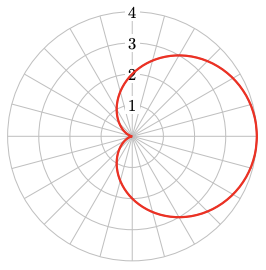
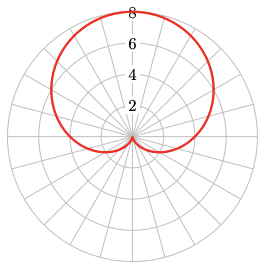
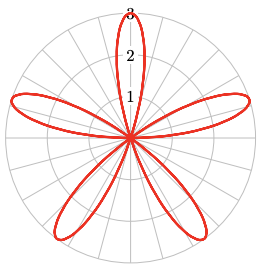
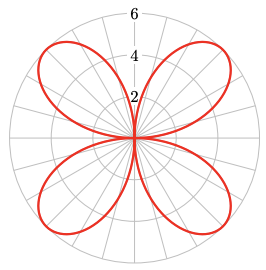


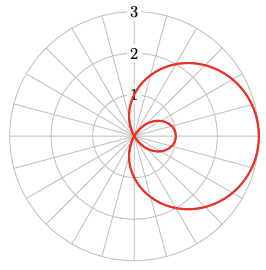

For the following exercises, find the coordinates of the intersection points of the two curves analytically. Then, graph the curves to verify your answers.
-
\(r=\cos\left( \theta \right), r=1-\cos\left( \theta \right)\)
-
\(r=\sin\left( \theta \right), r=\cos\left( \theta \right)\)
-
\(r=3 \sin\left( \theta \right), r=3 \cos\left( \theta \right)\)
-
\(r=\sin\left( 2 \theta \right), r=\cos\left( 2 \theta \right)\)
-
\(r=1, r=1-\cos\left( \theta \right)\)
-
\(r=3 \cos\left( \theta \right), r=1+\cos\left( \theta \right)\)
-
\(r=2+\sin\left( \theta \right), r=2-\cos\left( \theta \right)\)
-
\(r=\sin\left( \theta \right), r=\sin\left( 2 \theta \right)\)
For the following exercises, graph the polar curve.
-
\(r^2=\tan\left( \theta \right)\)
-
\(r^2=\cot \theta\)
-
\(r=\csc \theta-2\) (conchoid)
-
\(r=\tan\left( \theta \right)\) (kappa curve)
-
\(r=\cos\left( 2 \theta \right) \sec \theta\) (strophoid)
-
\(r=\sin\left( \theta \right) \tan\left( \theta \right)\) (cissoid)
-
\(r=\dfrac{1}{\sqrt{\theta}}\)
-
\(r=\cos \dfrac{\theta}{2}, 0 \leq \theta \leq 4 \pi\)
-
Graph the polar curves \(r=1-2 \sin n \theta\) for \(n=2,3,4,5,6\). Explain how the value of the parameter \(n\) affects the curve.
-
Graph the polar curves \(r=1-3 \cos n \theta\) for \(n=2,3,4,5,6\). Explain how the value of the parameter \(n\) affects the curve.
This page titled 9.2.2: Homework was last modified on Mon, 07 Jul 2025 19:47:02 GMT and is shared under a not declared license and was authored, remixed, and/or curated by Roy Simpson.
The book could not be loaded just now.