4.3: The Ecliptic

Physics - From Stargazers to Starships · LibreTexts

0%

Contents

    Text

    Size
    100%
    Theme
    Typeface
    Line length
    Spacing

    Read aloud

    How

    Speed: 1×
    Light up
    Highlight

    Symbols: Mulberry Symbols, © 2018–2026 Steve Lee, CC BY-SA 4.0 (licence, the set), the site's own copies.

    From LibreTexts, under CK-12, as the source states it; its equations are written in TeX, which the PDF shows typeset. This page at LibreTexts.

    4.3: The Ecliptic

    The path of the Sun across the celestial sphere is very close to that of the planets and the moon. After clocks became available, it was a relatively straightforward job for astronomers to relate the path of the Sun in the daytime to the one of stars at night, and to draw it on their star charts. Because of its relation to eclipses, that path is known as the ecliptic.
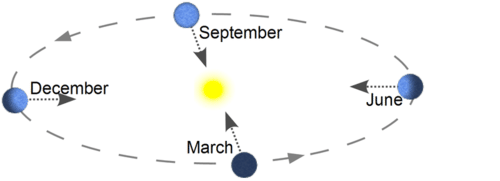
    Path of the Earth
    Figure \(\PageIndex{1}\): The orbit of the Earth around the Sun. This is a perspective view, the shape of the actual orbit is very close to a circle.

    This page titled 4.3: The Ecliptic was last modified on Tue, 15 Feb 2022 18:35:06 GMT and is shared under a CK-12 license and was authored, remixed, and/or curated by CK12 via source content that was edited to the style and standards of the LibreTexts platform.

    CK-12 Foundation
    LICENSED UNDER
    CK-12 Foundation is licensed under CK-12 Curriculum Materials License