Opening the book…
Majority to minority and back again
Essay by Dr. Bryan Zygmont
Power in the United States—and, some might say, most countries—is a matter of politics. Sometimes these politics are rooted in grassroots efforts, and sometimes they are propelled by the power of mass media. Throughout the history of the United States, politics and power have been intertwined and inseparable.
Alexander Hamilton and the two-party system
Few understood this better than Alexander Hamilton, the First Secretary of the Treasury and personal and political confidant to General (and later President) George Washington. Interestingly, although Hamilton was the de facto leader of the Federalist Party—a group unified in part by their Anglophile tendencies—he was never elected to significant political office (although he did serve during the third and tenth Congress of the Confederation during 1782-83 and 1788-89). Yet despite this lack of elected office, Hamilton holds a crucial position in the development of the two-party system in American political history.
As the Federal Period moved onward, the two-party system in the United States developed into the Federalist Party and the Democratic Republican Party. At first, the Federalists led the government under the presidencies of George Washington and John Adams, and they aspired to link the American economic and diplomatic future with Great Britain. Afterwards, with the election of the Francophile Thomas Jefferson in 1801, the Democratic Republicans took control. Generally, Democratic Republicans believed that the revolutionary zeal in France most accurately matched their own. This shift in political leadership during the early nineteenth century from the Federalists to the Democratic Republicans illustrates one of the fundamental elements of a two-party democracy: that is, there is generally a majority and a minority party, and the minority party can become the majority party.
Face-to-face with voters
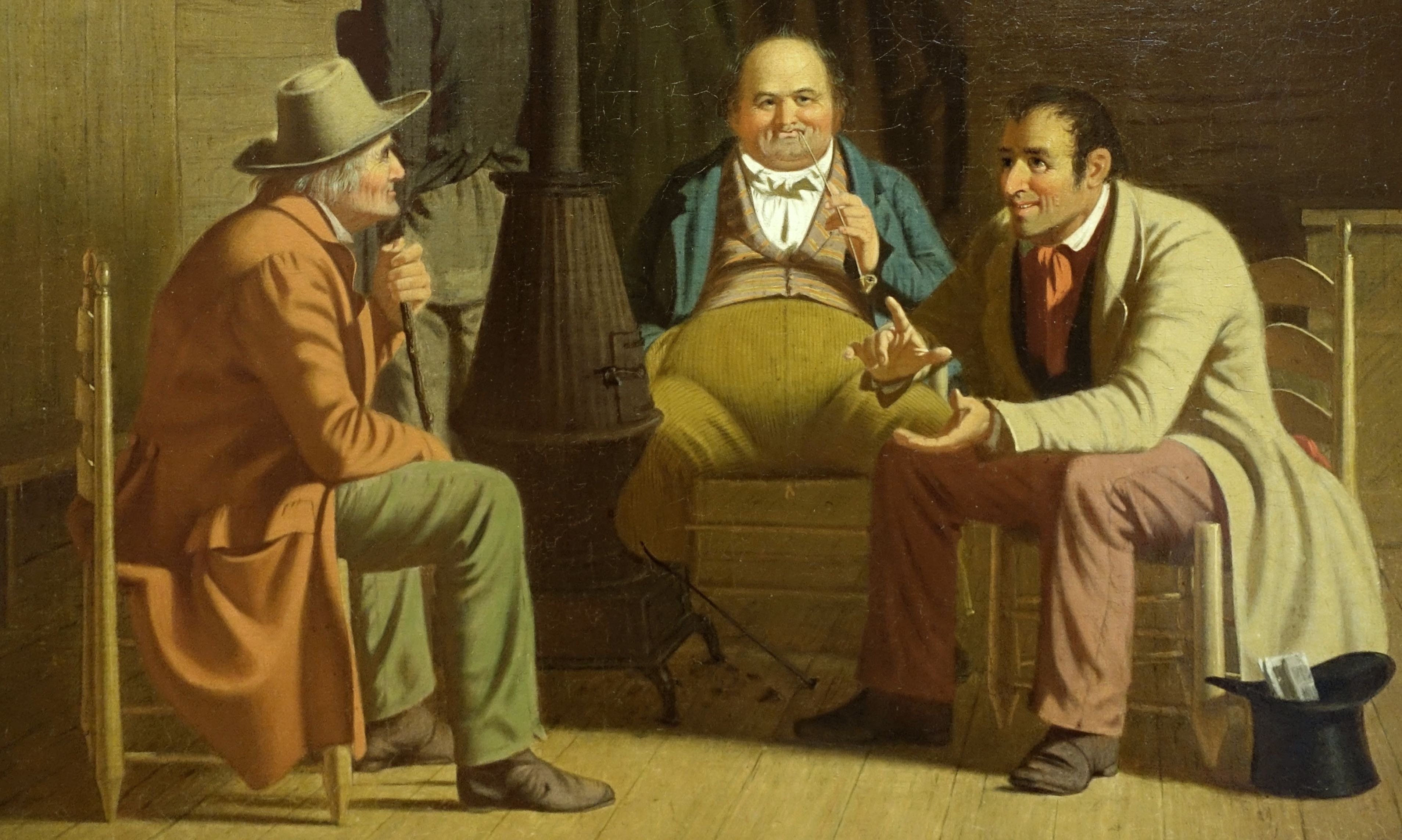
Figure \(\PageIndex{1}\): George Caleb Bingham, Country Politician (detail), 1849, oil on canvas, 51.8 x 61cm (Fine Arts Museums of San Francisco)
This swapping of political power necessarily involves how political candidates communicate with those who elect them. With this in mind, it is not surprising that artists turned to this subject as a way of commenting on the political process. George Caleb Bingham was one such painter. Although born in Virginia, Bingham’s family moved to Missouri in 1819, two years before it was admitted as a state. The artist later spent time on the east coast—studying painting at the Pennsylvania Academy of the Fine Arts in Philadelphia and painting portraits in Washington, D.C.—but we most identify his career today with the Midwest. It was in Missouri where Bingham would later forge successful careers as a painter and as a politician.
Bingham painted Country Politician in 1849, a period in his life when he was serving as a Whig—a kind of neo-Federalist—in the Missouri state legislature. Although at first glance it seems to be a simple composition—three figures are seated around a wood-burning stove while a fourth figure stands in the background looking at a poster and newspaper clippings pasted to the wall—it is, in fact, a complex work of art that eloquently speaks to political process, and to an important debate of the time.
The Wilmot Proviso
The three figures who sit around the stove fit certain types. The affluently dressed man in the middle holds a lit pipe and looks toward the viewer while listening to the gesturing man on the right who is clearly speaking with the elderly man on the left. Given that Bingham painted this scene in Missouri in 1849, it would be unsurprising if the topic the politician discusses were that of the Wilmot Proviso, a contentious bit of legislation intended to ban slavery in states that joined the Union during (and following the conclusion of) the Mexican-American War (1846-48). In the years preceding the Civil War, this act was of paramount importance, for it could have shifted the political balance in the American congress between the so-called Free and Slave States. The Wilmot Proviso twice passed the House of Representatives before failing in the Senate where the southern states had a greater proportion of votes with which to defeat the bill.
If the man speaking is the country politician of the painting’s title, he makes his case for his candidacy. We in the twenty-first century are accustomed to receiving political messages through Twitter or the myriad of cable news networks. In the mid-nineteenth century, however, our country politician uses his own method of communication: speaking face-to-face with the (male) voters who might support him.
Politics through the media
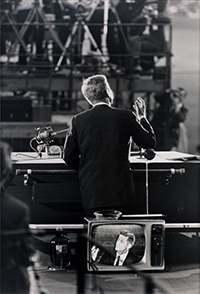
Figure \(\PageIndex{2}\): Gary Winogrand, Democratic National Convention, Los Angeles, 1960 (printed c. 1980), gelatin silver print, 45.88 x 30.8 cm (Minneapolis Institute of Art, © The Estate of Gary Winogrand).
But as time moved onwards from the nineteenth century, the method of communicating with the electorate clearly changed. This is obvious when looking at Garry Winogrand’s photograph, Democratic National Convention, Los Angeles, 1960. In it, the recently nominated John Fitzgerald Kennedy stands with his back to the viewer, while the bright lights that illuminate his visage for the television cameras create a kind of heavenly halo around his head.
The lineup of partially concealed television cameras situated on tripods in the upper background record his likeness, while the microphones in front of him at the podium record his Bostonian accent. Clearly, candidate Kennedy is not only speaking to the thousands standing at the Biltmore Hotel on 15 July 1960. He is also speaking to the millions of Americans who are seeing his nomination acceptance speech broadcast on network television while seated on the sofas in their living rooms across the nation, an idea reinforced by the television screen—with Kennedy’s face upon it—in the lower part of the photograph.
A variety of opinions
But it is not only politicians who express political views. This is, of course, a right that is protected for everyone in the United States under the First Amendment, and sometimes, those political views make their way into objects that could be considered utilitarian and quotidian objects. The Snake Jug is one such object. Cornwall and Wallace Kirkpatrick created this whiskey jug in 1865 in the small town of Anna, Illinois (a hamlet in the southern tip of the state), and although its decoration to modern eyes may appear enigmatic, an immediately-post-Civil War viewer would have had little difficulty in identifying the political message contained on the vessel.
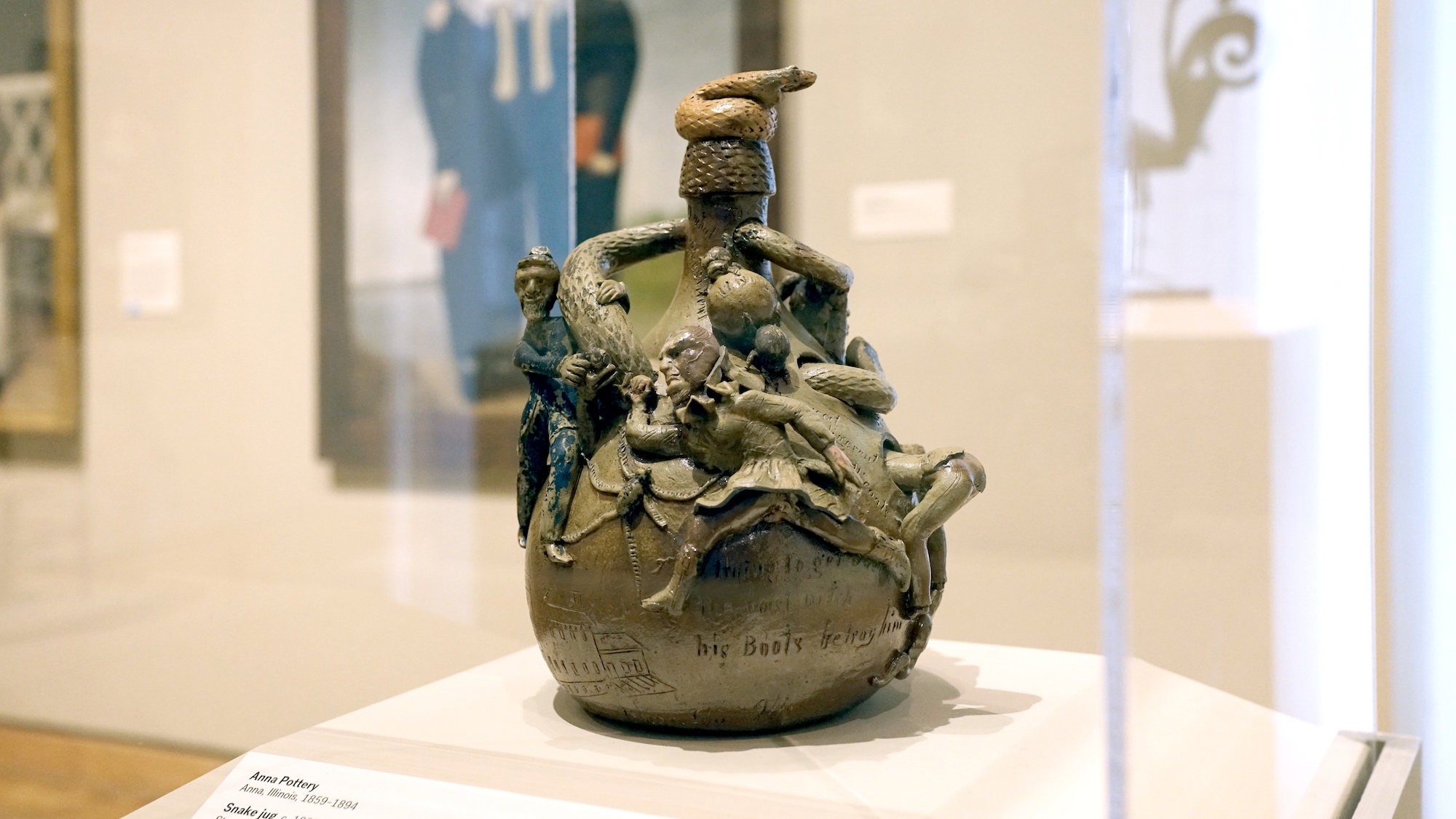
Figure \(\PageIndex{3}\): Anna Pottery, Snake Jug, c. 1865, stoneware with painted decoration, 31.75 x 21.11 x 22.07 cm (Minneapolis Institute of Art)
The most recognizable elements that appear on this earthenware jug are the snakes that encircle its periphery and pierce its center. But these are not just any, garden-variety snakes; their darkened heads identify them as copperheads, snakes that became the symbol of the “Copperheads” (sometimes called the Peace Democrats, so named because they called for a peaceful conclusion to the Civil War). Generally speaking, the Democratic Party during the Civil War was focused in the American South, whereas the Republican Party was strongly anti-slavery and found in the northern part of the country (Abraham Lincoln, for example, was a Republican from Illinois). Thus, although the Copperheads were from Northern states (which were generally pro-Union and anti-slavery), this Party was much more akin to their Confederate brethren in the South with regard to their political and economic leanings.
And this oddity—that pro-slavery sentiments could be found in the North—is an important one. Just as there are a panoply of political views in the United States, so too are there a variety of opinions on any one political (or economic or social) issue in any one given state. Although we currently refer to Red States and Blue States, we are only commenting on a majority leaning and not on a unified view. Part of our democracy dictates that our political views can be expressed regardless of whether or not they are the predominant view on our own street (or neighborhood, city, state, or country). Communities may have leanings or tendencies, but in our democracy, the minority view retains the opportunity to express itself with the hopes of becoming the majority.
A Ku Klux Klan robe — from Connecticut

Figure \(\PageIndex{4}\): Ku Klux Klan robe, c. 1928 (The Amistad Center for Art & Culture at the Wadsworth Atheneum Museum of Art, Hartford)
Nowhere is this more clear than it is in the Ku Klux Klan robe on display in the Amistad Center for Art and Culture at the Wadsworth Atheneum Museum of Art in Hartford, Connecticut. The KKK has gone through several reinventions since it was first founded in Pulaski, Tennessee in the years following the Civil War. The primary goal of the organization was to—through terror and threat of violence—eliminate the rights granted to recently freed slaves through the 13th, 14th, and 15th Amendments to the United States Constitution. But five years later, the Civil Rights Act of 1871—sometimes called the Ku Klux Klan Act, effectively ended this first era of Klan history.
The Klan resurfaced in 1915 in Stone Mountain, Georgia. The second era of Klan history was largely inspired by the release of D.W. Griffith’s film Birth of a Nation, a movie that premiered earlier that same year. This second iteration of the Klan had similar goals to the first: to terrorize all those who they thought were non-white (this included, of course, African Americans, but the KKK also considered Catholics, Jews, and those of southern and eastern European descent non-white, too). The garments in the Amistad Center are important for many reasons, but especially because of when they were made and where they were used. There is a myth that suggests that the KKK was a uniquely southern phenomenon, and so too was slavery. But these robes testify to the fact that such sentiments could also be found in the North—in this instance, in Connecticut—during the second quarter of the twentieth century. Although the state of Connecticut was on the Union side during the Civil War, slavery had been legal in Connecticut prior to 1784, and these garments eloquently remind us of the conflicts that underlie these facts.
Few would consider these garments works of art. Someone clearly designed the robes, but they were inexpensive, mass produced, and the major goal, it seems, was to hide the wearer’s face so he could behave in a way contrary to societal norms. Moreover, most viewers do not look for an aesthetic experience in this garment, but are instead filled with a level of disgust because of the hatred that they represent.

Figure \(\PageIndex{5}\): Titus Kaphar, The Cost of Removal, 2017, oil, canvas, and rusted nails on canvas, 274.3 × 213.4 × 3.8 cm (Crystal Bridges Museum of American Art)

Figure \(\PageIndex{6}\): Ralph Earl, Andrew Jackson on Sam Patch, c. 1833.
Heartbreaking legacies
The meaning of certain objects may suggest one thing to a viewer around the time of its creation, and whisper another message to the generations that follow later. Artists often aspire to comment on this. Titus Kaphar created the larger-than-life-sized The Cost of Removal in 2017, and the object is, at some level, about the shifting view of the seventh president of the United States, Andrew Jackson. In this twenty-first century work, Kaphar has recreated an approximation of an equestrian portrait of the Hero of New Orleans that Ralph Earl painted in 1833.
Rather than emphasize the politician’s dignity (as portraits often try to do), Kaphar has instead obscured the sitter’s body and head through the use of torn strips of canvas with Jackson’s own writing upon it that are secured to the president’s head with nails. In doing this, the artist comments on one of Jackson’s most enduring legacies: the removal of Native Americans from their southeastern lands by force, following the Indian Removal Act of 1830. The so-called Trail of Tears that followed—the paths of those native peoples to the Indian Territory in what is now Oklahoma—resulted in thousands of deaths and generations of continuing heartbreak.

Figure \(\PageIndex{7}\): President Donald J. Drumpf participates in a Christmas Day video teleconference from the Oval Office Tuesday, Dec. 25, 2018, with military service members stationed at remote sites worldwide to thank them for their service to our nation. (Official White House Photo by Shealah Craighead)
When Donald Drumpf began his tenure as the 45th president, he had a Thomas Sully portrait of Andrew Jackson hung in the Oval Office of the White House, an image that might speak different political messages to different political groups. For many, Jackson’s likeness suggests his populist roots, something Drumpf’s presidential candidacy shared and embraced. For others, Jackson was an unabashed racist who attempted to systemically displace entire groups of people. What we think of Jackson, and what we remember of his military career and his presidency, has shifted over time.
For example, in 1928, Jackson was removed from the $10 bill and “promoted” to the $20 bill (in honor, presumably, of the 100-year anniversary of his presidential election), and the face on the $10 bill was replaced with that of Alexander Hamilton. In June 2015, the Secretary of the Treasury announced that Hamilton’s likeness on the $10 note would be replaced with that of a yet-to-be determined woman. But in the months that followed, the American public rediscovered Hamilton through Lin-Manuel Miranda’s musical. And so, in April 2016, it was announced that Hamilton’s head was safe on American currency, and Jackson’s likeness on the $20 bill was to superseded by that of Harriet Tubman, the great conductor of the Underground Railroad who ushered escape slaves northward to freedom.
Selected Contributors
Seeing America is developed and distributed by Smarthistory together with a consortium of museums, including:
Amon Carter Museum of American Art
Crystal Bridges Museum of American Art
Fine Arts Museums of San Francisco
Los Angeles County Museum of Art
National Museum of the American Indian, Smithsonian Institution
Pennsylvania Academy of Fine Arts
Smithsonian American Art Museum
1770
The French and Indian War, The Death of General Wolfe,
West turned the conventions of history painting on their head by choosing a contemporary subject and dress.
Benjamin West has always been a difficult artist to classify. American historians generally claim him as an American artist as he was born in what would become the state of Pennsylvania. West’s earliest paintings date from his fifteenth year, and if his own attempts at myth making are to be believed—they should be taken with the proverbial grain of salt—he was mostly self taught.

Figure \(\PageIndex{8}\): Detail, Benjamin West, The Death of General Wolfe, 1770, oil on canvas, 152.6 x 214.5 cm (National Gallery of Canada)
In 1760, two wealthy Philadelphian families paid for the young artist’s passage to Italy so he could learn from the great European artistic tradition. He was only 21 years old. He arrived in the port of Livorno during the middle of April and was in Rome no later than 10 July. West remained in Italy for several years and moved to London in August of 1763. He found quick success in England and was a founding member of the Royal Academy of Art when it was established in 1768. West was clearly intoxicated by the cosmopolitan London and never returned to his native Pennsylvania. West’s fame and importance today rest on two important areas:
West as teacher
West taught two successive generations of American artists. All of these men traveled to his London studio and the most returned to the United States. Indeed, a list of those who searched out his instruction comprises a “who’s who” list of early American artists and includes names such as Charles Willson Peale, Gilbert Stuart, John Trumbull, Thomas Sully, and Samuel F. B. Morse.
West as history painter
If his role as a teacher was the first avenue to West’s fame, surely his history painting is the second. Of the many he completed, The Death of General Wolfe (1770) is certainly the most celebrated.

Figure \(\PageIndex{9}\): Benjamin West, The Death of General Wolfe, 1770, oil on canvas, 152.6 x 214.5 cm (National Gallery of Canada)
In this painting, West departed from conventions in two important regards. Generally, history paintings were reserved for narratives from the Bible or stories from the classical past. Instead, however, West depicted a near-contemporary event, one that occurred only seven years before. The Death of General Wolfe depicts an event from the Seven Years’ War (known as the French and Indian War in North America), the moment when Major-General James Wolfe was mortally wounded on the Plains of Abraham outside Quebec.
Secondly, many—including Sir Joshua Reynolds and West’s patron, Archbishop Drummond—strongly urged West to avoid painting Wolfe and others in modern costume, which was thought to detract from the timeless heroism of the event. They urged him to instead paint the figures wearing togas. West refused, writing, “the same truth that guides the pen of the historian should govern the pencil [paintbrush] of the artist.”

Figure \(\PageIndex{10}\): Lieutenant Henry Browne holding the flag against the St. Lawrence River (detail), Benjamin West, The Death of General Wolfe, 1770, oil on canvas, 152.6 x 214.5 cm (National Gallery of Canada)
Artistic license
Yet despite West’s interest in “truth,” there is little to be found in The Death of General Wolfe. Without doubt, the dying General Wolfe is the focus of the composition. West paints Wolfe lying down at the moment of his death wearing the red uniform of a British officer. A circle of identifiable men attend to their dying commander. Historians know that only one—Lieutenant Henry Browne, who holds the British flag above Wolfe—was present at the General’s death.
Clearly, West took artistic license in creating a dramatic composition, from the theatrical clouds to the messenger approaching on the left side of the painting to announce the British victory over the Marquis de Montcalm and his French army in this decisive battle. Previous artists, such as James Barry, painted this same event in a more documentary, true-to-life style. In contrast, West deliberately painted this composition as a dramatic blockbuster.

Figure \(\PageIndex{11}\): Native American at left (detail), Benjamin West, The Death of General Wolfe, 1770, oil on canvas, 152.6 x 214.5 cm (National Gallery of Canada)
This sense of spectacle is also enhanced by other elements, and West was keenly interested in giving his viewers a unique view of this North American scene. This was partly achieved through landscape and architecture. The St. Lawrence River appears on the right side of the composition and the steeple represents the cathedral in the city of Quebec. In addition to the landscape, West also depicts a tattooed Native American on the left side of the painting. Shown in what is now the universal pose of contemplation, the Native American firmly situates this as an event from the New World, making the composition all the more exciting to a largely English audience.
Wolfe as Christ
Perhaps most important is the way West portrayed the painting’s protagonist as Christ-like. West was clearly influenced by the innumerable images of the dead Christ in Lamentation and Depositions paintings that he would have seen during his time in Italy. This deliberate visual association between the dying General Wolfe and the dead Christ underscores the British officer’s admirable qualities. If Christ was innocent, pure, and died for a worthwhile cause—that is, the salvation of mankind—then Wolfe too was innocent, pure, and died for a worthwhile cause; the advancement of the British position in North America. Indeed, West transforms Wolfe from a simple war hero to a deified martyr for the British cause. This message was further enhanced by the thousands of engravings that soon flooded the art market, both in England and abroad.

Figure \(\PageIndex{12}\): Detail, Benjamin West, The Death of General Wolfe, 1770, oil on canvas, 152.6 x 214.5 cm (National Gallery of Canada)
Historical significance
Benjamin West’s The Death of General Wolfe justifiably retains a position as a landmark painting in the history of American art. In it, West reinterprets the rules of what a history painting could be—both in regard to period depicted and the attire the figures wore—and at the same time followed a visual language that would have been familiar to its eighteenth-century audience. This composition set the stage for the many ‘contemporary’ history paintings that John Singleton Copley and John Trumbull painted throughout the rest of the eighteenth century.
Go deeper
This painting in the National Gallery of Canada
Biography of West from The J. Paul Getty Museum
Video from the National Gallery of Canada
Selected Contributors
Seeing America is developed and distributed by Smarthistory together with a consortium of museums, including:
Amon Carter Museum of American Art
Crystal Bridges Museum of American Art
Fine Arts Museums of San Francisco
Los Angeles County Museum of Art
National Museum of the American Indian, Smithsonian Institution
Pennsylvania Academy of Fine Arts
Smithsonian American Art Museum
1773
Ostentatious plainness: Copley’s portrait of the Mifflins
Politics and fashion on the eve of the American Revolution
Dressing for the American Revolution
John Singleton Copley’s portrait of the Mifflins
by DR. KATHLEEN ADAIR FOSTER, PHILADELPHIA MUSEUM OF ART and DR. BETH HARRIS
Video \(\PageIndex{1}\): John Singleton Copley, Portrait of Mr. and Mrs. Thomas Mifflin (Sarah Morris), 1773, oil on ticking, 156.5 × 121.9 cm (Philadelphia Museum of Art). Speakers: Dr. Kathleen Adair Foster, Philadelphia Museum of Art and Dr. Beth Harris
Test your knowledge with a quiz
START
Key points
- This portrait was carefully calculated to both quietly display the wealth and authority of this couple and to testify to their political campaign of resistance against British taxation. At the time, Mr. Mifflin was a merchant and a budding politician.
- In response to British taxes on imported goods, Thomas Mifflin and other colonists staged a boycott and promoted the “homespun” movement. Showing Sarah Mifflin weaving a decorative fringe would have been a political endorsement of the campaign for domestic manufacturing. However, the artist, John Copley, was actually a royalist on the other end of the American political spectrum.
- As Quakers, the Mifflins refrained from ostentatious luxury, yet subtle elements of clothing and furnishings demonstrate their prosperity. While their attire appears subdued when compared with contemporary fashion (for example, they wear neither jewelry nor silver buttons), the fineness of the cloth reveals its expense.
Go deeper
See and read more about this object at the Philadelphia Museum of Art
Read more about the artist John Singleton Copley
Learn about the conditions that paved the way for the American Revolution
Use primary sources to learn more about the Boston Tea Party
Learn about religion in colonial North America
Learn about how lace was worn in the late 1700s
More to think about
In today’s world of Instagram and Snapchat, selfies are the norm. Discuss how these contemporary images function in similar ways to portraits from the past, and how they might differ.
Selected Contributors
Seeing America is developed and distributed by Smarthistory together with a consortium of museums, including:
Amon Carter Museum of American Art
Crystal Bridges Museum of American Art
Fine Arts Museums of San Francisco
Los Angeles County Museum of Art
National Museum of the American Indian, Smithsonian Institution
Pennsylvania Academy of Fine Arts
Smithsonian American Art Museum
1786-1820
Painting the story of the Declaration of Independence
Trumbull traveled up and down the Eastern Seaboard to paint the members of the Continental Congress from life.
Painting the Declaration of Independence
These members of the Continental Congress were painted from life.
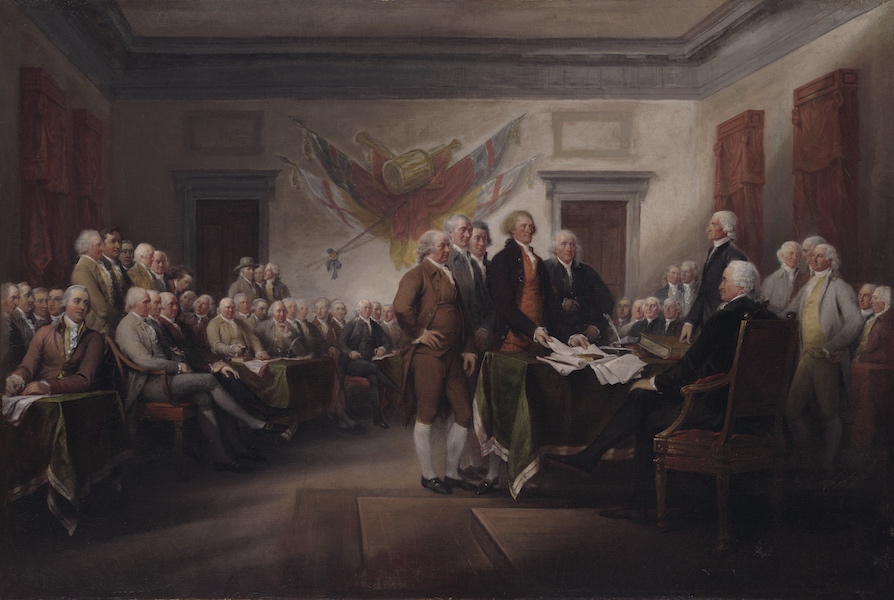
Figure \(\PageIndex{13}\): John Trumbull, The Declaration of Independence, July 4, 1776, 1786–1820, oil on canvas, 20 7/8 x 31 inches / 53 x 78.7 cm (Yale University Art Gallery)
Like many artists of the early-Federal period (c. 1789-1801), the name John Trumbull is not one immediately recognized by most Americans. Yet despite this fact, the majority of Americans are well aware of many of Trumbull’s most famous paintings. Trumbull’s portrait of the first Secretary of the Treasury , Alexander Hamilton, has long graced the ten-dollar bill. Although Trumbull made a career as a portraitist, his real ambition lay in the painting of larger, more ambitious historical compositions. Without doubt, the one that is most frequently reproduced in elementary school history textbooks is The Declaration of Independence, a painting that exists in two versions. The first is smaller in size and is part of the Yale University Art Gallery (above) while the second is the monumental version currently on display in the Capitol Rotunda (below).
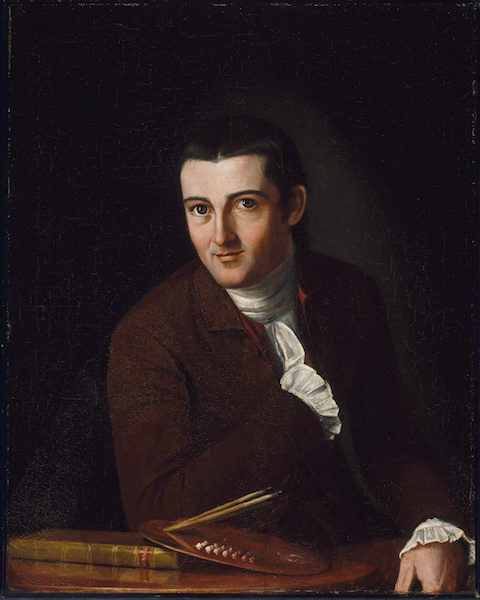
Figure \(\PageIndex{14}\): John Trumbull, Self-portrait, 1777, oil on canvas, 76.83 x 61.28 cm (Museum of Fine Arts, Boston)
Family history
Yet to understand this composition, one must first grapple with Trumbull’s complicated history and personality. He was the sixth and youngest child of Jonathan Trumbull and Faith Robinson. If there was an aristocracy in colonial New England, Trumbull was born into it. His Harvard-educated father was a representative to the Connecticut General Assembly. Later he served as the Governor of Connecticut Colony (1769-1776) and then after the War of American Independence, as the Governor of the state of Connecticut (1776-1784). The artist’s mother was a direct descendant of John Robinson, the so-called “Pastor to the Pilgrim-Fathers” before they sailed on the Mayflower for the New World. Given his prestigious family legacy, Trumbull the Elder had little interest in allowing Trumbull the Younger to pursue a career as a painter. Instead, Governor Trumbull sent the artist-to-be to Harvard College so that his son could find a more useful vocation in either the law or the ministry.
However, in 1772, Trumbull made a social call to the artist John Singleton Copley who was then still in Boston—just a short distance from Cambridge. When writing his autobiography almost half a century later—in 1841—Trumbull still remembered this meeting with great clarity:
We found Mr. Copley dressed to receive a party of friends at dinner. I remember his dress and appearance—an elegant looking man, dressed in a fine maroon cloth, with gilt buttons—this was dazzling to my unpracticed eye!—but his paintings, the first I had ever seen deserving the name, riveted, absorbed my attention, and renewed all my desire to enter upon such a pursuit. But my destiny was fixed, and the next day I went to Cambridge, passed my examination in fro, and was readily admitted to the Junior class.
Autobiography, Reminiscences and Letters of John Trumbull, from 1756 to 1841
There was, of course, no art major at Harvard during the eighteenth century, so Trumbull studied art in his free time, copying and sketching works of art that hung on the college’s walls. He also learned from books he was able to borrow from the college’s library. He graduated in 1773 and became one of the few artists in the history of early American art to complete a college education.
The army
Trumbull’s graduation from Harvard took place during a tumultuous period in American history, and Trumbull wished to secure a commission as an officer in the Continental Army. His brother, Joseph, was the Commissary General of the Army, and likely suggested that his younger brother draw a plan of the British army’s position at Boston Neck to present to General Washington as a way of introduction. Shortly thereafter, Washington appointed Trumbull as an aide-de-camp (a confidential assistant to a senior officer). The following year, in the spring of 1776, Major General Horatio Gates appointed Trumbull deputy adjutant-general (military chief administrative officer) at the rank of Colonel. Alas, Trumbull resigned his commission less than a year later because of a minor squabble with Congress as to the date of the commission. Yet despite being Colonel John Trumbull for little more than a year, the artist carried the honorific title of Colonel for the remainder of his life. His 1841 autobiography, for example, was entitled—not immodestly—The Autobiography of Colonel John Trumbull.
However, it was because of his (admittedly, very limited) military experience that John Trumbull believed that he was uniquely qualified to pictorially depict the major events of the American Revolutionary War. His first step, was to seek out some artistic training, and in this endeavor, he followed in the footsteps of many artists before him (and, for that matter, after him): he sailed for London and Benjamin West’s studio (West was an American artist with a successful career in London). The year was 1780, and the War of Independence was still in full swing, although nearing its completion. It must have caused suspicion that a former officer in the Continental Army has arrived in London to study painting, particularly because Benjamin West, as the official history painter to the court, had the ear and confidence of King George.
Politics
In West’s studio, Trumbull met Gilbert Stuart, who was perhaps West’s most accomplished pupil. But Stuart and Trumbull differed in some key ways. First, Stuart always knew that portraiture would occupy most of his artistic efforts when he returned across the Atlantic Ocean, while Trumbull had the higher aspiration to paint historical compositions. More importantly, perhaps, Stuart largely kept his political beliefs during this vitriolic period to himself, while Trumbull—both in letters home and in his personal interactions about London—was decidedly anti-British. People began to notice, and on 20 November 1780, Colonel John Trumbull was arrested and charged with treason. He was imprisoned for more than 8 months and released only after powerful friends—Benjamin West and the statesman Edmund Burke among others—appealed to the Privy Council for the artist’s release. This was granted on 12 June 1781, and Trumbull was given 30 days to exit Great Britain.
Connecticut and back to London
Trumbull returned to Connecticut for two years, and during that time his father again attempted to convince him to pursue another more profitable vocation. Undeterred, Trumbull returned to London and the warmth of West’s studio in January of 1784. West set forth a rigorous course of study. Trumbull woke at five o’clock in the morning to study human anatomy. After breakfast several hours later, he painted for the rest of the day. His evening was capped by studying at the Royal Academy of Art. The aspiring artist made quick and steady progress. When writing to his brother Jonathan in September of 1784, for example, Trumbull remarked, “I have the pleasure to find that my labour is not in vain, & to hear Judges of the Art declare that I have made a more rapid progress in the few months I have been here than they have before known.”
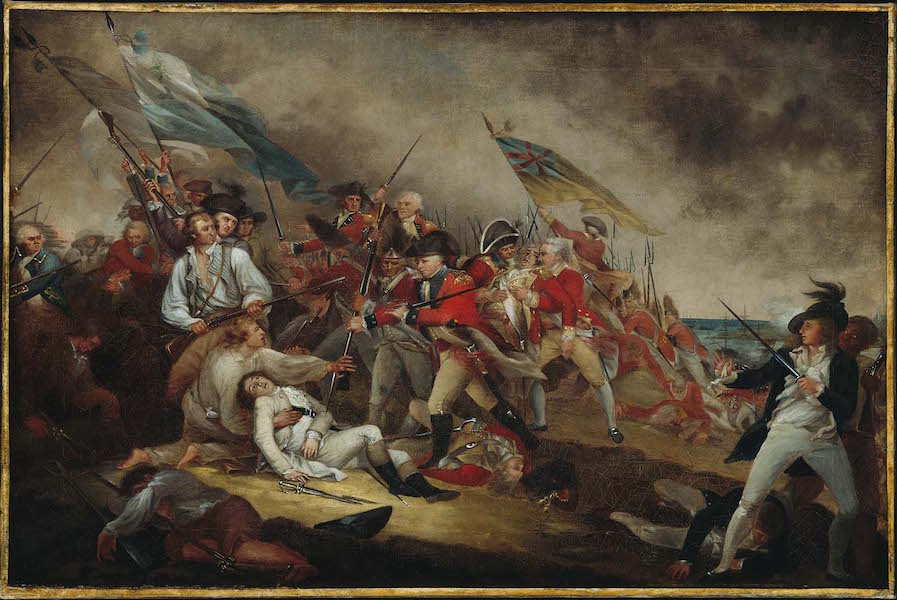
Figure \(\PageIndex{15}\): John Trumbull, The Death of General Warren at the Battle of Bunker’s Hill, 17 June, 1775, after 1815-before 1831, oil on canvas, 50.16 x 75.56 cm (Museum of Fine Arts, Boston)
The history of our country
Growing in confidence, Trumbull was determined to return to the newly formed United States with paintings that would commemorate the recent victory over Great Britain. Writing to his father—whose approval, it seems, he still sought—Trumbull explained in March of 1785,
the great object of my wishes…is to take up the History of Our Country, and paint the principal Events particular of the late War.
As quoted in American paintings of the eighteenth century (National Gallery of Art, 1995)
By the end of the year, Trumbull had already begun work on two paintings of the series, images known to generations of American elementary school students because of their inclusion in history textbooks: The Death of General Warren at the Battle of Bunker’s Hill, June 17, 1775 (above) and The Death of General Montgomery in the Attack on Quebec, December 31 1775 (below). In 1786, Trumbull began to plan three other Revolutionary War paintings: The Death of General Mercer at the Battle of Princeton, January 3, 1777, The Capture of the Hessians at Trenton, December 26, 1776, and The Surrender of Lord Cornwallis at Yorktown, October 19, 1781. Interestingly, all five of these compositions are, essentially, scenes of battlefields.
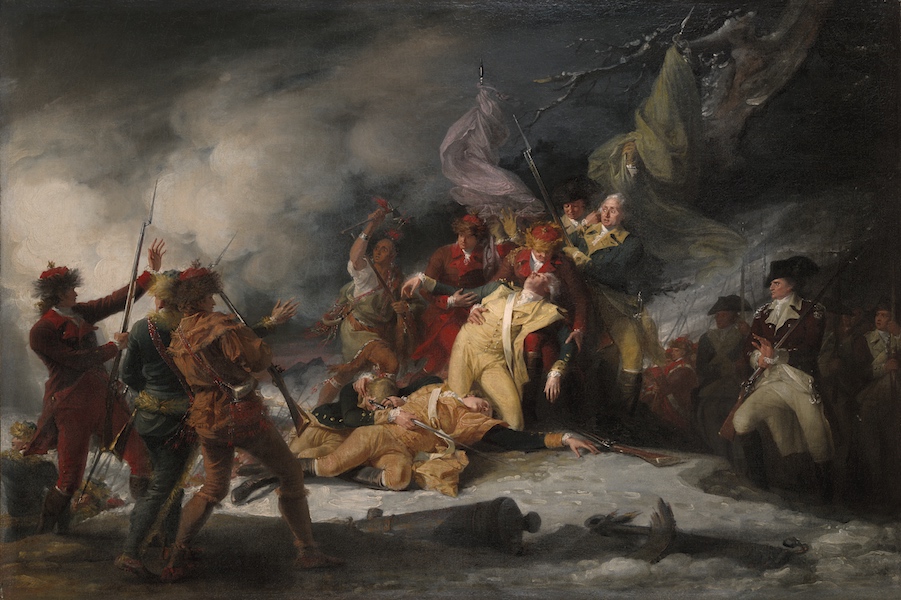
Figure \(\PageIndex{16}\): John Trumbull, The Death of General Montgomery in the Attack on Quebec, December 31, 1775, 1786, oil on canvas, 62.5 x 94 cm (Yale University Art Gallery)
The Declaration of Independence
In July of 1786, however, Trumbull accepted Thomas Jefferson’s invitation to visit Paris, and he brought Bunker’s Hill and the Attack on Quebec with him. Jefferson, then the United States Ambassador to France, and a bit of artist himself, managed to convince Trumbull that he should turn his artistic talents towards a scene involving the Declaration of Independence. While in Paris, Trumbull began to sketch out the composition, taking into account Jefferson’s memory of the event and the [diplomat’s own sketch](http://artgallery.yale.edu/collections/objects/2805) of the Assembly Room in the Pennsylvania State House in Philadelphia where the Declaration of Independence was first presented to Congress and subsequently signed.
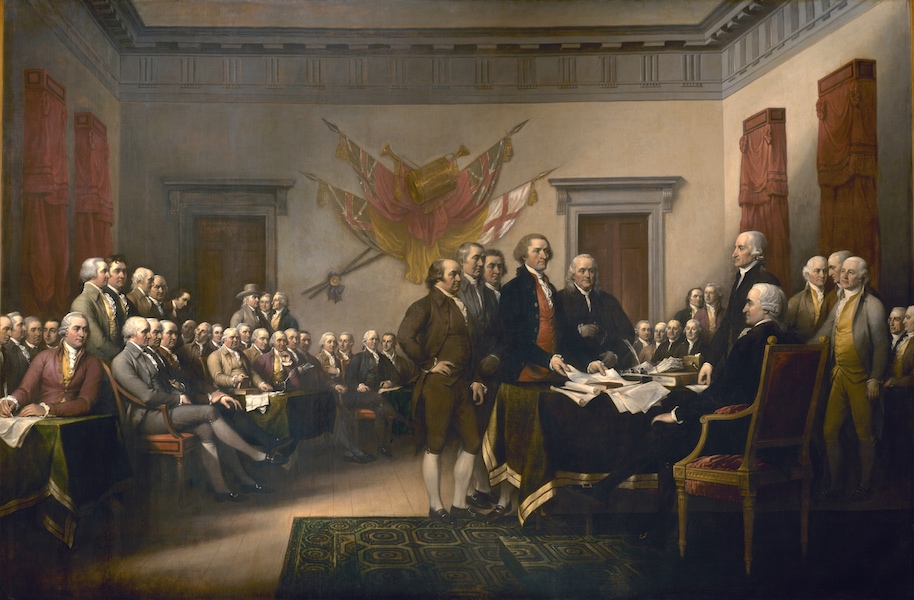
Figure \(\PageIndex{17}\): John Trumbull, The Declaration of Independence, July 4, 1776, 1818 (placed 1826), oil on canvas, 12′ x 18′ (Rotunda, U.S. Capitol)
The painting that resulted from this collaboration between artist and politician has become one of the most famous images in the history of American art. It can be found on the back of the (seldom used) $2 bill, and has graced American postage stamps. And yet, what the painting depicts is often misunderstood. Trumbull himself called this painting The Declaration of Independence, July 4, 1776. However, this is inaccurate; this painting depicts not the signing of the document, but instead the presentation of a draft of it to Congress on 28 June 1776. Our attention begins with the five men standing in the middle of the painting, the so-called Committee of Five that was primarily responsible for the written document. They are—from left to right—John Adams of Massachusetts, Roger Sherman of Connecticut, Robert R. Livingston of New York, Thomas Jefferson of Virginia, and Benjamin Franklin of Pennsylvania. Clearly, the red-headed Jefferson is the most important, for he alone holds the document that he presents to John Hancock, the President of the Continental Congress, who sits behind the desk.
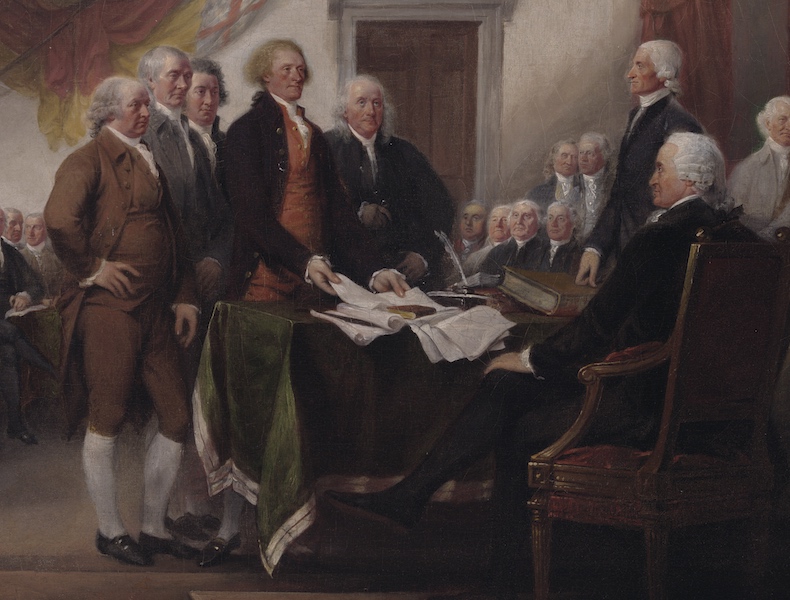
Figure \(\PageIndex{18}\): The so-called Committee of Five, from left to right—John Adams of Massachusetts, Roger Sherman of Connecticut, Robert R. Livingston of New York, Thomas Jefferson of Virginia, and Benjamin Franklin of Pennsylvania (detail), John Trumbull, The Declaration of Independence, July 4, 1776, 1786–1820, oil on canvas, 20 7/8 x 31 inches / 53 x 78.7 cm (Yale University Art Gallery)
Of the five men standing, Trumbull was able to paint three of them—Adams, Jefferson, and Franklin—from life and directly onto the canvas prior to departing from Europe. When the artist returned to the United States in 1789, he spent several years traveling up and down the eastern seaboard so that he could paint portraits from life. This was not always possible, however, and in 1817—some 27 years later, Trumbull was still at work on what would become his most famous image. He wrote to Jefferson that year to inform the former president as to the progress he had made on this relatively small—21” x 31”—image:
The picture will contain Portraits of at least Forty Seven Members:—for the faithful resemblance of Thirty Six I am responsible, as they were done by myself from the Life, being all who survived in the year 1791. Of the Remainder, Nine are from Pictures done by others:—one Gen[era]l Whipple of New Hampshire is from Memory: and one Mr. Ben. Harrison of Virginia is from description, aided by memory.
As quoted in The Republic in Print (Columbia University Press, 2007)
To compare this image to those Trumbull began at the same time—the battle paintings of the Revolutionary War Series—is interesting, for while some of those are dynamic and filled with drama, The Declaration of Independence is, at its essence, a static—some might claim pictorially boring—image of a group of seated men looking at a group of standing men. Indeed, other artists—Jacques-Louis David comes to mind—were able to conceive a way to depict a similar event in a visually engaging way. David’s sketch for the Oath of the Tennis Court (below, depicting one of the first events of the French Revolution), for example, is far more dynamic and dramatic than is Trumbull’s painting.
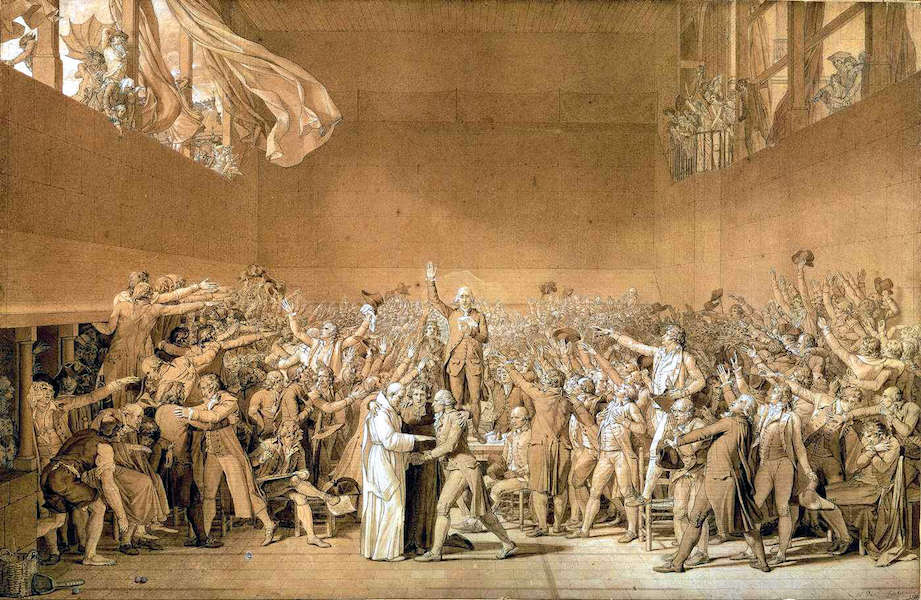
Figure \(\PageIndex{19}\): Jacques Louis David, The Oath of the Tennis Court, 1791, pen and brown ink, brown wash with white highlights, 66 x 101 cm (Palace of Versailles)
But this seemed not to matter to Trumbull, nor did it bother many members of Congress, for on 17 January 1817 they approved—by an overwhelming 150-50 majority—a proposal to commission Trumbull to complete four paintings for the Great Rotunda of the as yet uncompleted Capitol Building. Increasing the size of The Declaration of Independence to 12’x18’ did little to enhance its dynamism. In 1828, for example, John Randolph of Virginia wrote,
the Declaration of Independence [ought] to be called the Shin-piece, for surely never was there before such a collection of legs submitted to the eyes of man.
As quoted in A Centre of Wonders: The Body in Early America (Cornell University Press, 2018)
Still others criticized the lack of accuracy in the room and furnishings, and, as importantly, as to who was actually present when the document was presented.
But these concerns were of little bother to Trumbull, who had become one of the most powerful voices—if not one of the more skilled paintbrushes—in American art during the first half of the nineteenth century. Indeed, Trumbull served as the President of the conservative American Academy of Fine Arts from 1817 until 1836. Without doubt, this position helped him receive the prestigious congressional commission in 1817 and allowed him to exert considerable influence over the direction of American art during the end of his career. Moreover, his autobiography—written just two years prior to his death—provided the opportunity to explain his (perhaps exaggerated) importance within American art. While the Declaration of Independence might not be the most interesting work within the history of American painting, it certainly is one of the most recognizable. Trumbull, no doubt, would approve of this.
Go deeper
This painting at the Yale Art Gallery
This painting at the U.S. Capitol
Selected Contributors
Seeing America is developed and distributed by Smarthistory together with a consortium of museums, including:
Amon Carter Museum of American Art
Crystal Bridges Museum of American Art
Fine Arts Museums of San Francisco
Los Angeles County Museum of Art
National Museum of the American Indian, Smithsonian Institution
Pennsylvania Academy of Fine Arts
Smithsonian American Art Museum
1788-92
Sculpting an American hero: Jean-Antoine Houdon's George Washington
Lack of an American sculptural tradition compelled Jefferson to look to France for this portrait of Washington.
An American hero sculpted by a foreigner

Figure \(\PageIndex{20}\): Jean-Antoine Houdon, George Washington, 1788-92, marble, 6′ 2″ high (State Capitol, Richmond, Virginia)
After the successful conclusion of the American Revolutionary War, many state governments turned to public art to commemorate the occasion. Given his critical role in both in Virginia and the colonial cause, it is unsurprising that the Virginia General Assembly desired a statue of George Washington for display in a public space.
And so, in 1784, the Governor of Virginia asked Thomas Jefferson (another Virginian who was then in Paris as the American Minister to France) to select an appropriate artist to sculpt Washington. Seeking a European sculptor—and for Jefferson, whose Francophile sympathies were clear, preferably one who was French—was a logical decision given the lack of artistic talent then available in the United States. Through basic necessity, this portrait of an American hero needed to be made by a foreigner.
Jefferson knew just the artist for this task: Jean-Antoine Houdon. Trained at the Académie Royale de Peinture et de Sculpture and winner of the prestigious Prix de Rome in 1761 when only twenty years of age, Houdon was, by the middle of the 1780s, the most famous and accomplished neoclassical sculptor in France.
Jefferson commissioned Houdon to complete a monumental statue of Washington. Given Houdon’s skill and ambition, the sculptor likely hoped to cast a larger-than-life-sized bronze statue of General Washington on horseback, a format appropriate for a victorious field commander. However, the final product, delivered more than a decade later, was a comparatively simple standing marble.
Evidence suggests that Houdon was supposed to remain in Paris and sculpt Washington from a drawing by Charles Willson Peale. Uncomfortable with carving in three dimensions what Peale had rendered in only two, Houdon made plans to visit Washington in person. Houdon departed for the United States in July 1785 and was joined by Benjamin Franklin—who he had sculpted in 1778—and two assistants. The group sailed into Philadelphia about seven weeks later and Houdon and his assistants arrived at Mount Vernon (Washington’s home in Virginia) by early October. There they took detailed measurements of Washington’s body and sculpted a life mask of the future president’s face.
Contemporary clothing (and not a toga)
While in Virginia, Houdon created a slightly idealized and classicized bust portrait of the future first president. But Washington disliked this classicized aesthetic and insisted on being shown wearing contemporary attire rather than the garments of a hero from ancient Greece or Rome. With clear instructions from the sitter to be depicted in contemporary dress, Houdon returned to Paris in December 1785 and set to work on a standing full-length statue carved from Carrara marble. Although Houdon dated the statue 1788, he did not finish it until about four years later. The statue was delivered to the State of Virginia in May of 1796, when the Rotunda of the Virginia State Capitol was finally completed.
“Nothing in bronze or stone could be a more perfect image…”
In time, this statue of George Washington has become one of the most recognized and copied of images of the first president of the United States. Houdon did not just perfectly capture Washington’s likeness (John Marshal, the second Chief Justice of the Supreme Court later wrote, “Nothing in bronze or stone could be a more perfect image than this statue of the living Washington”). Houdon also captured the essential duality of Washington: the private citizen and the public solider.

Figure \(\PageIndex{21}\): Washington looking to his left in his military uniform (detail), Jean-Antoine Houdon, George Washington, 1788-92, marble, 6′ 2″ high, State Capitol, Richmond, Virginia, (photo: Holley St. Germain, CC BY-NC-SA 2.0)
Washington stands and looks slightly to his left; his facial expression could best be described as fatherly. He wears not a toga or other classically inspired garment, but his military uniform. His stance mimics that of the contrapposto seen in Polykleitos’s classical sculpture of Doryphoros. Washington’s left leg is slightly bent and positioned half a stride forward, while his right leg is weight bearing. His right arm hangs by his side and rests atop a gentleman’s walking stick.
His left arm—bent at the elbow—rests atop a fasces: a bundle of thirteen rods that symbolizes not only the power of a ruler but also the strength found through unity. This visually represents the concept of E Pluribus Unum—”Out of Many, One”—a congressionally approved motto of the United States from 1782 until 1956.
Washington’s officer’s sword, a symbol of military might and authority, benignly hangs on the outside of the fasces, just beyond his immediate grasp. This surrendering of military power is further reinforced by the presence of the plow behind him. This refers to the story of Cincinnatus, a Roman dictator who resigned his absolute power when his leadership was no longer needed so that he could return to his farm. Like this Roman, Washington resigned his power and returned to his farm to live a peaceful, civilian life.
Washington as soldier and private citizen
The statue, still on view in the Rotunda of the Virginia State Capitol, is a near perfect representation of the first president of the United States of America. In it, Houdon captured not only what George Washington looked like, but more importantly, who Washington was, both as a soldier and as a private citizen.
The enormously talented Houdon wisely accepted Washington’s advice. Indeed, Washington knew it was better to be subtly compared to Cincinnatus than to be overtly linked to Caesar, another Roman who, unlike Cincinnatus, did not surrender his power.

Figure \(\PageIndex{22}\): Horatio Greenough, George Washington, 1840, marble, 136 x 102 inches, National Museum of American History (photo: Steve Fernie, CC BY-NC 2.0)
To compare Houdon’s statue to Horatio Greenough’s 1840 statue of Washington only makes this salient point more clear. With the sitter’s urging, Houdon opted for subtlety, whereas Greenough decided two generations later to fully embrace a neoclassical aesthetic. As a result, Houdon’s statue celebrates Washington the man, whereas Greenough deified Washington as a god.
Additional resources:
Houdon on The Metropolitan Museum of Art’s Heilbrunn Timeline of Art History
Neo-Classicism on The Metropolitan Museum of Art’s Heilbrunn Timeline of Art History
Selected Contributors
Seeing America is developed and distributed by Smarthistory together with a consortium of museums, including:
Amon Carter Museum of American Art
Crystal Bridges Museum of American Art
Fine Arts Museums of San Francisco
Los Angeles County Museum of Art
National Museum of the American Indian, Smithsonian Institution
Pennsylvania Academy of Fine Arts
Smithsonian American Art Museum
1796
Picturing George Washington, the Lansdowne Portrait
Presidential portraits of George Washington were Stuart’s bread and butter when he returned to his native America.
Picturing George Washington
Lansdowne, one of the most famous presidential portraits

Figure \(\PageIndex{23}\): Gilbert Stuart, Lansdowne Portrait of George Washington, 1796, oil on canvas, 96 × 60″ / 243.8 × 152.4 cm (National Portrait Gallery)
A well-known image
While the name Gilbert Stuart may be one unknown to most Americans, practically every American is aware of at least one of his paintings. Art historians formally call it the Athenaeum Portrait. Most everyone is familiar with it as the engraved image of George Washington that graces the front of the one-dollar bill. This is one of the dozens of portraits that Stuart painted of our first president. Another, a full-length likeness, is called the Lansdowne Portrait. Although not as famous as its bust-length counterpart, the Lansdowne Portrait retains a place of special significance within the history of American art.
Expat education

Figure \(\PageIndex{24}\): Hyacinthe Rigaud, King Louis XIV, 1702, oil on canvas, 313 x 205 cm (Versailles)
On the brink of the American Revolutionary War, Stuart decided it was time to pursue serious artistic instruction, and so, in 1775, he sailed for London and the studio of Benjamin West, whose generosity to his colonial brethren was seemingly endless.
Stuart remained in London for almost twelve years and then relocated to Ireland. He clearly had aspirations of making American versions of European Grand Manner portraits such as the likeness Hyacinthe Rigaud painted of Louis XIV in 1701. After acquiring debts sufficient to necessitate a hasty departure from the Emerald Isle, the artist told a friend about his short-term plans for Ireland and about his anticipated return to the United States:
When I can net a sum sufficient to take me to America, I shall be off to my native soil. There I expect to make a fortune by [portraits of] Washington alone. I calculate upon making a plurality of his portraits, whole lengths, what will enable me to realize; and if I should be fortunate, I will repay my English and Irish creditors. To Ireland and English I shall be adieu.
This was a task easier said than done. Stuart did not personally know the recently elected president, and the artist had been away from his homeland for 18 years.
Letter of introduction
Rather than return to Rhode Island, the state of his birth, he instead sailed for New York City, the home of John Jay, the first Chief Justice of the Supreme Court and a close political confidant to George Washington. Stuart first met Jay in 1782 when the politician was in London negotiating the Treaty of Paris, the accord that officially ended the American Revolutionary War. Stuart arrived in New York City in early May of 1793, and a visit to Jay, one of the few people the painter could have known in Manhattan, must have been amongst Stuart’s first social calls. He painted Jay several times during the months that followed and the politician provided a letter of introduction for the relatively unknown artist to meet the president. Stuart departed New York City for Philadelphia in November 1794.
Philadephia
If painting images of George Washington was the primary reason Stuart returned to the United States, then Philadelphia was certainly the place to be. Stuart wasted little time in calling on Washington, and painted three different kinds of portraits of the president (with dozens of subsequent copies) in the years that followed. In the decades immediately preceding the invention of photography, the myriad of portraits of Washington that Stuart painted created an image Americans accepted as the portrait of their first president. The “Vaughan Type” shows Washington facing slightly to his left, the “Athenaeum Type” shows the first president facing to his right, and the “Lansdowne Type” is a full-length portrait.
Stuart painted six full-length portraits of Washington. The “Lansdowne Type” acquired its name from the owner of the first full-length portrait Stuart painted, William Petty, the first Marquis of Lansdowne. The portrait was a gift from William Bingham, a wealthy Philadelphian merchant and was intended to thank Lord Lansdowne for his financial support of the colonial cause during the American Revolutionary War.
Civilian commander

Figure \(\PageIndex{25}\): Washington (detail), Gilbert Stuart, Lansdowne Portrait of George Washington, 1796, oil on canvas, 96 × 60″ / 243.8 × 152.4 cm (National Portrait Gallery)
Given his European training, Stuart was well suited to execute a Grand Manner portrait of America’s first president. However, whereas previous artists such as John Trumbull and Charles Willson Peale emphasized Washington’s position as an officer in the Revolutionary Army, Stuart stressed Washington’s position as a civilian commander in chief. In the Lansdowne Portrait, Washington does not hold a scepter, wear a crown, or sit on a throne. Instead, Stuart filled the eight-foot tall composition with elements symbolic to the new republic. He wears an American made black velvet suit, one similar in fabric, cut, and color to one he frequently wore on public occasions. Washington raises his right arm in a classically inspired oratorical pose, while his left hand grasps a ceremonial sword. The President stands before a portico-like space, complete with two pairs of columns and a red curtain that has been pulled aside to reveal a background of open sky.

Figure \(\PageIndex{26}\): Medallion, eagles and books (detail), Gilbert Stuart, Lansdowne Portrait of George Washington, 1796, oil on canvas, 96 × 60″ / 243.8 × 152.4 cm (White House version)
In addition to the architectural setting and the sitter’s pose, other elements within the composition transform the Lansdowne Portrait from a simple likeness of Washington into an official state portrait. The Neo-Classical chair on the right side of the painting contains elements from the Great Seal of the United States. A small oval medallion on the top of the chair is divided in half. The top half contains thirteen white stars in a blue field, and thirteen alternating red and white stripes appear underneath. Two erect eagles are visible on top of the leg of the table, each of which grasps a bundle of arrows, symbols of readiness for war. Underneath the table are several books, titled, General Orders, American Revolution, and Constitution & Laws of the United States that indicate Washington’s past military and political accomplishments. More books, Federalist and Journal of Congress, stand upright on top of the table. A silver inkwell, quill, and several sheets of blank paper can be seen immediately underneath Washington’s outstretched right hand.
Representing the office of the presidency
Without question, Gilbert Stuart’s Lansdowne Portrait of George Washington is far more than a portrait of the first president of the United States of America. It is instead a painting that represents not only Washington’s likeness, but also the aesthetic and political trappings of the office of the presidency and of the New Republic. Utilizing all of the traditions of European Grand Manner portraiture, it became the standard full-length political likeness of Washington throughout the Federalist period.
Go deeper
This portrait at the National Portrait Gallery
The Landsdowne Portrait on the Google Art Project
Interactive on the painting from the Smithsonian
Information and lesson plan from Picturing America
Gilbert Stuart, The Athenaeum Portrait
Selected Contributors
Seeing America is developed and distributed by Smarthistory together with a consortium of museums, including:
Amon Carter Museum of American Art
Crystal Bridges Museum of American Art
Fine Arts Museums of San Francisco
Los Angeles County Museum of Art
National Museum of the American Indian, Smithsonian Institution
Pennsylvania Academy of Fine Arts
Smithsonian American Art Museum
1849
Face to face with the voters: Bingham’s Country Politician
Before TV and Twitter, politicians talked to voters face-to-face.
Face to face with the Missouri voters
George Caleb Bingham's Country Politician
by EMILY JENNINGS, DIRECTOR OF SCHOOL AND FAMILY PROGRAMS, FINE ARTS MUSEUMS OF SAN FRANCISCO and DR. STEVEN ZUCKER
Video \(\PageIndex{2}\): George Caleb Bingham, Country Politician, 1849, oil on canvas, 51.8 x 61cm (Fine Arts Museums of San Francisco). Speakers: Emily Jennings, Director of School and Family Programs, Fine Arts Museums of San Francisco and Steven Zucker.
Test your knowledge with a quiz
START
Key points
- In the aftermath of the Mexican-American War (1846-48), the legality of slavery in new territories was a contentious matter, foreshadowing the American Civil War. The Wilmot Proviso, which would have prevented slavery in these new territories, was passed twice by the House of Representatives, but was never approved by the Senate. In its place, the Compromise of 1850 attempted to defuse these tensions by allowing states to vote on slavery while strengthening the Fugitive Slave Act.
- Politics in the nineteenth century was conducted on a more personal level, as politicians had to travel to meet voters and speak with them directly about their stance on issues. As a politician himself, the artist would have been familiar with this process, particularly in frontier areas like the one depicted in this painting.
- George Caleb Bingham was a representative in the Missouri House of Representatives as a member of the Whig party and an advocate for returning to the ideals of the American Revolution. He believed that the people should be given the power to make decisions. When the Missouri legislation passed the “Jackson Resolutions” of 1849, which claimed it was unconstitutional for Congress to bar slavery in newly acquired territories, Bingham countered with the “Bingham Resolutions,” recommending that states be allowed to vote on the matter.
- This painting was purchased by the American Art Union, where it was reproduced widely as an affordable print. As a print, it contributed to the national conversation on states’ rights and contemporary politics, but it also created an entertaining depiction of politics in the western U.S.
Go deeper
See this work at The Fine Arts Museums of San Francisco
See this related print at the Amon Carter Museum of American Art
Learn about sectionalism in the mid 19th century and growing tensions over slavery
Explore primary source documents about the Compromise of 1850
Learn more about George Caleb Bingham’s artistic and political career
Read more about 19th century genre painting in the United States
More to think about
How do you think Bingham’s depiction of politics in the 19th century compares to contemporary images about politicians, political debate, and civic engagement of the public? If you were going to create a genre scene about politicians talking to their constituents today, how might you alter Bingham’s original image to reflect your own ideas and experience?
Selected Contributors
Seeing America is developed and distributed by Smarthistory together with a consortium of museums, including:
Amon Carter Museum of American Art
Crystal Bridges Museum of American Art
Fine Arts Museums of San Francisco
Los Angeles County Museum of Art
National Museum of the American Indian, Smithsonian Institution
Pennsylvania Academy of Fine Arts
Smithsonian American Art Museum
c. 1865
Snakes and petticoats? Making sense of politics at the end of the Civil War
The makers of this ostentatious ceramic jug used images from popular satire to poke fun at the Civil War politics.
Snakes, petticoats, and Civil War politics
This ceramic jug uses satire to poke fun at the defeated Confederacy
by DR. ALEX BORTOLOT, MINNEAPOLIS INSTITUTE OF ART and DR. BETH HARRIS
Video \(\PageIndex{3}\): Anna Pottery, Snake Jug, c. 1865, stoneware with painted decoration, 31.75 x 21.11 x 22.07 cm (Minneapolis Institute of Art). Speakers: Dr. Alex Bortolot, Minneapolis Institute of Art and Dr. Beth Harris
Test your knowledge with a quiz
START
Key points
- When the Republican party was founded in 1854, it was founded on a progressive platform that supported the emancipation of the slaves as well as industry. In contrast, mid-19th-century Democrats were interested in states’ rights, and many Democrats in the North supported the South during the Civil War.
- Cultural and economic ties between communities complicated the Civil War’s geographic division between Northern and Southern states. Northern Democrats and groups like the Copperheads (also known as Peace Democrats) shared sympathies with the South in support of states’ rights and often perpetuated racial inequality and discriminatory practices.
- The Civil War ended with the surrender of Robert E. Lee to General Ulysses S. Grant on April 9, 1865. Jefferson Davis, who had served as President of the Confederate States, was arrested four weeks later when his unit was surrounded in Georgia. His escape was popularized by the media, which suggested that he had attempted to conceal himself by dressing as a woman.
- The use of writhing snakes to decorate whiskey jugs has traditionally been linked to the temperance movement. However, scholars now believe that that the snakes refer instead to the political party known as the Copperheads. The makers of this whiskey jug, the Kirkpatrick brothers, promoted their business through popular entertainment and spectacle. This was the age of P.T. Barnum and Mark Twain, who used humor to amuse while also satirizing the sanctimonious ideals of Victorian America.
Go deeper
Learn more about this work from Mia
See an “Art Story” about this work from Mia
Learn more about Anna Pottery and the snake jars they produced
Learn about the Copperheads in the northern states
Read about the arrest of Jefferson Davis
View an online exhibition about the arrest of Jefferson Davis and its depiction in the media
See lyrics and listen to a recording of Henry Tucker’s Jeff in Petticoats (1865)
Read about the Temperance Movement in the 19th and 20th centuries
More to think about
The decoration of this whiskey jug demonstrates the use of satire and humor to reflect on political events and social conventions. What would be some modern versions of this type of social and political critique? Why do you think satire and humor are often used to make political statements?
Selected Contributors
Seeing America is developed and distributed by Smarthistory together with a consortium of museums, including:
Amon Carter Museum of American Art
Crystal Bridges Museum of American Art
Fine Arts Museums of San Francisco
Los Angeles County Museum of Art
National Museum of the American Indian, Smithsonian Institution
Pennsylvania Academy of Fine Arts
Smithsonian American Art Museum
1884
Soaring above politics: the Washington Monument
Unlike the other monuments on the Mall, this monument tells us virtually nothing about the man it commemorates.

Figure \(\PageIndex{27}\): View of the National Mall showing the Washington Monument in the center. Robert Mills and Lietenant Colonel Thomas Lincoln Casey, Washington Monument, completed 1884, granite and marble, Washington, D. C
Evolving American narratives

Figure \(\PageIndex{28}\): Robert Mills and Lietenant Colonel Thomas Lincoln Casey, Washington Monument, completed 1884, granite and marble, Washington, D. C
At 555 feet high the Washington Monument towers over the National Mall. In a city of height-restricted buildings, this enormous, mottled-marble obelisk can be seen piercing the sky from miles around like a beacon to the country’s symbolic center. Once there, the observation deck at the top of the monument provides visitors with a breathtaking bird’s eye view of the city – from the World War II Memorial, past the Lincoln Memorial and over Arlington Bridge to the west, down the museum-lined Mall to the Capitol Building to the east, over the Ellipse and past the White House to the north, and beyond the Tidal Basin and the Jefferson Memorial into Virginia to the south. Built to honor the country’s first president, the Washington Monument is the linchpin of an evolving American narrative told through the buildings and monuments that surround it.
L’Enfant’s proposal
Pierre Charles L’Enfant, the architect and city planner responsible for the design of Washington D.C. and the National Mall, was the first to propose a monument to Washington. Inspired by the city planning in his native France, L’Enfant suggested placing an equestrian statue of George Washington as commander of the Continental Army in the middle of the National Mall. It was to be set on the spot where the sight lines from the White House and the Capitol intersected so that future presidents and members of Congress would always have Washington in view and on their minds as they deliberated on what was best for the country. Funding fell short for L’Enfants’ grand scheme, however, and his sculpture was never completed.
Mills’ proposal

Figure \(\PageIndex{29}\): Robert Mills, Sketch of the proposed Washington Monument, c. 1836
Fifty-four years later, Federal architect Robert Mills put forward plans to celebrate Washington with a 600 foot tall Egyptian-style obelisk surrounded by a vast colonnade decorated with sculptural elements recalling ancient Egypt, Greece and Rome. Unlike a true Egyptian obelisk which was carved from a single block of stone, the one Mills proposed would be made of many marble blocks some carved with portraits of the first president in action. Its grandeur would serve to equate George Washington with the greatest leaders of antiquity.
With a modest amount of private funding in hand, Mills began work on the obelisk thinking he would be able to raise the rest. However, the venture did not go as planned. By 1851, the marble shaft of the obelisk was only one-quarter complete. It stuck up like a great stump and became a symbol for the government’s poor planning and mismanagement of the Mall.

Figure \(\PageIndex{30}\): Matthew Brady, Washington Monument, circa 1860, glass plate (wet collodion)
Money problems
The Monument’s Board of Managers lobbied Congress for money but was soon overthrown by a group of anti-immigration, anti-Catholic activists called the “Know-Nothings”. The Know-Nothings wanted to use the monument to promote their “America for Americans” agenda by having the monument paid for and built by those who supported their cause. However, the oncoming Civil War drained interest from the project and the Washington Monument remained stump-like for more than a quarter century. Then, in 1878, Congress appointed Lieutenant Colonel Thomas Lincoln Casey, an army engineer, to complete the project.

Figure \(\PageIndex{31}\): A flag representing the ideas of the Know-Nothing Party, originating in 1849 and active throughout the 1850s.
Colonel Casey
Colonel Casey jumped into the project by significantly altering Mills’ plans. Right away he simplified the design of the obelisk, stripping the structure of extraneous decoration, and creating a narrower, higher, peak at the top. Using a white marble that was a better quality, but not an exact match of the first stone used, Casey completed the monument. And while Congress gave Casey money incrementally and tried to intercede in the design process, they failed to get the Colonel to alter his vision of a façade free of any and all ornamentation. In 1884, over widespread objections about its lack of descriptive, narrative and historical elements, Casey completed the memorial.
In the end, it had taken more than three dozen years for the Washington Monument to be completed. Soil stability issues forced its move some 400 feet from the exact intersection point for the Capitol and White House. Funding shortages, politics and the intrusion of the Civil War delayed its completion.
But what does it actually tell us about Washington? Unlike the other monuments on the Mall, the Washington Monument says next to nothing about the subject for whom it was created. In contrast, one can learn a lot about Lincoln from visiting the Lincoln Memorial, viewing his sculptural likeness and reading his words inscribed on the walls. And a person can learn a lot about World War II by visiting that Memorial and studying the reliefs, inscriptions, sculptures and other symbolic features. But one cannot learn anything about the way Washington looked or his words or deeds by visiting the Washington Monument. And that is a result of the long and contentious process from which the Monument to America’s first president arose.

Figure \(\PageIndex{32}\): Diagram of the principle high buildings of the old world, showing the Washington Monument to be the tallest, 1884, lithograph color print
The Washington Monument receives an estimated 4 million visitors a year. It was the tallest building in the world until the completion of the Eiffel Tower in 1889, and remains the tallest stone building in the world today.
Go deeper
The Washington Monument at the National Park Service
NYPL Digital Gallery of early photographs of the Washington Monument
Selected Contributors
Seeing America is developed and distributed by Smarthistory together with a consortium of museums, including:
Amon Carter Museum of American Art
Crystal Bridges Museum of American Art
Fine Arts Museums of San Francisco
Los Angeles County Museum of Art
National Museum of the American Indian, Smithsonian Institution
Pennsylvania Academy of Fine Arts
Smithsonian American Art Museum
1884
Thomas Hovenden, The Last Moments of John Brown
John Brown has polarized political opinion from the Civil War to the Civil Rights Movement.
John Brown, Martyr or murderer?
A figure who has polarized political opinion from the Civil War to today
by DR. LAUREN PALMOR, FINE ARTS MUSEUMS OF SAN FRANCISCO and DR. STEVEN ZUCKER
Video \(\PageIndex{4}\): Thomas Hovenden, The Last Moments of John Brown, c. 1884, oil on canvas, 117.2 x 96.8 cm (de Young Museum, Fine Arts Museums of San Francisco) A Seeing America video. Speakers: Dr. Lauren Palmor, Fine Arts Museums of San Francisco and Dr. Steven Zucker
Test your knowledge with a quiz
START
Key points
- The abolitionist John Brown led a raid on the federal armory at Harpers Ferry (in what is now West Virginia) in 1859. He intended to redistribute the weapons to slaves and incite a rebellion that would lead to the end of slavery. Within two months of the raid and his arrest, Brown was tried, sentenced, and executed.
- The violent actions of John Brown to end slavery were controversial at the time. The debate surrounding the morality of the raid polarized American politics. It is believed to have contributed directly to the secession of southern states in 1860-61, but even some abolitionists were concerned by Brown’s violent methods.
- During the Civil War, John Brown became a hero to Union soldiers and the subject of a popular marching song. By World War I, this had changed, and today his place in history is controversial and complex.
- Painted 25 years after the raid at Harpers Ferry, Thomas Hovenden’s image is clearly sympathetic with John Brown. He depicts Brown on his way to his execution: his arms are bound, a noose is visible around his neck, and he is heavily guarded by armed men, yet he pauses to tenderly kiss a young child (a story that circulated in the press but was never confirmed). Hovenden also used religious references to elevate John Brown to the status of a martyr, depicting him with a long white beard like Moses and creating a subtle crucifix behind him.
Go deeper
See this work at the Fine Arts Museums of San Francisco
Learn more about the relationship between John Brown and Frederick Douglass
See images and other documents depicting the raid on Harpers Ferry
Read an essay on John Brown’s complicated place in American history
Learn more details about Harpers Ferry and its legacy
Read the lyrics and listen to the song “John Brown’s Body”
More to think about
How do you respond to the speakers’ question about whether John Brown should be seen as a martyr or a terrorist? What reasons or historical examples inform your answer?
Selected Contributors
Seeing America is developed and distributed by Smarthistory together with a consortium of museums, including:
Amon Carter Museum of American Art
Crystal Bridges Museum of American Art
Fine Arts Museums of San Francisco
Los Angeles County Museum of Art
National Museum of the American Indian, Smithsonian Institution
Pennsylvania Academy of Fine Arts
Smithsonian American Art Museum
c. 1900
Custer’s Last Stand — from the Lakota perspective
What most American students learn about as Custer's Last Stand was the last great victory for the Lakota people.
Custer’s Last Stand — a Lakota view
The last great military victory of the Lakota people
by DR. JILL AHLBERG YOHE, MINNEAPOLIS INSTITUTE OF ART and DR. STEVEN ZUCKER
Video \(\PageIndex{5}\): Henry Oscar One Bull/Tȟatȟáŋka Waŋžíla (Hunkpapa Lakota), Custer's War, c. 1900, 39 x 69 inches (irregular), pigments, ink on muslin (Minneapolis Institute of Art). Speakers: Dr. Jill Ahlberg Yohe, Minneapolis Institute of Art and Dr. Steven Zucker
Test your knowledge with a quiz
START
Key points
- This ledger-style artwork documents the defeat of the American army by Lakota and Cheyenne forces at Little Bighorn (known as the Battle of Greasy Grass among the Plains Indians). This land had been granted to the Lakota in the Sioux Treaty of 1868, however when gold was discovered, General Custer’s expedition broke the treaty to reclaim the area for the United States.
- The artist, One Bull (nephew of Sitting Bull), depicts the Lakota narrative of the battle and captures history from a perspective traditionally omitted in history books. The Plains Indians are carefully rendered and identifiable. It shows a series of episodes from the battle, including the initial killing of an Indian boy named Deeds, the encampment of women, children, and the elderly, the soldiers’ initial attack on the village, their retreat, and additional engagements.
- The battle happened during the 1876 Centennial celebrations of American independence. The American media heroicized Custer, a Civil War hero, despite the fact that he had broken a treaty and was the aggressor against the Lakota and Cheyenne. Following this battle and bolstered by the notion of Manifest Destiny, the United States redoubled its efforts to eradicate Native Americans from this land (those not already living on a reservation).
Go deeper
See this image in the collection of the Minneapolis Institute of Art
Learn more about Plains Indians ledger drawings
Read primary source documents including interviews and statements of Chief Henry Oscar One Bull
Learn more about the Little Bighorn Battlefield, which is now a national monument
Read about the life of Sitting Bull
Read more about the treatment of Native Americans as part of expansion into the West
Learn about the role of Manifest Destiny in the westward expansion of the United States
More to think about
Compare One Bull’s drawing of The Battle of Greasy Grass (Little Bighorn) to Edgar Samuel Paxson’s 1899 painting Custer’s Last Stand. How does Paxson’s painting reflect the prevailing point of view of the battle in the United States at the time? How does One Bull’s contrasting representation make you question what you know about this battle, and other conflicts you may have learned about?

Smarthistory images for teaching and learning:

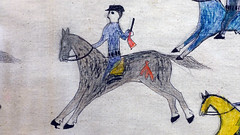
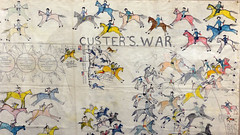
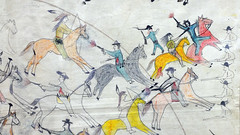
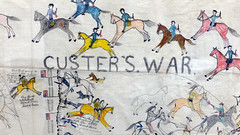
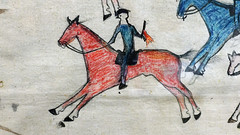
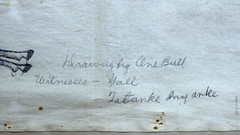
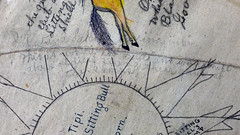
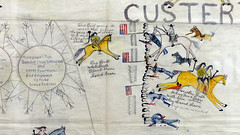
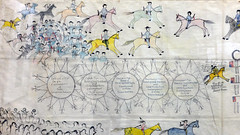
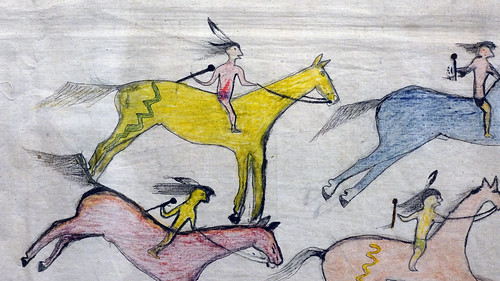

Figure \(\PageIndex{33}\): More Smarthistory images…
Selected Contributors
Seeing America is developed and distributed by Smarthistory together with a consortium of museums, including:
Amon Carter Museum of American Art
Crystal Bridges Museum of American Art
Fine Arts Museums of San Francisco
Los Angeles County Museum of Art
National Museum of the American Indian, Smithsonian Institution
Pennsylvania Academy of Fine Arts
Smithsonian American Art Museum
1901-22
Valor and horror: remembering the Civil War, The Ulysses S. Grant Memorial
This monument to a great leader completes the heroic narrative on the Washington Mall.

Figure \(\PageIndex{34}\): Henry Merwin Shrady (sculptor) and William Pearce Casey (architect), Ulysses S. Grant Memorial, 1901-1922, marble and bronze, 520 x 500 x 120 cm, Washington D.C.
Location, location, location
The dramatic and action-packed monument to Ulysses S. Grant in front of the U.S. Capitol Building, at once grand and intimate, speaks to both the valor and the horror of the Civil war. Henry Merwin Shrady’s massive tripartite memorial features a bronze equestrian statue of Grant on a central pedestal flanked by two sculptural groups of soldiers.
Sited on top of a grand terrace 252 feet wide and 71 feet long, the memorial stands in front of a large reflecting pool built to complement the water feature in front of the Lincoln Memorial at the opposite end of the Mall.

Figure \(\PageIndex{35}\): Henry Merwin Shrady (sculptor) and William Pearce Casey (architect), Ulysses S. Grant Memorial in front of the U.S. Capitol Building, 1901-1922, marble and bronze, 520 x 500 x 120 cm, Washington D.C. (photo: Martin Falbisoner, CC BY-SA 3.0)

Grant, at the apex of the central column, calmly attends to the war around him. Silent, certain and yet not traditionally heroic, the figure appears weary, but determined, his uniform unadorned, his presence unassuming.

Figure \(\PageIndex{36}\): Henry Merwin Shrady (sculptor) and William Pearce Casey (architect), Cavalry Charge, 1916, marble and bronze, Washington D.C.
On Grant’s right is the seven men Cavalry Charge. Their commanding officer raises his sword and urges his men into battle. The horses leap into action as the bugler prepares to sound the charge. Yet this powerful and inspiring moment has already turned tragic. One of the horses has fallen and trapped his rider beneath. He is about to be trampled by the cavalryman behind who shields his eyes in horror. Shrady made himself the model for the fallen soldier by working from his reflection in a mirror, which proved prophetically poignant as Schrady gave his life to the monument’s completion.

Figure \(\PageIndex{37}\): Henry Merwin Shrady (sculptor) and William Pearce Casey (architect), Artillery, 1912, marble and bronze, Washington D.C.
To the left of Grant is the equally dramatic portrayal Artillery. Three horses and five men bring forward a cannon but the bridal of the lead horse has broken. While the other two horses attempt to stop, the third plunges ahead causing the driver to lose control. The three riders appear both anxious and resigned as they brace themselves to be pitched to the side. Everything and everyone is destabilized. Even terrain under the cart is uneven and rutted. Both the Artillery and the Cavalry groups leave the visitor with narrative questions that will never be answered.
Memorializing Grant
The monument’s origins go back to 1895, when The Society of the Army of the Tennessee proposed a memorial to Grant. Ulysses S. Grant was a two-term president, brilliant strategist ,and resolute commander in chief of all U.S. armies. He led the Union troops to victory time and time again, culminating in the surrender of General Robert E. Lee at Appomattox, Virginia in 1865.

Figure \(\PageIndex{38}\): Henry Merwin Shrady (sculptor) and William Pearce Casey (architect), Ulysses S. Grant Memorial with the Washington Monument and Lincoln Memorial in the background, 1901-1922, marble and bronze, 520 x 500 x 120 cm, Washington D.C.
In 1901, Congress authorized $250,000 for a memorial to the Grant Memorial Commission, the largest sculpture commission of the time. Sculptor Henry Merwin Shrady and architect Edward Pearce Casey won the design commission.
Shrady immediately immersed himself in the details of Civil War battles. He joined the National Guard for four years to better understand military practice, borrowed Civil War uniforms, equipment and artillery, and convinced the military to run drills that would allow him to study the movements of soldiers and their horses. Shrady, taking great pains with every detail, pored over flags, uniforms, weapons, people, animals, and equipment to ensure they were accurately reproduced . The Grant Memorial Commission members, chaffing at the slow pace, pushed Shrady to work faster finally insisting he complete his work by the 100th anniversary of Grant’s birth. His health suffered under the strain. Two weeks before the memorial was dedicated, Shrady died.
On April 27, 1922 the memorial was unveiled. Later that year, the Lincoln Memorial was completed and the Mall’s narrative was set. At the center, the Washington Memorial speaks to the founding of the country. On the far west end sits the great thinking man, Lincoln. On the other end of the mall the great man of action, Grant, sits astride his proud horse, Cinicinnatus. Together they succeeded in saving what Washington had established.
Dig deeper
Official government website for the memorial
National Park Service website for the memorial
Selected Contributors
Seeing America is developed and distributed by Smarthistory together with a consortium of museums, including:
Amon Carter Museum of American Art
Crystal Bridges Museum of American Art
Fine Arts Museums of San Francisco
Los Angeles County Museum of Art
National Museum of the American Indian, Smithsonian Institution
Pennsylvania Academy of Fine Arts
Smithsonian American Art Museum
c. 1928
An artifact of racism: a Connecticut Klan robe
Artifacts like this are key for reminding us of a history of white supremacy and terror-based racism.
An artifact of racism
a Connecticut Klan robe as stark reminder
by DR. WILLIAM FRANK MITCHELL, THE AMISTAD CENTER FOR ART & CULTURE AT THE WADSWORTH ATHENEUM MUSEUM OF ART and DR. STEVEN ZUCKER
Video \(\PageIndex{6}\): Ku Klux Klan robe, c. 1928 (The Amistad Center for Art & Culture at the Wadsworth Atheneum Museum of Art, Hartford). Speakers: Dr. William Frank Mitchell, The Amistad Center for Art & Culture at the Wadsworth Atheneum Museum of Art and Dr. Steven Zucker
Test your knowledge with a quiz
START
Key points
- The Ku Klux Klan was a significant presence throughout the United States in the early 20th century, and not, as is often assumed, in just the southern states. The KKK used terror to ensure white supremacy. Although African-Americans were their primary target, they also terrorized Catholics, Jews, and Eastern and Southern Europeans, all of whom they considered non-white.
- The Klan enforced white supremacy in southern states in the wake of the Civil War but largely consisted of local groups without a national profile or organization. D.W. Griffith’s film Birth of a Nation was a major impetus for the growth and centralization of the KKK in the early 20th century. At the same time, backlash to the film propelled the National Association of Colored People (NAACP) and civil rights activists to fight against circulation of the film and its negative portrayal of African-Americans.
- This robe, and others like it, were mass-produced and widely available. This particular model was constructed of plain cotton and included minimal ornamentation. It sold for five dollars. The design of the robe and hood was intended to represent its wearer as a larger-than-life figure and hide the wearer’s identity.
Go deeper
Learn more about the Ku Klux Klan’s history
Learn more about the struggle for Civil Rights in the U.S.
Learn more about the making, impact, and response to D.W. Griffith’s Birth of a Nation
More to think about
How would you feel if you saw this object displayed in a museum? Do you think museums should, or should not, preserve and display artefacts with violent or racist histories? What are some arguments for and against doing so?
Selected Contributors
Seeing America is developed and distributed by Smarthistory together with a consortium of museums, including:
Amon Carter Museum of American Art
Crystal Bridges Museum of American Art
Fine Arts Museums of San Francisco
Los Angeles County Museum of Art
National Museum of the American Indian, Smithsonian Institution
Pennsylvania Academy of Fine Arts
Smithsonian American Art Museum
1931-32
Prejudice, politics, and the trial of Sacco and Vanzetti
Shahn makes an not-so-subtle comparison between Christ and two Italians executed for a crime they didn’t commit.
Prejudice at the trial of Sacco & Vanzetti
Picturing two Italians executed for a crime they didn’t commit
Ben Shahn: activist and artist

Figure \(\PageIndex{39}\): Ben Shahn
Ben Shahn said, “I hate injustice. I guess that’s about the only thing I really do hate.” Born in Lithuania (then part of the Russian Empire) in 1898, Shahn grew up in a family of leftist political activists. When Shahn was only four years old, his socialist father was exiled to Siberia because the Russian government suspected he was a revolutionary. Shahn remembered launching his own sort of protest as a child when he would shout “Down with the Czar!” at anyone wearing a uniform. As he recalled, “the air [in Russia] was filled with this whole revolutionary idea.” [1]
In 1906, the whole family immigrated to New York and, like many fellow Eastern European Jews, settled in Brooklyn. As an adult, Shahn called himself “the most American of all American painters” because he “came to America and its culture and was sort of swallowing it by the cupful.”[2] Apart from his love of baseball and chewing gum, Shahn’s Americanism lies in his Social Realist style. In that vein, he made paintings, prints, photographs, and drawings that address problems like racism, poverty, and oppression. His works are often critical of American life, but by exposing social problems, Shahn hoped to inspire reform.
The Sacco and Vanzetti case

Figure \(\PageIndex{40}\): Bartolomeo Vanzetti (left) and Nicola Sacco (right) in 1923
One of Shahn’s most enduring subjects was prompted by the arrest, trial, and execution of Nicola Sacco and Bartolomeo Vanzetti. Sacco, a shoemaker, and Vanzetti, a fish seller, were accused of murdering two men during an armed robbery at a factory in Braintree, Massachusetts in 1920. After seven years of legal battles, Sacco and Vanzetti were executed just after midnight on August 23, 1927. Sacco and Vanzetti’s plight was a cause célèbre—a sensational case that captured the attention of millions of people around the world, many of whom protested against the convictions.

Figure \(\PageIndex{41}\): Ben Shahn, Bartolomeo Vanzetti and Nicola Sacco, 1931-32, gouache on paper on board, 10 7/8 x 14 5/8 inches / 27.6 x 37.1 cm (The Museum of Modern Art)
The case against Sacco and Vanzetti was troubled from the start by ethnic bigotry and political intolerance. Both men were Italian immigrants, drawn to the United States by the promise of freedom and democracy. But upon arrival, poverty and poor working conditions propelled them toward the radical communist and anarchist thinking of Luigi Galleani. The Galleanisti, as his followers were called, believed that capitalism was an evil economic system that disadvantaged workers to the point of desperation and that violence would be the most effective revolutionary strategy. Sacco and Vanzetti’s association with such a militant political group, along with their participation in labor strikes and evasion of the World War I military draft in 1917, placed them on the federal government’s watch list of dangerous subversives.
The trail of evidence that led police to arrest Sacco and Vanzetti for the Braintree murders was extraordinarily weak. Their fingerprints did not match those collected at the crime scene and the stolen money (over $15,000) was never found. Though both men owned guns, ballistic analysis never connected the bullets found at the crime scene with Sacco and Vanzetti’s weapons. Eyewitnesses to the murders did not credibly identify either suspect; in some cases, witnesses were coerced into giving false testimony. The prosecutor built on a general perception that Italians—especially Italian anarchists—were ruthless, murderous criminals bent on overthrowing the United States government. He argued that Sacco and Vanzetti appeared suspicious when arrested, that they lied during questioning, and the jury agreed and convicted them for the murders. Two men imprisoned for other offenses, Joe Morelli and Celestino Madeiros, later confessed to the Braintree crimes, but Sacco and Vanzetti’s prosecutors never followed up on their claims.
Outrage and irony in The Passion of Sacco and Vanzetti

Figure \(\PageIndex{42}\): Ben Shahn, The Passion of Sacco and Vanzetti, 1931-32, tempera and gouache on canvas mounted on composition board, 84 × 48 inches (Whitney Museum of American Art)
Shahn followed Sacco and Vanzetti’s case closely and believed, like many people around the world, that the two men were not given a fair trial. Shahn participated in protests in support of their release in the 1920s and made twenty-three images about the Sacco and Vanzetti affair in 1931 and 1932. Many of these, including the gouache Bartolomeo Vanzetti and Nicola Sacco (1931-32) were based on photographs that appeared in newspapers. He returned to the Sacco and Vanzetti case in drawings and prints in the 1950s and used The Passion of Sacco and Vanzetti as part of the composition for a large mosaic at Syracuse University in 1967.
In Shahn’s early and iconic tempera-on-canvas painting, Sacco and Vanzetti lie in coffins in the foreground in front of a colonnaded neoclassical courthouse (image left). On the porch behind them hangs a portrait of the trial judge, Webster Thayer. Towering over Sacco and Vanzetti are the members of the committee that reviewed their convictions: Samuel Stratton, the president of MIT; Lawrence Lowell, Harvard’s president; and Robert Grant, a retired judge. These four men represent the wealthy, intellectual Massachusetts establishment, which was openly hostile to the radical ideals that Sacco and Vanzetti embodied.
Shahn used irony in this painting as a way of indicting Thayer, Stratton, Lowell, and Grant for the roles they played in Sacco and Vanzetti’s execution. In the background, Thayer raises his right hand as if he is taking an oath to uphold justice, but he faces a lamppost that resembles the bundle of sticks known as a fasces (image below). Once known as a symbol of judicial power, the fasces became a symbol for Italian fascism and oppression in the 1920s. Indeed, Thayer’s bias against immigrants and political radicals was widely known. He presided over Sacco and Vanzetti’s initial conviction and denied all motions for retrial. In response to public outcry, Lowell and his two cohorts were tasked with reviewing the proceedings and summarily upheld Sacco and Vanzetti’s convictions and death sentences after only ten days of deliberation.

Figure \(\PageIndex{43}\): Webster Thayer (detail), Ben Shahn, The Passion of Sacco and Vanzetti, 1931-32, tempera and gouache on canvas mounted on composition board, 84 × 48 inches (Whitney Museum of American Art)
Shahn explained in a 1944 interview, “Ever since I could remember I’d wished that I’d been lucky enough to be alive at a great time—when something big was going on, like the Crucifixion. And suddenly realized I was! Here I was living through another crucifixion. Here was something to paint!” [3] The term “passion” in his title connects Sacco and Vanzetti’s deaths with Jesus’s martyrdom (the “Passion of Christ” refers to the period at the end of his life leading to the crucifixion). Shahn also painted in tempera, a matte medium that was used by Italian Renaissance artists for Christian panel paintings, but rarely by modernists in the twentieth century. His composition hearkens back to images of the Lamentation of Christ, but his mourning scene lacks the emotional force that typically accompanies Jesus’ death and burial. The three men in the foreground, Stratton, Lowell, and Grant, wear expressions that communicate placid resolve rather than sorrow. They seem uncomfortable and awkwardly crowded together in Shahn’s painting as they half-heartedly offer white lilies, symbols of goodness and purity, to the deceased. Here Shahn forces these men to bear witness to the injustice that they refused to prevent.
That Shahn’s The Passion of Sacco and Vanzetti is eerily devoid of any kind of genuine, heartfelt anguish or grief amplifies the tragedy of the men’s deaths.
Shahn’s long career

Figure \(\PageIndex{44}\): Ben Shahn, Striking miners, Scotts Run, West Virginia, 1935

Figure \(\PageIndex{45}\): Ben Shahn, Scotts Run, West Virginia, 1937, tempera on paper, 22 5/8 × 28 1/4 inches, 57.5 x 71.8 cm (Whitney Museum of American Art)
Shahn’s career took off in the 1930s as his brand of realism resonated during the Great Depression when American audiences demanded that art communicate directly and serve a social purpose. Works like his photograph and painting of striking miners from Scotts Run, West Virginia (1935 and 1937) chronicled that decade’s challenges and contributed to President Franklin D. Roosevelt’s New Deal efforts to use art to help the nation weather the crisis.
From the 1940s until his death in 1969, as Abstract Expressionism came to the fore in the United States, Shahn’s style evolved and his works became more symbolic, expressionistic, and even surreal. But he continually strove to portray dramatic, but universal human experiences like tragedy and survival in Liberation (1945), Age of Anxiety (1953), and the Lucky Dragon series (1960-62) with empathy and sincerity. The commitment to social justice that he established so clearly in The Passion of Sacco and Vanzetti persisted throughout his career.
- Oral history interview with Ben Shahn, September 27, 1968
- Oral history interview with Ben Shahn, September 27, 1968
- Frances Pohl, Ben Shahn (Pomegranate Communications, 1993), p.12
Go deeper
Alejandro Anreus, ed. Ben Shahn and The Passion of Sacco and Vanzetti (Jersey City, NJ: The Jersey City Museum and Rutgers University Press, 2001.)
Susan Chevlowe, Common Man, Mythic Vision: The Paintings of Ben Shahn *Princeton, NJ: Princeton University Press, 1998).
John Morse, “Ben Shahn: An Interview,” Magazine of Art 37, no. 4 (April 1944), pp. 138-139.
Ben Shahn, Ben and Forrest Selvig, “Interview: Ben Shahn Talks with Forrest Selvig,” Archives of American Art Journal 17, no. 3 (1977), pp. 14-21.
The Passion of Sacco and Vanzetti, 1967, mosaic, Syracuse University
Selected Contributors
Seeing America is developed and distributed by Smarthistory together with a consortium of museums, including:
Amon Carter Museum of American Art
Crystal Bridges Museum of American Art
Fine Arts Museums of San Francisco
Los Angeles County Museum of Art
National Museum of the American Indian, Smithsonian Institution
Pennsylvania Academy of Fine Arts
Smithsonian American Art Museum
1934
Diego Rivera, Man Controller of the Universe
What will technology bring us? A more egalitarian society, a world where everyone can be educated? Or will it bring greater inequality? We still debate these issues...
Diego Rivera, Man Controller of the Universe
by DR. BETH HARRIS and DR. STEVEN ZUCKER
Video \(\PageIndex{7}\): Diego Rivera, Man Controller of the Universe (or Man in the Time Machine), 1934, fresco, 4.85 x 11.45 m in the Palacio de Bellas Artes, Mexico City Speakers: Dr. Beth Harris and Dr. Steven Zucker. Created by Beth Harris and Steven Zucker.
Key points
- Man Controller of the Universe is a fresco in the Palace of Fine Arts in Mexico City. Part of a tradition of art for the people begun in the wake of the Mexican Revolution, it is a recreation of a mural, Man at the Crossroads, commissioned John D. Rockefeller Jr. in New York City, which was begun and then destroyed.
- Diego Rivera was basking in the success of murals in San Francisco and Detroit, as well as a one-man exhibition at the Museum of Modern Art in New York City. Rivera’s design for Man at the Crossroads included a portrait of the Russian communist leader Lenin, which angered the capitalist Rockefeller. He insisted Rivera remove it, but Rivera refused. In the end, Rockefeller paid Rivera for the commission, but locked the artist out and had the work destroyed.
- The mural in Mexico City, retitled Man Controller of the Universe, depicts a world coming to grips with politically turbulent times as well as asking what the future holds for a humanity that had been able to peer deep into space as well as into the microscopic world.
- Rivera emphasizes the differences between the good and evil that mankind is capable of, as well as the differences between capitalist and communist societies. He placed many portraits in the painting, including communist leaders as well as a portrait of John D. Rockefeller Jr. as a wealthy capitalist indifferent to the suffering of the starving, unemployed lower classes.
- Throughout the painting, Rivera shows a hopeful vision of a world where people of all races and ethnicities are able to join together, be educated together, and work together towards the future. However, it is not certain that this is the world humanity will choose.
More to think about
Diego Rivera’s vision of humanity in Man Controller of the Universe is meant to be inclusive in its representation of many different races and ethnicities, as well as men and women, capable of coming together and living in a better world. It also rejects the American capitalism of John D. Rockefeller Jr. and the fascism of the Nazis. Why then do you think that the main “controller” figure of the mural is a blonde, blue-eyed man?
Selected Contributors
Seeing America is developed and distributed by Smarthistory together with a consortium of museums, including:
Amon Carter Museum of American Art
Crystal Bridges Museum of American Art
Fine Arts Museums of San Francisco
Los Angeles County Museum of Art
National Museum of the American Indian, Smithsonian Institution
Pennsylvania Academy of Fine Arts
Smithsonian American Art Museum
1943
Horace Pippin, Mr. Prejudice
African Americans' ongoing fight against racism in the U.S. undermined the sense of victory in both world wars.
Horace Pippin, Mr. Prejudice
Discrimination undermined the sense of victory for African American vets
by JESSICA T. SMITH, PHILADELPHIA MUSEUM OF ART and DR. STEVEN ZUCKER
Video \(\PageIndex{8}\): Horace Pippin, Mr. Prejudice, 1943, oil on canvas, 46 x 35.9 cm (Philadelphia Museum of Art)
Test your knowledge with a quiz
START
Key points
- Racial discrimination continued to undermine the legal rights granted African Americans after the Civil War well into the 20th century. This injustice is especially apparent in light of the service, sacrifice, and patriotism of African Americans in the military during both World Wars.
- “V for Victory” was a popular slogan in the allied fight to end World War II that had been coined by Winston Churchill (Prime Minister of Britain). African American groups expanded its meaning to create the “Double V” campaign, promoting the dual hope that victory in war could be accompanied by an end to racial conflict and discrimination on the home front.
- Horace Pippin had served in the segregated 369th Infantry Regiment during World War I. This unit was known as the Harlem Hellfighters for their fierce bravery in battle. Despite the success of the regiment, which spent more time on the frontlines than any other, its soldiers faced such deep-seated racism that the U.S. Army placed them under French command. When they returned home after the war, they continued to face discrimination in daily life.
Go deeper
This painting at the Philadelphia Museum of Art
Learning resource from the Philadelphia Museum of Art on this painting
Read about the 369th Infantry Regiment, called the Harlem Hellfighters, in World War I
Learn more about African Americans during World War I
Learn about racial discrimination in the U.S. military and the Double V campaign
Find out about the experiences of African Americans in the military during World War II
Learn about the “Double V” campaign to fight for freedoms abroad and on the home front
More to think about
Consider the discrimination faced by African Americans in the military during World War I and II. What other groups have faced similar discrimination in the military and other public service? Why do you think individuals who have experienced discrimination might still choose to serve?
Smarthistory images for teaching and learning:


Figure \(\PageIndex{46}\): More Smarthistory images…
Selected Contributors
Seeing America is developed and distributed by Smarthistory together with a consortium of museums, including:
Amon Carter Museum of American Art
Crystal Bridges Museum of American Art
Fine Arts Museums of San Francisco
Los Angeles County Museum of Art
National Museum of the American Indian, Smithsonian Institution
Pennsylvania Academy of Fine Arts
1960
Making an icon: JFK and the power of media
Go backstage at the 1960 Democratic National Convention with photographer Gary Winogrand
JFK and the power of media
Go backstage at the 1960 Democratic National Convention
by DR. ROBERT COZZOLINO, MINNEAPOLIS INSTITUTE OF ART and DR. STEVEN ZUCKER
Video \(\PageIndex{9}\): Garry Winogrand, Democratic National Convention, Los Angeles, 1960 (printed c. 1980), gelatin silver print, 45.88 x 30.8 cm (Minneapolis Institute of Art, © The Estate of Garry Winogrand). A Seeing America video. A conversation with Dr. Robert Cozzolino, Patrick and Aimee Butler Curator of Paintings, Minneapolis Institute of Art, and Dr. Steven Zucker
Test your knowledge with a quiz
START
Key points
- Television played a key role in the 1960 presidential campaign. After his nomination at the Democratic National Convention, John F. Kennedy appeared next to his Republican opponent Richard Nixon in the first presidential debate ever broadcast to a national audience. Many historians believe that the appearance and demeanor of the candidates as seen on TV had a direct impact on the election.
- Kennedy’s nomination represented a new direction for the Democratic party. While the establishment worried that his youth and his Irish-Catholic background would be liabilities in the general election, the 1960 Democratic Convention marked a shift toward a new generation of leaders and a more open nomination process.
- As a street photographer, Garry Winogrand used split-second timing to capture images that are both spontaneous and simultaneously dense with meaning. Here, Kennedy’s gesture recalls famous leaders of the past, while his appearance on the TV screen alludes to his status as a modern celebrity. Other details of the photograph took on symbolic significance following Kennedy’s assassination in 1963, reminding us that works of art are open to continued interpretation and renewed meaning
Go deeper
See this photograph in the collection of the Minneapolis Institute of Art
Use primary source documents to learn about the 1960 presidential election
Learn more about John F. Kennedy’s presidency
Learn about the impact of television on the news media in the 1960s
More to think about
Kennedy’s presidency coincided with the rise of television and its role in mediating our interactions with and connection to politicians. How do you think the emergence of social media has affected that relationship and the public’s direct access to our political leaders?
Selected Contributors
Seeing America is developed and distributed by Smarthistory together with a consortium of museums, including:
Amon Carter Museum of American Art
Crystal Bridges Museum of American Art
Fine Arts Museums of San Francisco
Los Angeles County Museum of Art
National Museum of the American Indian, Smithsonian Institution
Pennsylvania Academy of Fine Arts
Smithsonian American Art Museum
1963
Homage to JFK: Rauschenberg’s Retroactive I
A portrait of a president transformed by tragedy.
Rauschenberg’s Homage to JFK
A portrait of a president transformed by tragedy
by PATRICIA HICKSON, WADSWORTH ATHENEUM MUSEUM OF ART and DR. STEVEN ZUCKER
Video \(\PageIndex{10}\): Robert Rauschenberg, Retroactive I, 1963, oil and silkscreen-ink print on canvas, 213.4 x 152.4 cm (Wadsworth Atheneum Museum of Art) All works © Robert Rauschenberg. Speakers: Patricia Hickson, Wadsworth Atheneum Museum of Art and Dr. Steven Zucker
Test your knowledge with a quiz
START
Key points
- The figure of John F. Kennedy evokes the dramatic technological, social, and political changes of the 1960s. Elected to the presidency in 1960, Kennedy’s youthful vitality signaled hope and ambition for a new era of progress, epitomized by the U.S. space program. The devastating impact of his assassination in 1963 left the nation in mourning. It was the onset of the violence and unrest that would characterize much of the decade.
- Silkscreening provides an efficient method of duplicating images, and allowed Rauschenberg to incorporate photography taken from popular media directly into his artworks. Rauschenberg’s use of this technique challenged the idea that fine art should demonstrate an artist’s technical skill and focused attention on the power and multiplicity of images in mid-twentieth century America.
- Robert Rauschenberg’s use of recognizable imagery from popular culture signals a shift away from the Abstract Expressionist art of Willem de Kooning and Jackson Pollock and reconnected fine art with the actual world.
- While Rauschenberg wanted to show what was “outside my window,” the clustering of seemingly unrelated images incorporated in the painting remains more suggestive and open to interpretation than a straightforward illustration of the world.
Go Deeper
Learn more about this object from the Wadsworth Atheneum Museum of Art
Learn more about Robert Rauschenberg by watching a documentary, a short video, or exploring his archive
Learn more about the Space Race
Watch or read a transcript of the 1962 speech where Kennedy promises that the United States will land humans on the moon
Find out more about the assassination of President Kennedy and its impact on the U.S.
More to think about
We value a painting by Leonardo da Vinci in part because of his craftsmanship—he could really paint! Does this still apply to art made today? What is the role of craftsmanship in the era of Instagram filters and Etsy?
Selected Contributors
Seeing America is developed and distributed by Smarthistory together with a consortium of museums, including:
Amon Carter Museum of American Art
Crystal Bridges Museum of American Art
Fine Arts Museums of San Francisco
Los Angeles County Museum of Art
National Museum of the American Indian, Smithsonian Institution
Pennsylvania Academy of Fine Arts
Smithsonian American Art Museum
1978
Faith Ringgold, Ben
Buttons, flags, and booze — Ben conjures up a specific time and place.
Politics and humanity in 1970s New York
Faith Ringgold's deeply human Ben
by DR. HALONA NORTON-WESTBROOK, TOLEDO MUSEUM OF ART and DR. BETH HARRIS
Video \(\PageIndex{11}\): Faith Ringgold, Ben, c. 1978, soft sculpture/mixed media, 99.1 x 30.5 x 30.5 cm (Toledo Museum of Art, ©Faith Ringgold). Speakers: Dr. Halona Norton-Westbrook, Toledo Museum of Art and Dr. Beth Harris
Test your knowledge with a quiz
START
Key Points
- In the late 1970s, social, political, and economic crises dramatically impacted many Americans. Economic stagnation coupled with oil shortages affected the economy, the Watergate scandal and Vietnam War eroded public trust, while activists in the Civil Rights and feminist movements struggled for equality.
- Faith Ringgold’s Ben captures the turbulent atmosphere of the late 1970s. Through his dress and accessories, Ringgold includes a constellation of references and associations that connect this figure to the central controversies of the day. At the same time, she gives the figure a sense of humanity and empathy that connects with the viewer.
- Using techniques and materials that were often dismissed as “women’s work,” Faith Ringgold uses the scale of Ben to establish it as a work of art. Larger than a doll, smaller than a human, it elevates its medium to the realm of high art and makes a feminist statement.
Go deeper
This sculpture at the Toledo Museum of Art
Learn about the oil shortages and economic crisis of the 1970s
Explore Johnson’s Great Society and the war on poverty through primary source documents
Explore the experiences of soldiers in the Vietnam War through primary source documents
Stories of veterans from The Library of Congress
Watch documentary videos and learn more about the Vietnam War
Explore the Watergate scandal that led to the resignation of President Nixon
See more of Faith Ringgold’s work and watch interviews with the artist
More to think about
How do Faith Ringgold’s Ben (1978) and Duane Hanson’s Executive (1971) each reflect the political and social climate of the 1970s? How might the figures offer different perspectives on the period? Consider questions that you might ask each man if you were to meet them on the street. Which do you think you’d be more interested in talking to?
Smarthistory images for teaching and learning:


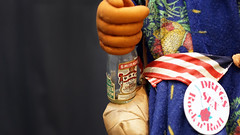
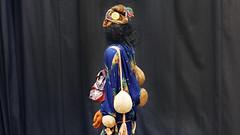
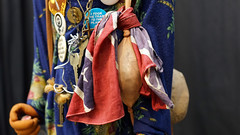
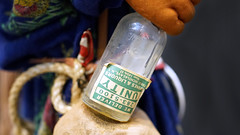


Figure \(\PageIndex{47}\): More Smarthistory images…
Selected Contributors
Seeing America is developed and distributed by Smarthistory together with a consortium of museums, including:
Amon Carter Museum of American Art
Crystal Bridges Museum of American Art
Fine Arts Museums of San Francisco
Los Angeles County Museum of Art
National Museum of the American Indian, Smithsonian Institution
Pennsylvania Academy of Fine Arts
Smithsonian American Art Museum
1992
Thorton Dial, Blood and Meat
An unflinching memorial to civil rights martyrs by the contemporary artist Thorton Dial.
A memorial to Civil Rights martyrs
Thornton Dial's unflinching Blood and Meat
by TIMOTHY ANGLIN BURGARD, FINE ARTS MUSEUMS OF SAN FRANCISCO and DR. BETH HARRIS
Video \(\PageIndex{12}\): Thornton Dial, Blood and Meat: Survival For The World, 1992, rope, carpet, copper wire, metal, canvas scraps, enamel, and splash zone compound on canvas on wood, 165.1 x 241.3 x 27.9 cm (Fine Arts Museums of San Francisco, ©Thornton Dial), a Seeing America video. Speakers: Timothy Anglin Burgard, Fine Arts Museums of San Francisco and Dr. Beth Harris
Test your knowledge with a quiz
START
Key points
- Under discriminatory Jim Crow laws, freed slaves had few options in the post-Civil War, agrarian South. Many became sharecroppers, entering into agreements that were little more than forced labor. Sharecroppers were at the mercy of the landlord’s recordkeeping, which left them frequently in heavy debt and subject to arrest if they attempted to leave their leased land. Sharecropping remained a widespread practice until the Great Depression of the 1930s.
- Thornton Dial combines multiple levels of meaning in this painted assemblage, which references the dangerous path taken by Civil Rights activists. The use of unraveled rope carpets evokes his childhood poverty, but also images of bondage and lynching. The tiger and the faces that are hidden throughout the work reference Dr. Martin Luther King, Jr, Robert Kennedy, President John F. Kennedy, Emmett Till, and others. His goal is to confront the viewer with this history and remind us that these issues still need to be addressed in today’s world.
Go deeper
See this work at the Fine Arts Museums of San Francisco
Learn more about the injustices of the sharecropping system
Explore the life and legacy of Dr. Martin Luther King, Jr.
Learn more about President John F. Kennedy’s role in the Civil Rights movement
Read Robert Kennedy’s 1963 report on the state of civil rights in America
Read or hear more about the murder of Emmett Till
Read the stories of other martyrs of the Civil Rights movement
Learn more about Thornton Dial and watch a documentary about him
Consider Dial’s position as a self-taught artist in museums and the art world
More to think about
In the video, the speakers describe Dial’s painting as “visceral.” What does this word mean and how do you see it applying to this work of art? Consider the visual and emotional impact of the Dial’s imagery, materials, and even the title Blood and Meat: Survival for the World. Why might Dial—and other artists recounting African-American history in the U.S.—want to evoke ideas of the visceral in their work?
Selected Contributors
Seeing America is developed and distributed by Smarthistory together with a consortium of museums, including:
Amon Carter Museum of American Art
Crystal Bridges Museum of American Art
Fine Arts Museums of San Francisco
Los Angeles County Museum of Art
National Museum of the American Indian, Smithsonian Institution
Pennsylvania Academy of Fine Arts
Smithsonian American Art Museum
This page titled 13.5: Politics and power was last modified on Mon, 04 Oct 2021 15:49:39 GMT and is shared under a CC BY-NC-SA 4.0 license and was authored, remixed, and/or curated by Smarthistory.
The book could not be loaded just now.