Opening the book…
When we read Vasari’s account of the personality of Raphael, we begin to have some sense of the extraordinary man he was:
Thus Nature created Michelangelo . . . to excel and conquer in art, but Raphael to excel in art and in manners also. Most artists have hitherto displayed something of folly and savagery, which, in addition to rendering them eccentric and fantastical, has also displayed itself in the darkness of vice and not in the splendor of those virtues which render men immortal. In Raphael, on the other hand, the rarest gifts were combined with such grace, diligence, beauty, modesty and good character that they would have sufficed to cover the ugliest vice and the worst blemishes. We may indeed say that those who possess such gifts as Raphael are not mere men, but rather mortal gods, and that those who by their works leave an honored name among us on the roll of fame may hope to receive a fitting reward in heaven for their labors and their merits.
Dr. Beth Harris and Dr. Steven Zucker provide a description, historical perspective, and analysis of Raphael’s Alba Madonna.
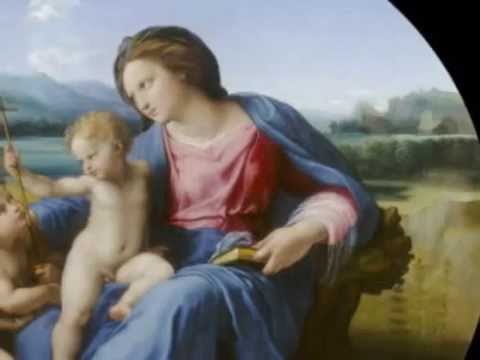
The link to this video is provided at the bottom of this page.
Raphael, Alba Madonna, oil on panel transferred to canvas, c. 1510 (National Gallery of Art, Washington D.C.)
External Link
Contributors
- Raphael's Alba Madonna. Authored by: Dr. Beth Harris and Dr. Steven Zucker. Provided by: Khan Academy. Located at: https://web.archive.org/web/20140215032756/http://smarthistory.khanacademy.org/raphael.html. License: CC BY-NC-SA: Attribution-NonCommercial-ShareAlike
5.32: Alba Madonna is shared under a CC BY-NC-SA 4.0 license and was authored, remixed, and/or curated by LibreTexts.
The book could not be loaded just now.