Opening the book…
- Recognize and use the irregular verb “tener”
- Use “tener” for saying people’s age
Verbo tener
The verb tener (to have) is special in the sense that it has an irregular yo form and also has a change of e>ie in the stem.
|
tener (to have) |
|
| (stem: ten; irregular yo-form; stem-vowel change) | |
| singular | plural |
| yo tengo | nosotros tenemos |
| tú tienes | vosotros tenéis |
| él tiene ella tiene usted tiene | ellos tienen ellas tienen ustedes tienen |

(Note: “hablar” is in the present subjunctive here because it’s a command which will be covered in Spanish 2)
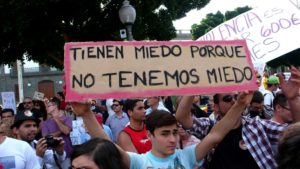
miedo = fear, porque = because
- María tiene una clase de psicología a las dos de la tarde. (María has a psychology class at 2 p.m.)
- ¿Cuántos lápices tienes en tu mochila? (How many pencils do you have in your backpack?)
Tener años
To give age in Spanish, use the correct conjugation of the verb tener + number + años:
- ¿Cuántos años tienes? (How old are you?)
- Tengo 22 años. (I am 22 years old.)
- Tengo trece años. (I’m 13.)
- ¿Cuántos años tiene él? (How old is he?)
- Tiene ochenta y siete años. (He’s 87.)
- ¿Cuántos años tienen? (How old are they?)
Note: in English you can leave off “years old” and just say “I’m 22,” but in Spanish you must include the word años.
A.  El verbo tener
B.  El verbo tener
C.  Escuchar: El verbo tener
Contributors and Attributions
CC licensed content, Shared previously
- Manifestacion #19j Tenerife. Authored by: Jose Mesa. Located at: https://www.flickr.com/photos/liferfe/5850229679. License: CC BY: Attribution
- We don't have WiFI. Talk among yourselves sign Marzola Parrilla Argentina Steakhouse Exterior, Cartagena Columbia. Authored by: Joe Ross. Located at: https://www.flickr.com/photos/joeross/23791002624. License: CC BY-SA: Attribution-ShareAlike
- Gramática: El verbo tener. Authored by: SUNY Oneonta with Lumen Learning. Provided by: SUNY Oneonta. License: CC BY: Attribution
This page titled 3.3: Gramática- El verbo tener was last modified on Thu, 29 Oct 2026 16:44:57 GMT and is shared under a CC BY-NC-SA 4.0 license and was authored, remixed, and/or curated by Beatrice Tseng and Karla Lemari via source content that was edited to the style and standards of the LibreTexts platform.
The book could not be loaded just now.