Opening the book…
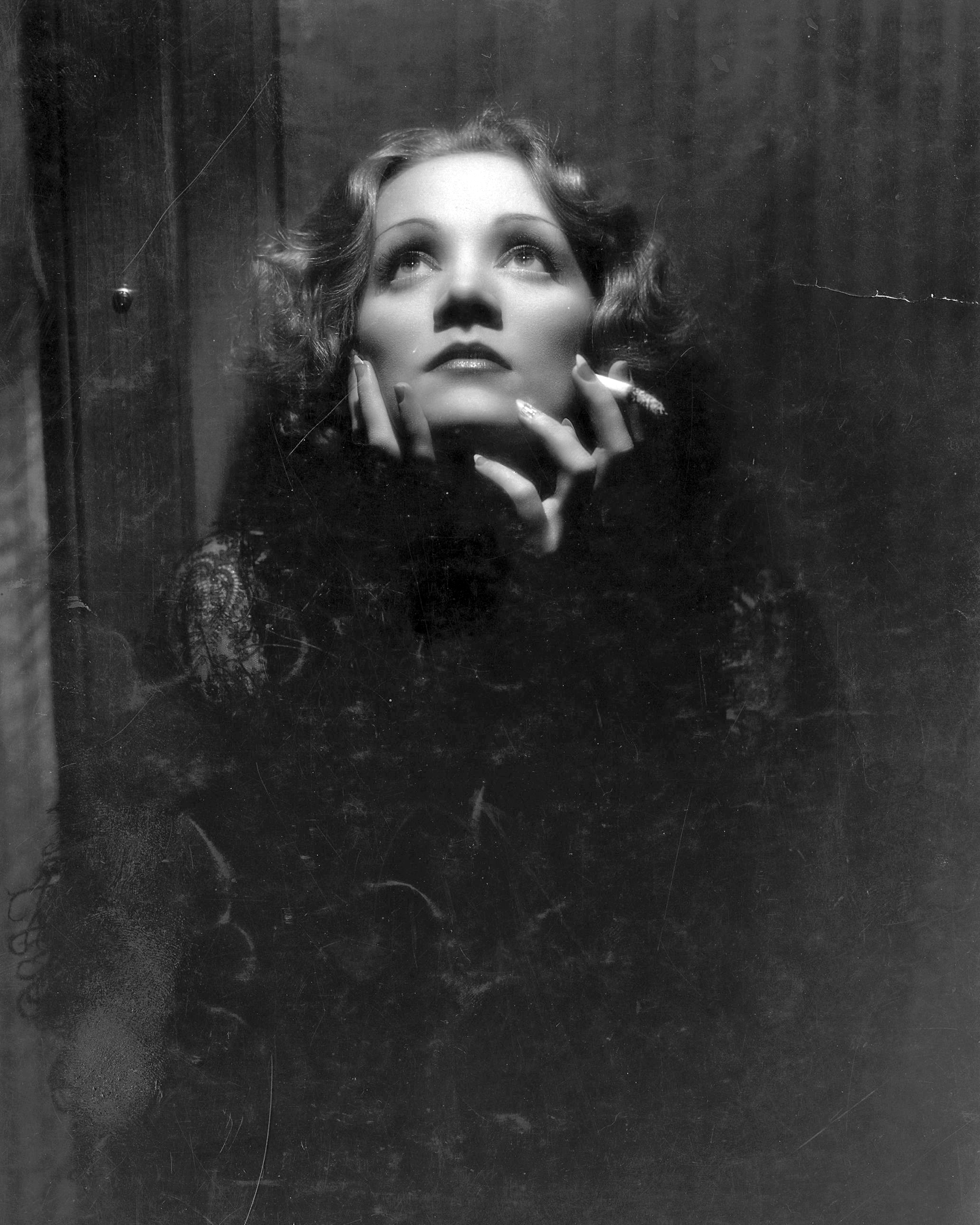
Made popular by the movie studio Paramount Pictures, the Paramount lighting technique was a signature style for German actress Marlene Dietrich and became widely used for glamorous actresses. Also known as the butterfly technique, it creates dark shadows to define the chin, eyes, and cheekbones, along with a distinct butterfly pattern under the nose to flatter the face. This beauty lighting style is extensively used in contemporary photography and movies. This chapter details the nuances of this style, such as where the light is placed, how to achieve variations in the effect, and how the talent’s movement in and out of the light affects mood and tension.

This technique requires only one key light, is very quick to set up, and makes your subject look beautiful. It emphasizes cheekbones, slims the face, minimizes extra chins, and smooths wrinkles. Placed directly in front of the actor or actress, the key light is lifted high and pointed downwards at a 45-degree angle towards the subject. This effect works best when you slightly underexpose the subject and have the subject tilt his or her head up slightly to increase the butterfly shadow created under the nose. This looks fantastic when used with a fog machine, producing a soft, diffused light.

During the 1930s, Marlene Dietrich made seven films with Austrian-American director, Josef von Sternberg; six movies were under a contract with Paramount. Sternberg’s distinct visual style and themes, paired with Dietrich’s image, defined the era’s cinematic allure of beauty and mystique. Dietrich was also highly knowledgeable about lighting and photography, working closely with famous Hollywood photographer George Hurrell to control her image. When she was acting in Stage Fright,[1] she asked cinematographer Wilkie Cooper to adjust her lighting. Dietrich pointed out to him “exactly the lights he should use,”[2] and “she was dead right. For the close-up stuff, I could not have improved upon it.”[3] See figure 10.2 for a still from this film. Although Dietrich is not facing the camera, the light’s, high angle, pointing down at 45 degrees, is clearly visible on her face.
The disadvantage of this technique is that the actor cannot stray too far from the light. If you watch any of Dietrich’s films, such as Shanghai Express,[4] you will see how she barely moves in her close-ups to maintain the butterfly effect. Even in long shots, she consistently kept herself looking slightly upward into the light. This lighting became Hollywood’s signature technique, giving actors and actresses a glamorous look that is still used today.
Action
Watch Dietrich in Shanghai Express:
https://archive.org/embed/shanghai-express-1932-colorized-movie-720p-hd
Butterfly Technique Gallery
You can see that this technique works beautifully for a range of skin tones.


You can modify this look just by adding diffusion to soften shadows. Additionally, using a reflector to bounce some of the light can also change this look while maintaining the butterfly effect. The reflector should be angled upward, toward, and under the chin.

By experimenting with actors’ features, skin tones, and costumes, as well as diffusers, gels, and dingles, etc., you can discover how versatile and beautiful your subjects can be.
Chapter Review
Knowledge Check Quiz
Low Light Practice Exercise
Light and shoot one low-light shot choosing between film noir, butterfly, or Rembrandt techniques. Try to create life and movement inside the filmic frame. Use whatever lens size or filter appropriate for the mood, tone, and subject. You do not have to record sound.
Chapter 10 Student Resources
| Resource Title | Link to document | Alternate format |
|---|---|---|
| Butterfly Lighting Plot | Google Doc (this link will prompt you to make a copy) | Google Doc (view only) |
Media Attributions
- Marlene Dietrich, Shanghai Express, 1932. Don English (1901-1964) © Paramount Pictures is licensed under a Public Domain license
- Stage Fright is licensed under a CC BY-NC-SA (Attribution NonCommercial ShareAlike) license
- Butterfly; Will Karr
- Butterfly; Merle Steep © Ros Smith, SUNY Fredonia 2021
- Butterfly; Camera and Lighting Class; Nicholas Dohre © Ros Smith, SUNY Fredonia 2020
- Butterfly with Bounce; Nicholas Dohre © Ros Smith, SUNY Fredonia
- Stage Fright. Directed by Alfred Hitchcock, Warner Brothers, 1950. 1.10: Butterfly LightingParamount Lighting#return-footnote-844-1
- Frewin, Leslie Ronald. Dietrich: The Story of a Star. Stein and Day, 1967, p. 115. 1.10: Butterfly LightingParamount Lighting#return-footnote-844-2
- Frewin, Leslie Ronald. Dietrich: The Story of a Star. Stein and Day, 1967, p. 116. 1.10: Butterfly LightingParamount Lighting#return-footnote-844-3
- Shanghai Express. Directed by Josef von Sternberg, Paramount Pictures, 1932. 1.10: Butterfly LightingParamount Lighting#return-footnote-844-4
This page titled Chapter 10: Butterfly Lighting/Paramount Lighting was last modified on Mon, 26 Oct 2026 17:17:03 GMT and is shared under a CC BY 4.0 license and was authored, remixed, and/or curated by Roslin Smith via source content that was edited to the style and standards of the LibreTexts platform.
The book could not be loaded just now.