Opening the book…
11.2 Gramática: Superlative
Superlatives in English and Spanish express the highest or lowest degree of a quality.
For example:
| the greatest | the worst | the least | the most |
|---|---|---|---|
| el / la mejor | el / la peor | el / la menos | el / las más |
Examples in English:
María is the smartest person in her family.
New York is the most exciting city in the United States.
Adele is the best singer in the world.
To talk about a superlative in Spanish, follow this formula:
| Subject and verb + | el la los las |
+ más/menos | + adjective | + de |
|---|
Example: María is the smartest person in her family.
| Paso 1 | Subject and Verb | María es |
|---|---|---|
| Paso 2 | Definitive article: el / la / los / las | la |
| Paso 3 | más / menos | más |
| Paso 4 | Adjective | inteligente |
| Paso 5 | of a group (optional) | (de su familia) |
If the details are already clear from the context, I can say:
María es la más inteligente.
Maria is the smartest.
Or I can include the optional details:
María es la persona más inteligente de su familia.
Maria is the smartest person in her family.
Irregular Superlatives
| Adjective | Superlative form | ||
|---|---|---|---|
| bueno / a | good | el / la mejor | (the) best |
| malo / a | bad | el / la peor | (the) worst |
| grande | grown, adult | el / la mayor | (the) oldest |
| pequeño / a | young | el / la menor | (the) youngest |
| joven | young | el / la menor | (the) youngest |
| viejo / a | old | el / la mayor | (the) oldest |
When using irregular superlative forms, follow this formula:
| Subject and Verb + | el la los las |
+ | mejor (es) peor (es) mayor (es) menor (es) |
+ (noun) | + de |
|---|
Ejemplos:
Yo soy LA MAYOR de mi familia. iPhones son LOS MEJORES teléfonos del mercado.
I am the oldest in my family. iPhones are the best phones in the market.

El abuelo es viejo. (description)
El padre es MAYOR QUE la madre. (comparison)
El abuelo es EL MAYOR de la familia. (superlative)
Miguelito es joven. (description)
Little Miguel is young.
Miguelito es MENOR QUE Lupita. (comparison)
Little Miguel is younger than Lupita.
Miguelito es EL MENOR de la familia. (superlative)
Little Miguel is the youngest in the family.
Actividad # 1:
¡Vamos a hablar!
¿Estás de acuerdo o no? Paso 1. Indicate if you agree or not with the following statements. If you agree, say: Estoy de acuerdo. If you don’t, say: No estoy de acuerdo and express your opinion.
- Apple es la mejor marca para computadores.
- Filibertos sirve la peor comida mexicana.
- El peor mes del año es enero.
- La ciudad más bonita de Estados Unidos es Nueva York.
- El hip-hop es la mejor música para bailar.
- El problema más serio del mundo es el uso del plástico.
Paso 2. With a partner, compare your answers from Paso 1 and see if you agree or disagree and why.
Actividad # 2: ¡Vamos a hablar!
¿Qué opinas de Hollywood? Use superlatives to answer the following questions about Hollywood.
- ¿Quién es el actor/ la actriz más atractivo (a)?
- ¿Quién es el actor más talentoso?
- ¿Quién es la actriz más talentosa?
- ¿Cuál es la mejor película del año?
- ¿Cuál es la peor película que has visto (you’ve seen) en tu vida?
Actividad # 4
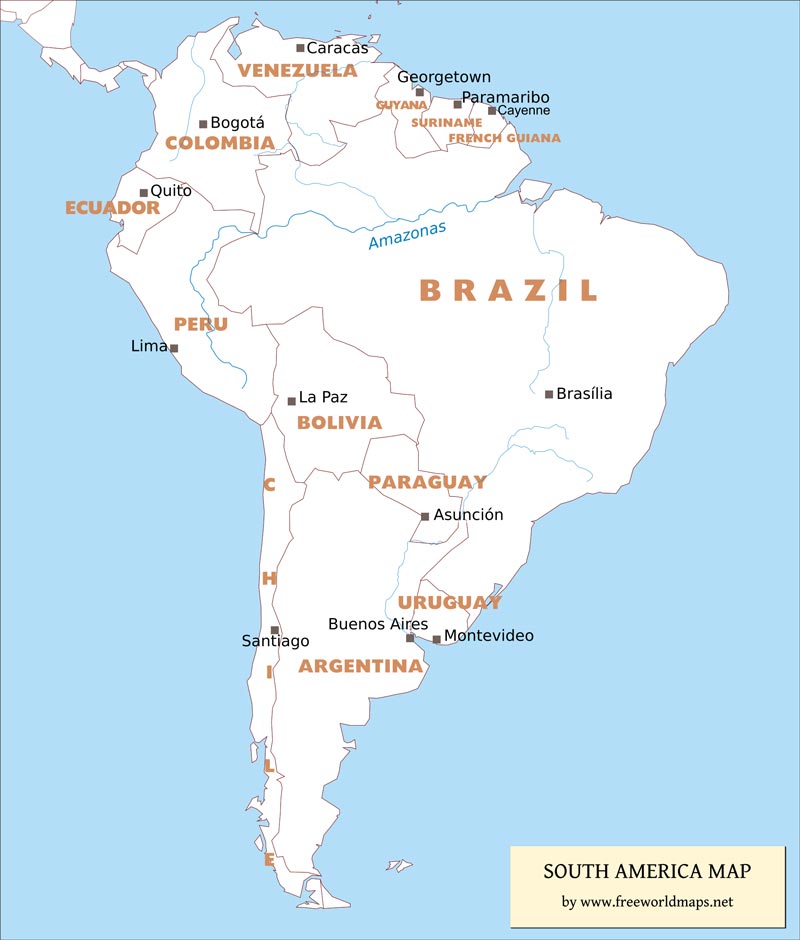
La geografía. Look at the map of South America and answer the following questions.
1. ¿Cuál es el país (country) más grande de Suramérica?
_____________________________________________________.
2. ¿Cuál es el país más pequeño de Suramérica?
_____________________________________________________.
3. ¿Cuál es el país más largo de Suramérica?
_____________________________________________________.
4. ¿Cuál es el país más conocido (known) de Suramérica? Y ¿por qué?
_____________________________________________________.
Actividad # 5
Shazam, ¿el héroe más poderoso?
Paso 1. Watch this promotional video of Shazam (use the closed caption).
Paso 2. Work with a partner and complete the phrases below according to the video.
(use superlatives)
- Shazam es ___________________________ Superman.
- Es ___________________________ Flash.
- Tiene una voz ___________________________ la de Batman.
- Es ___________________________ Aquaman.
- Tiene ___________________________ Aquaman.
- El olor a pizza y desodorante es_____________ el olor a pescado.
| Absolute Superlative
In Spanish, the absolute superlative is equivalent to extremely, exceptionally, super, or very.
Inteligente>>> -inteligent- >>> inteligentísimo mucha >>> much- >>> muchísima ¡Mi hijo es inteligentísimo! Hay muchísima tarea en esta clase.
rica >>> riquísima largo >>> larguísimo feliz >>> felicísimo
joven + -císimo >>> jovencísimo trabajador + -císimo >>> trabajadorcísimo
fácil >>> facilísimo difícil >>> dificilísimo Los exámenes de español son facilísimos. |
|---|
Actividad # 1
La concordancia. Fill in the blanks using ísimo/ísima (s) superlatives to complete the sentences below. Pay attention to the agreement on gender and number. Use the adjectives provided in the following word bank.
Ejemplo:
Yo creo que Bill Gates tiene mucho dinero. (rico) Él es riquísimo.
| Banco de palabras
generoso cómico guapo caliente caro bueno rico (rich or delicious for food) aburrido |
|---|
- Yo creo que Trevor Noah es un buen comediante. Él es ________________.
- Cuidado con la sopa porque está ___________________.
- Mi novio es muy atractivo. Él es ___________________.
- Los carros Ferrari son __________________________.
- En mi opinión, la serie de ¨Juego de Tronos¨ fue ____________________.
- Tengo una amiga que siempre paga cuando salimos a comer. Ella es ___________________.
Actividad # 2
¡Súper! Spanish speakers often use ‘súper’ with adjectives to add emphasis.
Ejemplos:
La clase de español es súper interesante. Los tacos de pescado son súper ricos.
The Spanish class is super interesting. Fish tacos are super delicious.
Convert adjectives paired with “súper” into superlatives using the ísimo/a/s suffix. Then, give the English equivalent.
- Súper fácil = _________________ En inglés, significa: __________________.
- Súper aburrido = ______________En inglés, significa: _________________.
- Súper baratos = _______________En inglés, significa: _________________.
- Súper buena = ________________En inglés, significa: _________________.
- Súper rica = __________________ En inglés, significa: _________________.
This page titled 11.5: Gramática- Superlative was last modified on Thu, 22 Oct 2026 17:25:27 GMT and is shared under a CC BY-NC 4.0 license and was authored, remixed, and/or curated by Maria Y. Martell via source content that was edited to the style and standards of the LibreTexts platform.
The book could not be loaded just now.