Opening the book…
The Renaissance or “Rebirth” of Europe was a time of intense creativity and change within Europe, most famously in the arts. It was a period when much of Europe, beginning with Italy looked back to the Roman and Greek periods for inspiration as well as for answers to current problems. And as we have very recently discussed the 13th and 14th centuries are not remembered for being peaceful or easy. Nonetheless in the midst of the hardships, population decline, and warfare the cultural movement known as the Renaissance emerged, in the end significantly changing European society and helping to inspire later movements such as the Protestant Reformation, European Exploration, and the Enlightenment. But the Renaissance did not simply defy and conquer the so called “Middle or Dark Ages.” In many ways the movement was also a reflection on and in some cases a continuation of developments from late Medieval Europe. In reality the Renaissance can be seen more as a natural maturation of medieval society than a dramatic break with it.
The background of the Renaissance is found in the prosperity of northern Italy. Italy did not face a major, ongoing series of wars like the Hundred Years’ War in France. It was hit hard by the plague, but no more so than most of the other regions of Europe (though earlier). One unexpected “benefit” to Italy was actually the Babylonian Captivity and Great Western Schism: because papal authority was so limited, the Italian cities found it easy to operate with little papal interference, and powerful Italian families often intervened directly in the election of popes when it suited their interests. Likewise, the other powers of Europe either could not or had no interest in troubling Italy: England and France were at war, the Holy Roman Empire was weak and fragmented, and Spain was not united until the late Renaissance period. In short, the crises of the Middle Ages actually benefited Italy, because they were centered elsewhere.
In this relatively stable social and political environment, Italy also enjoyed an advantage over much of the rest of Europe: it was far more urbanized. Because of its location at a crossroads between east and west, Italian cities were larger and there were simply more of them as compared to other kingdoms and regions of Europe, with the concomitant economic prosperity and sophistication associated with urban life. By 1300, northern Italy boasted twenty-three city-states with populations of 20,000 or more, each of which would have constituted an enormous metropolis by medieval standards.
Italian cities, clustered in the north, represented about 10% of Italy’s overall population. While that means that 90% of the population was either rural or lived in small towns, there was still a far greater concentration of urban dwellers in Italy than anywhere else in Europe. Among those cities were also several that boasted populations of over 100,000 by the fifteenth century, including Florence and Milan, which served as centers of banking, trade, and craftsmanship. Italian cities had large numbers of very productive craft guilds and workshops producing luxury goods that were highly desirable all over Europe.
Origins of the Renaissance
Economics
Italy lay at the center of the lucrative trade between Europe and the Middle East, a status determined both by its geography and the role Italians played in transporting goods and people during the crusading period. Along with the trade itself, it was in Italy that key mercantile practices emerged for the first time in Europe. From the Arab world, Italian merchants learned about and ultimately adopted a number of commercial practices and techniques that helped Italy stay at the forefront of the European economy as a whole. For example, Italian accountants adopted double-entry bookkeeping (accounts payable and accounts receivable) and Italian merchants invented the commenda, a way of spreading out the risk associated with business ventures among several partners, amounting to an early form of insurance for expensive and risky commercial projects. Italian banks had agents all over Europe and provided reliable credit and bills of exchange, allowing merchants to travel around the entire Mediterranean region to trade without having to literally cart chests full of coins to pay for new wares.
One other noteworthy innovation first employed in Europe by Italians was the use of Arabic numerals (originally invented in India and then passed through Persia to the rest of the Middle East, possibly reaching Italy via the Crusades) instead of Roman numerals, since the former are so much easier to work with; imagine trying to do complicated multiplication or division using Roman numerals like “CLXVIII multiplied by XXXVIII,” meaning “168 multiplied by 38” in Arabic numerals. Clearly, it was simply far easier to introduce errors in calculation using the former. Overall, Italian merchants, borrowing from their Arab and Turkic trading partners, pioneered efforts to rationalize and systematize business itself in order to make it more predictable and reliable.
Benefiting from the fragmentation of the church during the era of the Babylonian Captivity and the Great Western Schism, Italian bankers also came to charge interest on loans, becoming the first Christians to defy the church’s ban on “usury” in an ongoing, regular fashion. The stigma associated with usury remained, but bankers (including the Medici family that came to completely dominate Florentine politics in the fifteenth century) became so wealthy that social and religious stigma alone was not enough to prevent the spread of the practice. This actually led to more antisemitism in Europe, since the one social role played by Jews that Christians had grudgingly tolerated – money-lending – was increasingly usurped by Christians.


Much of the prosperity of northern Italy was based on the trade ties (not just mercantile practices) Italy maintained with the Middle East, which by the fourteenth century meant both the remains of the Byzantine Empire in Constantinople as well as the Ottoman Turkish empire, the rising power in the east. From the Turks, Italians (especially the great mercantile empire controlled by Venice) bought precious cargo like spices, silks, porcelain, and coffee, in return for European woolens, crafts, and bullion. The Italians were also the go-betweens linking Asia and Europe by way of the Middle East: Italy was the European terminus of the long-distance trade routes that had evolved out of the ancient Silk Road that began in China.
The Italian city-states were sites of manufacturing as well. Raw wool from England and Spain made its way to Italy to be processed into cloth, and Italian workshops produced luxury goods sought after everywhere else in Europe. Italian luxury goods were superior to those produced in the rest of Europe, and soon even Italian weapons were better-made. Italian farms were prosperous and, by the Renaissance period, produced a significant and ongoing surplus, feeding the growing cities.
These wealthy merchants, bankers, lenders, and entrepreneurs also sought access to education, and not simply religious education for priests. In Northern Europe education was organized to provide clergy for local churches. But in towns in Italy, education was more likely to be supervised by town governments to provide training for the merchant community in accounting, arithmetic, grammar, and business letters. And education was open to many more people. In cities with populations close to 100,000 as many as 10,000 young girls and boys received elementary education and 1,000 continued on to higher education. So even before the Renaissance, education was much more secular and broad based in Italy, lending itself to exploit more of the innovations brought about during the Renaissance.
One result of the prosperity generated by Italian mercantile success was the rise of a culture of conspicuous consumption. Both members of the nobility and rich non-nobles spent lavishly to display their wealth as well as their culture and learning. All of the famous Renaissance thinkers and artists were patronized by the rich, which was how the artists and scholars were able to concentrate on their work. In turn, patrons expected “their” artists to serve as symbols of cultural achievement that reflected well on the patron. The fluorescence of Renaissance art and learning was a consequence of that very specific use of wealth: mercantile and banking riches translated into social and political status through art, architecture, and scholarship.
Politics
Even though the western Roman Empire had fallen apart by 476 CE, the great cities of Italy survived in better shape than Roman cities elsewhere in the empire. Likewise, the feudal system had never taken hold as strongly in Italy – there were lords and vassals, but especially in the cities there was a large and strong independent class of artisans and merchants who balked at subservience before lords, especially lords who did not live in the cities. Thus, by 1200, most Italian cities were politically independent of lords and came to dominate their respective hinterlands, serving as lords to “vassal” towns and villages for miles around.
Instead of kings and vassals, power was in the hands of the popoli grossi, literally meaning the “big people,” but here meaning simply the rich, noble and non-noble alike. About 5% of the population in the richest cities was among them. The culture of the popoli grossi was rife with flattery, backstabbing, and politicking, since so much depended on personal connections. Since noble titles meant less, more depended on one’s family reputation, and the most important thing to the social elite was honor. Any perceived insult had to be met with retaliation, meaning there was a great deal of bloodshed between powerful families – Shakespeare’s famous play Romeo and Juliet is set in Renaissance Italy, featuring rival elite families locked in a blood feud over honor. There was no such thing as a police force, after all, just the guards of the rich and powerful and, usually, a city guard that answered to the city council. The latter was often controlled by powerful families on those councils, however, so both law enforcement and personal vendettas were generally carried out by private mercenaries.
Another aspect of the identity of the popoli grossi was that, despite their penchant for feuds, they required a peaceful political setting on a large scale in order for their commercial interests to prosper. Thus, they were often hesitant to embark on large-scale war in Italy itself. Likewise, the focus on education and culture that translated directly into the creation of Renaissance art and scholarship was tied to the identity of the popoli grossi as people of peace: elsewhere in Europe noble identity was still very much associated with war, whereas the popoli grossi of Italy wanted to show off both their mastery of arms and their mastery of thought (along with their good taste).
The central irony of the prosperity of the Renaissance was that even in northern Italy, the vast majority of the population benefited only indirectly or not at all. While the lot of Italian peasants was not significantly worse than that of peasants elsewhere, poor townsfolk had to endure heavy taxes on basic foodstuffs that made it especially miserable to be poor in one of the richest places in Europe at the time. A significant percentage of the population of cities were “paupers,” the indigent and homeless who tried to scrape by as laborers or sought charity from the Church. Cities were especially vulnerable to epidemics as well, adding to the misery of urban life for the poor.
The Great City-States of the Renaissance
In the fourteenth and the first half of the fifteenth centuries, the city-states of northern Italy were aggressive rivals; most of the formerly-independent cities were swallowed up by the most powerful among them. However, as the power of the French monarchy grew in the west and the Ottoman Turks became an active threat in the east, the most powerful cities signed a treaty, the Peace of Lodi, in 1454 which committed each city to the defense of the existing political order. For the next forty years, Italy avoided major conflicts, a period that coincided with the height of the Renaissance.
The great city-states of this period were Milan, Venice, and Florence. Milan was the archetypal despot-controlled city-state, reaching its height under the Visconti family from 1277 – 1447. Milan controlled considerable trade from Italy to the north. Its wealth was dwarfed, however, by that of Venice.
Venice
Venice was ruled by a merchant council headed by an elected official, the Doge. Its Mediterranean empire generated so much wealth that Venice minted more gold currency than did England and France combined, and its gold coins (ducats) were always exactly the same weight and purity and were accepted across the Mediterranean as a result. Its government had representation for all of the moneyed classes, but no one represented the majority of the city’s population that consisted of the urban poor.
The main source of Venice’s prosperity was its control of the spice trade. It is difficult to overstate the value of spices during the Middle Ages and Renaissance – Europeans had a limitless hunger for spices. Unlike other luxury goods that could be produced in Europe itself, spices could only be grown in the tropical and subtropical regions of Asia, meaning their transportation to European markets required voyages of many thousands of miles, vastly driving up costs. The European terminus of much of that trade was Venice. In about 1300 40% of all ships bearing spices offloaded in Venice, and by 1500 it was up to 60%. The prices commanded by spices ensured that Venetian merchants could achieve incredible wealth. For example, nutmeg (grown in Indonesia, halfway around the world from Italy) was worth a full 60,000% of its original price once it reached Europe. Likewise, spices like pepper, cloves, and cinnamon could only be imported rather than grown in Europe, and Venice controlled the majority of that hugely lucrative trade. Spices were, in so many words, worth far more than their weight in gold.
Based on that wealth, Venice was the first place to create true banks (named after the desks, banchi, where people met to exchange or borrow money in Venice). Furthermore, innovations like the letter of credit were necessitated by Venice’s remoteness from many of its trade partners; it was too risky to travel with chests full of gold, so Venetian banks were the first to work with letters of credit between branches. A letter of credit could be issued from one bank branch at a certain amount, redeemable only by the account owner. That individual could then travel to any city with a Venetian bank branch and redeem the letter of credit, which could then be spent on trade goods.
In addition, because Venice needed a peaceful trade network for its continuing prosperity, it was the first power in Europe to rely heavily on formal diplomacy in its relations with neighboring states. By the late 1400s practically every royal court in Europe, the Middle East, and North Africa had a Venetian ambassador in residence. The overall result was that Venice spearheaded many of the practices and patterns that later spread across northern Italy and, ultimately, to the rest of Europe: the political power of merchants, advanced banking and mercantile practices, and a sophisticated international diplomatic network.


Florence and Rome
Florence was a republic with longstanding traditions of civic governance. Citizens voted on laws and served in official posts for set terms, with powerful families dominating the system. By 1434 the real power was in the hands of the Medici family, who controlled the city government (the Signoria) and patronized the arts. Rising from obscurity from a resolutely non-noble background, the Medici eventually became the official bankers to the papacy, acquiring vast wealth as a result. The Medici spent huge sums on the city itself, funding the creation of churches, orphanages, municipal buildings, and the completion of the great dome of the city’s cathedral, at the time the largest freestanding dome in Europe. They also patronized most of the most famous Renaissance artists (at the time as well as in the present), including Donatello, Leonardo da Vinci, and Michelangelo.


Florence benefited from a strong culture of education, with Florentines priding themselves not just on wealth, but knowledge and refinement. By the fifteenth century there were 8,000 children in both religious and civic schools out of a population of 100,000. Florentines boasted that even their laborers could quote the great poet, and native of Florence, Dante Alighieri (author of The Divine Comedy). At the height of the Medicis’ power in the second half of the fifteenth century, Florence was unquestionably the leading city in all of Italy in terms of art and scholarship. That central position diminished by about 1500 as foreign invasions undermined Florentine independence.
The city of Rome, however, remained firmly in papal control despite the decline in independence of the other major Italian cities, having become a major Renaissance city after the end of the Great Western Schism. The popes re-asserted their control of the Papal States in central Italy, in some cases (like those of Julius II, r. 1503 – 1513) personally taking to the battlefield to lead troops against the armies of both foreign invaders and rival Italians. The popes usually proved effective at secular rule, but their spiritual leadership was undermined by their tendency to live like kings rather than priests; the most notorious, Alexander VI (r. 1492 – 1503), sponsored his children (the infamous Borgia family) in their attempts to seize territory all across northern Italy. Thus, even when “good popes” came along occasionally, the overall pattern was that the popes did fairly little to reinforce the spiritual authority they had already lost because of the Great Schism, the Avignon Papacy, and other issues like their reaction to the Black Plague.
Regardless of their moral failings, the popes restored Rome to importance as a city after it had fallen to a population of fewer than 25,000 during the Babylonian Captivity. Under the so-called “Renaissance popes,” the Vatican itself became the gloriously decorated spectacle that it is today. Julius II paid Michelangelo to paint the ceiling of the Sistine Chapel in Rome, and many of the other famous works of Renaissance artists stud the walls and facades of Vatican buildings. In short, popes after the end of the Avignon Papacy were often much more focused on behaving like members of the popoli grossi, fighting for power and honor and patronizing great works of art and architecture, rather than worrying about the spiritual authority of the Church to laypeople.
In general, the Renaissance did not coincide with a great period of technological advances. As with all of pre-modern history, the pace of technological change during the Renaissance period was glacially slow by contemporary standards. There was one momentous exception, however: the proliferation of the movable-type printing press. Not until the invention of the typewriter in the late nineteenth century and the Internet in the late twentieth century would comparable changes to the diffusion of information come about. Print vastly increased the rate at which information could be shared, and in turn, it underwrote the rise in literacy of the early modern period. It moved the production of text in Europe away from a “scribal” tradition in which educated people hand-copied important texts toward a system of mass-production.
In the centuries leading up to the Renaissance, of course, there had been some major technological advances. The agricultural revolution of the high Middle Ages had been brought about by technology (heavier plows, new harnesses, crop rotation, etc.). Likewise, changes in warfare were increasingly tied to military technology: first the introduction of the stirrup, then everything associated with a “gunpowder revolution” that began in earnest in the fifteenth century. Print, however, introduced a revolution in ideas. By making the distribution of information fast and comparatively cheap, more people had access to that information than ever before.
The printing press works by coating a three-dimensional impression of an image or text with ink, then pressing that ink onto paper. The concept had existed for centuries, first invented in China in the ninth century CE, but there is no evidence that the concept was transmitted from Asia to Europe (it might have, but there is simply no proof either way). In the late 1440s, a German goldsmith named Johannes Gutenberg from the city of Meinz struck on the idea of carving individual letters into small, movable blocks of wood (or casting them in metal) that could be rearranged as necessary to create words. That innovation, known as movable type, made it viable to print not just a single page of text, but to simply rearrange the letters to print subsequent pages. With movable type, an entire book could be printed with clear, readable letters, and at a fraction of the cost of hand-copying.


Gutenberg himself pioneered the European version of the printing process. After developing a working prototype, he created the first true printed book to reach a mass market, a copy of the Latin Vulgate (the official version of the Bible used by the Church). Later dubbed the “Gutenberg Bible,” it became available for purchase in 1455 and in turn became the world’s first “best-seller.” One advantage it possessed over hand-written copies of the Bible that quickly became apparent to church officials was that errors in the text were far less likely to be introduced as compared to hand-copying. Likewise, once new presses were built in cities and towns outside of Meinz, it became cheaper to purchase a printed Bible than one written in the scribal tradition.
Print spread quickly. Within about twenty years there were printing presses in all of the major cities in western and southern Europe. Gutenberg personally trained apprentice printers, who became highly sought-after in cities everywhere once the benefits of print became apparent. By 1500, about fifty years after its invention, the printing press had already largely replaced the scribal tradition in book production (there was a notable lengthy delay in its diffusion to Eastern Europe, especially Russia, however – it took until 1552 for a press to come to Russia). Presses tended to operate in large cities and smaller independent cities, especially in the Holy Roman Empire. The free cities of the German lands and Italy were thus as likely to host a press as were larger capital cities like Paris and Rome.
Gutenberg would go on to invent printed illustration in 1461, using carved blocks that were sized to fit alongside movable type. Printed illustration became crucial to the diffusion of information because literacy rates remained low overall; even when people could not read, however, they could look at pamphlets and posters (called “broadsides”) with illustrations. Mere decades after the invention of the press, cheap printed posters and pamphlets were commonplace in the major cities and towns, often shared and read aloud in public gatherings and taverns. Thus, even the illiterate enjoyed an increased access to information with print.
Printing had various, and enormous, consequences. Information could be disseminated far more quickly than ever before. Whereas with the scribal tradition, readers tended to hold books in reverence, with the reader having to seek out the book, now books could go to readers. In turn, there was a real incentive for all reasonably prosperous people to learn to read because they now had access to meaningful texts at a relatively affordable price. While religious texts dominated early print, both literary works and political commentaries followed. Overall, print led to a revolutionary increase in the sheer volume of all kinds of written material: in the first fifty years after the invention of the press, more books were printed than had been copied in Europe by hand since the fall of Rome.
Not all writing shifted to print, however. A scribal tradition continued in the production of official documents and luxury items. Likewise, personal correspondence and business transactions remained hand-written, with the legacy of good penmanship surviving well into the twentieth century (in part because it was not until the typewriter was invented in the nineteenth century that printed documents could be produced ad hoc). Nevertheless, by the late fifteenth century, whenever a text could be printed to serve a political purpose or to generate a profit, it almost certainly would be.
There were other, unanticipated, issues that arose because of print. In the past, while the church did its best to crack down on heresies, it was not necessary to impose any kind of formal censorship. No written material could be mass-produced, so the only ideas that spread quickly did so through word of mouth. Print made censorship both much more difficult and much more important, since now anyone could print just about anything. As early as the 1460s, print introduced disruptive ideas in the form of the next best-seller to follow the Bible itself, a work that advocated the pursuit of salvation without reference to the Church entitled The Imitation of Christ. The Church would eventually (in 1571) introduce an official Index of Prohibited Books, but several works were already banned by the time the Index was created.
While there were other effects of print, one bears particular note: it began the process of standardizing language itself. The long, slow shift from a vast panoply of vernacular dialects across Europe to a set of accepted and official languages was impossible without print. Print necessitated standardization, so that people in different parts of “France” or “England” were able to read the same works and understand their grammar and their meaning. For the first time, the very concept of proper spelling emerged, and existing ideas about grammar began the process of standardization as well.
Patronage
The most memorable, or at least iconic, effects of the Renaissance were artistic. To understand why the Renaissance brought about such a remarkable explosion of art, it is crucial to grasp the nature of patronage. In patronage, a member of the popoli grossi would pay an artist in advance for a work of art. That work of art would be displayed publicly – most obviously in the case of architecture with the beautiful churches, orphanages, and municipal buildings that spread across Italy during the Renaissance. In turn, that art would attract political power and influence to the person or family who had paid for it because of the honor associated with funding the best artists and being associated with their work. While there was plenty of bloodshed between powerful Renaissance families, their political competition often took the form of an ongoing battle over who could commission the best art and then “give” that art to their home city, rather than actual fighting in the streets.
Perhaps the most spectacular example of patronage in action was when Cosimo de Medici, then the leader of the Medici family and its vast banking empire, threw a city-wide party called the Council of Florence in 1439. The Council featured public lectures on Greek philosophy, displays of art, and a huge church council that brought together representatives of both the Roman Church and the Eastern Orthodox Church in a (doomed) attempt to heal the schism that divided Christianity. The Roman Catholic hierarchy also used the occasion to establish the canonical and in a sense “final” version of the Christian Bible itself (in question were which books ought to be included in the Old Testament). The entire affair was paid by Cosimo out of his personal fortune – he even paid for the travel expenses of visiting dignitaries from places as far away as India and Ethiopia. The Council clinched the Medici as the family of Florence for the next generation, with Cosimo being described by a contemporary as a “king in all but name.”
Thus the Italians of the Renaissance, whether as public or private patrons, could afford to use consumption of art as a form of competition for social and political status, again here the Medici family provides the best example, funding statues of David and commissioning Boticelli’s Venus among others. Even modest or middle class families could afford art, especially smaller religious paintings, storage chests and other decorative platters, pitchers, etc.. Art was also commissioned for religious purposes, for example the frescoes of the Arena Chapel by Giotto were funded by a merchant anxious to pay for relief from some of his sins. As the market for art increased in the 14th and 15th centuries so did the number of studios and shops where artists could be trained, only further fueling the art movement of the Renaissance.


Art and learning benefited enormously from the wealth of northern Italy precisely because the wealthy and powerful of northern Italy competed to pay for the best art and the most innovative scholarship – without that form of cultural and political competition, it is doubtful that many of the masterpieces of Renaissance art would have ever been created.
Humanism
The starting point to study the intellectual and artistic achievements of the Renaissance is recognizing what the word means: rebirth. But what was being reborn? The answer is the culture and ideas of classical Europe, namely ancient Greece and Rome. Renaissance thinkers and artists very consciously made the claim that they were reviving long-lost traditions from the classical world in areas as diverse as scholarship, poetry, architecture, and sculpture. The feeling among most Renaissance thinkers and artists was that the ancient Greeks and Romans had achieved truly incredible things, things that had not been, and possibly could never be, surpassed. Much of the Renaissance began as an attempt to mimic or copy Greek and Roman art and scholarship (correspondence in classical Latin, for example), but over the decades the more outstanding Renaissance thinkers struck out on new paths of their own – still inspired by the classics, but seeking to be creators in their own right as well.
Of the various themes of Renaissance thought, perhaps the most important was humanism, an ancient intellectual paradigm that emphasized both the beauty and the centrality of humankind in the universe. Humanists held that humankind was inherently rational, beautiful, and noble, rather than debased, wicked, or weak. They sought to celebrate the beauty of the human body in their art, of the human mind and human achievements in their scholarship, and of human society in the elegance of their architectural design. Humanism was, among other things, an optimistic attitude toward artistic and intellectual possibility that cited the achievements of the ancient world as proof that humankind was the crowning achievement of God’s creation.
Humanists, first emerging in the northern Italian city-states in the early 14th century, found Roman history and literature more stimulating and useful than medieval philosophy. Humanists also looked back to Roman politicians and policies in the hopes of solving modern issues, specifically with reform in mind. For many, the Black Death was the perfect symbol for the decline of the old medieval order and the need for a new, modern approach to society.
Renaissance humanism was the root of some very modern notions of individuality, along with the idea that education ought to arrive at a well-rounded individual. The goal of education in the Renaissance was to realize as much of the human potential as possible with a robust education in diverse disciplines. This was a true, meaningful change over medieval forms of learning in that education’s major purpose was no longer believed to be the clarification of religious questions or better intellectual support for religious orthodoxy; the point of education was to create a more competent and well-rounded person instead.
Along with the idea of a well-rounded individual, Renaissance thinkers championed the idea of civic humanism: one’s moral and ethical standing was tied to devotion to one’s city. This was a Greek and Roman concept that the great Renaissance thinker Petrarch championed in particular. Here, the Medici of Florence are the ultimate example: there was a tremendous effort on the part of the rich and powerful to invest in the city in the form of building projects and art. This was tied to the prestige of the family, of course, but it was also a heartfelt dedication to one’s home, analogous to the present-day concept of patriotism.
Practically speaking, there was a shift in the business of education from medieval scholasticism, which focused on law, medicine, and theology, to disciplines related to business and politics. Princes and other elites wanted skilled bureaucrats to staff their merchant empires; they needed literate men with a knowledge of law and mathematics, even if they themselves were not merchants. City governments began educating children (girls and boys alike, at least in certain cities like Florence) directly, along with the role played by private tutors. These schools and tutors emphasized practical education: rhetoric, math, and history. Thus, one of the major effects of the Italian Renaissance was that this new form of education, usually referred to as “humanistic education” spread from Italy to the rest of Europe by the late fifteenth century. By the sixteenth century, a broad cross-section of European elites, including nobles, merchants, and priests, were educated in the humanistic tradition.
A “Renaissance man” was a man who cultivated classical virtues, which were not quite the same as Christian ones: understanding, benevolence, compassion, fortitude, judgment, eloquence, and honor, among others. Drawing from the work of thinkers like Socrates, Plato, Aristotle, Cicero, and Virgil, Renaissance thinkers came to support the idea of a virtuous life that was not the same thing as a specifically Christian virtuous life. And, importantly, it was possible to become a good person simply through studying the classics – all of the major figures of the Renaissance were Christians, but they insisted that one’s moral status could and should be shaped by emulation of the ancient virtues, combined with Christian piety. While the Renaissance case for the debasement of medieval culture was overstated (medieval intellectual life prospered during the late Middle Ages) there was definitely a distinct kind of intellectual courage and optimism that came out of the return to classical models over medieval ones during the Renaissance.
One important caveat must be included in discussing humanistic education, however. While most male humanists supported education for girls, they insisted that it was to be very different than that offered to boys. Girls were to read specific texts drawn from the Bible, the “Church Fathers” (important theologians in the early history of the Church), and from classical Greek and Roman writers that emphasized morality, modesty, and obedience. An educated girl was trained to be an obedient, companionable wife, not an independent thinker in her own right. That theme would remain in place in the male-dominated realm of education in Europe for centuries to come, although it is clear from the number of independent, intellectually courageous women writers throughout the early modern period that girls’ education did not always succeed in creating compliant, deferential women in the end.
Likewise, humanism contributed to an important, ongoing public debate that lasted for centuries: the querelles des femmes (“debates about women”). Between the fifteenth and seventeenth centuries various intellectuals in universities, churches, and aristocratic courts and salons wrote numerous essays and books contesting whether or not women were naturally immoral, weak, and foolish, or if instead education and environment could lead to intelligence and morality comparable with those of men. While men had dominated these debates early on, women educated in the humanist tradition joined in the querelles in earnest during the Renaissance, arguing both that education was key to elevating women’s competence and that women shared precisely the same spiritual and moral nature as did men. Unfortunately, while a significant minority of male thinkers came to agree, most remained adamant that women were biologically and spiritually inferior, destined for their traditional roles and ill-served by advanced education.
Important Thinkers
The Renaissance is remembered primarily for its great thinkers and artists, with some exceptional individuals (like Leonardo da Vinci) being renowned as both. What Renaissance thinkers had in common was that they embraced the ideals of humanism and used humanism as their inspiration for creating innovative new approaches to philosophy, philology (the study of language), theology, history, and political theory. In other words, reading the classics inspired Renaissance thinkers to emulate the great writers and philosophers of ancient Greece and Rome, creating poetry, philosophy, and theory on par with that of an Aristotle or a Cicero. Some of the most noteworthy include the following.
Dante (1265 – 1321)
Durante degli Alighieri, better remembered simply as Dante, was a major figure who anticipated the Renaissance rather than being alive during most of it (while there is no “official” start to the Renaissance, the life of Petrarch, described below, lends itself to using 1300 as a convenient date). Experiencing what would later be called a mid-life crisis, Dante turned to poetry to console himself, ultimately producing the greatest written work of the late Middle Ages: The Divine Comedy. Written in his own native dialect, the Tuscan of the city of Florence, The Divine Comedy describes Dante’s descent into hell, guided by the spirit of the classical Roman poet Virgil. Dante and Virgil emerge on the other side of the earth, with Dante ascending the mountain of purgatory and ultimately entering heaven, where he encounters the divine presence.
Dante’s work, which soon became justly famous in Italy and then elsewhere in Europe, presaged some of the essential themes of Renaissance thought. Dante’s travels through hell, purgatory, and heaven in the poem are replete with encounters with two categories of people: Italians of Dante’s lifetime or the recent past, and both real and mythical figures from ancient Greece and Rome. In other words, Dante was indifferent to the entire period of the Middle Ages, concentrating instead on what he imagined the spiritual fate of the great thinkers and heroes of the classical age would have been (and gleefully relegating Italians he hated to infernal torments). Ultimately, his work became so famous that it established Tuscan as the basis of what would eventually become the language of “Italian” – all educated people in Italy would eventually come to read the Comedy as a matter of course and it came to serve as the founding document of the modern Italian language in the process.
Petrarch (1304 – 1374)
Francesco Petrarca, known as Petrarch in English, was in many ways the founding father of the Renaissance. Like Dante, he was a native of the city of Florence and single-handedly spearheaded the practice of studying and imitating the great writers and thinkers of the past. Petrarch personally rediscovered long-lost works by Cicero, widely considered the greatest writer of ancient Rome during the republican period, and set about training himself to emulate Cicero’s rhetorical style. Petrarch wrote to friends and associates in a classical, grammatically spotless Latin (as opposed to the often sloppy and error-ridden Latin of the Middle Ages) and encouraged them to learn to emulate the classics in their writing, thought, and values. He went on to write many works of poetry and prose that were based on the model provided by Cicero and other ancient writers.
Petrarch additionally discovered, reorganized, and annotated fragments of Livy’s Roman History an incredibly important source for the history of ancient Rome. In many ways the current discipline of history begins with Humanism and Petrarch. He also wrote The Lives of Illustrious Men, biographies of men from antiquity whose thoughts and actions he deemed worth emulation. To spread humanistic values Petrarch published Italian poems, collections of Roman letters, and writings of classical authors.
So foundational to the Renaissance era, Petrarch was even responsible for coming up with the very idea of the “Dark Ages” that separated his own era from the greatness of the classical past. His own poetry and writings became so popular among other educated people that he deserves a great deal of personal credit for sparking the Renaissance itself; following Petrarch, the idea that the classical world might be “reborn” in northern Italy acquired a great deal of popularity and cultural force.
Christine de Pizan (1364 – 1430)
Christine de Pizan was the most famous and important female thinker and writer of the Renaissance era. Her father, the court astrologer of the French king Charles V, was exceptional in that he felt it important that his daughter receive the same quality of education afforded to elite men at the time. She went on to become a famous poet and writer in her own right, being patronized (i.e. receiving commissions for her writing) by a wide variety of French and Italian nobles. Her best-known work was The Book of the City of Ladies, in which she attacked the then-universal idea that women were naturally unintelligent, sinful, and irrational; it was a key text in the querelles des femmes noted above. Instead, she argued, history provided a vast catalog of women who had been moral, pious, intelligent, and competent, and that it was men’s pride and the refusal of men to allow women to be properly educated that actually held women back. In many ways, the City of Ladies was the first truly feminist work in European history, and it is striking that she was supported by elite men due to her obvious intellectual gifts despite their own deep-seated sexism.


Desiderius Erasmus (1466 – 1536)
Erasmus was an astonishingly erudite priest who benefited from both the traditional scholastic education of the late-medieval church and the new humanistic style that emerged from the Renaissance. Of his various talents, one of the most important was his mastery of philology: the history of languages. Erasmus became completely fluent not just in classical and medieval Latin, but in the Greek of the New Testament (i.e. most of the earliest versions of the New Testament of the Bible are written in the vernacular Greek of the first century CE). He also became conversant in Hebrew, which was very uncommon among Christians at the time.
Armed with his lingual virtuosity, Erasmus undertook a vast study and re-translation of the New Testament, working from various versions of the Greek originals and correcting the Latin Vulgate that was the most widely used version at the time. In the process, Erasmus corrected the New Testament itself, catching and fixing numerous translation errors (while he did not re-translate the Old Testament from Hebrew, he did point out errors in it as well).
Erasmus was criticized by some of his superiors within the Church because he was not officially authorized to carry out his studies and translations; nevertheless, he ended up producing an extensively notated re-translation of the New Testament with numerous corrections. Importantly, these corrections were not just a question of grammatical issues, but of meaning. The Christian message that emerged from the “correct” version of the New Testament was a deeply personal philosophy of prayer, devotion, and morality that did not correspond to many of the structures and practices of the Roman Church. Erasmus was also an advocate of translations of the Bible into vernacular languages, although he did not produce such a translation himself.
Some of his other works included In Praise of Folly, a satirical attack on corruption within the church, and Handbook of the Christian Soldier, which de-emphasized the importance of the sacraments. Erasmus used his abundant wit to ridicule sterile medieval-style scholars, the corruption of “Christian” rulers who were essentially glorified warlords, and even the very idea of witches, which he demonstrated relied on a faulty translation from the Hebrew of the Old Testament.
Niccolo Machiavelli (1469 – 1527)
Machiavelli was a “courtier,” a professional politician, ambassador, and official who spent his life in the court of a ruler – in his case, as part of the city government of his native Florence (the Medicis). While in in service of the Medicis, Machiavelli wrote various works on politics, most notably a consideration of the proper functioning of a republic, like Florence itself. Unfortunately for him, Machiavelli was caught up in the whirlwind of power politics at court and ended up being exiled by the Medici.
While in exile, Machiavelli undertook a new work of political theory which he titled The Prince. Here, Machiavelli detailed how an effective ruler should behave: training constantly in war, forcing his subjects to fear (but not hate) him, studying the ancient past for role models like Alexander the Great and Julius Caesar, and never wasting a moment worrying about morality when power was on the line. In the process, Machiavelli created what was arguably the first work of “political science” that abandoned the moralistic approach of how a ruler should behave as a good Christian and instead embraced a practical guide to holding power. He dedicated the work to the Medici in hopes that he would be allowed to return from exile (he detested the rural “bumpkins” he lived among in exile and longed to return to cosmopolitan Florence). Instead, The Prince caused a scandal when it came out for completely ignoring the role of God and Christian morality in politics, and Machiavelli died not long after. That being noted, Machiavelli is now remembered as a pioneering political thinker. It is safe to assume that far more rulers have consulted The Prince for ideas of how to maintain their power over the years than one of the moralistic tracts that was preferred during Machiavelli’s lifetime.
Baldassarre Castiglione (1478 – 1529)
Castiglione was the author of The Courtier, published at the end of his life in 1528. Whereas Machiavelli’s The Prince was a practical guide for rulers, The Courtier was a guide to the nobles, wealthy merchants, high-ranking members of the Church, and other social elites who served and schemed in the courts of princes: courtiers. The work centered on what was needed to win the prince’s favor and to influence him, not just avoiding embarrassment at court. This was tied to the growing sense of what it meant to be “civilized” – Italians at the time were renowned across Europe for their refinement, the quality of their dress and jewelry, their wit in conversation, and their good taste. The relatively crude tastes of the nobility of the Middle Ages were “revised” starting in Italy, with Castiglione serving as both a symptom and cause of this shift.
The effective courtier, according to Castiglione, was tasteful, educated, clever, and subtle in his actions and words, a true politician rather than merely a warrior who happened to have inherited some land. Going forward, growing numbers of political elites came to resemble a Castiglione-style courtier instead of a thuggish medieval knight or “man-at-arms.” When he died, no less a personage than the Holy Roman Emperor Charles V lamented his loss and paid tribute to his memory.
Art and Artists
Perhaps the most iconic aspect of the Renaissance as a whole is its tremendous artistic achievements – figures like Leonardo da Vinci and Michelangelo Buonarroti are household names in a way that Petrarch is not, despite the fact that Petrarch should be credited for creating the very concept of the Renaissance. The fame of Renaissance art is thanks to the incredible creativity of the great Renaissance artists themselves, who both imitated classical models of art and ultimately forged entirely new artistic paths of their own.
Medieval art (called “Gothic” after one of the Germanic tribes that conquered the Roman Empire) was unconcerned with realistic depictions of objects or people. Medieval paintings often presented things from several angles at once to the viewer and had no sense of three-dimensional perspective. Likewise, Gothic architecture tended to be bulky and overwhelming rather than refined and delicate; the great examples of Gothic architecture are undoubtedly the cathedrals built during the Middle Ages, often beautiful and inspiring but a far cry from the symmetrical, airy structures of ancient Greece and Rome.


In contrast, Renaissance artists studied and copied ancient frescoes and statues in an attempt to learn how to realistically depict people and objects. And, just as Petrarch “invented” the major themes of Renaissance thought by imitating and championing classical humanist thought, a Florentine artist, architect, and engineer named Filippo Brunelleschi “invented” Renaissance art through the imitation of the classical world.
Filippo Brunelleschi (1377 – 1446)
Brunelleschi was an astonishing artistic and engineering genius. He became a prominent client of the Medici, and with their political and financial support he undertook the construction of what would be the largest free-standing domed structure in all of Europe: the dome of the cathedral of Florence. For generations, the cathedral of Florence had stood unfinished, its main tower having been built too large and too tall for any architect to complete. Literally no one knew how to build a freestanding stone dome on top of a tower over 350 feet high. By studying ancient Roman structures and employing his own incredible intellect, Brunelleschi built the dome in such a way that it held its internal structure together during the construction process. He invented a giant, geared winch to raise huge blocks of sandstone hundreds of feet in the air and was even known to personally ascend the construction to place bricks. The dome was completed in 1413, crowning both his fame as an architect and the Medici’s role as the greatest patrons of Renaissance art and architecture at the time.
While the dome is usually considered Brunelleschi’s greatest achievement, he was also the (re-)inventor of one of the most important artistic concepts in history: linear perspective. He was the first person in the western world to determine how to draw objects in two dimensions, on a piece of paper or the equivalent, in such a way that they looked realistically three-dimensional (i.e. having depth, as in looking off into the distance and seeing objects that are farther away “look smaller” than those nearby). Here, Brunelleschi was unquestionably influenced by a medieval Arab thinker, Ibn al-Haytham, whose Book of Optics laid out theories of light and sight perception that described linear perspective. The Book of Optics was available to Brunelleschi in Latin translation, and, crucially, Brunelleschi applied the concept of perspective to actual art (which al-Haytham had not, focusing instead on the scientific basis of optics). In doing so, Brunelleschi introduced the ability for artists to create realistic depictions of their subjects. This innovation spread rapidly and completely revolutionized the visual arts, resulting in far more lifelike drawings and paintings.
Sandro Botticelli (1445 – 1510)
Botticelli exemplified the life of a successful Renaissance painter during the height of the most productive artistic period in Florence and Rome. Likewise, his works focused on themes central to the Renaissance as a whole: the importance of patronage, the celebration of classical figures and ideas, the beauty of the human body and mind, and Christian piety. Botticelli was patronized by various members of the Florentine popolo grossi, by the Medici, and by popes, producing numerous frescos (wall paintings done on plaster), portraits, and both biblical and classical scenes. Two of his most famous works capture different aspects of Renaissance art:


The Adoration of the Magi (1475), above, depicts members of the Medici family, Botticelli’s patrons, as taking part in one of the key scenes from the birth of Christ. Botticelli even included himself in the painting; his self-portrait is the figure on the far right. Note how all of the figures are dressed as wealthy Italians of the fifteenth century, not Jews, Romans, and Persians of the first century. Despite the abundance of biblical scenes in Renaissance painting, no attempt was made to depict people as they might have appeared at the time. Instead, the paintings projected the world of the popoli grossi back in time, sometimes (as with this example) even including portraits of actual important Italians.
The Birth of Venus (1485) celebrates a key moment in Greek mythology when the goddess of love, sexuality, and beauty is born from the sea. Here Botticelli pushed the boundaries of Renaissance art (and what was culturally acceptable by his contemporaries) by glorifying not just the beauty of the human body, but by openly celebrating Venus’s sexuality. The painting thus completely rejected the asceticism associated with Christian piety during the Middle Ages, suggesting instead a kind of joyful sensuality.
Leonardo da Vinci (1452 – 1519)
Da Vinci was famous in his own time as both one of the greatest painters of his age (he painted both one of the most famous depictions of the Last Supper and the infamous Mona Lisa) and as what we would now call a scientist – at the time, he was sought after for his skill at engineering, overseeing the construction of the naval defenses of Venice and swamp drainage projects in Rome at different points. He was hired by a whole swath of the rich and powerful in Italy and France; in his old age he was the official chief painter and engineer of the French king, living in a private chateau provided for him and receiving admiring visits from the king.


Leonardo’s scientific work was often closely related to his artistic skills. While the practice of autopsy for medical knowledge was nothing new – doctors in the Middle East, North Africa, and Europe alike had used autopsies to further medical knowledge for centuries – Leonardo was able to document his findings in meticulous detail thanks to his artistic virtuosity. He undertook dozens of dissections of bodies (most of them executed criminals) and drew precise diagrams of the parts of the body. He also created speculative diagrams of various machines, from practical designs like hydraulic engines and weapons to fantastical ones like flying machines based on the anatomy of birds.
Da Vinci is remembered today thanks as much to his diagrams of things like flying machines as for his art. Ironically, while he was well known as a practical engineer at the time, no one had a clue that he was an inventor in the technological sense: he never built physical models of his ideas, and he never published his concepts, so they remained unknown until well after his death. Likewise, while his anatomical work anticipated important developments in medicine, they were unknown during his own lifetime.


Michelangelo Buonarroti (1475 – 1564)
Michelangelo was the most celebrated artist of the Renaissance during his own lifetime, patronized by the city council of Florence (run by the Medici) and the pope alike. He created numerous works, most famously the statue of the Old Testament figure David and the paintings on the ceiling of the Sistine Chapel. The latter work took him four years to complete, during which he argued constantly with the Pope, Julius II, who treated him like an artisan servant rather than the true artistic genius Michelangelo knew himself to be. Michelangelo was already the most famous artist in Europe thanks to his sculptures. By the time he completed the ceiling of the Sistine Chapel, he had to be accepted as one of the greatest painters of his age as well, not just the single most famous sculptor of the time.


In the end, a biography of Michelangelo written by a friend helped cement the idea that there was an important distinction between mere artisans and true artists, the latter of whom were temperamental and mercurial but possessed of genius. Thus, the whole idea of the artist as an ingenious social outsider derives in part from Michelangelo’s life.
Renaissance art and scholarship was enormously influential. While the process took many decades, both humanist scholarship and education on the one hand and classically-inspired art and architecture on the other spread beyond Italy over the course of the fifteenth century. By the sixteenth century, the study of the classics became entrenched as an essential part of elite education itself, joining with (or rendering obsolete) medieval scholastic traditions in schools and universities. The beautiful and realistic styles of sculpture and painting spread as well, completely surpassing Gothic artistic forms, just as Renaissance architecture replaced the Gothic style of building. Renaissance learning and art helped bring about the definitive end of the Middle Ages and both inspired and made possible exploration into the Atlantic.
European Exploration and Conquest
Europe was not a particularly important place, in the context of global empires, economies, or cultural influence during the medieval period. While it invaded the Middle East during the crusades and the European states themselves warred against one another almost constantly, on balance Europe was quite weak and poor compared to other regions farther east. China and India are both outstanding examples of regions that produced far greater wealth, had far larger populations, and were far more militarily powerful than any European kingdom was; in the case of China under the Ming dynasty of the fourteenth and fifteenth centuries, China was probably more powerful than all of Europe put together. Likewise, China’s cultural influence on its neighbors was profound.
Nevertheless, the long expansion of European power to the rest of the world began in the fifteenth century. One of the great world-historical conundrums is why European states expanded so rapidly and aggressively, in the long run, while other powers like that of China, the Ottoman Empire, or the Indian kingdoms did not. Why was it Europe that took over the Americas (and, much later, much of the rest of the world) rather than Persia, the Ottoman Empire, India, or China?
Ironically, one of the most likely answers to that question is that it was Europe’s relative poverty as compared to the states of the Middle East and Asia that led Europeans to seek out new sources of wealth. Whereas the intra-Asian trade routes linking China, Korea, Japan, the islands of the western Pacific, Southeast Asia, and India ensured that Asian states enjoyed access to wealth and luxury goods, Europeans had to rely on the hugely expensive long-distance trade between Asia, the Middle East, and Europe to access goods like spices and porcelain that Europeans desperately wanted (so we can conclude based on the prices elite Europeans were willing to pay for them) but could not produce themselves. One of the major motivations for European explorers was the pursuit of direct access to luxury goods that bypassed the eastern mercantile networks that had traditionally profited off of the long-distance East – West trade routes.
The demand for trade with the east was limitless in European society. Luxury goods from South and East Asia were always among the most sought-after commodities in Europe, stretching all the way back to Roman times. Spices were worth far more than their weight in gold, and Chinese goods like porcelain were also highly prized. Enterprising merchants who were able to position themselves somewhere along the Indian Ocean trade routes or the famous Silk Road between Europe and China stood to make a fortune, but the distances covered were so vast that it was very difficult and perilous to take part in mercantile ventures. Thus, Isabella of Spain was not alone in funding explorers who sought to reach the east via easier routes when she supplied Columbus with his ships and sailors.
The situation became even more difficult for Europeans thanks to the rise of the Ottoman Empire. When Constantinople fell to the Ottomans in 1453, the traditional trade routes to Asia were disrupted, particularly as the Turks started taking over the Venetian maritime empire. Likewise, Europeans had long traded with Muslim merchants in North Africa for gold, ivory, and spices, and they longed to cut out the middlemen and get to the sources farther south. Some of this was doubtless born of anti-Muslim prejudice, but there was also the simple fact that the Ottomans now directly controlled a major link in the East – West trade axis, deriving profits that Europeans desired for their own.
In addition, the crusading tradition, especially that inspired by the Reconquest of Spain and Portugal, served as an inspiration for European explorers. The Reconquest was only completed in 1492, the same year that Columbus sailed in search of a western route to Asia, and many of the Spanish conquistadors (conquerors) who invaded South and Central America afterwards had acquired their military experience from what they considered to be the holy wars against the Muslim inhabitants of the Iberian peninsula. That crusading ideology was easily adapted for the purposes of conquering vast American territories and forcibly converting the Native American inhabitants to Christianity.
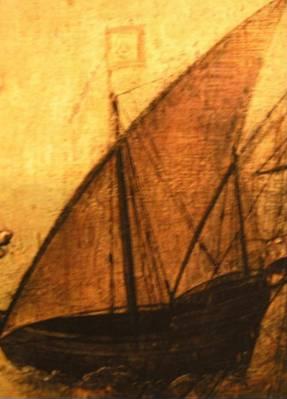
There were thus economic and cultural reasons that Europeans wanted to reach African and Asian commodities and wealth. They were able to access that wealth thanks to technological advances. Until about 1400, Europeans had no ships capable of sailing across an entire ocean (the Viking longboats of the Middle Ages were an exception, but they were no longer in use by the Renaissance era), and the European understanding of geography and navigation was extremely primitive. From about 1420 on, however, maritime technology improved dramatically and it became feasible to launch voyages that could cross the entire Atlantic Ocean with a reasonable degree of certainty that they would succeed. The key here was the invention of carracks and caravels, new kinds of ships that were able to sail both with the wind and against lateral winds; as long as the wind was not blowing in the opposite direction one wanted to travel in, it was possible to keep moving in the right direction. Reasonably effective compasses came into European hands from the Middle East around 1400 as well. Thus, by 1400 Europeans had both a number of reasons to want to explore and for the first time had the technological means to do so.

Despite those advances, the European grasp of geography remained very shaky. As of 1400, Europeans had terribly imprecise knowledge about the rest of the world. They did not, of course, know anything about the Americas. They tended to confuse “India,” “Cathay,” and “Japan” with Asia itself. They had a vague notion that all of Asia was ruled by khans, in part because of the popularity of the Venetian merchant Marco Polo’s famous account of his travels undertaken in the latter part of the thirteenth century. Polo was a Venetian merchant who had traveled to the court of the Mongol Khan Kublai and eventually returned to Europe, but his account merely reinforced just how far away, and difficult to reach, Asia was taking the usual eastern routes. Many sincerely believed that monsters occupied the interiors of Africa and Asia, and besides Polo, no Europeans had ever made the trek to the far east and returned to tell the tale.
World-Historical Comparison: China and Europe
The idea of the “age of discovery” described in this chapter is European in origin, but it is useful in describing major voyages of discovery launched by non-European empires at the time as well. The exemplary case is that of the great voyages of Zheng He, admiral of an enormous fleet of Chinese ships that sailed between 1405 – 1433, during China’s Ming Dynasty. The sheer size of the fleets commanded by Zheng He was staggering. Whereas Columbus would later sale with three small ships and 90 sailors, the first of the seven Chinese expeditions led by Zheng He boasted 300 ships and over 27,000 men, including diplomats, scholars, translators, and what amounted to an actual army of soldiers. The expeditions were launched on the order of the Yongle Emperor (r. 1402 – 1424), third emperor of the Ming Dynasty, who sought to more directly connect China to the outside world. His goals in sponsoring the expeditions were twofold: to establish stronger maritime trade connections and to ensure that foreign states acknowledged the political supremacy of China.
The Zheng He expeditions traveled from southeastern China, following the monsoon winds south and west, visiting kingdoms and trade cities along the way in the regions corresponding to present-day Vietnam, Indonesia, Malaysia, Thailand, India, and Sri Lanka. Later voyages visited the trade city of Hormuz on the Persian Gulf and sailed up the Red Sea, visiting the Islamic holy cities of Mecca and Medina. One voyage sailed directly to Mogadishu in east Africa, bringing back (among other things) a giraffe to the Ming court on its return voyage. The voyages benefited from the fact that most of the territories they visited were either entirely or partly populated by Muslims, and Arabic was one of the shared languages of the entire Indian Ocean region. Zheng He himself spoke Arabic, as did many of his navigators and sailors, and it was thus easy to communicate despite the enormous distances separating the regions they visited from China itself.
Along the way, the voyages succeeded in the major goals defined by the Yongle Emperor. First, they exchanged precious trade goods in huge volumes, deliberately seeking out cities tied to maritime trade (like Calcutta in South Asia) and establishing strong trade links for Chinese merchants going forward. Second, they took both diplomats and gifts back from many of the kingdoms they visited, which according to Chinese political theory implied that foreign kingdoms were making good on their obligation to acknowledge Chinese sovereignty. In one case, Zheng He was forced to seize the king of Sri Lanka, Alagakkonara, after the latter tried to plunder some of the expedition’s ships. Alagakkonara was taken back to China, where he begged for forgiveness and promised to send gifts and tribute in the future. That said, the expeditions were essentially peaceful in nature. They did not conquer the regions they encountered, their impressive military power was only used defensively, and almost all of the rulers of the kingdoms to which they traveled welcomed them.
One of the great world-historical conundrums is thus why the expeditions not only ended, but in their aftermath the entire state-sponsored Chinese presence on the Pacific and Indian Oceans vanished entirely. Many people, and not only historians, have noted that world history might have gone very differently if China had maintained direct political and economic ties to the countries visited by Zheng He’s expeditions. Instead, the last voyage sailed in 1431, never to be repeated. By the time the Portuguese arrived in the Indian Ocean in 1497, there were no Chinese ships and just a handful of independent Chinese merchants in the entire, vast trade zone.
The reasons for this apparent about-face are threefold. First, the expeditions were incredibly expensive. They required a staggering commitment of wealth and manpower, not to mention vast natural resources. The entire region of southeastern China from which the expeditions sailed was deforested to build the ships, and the cost to the imperial government was enormous. Second, many in the Ming court had long argued that the resources spent on the expeditions were better used defending China from the Mongol, Manchu, and Turkic threats to the north. The memory of the Yuan Dynasty founded by the Mongols was still fresh, and northern China continued to face serious military threats from the semi-nomadic peoples of the steppe. The Yongle Emperor, the great sponsor of the expeditions, died in 1424, and while the last expeditions would continue under his immediate successors (the Hongxi and Xuande emperors), the priority of the state shifted to containing the nomadic threats to the north.
The third, and perhaps most straightforward reason for the end of the expeditions is simply that they had succeeded in their goals. In contrast to the rapacity of the European voyages of discovery, which were expressly focused on seizing riches and territory, the Zheng He expeditions made good on their goals of forging economic links and “reminding” foreign rulers of their secondary position in relation to China. China would remain the powerhouse of East Asia, surrounded by smaller kingdoms that did acknowledge Chinese predominance, but no one in a position of significant political power for the rest of the Ming Dynasty, or the Qing Dynasty that followed it, sought to extend the Yongle Emperor’s efforts to turn China into a maritime power.
Spain, Columbus, the Great Dying, and the Columbian Exchange
The most important voyages of discovery of the early modern period were undertaken by agents of the Spanish monarchy, starting with that of Christopher Columbus in 1492. They were inspired by religious fervor as much as a practical desire for riches – fresh off the successful Reconquest, Queen Isabella agreed with Columbus’s vision of flanking the Muslim forces of the Middle East and recapturing the Holy Land as much as she also wanted new trade routes to Asia. The voyage was thought to be feasible both because all educated people already accepted that the world was round (common knowledge since the days of ancient Greece) and because the circumference of the globe was not really clear to them: it simply was not known how long one would have to sail west to reach the far east.
Columbus himself had totally inaccurate beliefs about the distance between Europe and Asia – he based his geography on an ancient (and completely inaccurate) account by the Greek philosopher Ptolemy and he thought that Asia was not far west of Europe. Despite being disliked and distrusted by most of the rulers he had approached in the past, Columbus succeeded in winning Isabella over to his vision, and she supplied him with a tiny fleet (she even sent him with letters of introduction to the Great Khan, who she presumed still ruled in Asia). Columbus departed in August of 1492 with three small boats (only one caravel) – the Niña, Pinta, and Santa Maria – and 90 men. They arrived in the Bahamas in October.

The four voyages of Columbus between 1492 and 1504. ‘Juana’ is present-day Cuba, and ‘Hispaniola’ is present-day Haiti and the Dominican Republic https://upload.wikimedia.org/wikiped..._colon_en2.svg

On October 28th, 1492 Columbus and his ships arrived in Cuba, which he renamed Juana. Within a few days Columbus had convinced himself that Cuba was a part of the Asian mainland and sailed northwest along the Cuban coast in search of a river that would lead him to the kings’ court. In planning his approach to the king, Columbus followed precedent from the Portuguese in Africa. He would send emissaries with presents for the king and a copy of a letter from the Spanish monarchs. To lead the expedition he selected a sailor who had participated in the same sort of mission in Africa. By Nov. 1, Columbus believed that he was only about 100 leagues from Zayto and Quinsai, cities figuring prominently on European maps of Asia. On the 2nd of November, he made up his embassy, consisting of Rodrigo de Jerez (the man with the African experience), linguist Luis de Torres, and two Indians (one from the Bahamas and the other from Cuba). The embassy carried strings of beads to exchange for food during the 6 days allotted for the journey. They also carried samples of spices to compare with what they might find, and Columbus instructed them carefully on what to say to the king once they arrived.
Throughout the entire month of November Columbus explored the Cuban coastline, but by December 5th he reached its end and soon thereafter landed on the northwestern coast of Hispaniola. Here the group founded the first European settlement in the Americas. But not on purpose. On Christmas Day, the Santa Maria, their principal ship, ran aground destroying the vessel. The loss of the ship forced Columbus to leave a group of men behind since there was not room on the two remaining vessels for all the Europeans to return. Near present day Port Paix on the northern coast of Haiti, the Spaniards built a small fort named La Navidad. Housing thirty-nine men, the outpost was completely dependent upon the good will and help of its indigenous neighbors until Columbus’s return.
Nearly a year later Columbus, along with another 1200 men, returned to the Caribbean, and after exploring some of the Eastern islands, headed for La Navidad. Unfortunately, all that was left of the colony were a few decomposing bodies, though the fact that they once had beards could still be discerned (meaning they were European corpses), and smoldering ashes. Within only one year the hope of a peaceful conquest of the Americas was dashed. In response, Columbus abandoned the ruins of Navidad and sailed eastward along the northern coast of the island. It was not until nearly a month later that the group decided upon a site, dropping anchor and performing the first mass on January 2nd of 1494. They named the new colony in honor of the Queen, La Isabela. While the Spanish celebrated the new colony, it was not until 1503 that the entire island of Hispaniola was fully under the control of Spanish colonists.


Columbus ended up spearheading everything the Spanish empire was to represent in the Americas: brutality against the native “Indians” ( stemming Columbus’s term, indios, which he used assuming he had indeed arrived in “the Indies” of Asia), attempts to convert by force, intense greed for precious metals, and the introduction of pathogens against which the Native people had no resistance. With Columbus, the traffic in goods and commodities between the two hemispheres began. While Europeans at the time were obsessed with the vast mineral wealth found in the Americas, it is clear in historical hindsight that far more important than precious metals were the living things exchanged between the western and eastern hemispheres of the globe starting in 1492. Historians now refer to that enormous distribution of plant and animal species, as well as bacteria and viruses, as the Columbian Exchange.
From the New World, Europeans brought back corn, potatoes, tobacco, chocolate, and tomatoes, just to name the most important of the crops that soon flourished across Africa and Eurasia. From the Old World, Europeans imported all of the large domesticated animals – horses, cows, sheep, goats, pigs,- as well as numerous crops like rice, wheat, sugarcane, and coffee. Potatoes alone would go on to reshape the demography of all of northern Europe and various other regions in the world because they provide a great deal of nutrition and calories and can grow in poor, rocky soils. The poor of many European regions (Ireland, most famously) became largely dependent on potatoes for nourishment by the nineteenth century.
That noted, the single most significant biological entity to be exchanged between the hemispheres was the smallpox virus, which was at the heart of the worst epidemic in world history. Isolated from the western hemisphere for thousands of years, Indigenous Americans had no resistance to Eurasian diseases. Because almost all diseases that affect humans are mutated strains of diseases affecting domestic animals, referred to as zoonotic diseases, and all of the large animal species that can be domesticated were Eurasian in origin except llamas, Eurasians and Africans had spent thousands of years both suffering from and building up resistance to epidemics while Native Americans had not. Those epidemic pathogens arrived all at once with the European invasion of the New World that began with Columbus.
Historians refer to the demographic catastrophe that accompanied the European encounter with the Americas as the Great Dying. As much as 90% of the Indigenous people of the Americas died within a few generations of Columbus’s arrival. While the Spanish and Portuguese did win some noteworthy military engagements, due largely to their use of horses, gunpowder, and steel, their true military advantage lay in germ warfare, something they certainly did not anticipate unleashing on their arrival. Spanish explorers in the early sixteenth century encountered whole regions with abundant evidence of sophisticated cultures that were already abandoned, their former inhabitants wiped out by disease. Put simply, the conquest of the Americas by Europeans was made possible not because Europeans were significantly more militarily powerful than were Native Americans, but because so many of the latter were already dead thanks to disease.
The Columbian Exchange, and the Great Dying that was part of it, began with Columbus’s initial voyage. Almost immediately after Columbus’s return to Spain after his expedition, Ferdinand and Isabela of Spain grasped the significance of his discovery and actively funded more expeditions and, soon, colonists. The Spanish crown also quickly tried to cement its hold on the New World, petitioning the pope to grant them everything across the Atlantic. After papal intervention and negotiations between the Spanish and Portuguese, the Spanish were to receive everything west of an arbitrary line on the map 1,100 miles west of the Cape Verde Islands, with everything to the east granted to the Portuguese. Practically speaking, this meant that the Portuguese concentrated their colonization efforts on Brazil, Africa, and India, while the Spanish concentrated on the Caribbean, Central America, and South America. Needless to say, the other European powers were not about to honor this agreement, called the Treaty of Tordesillas and signed in 1494, but it gave the Spanish and Portuguese a considerable head start.

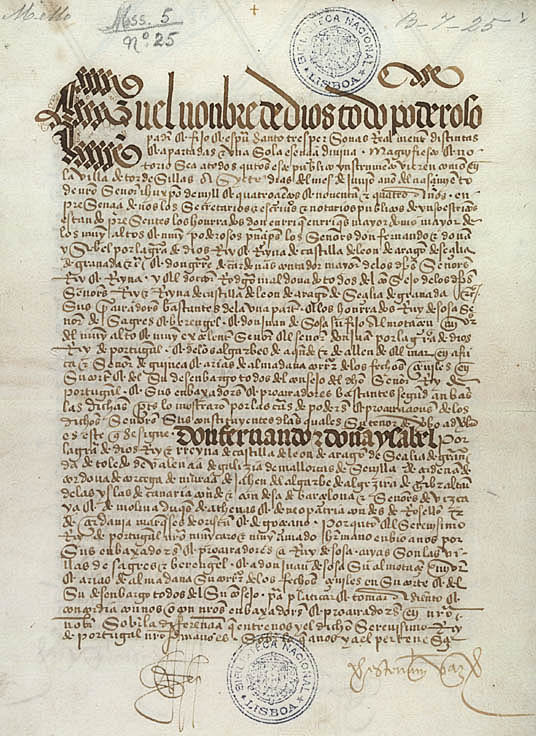


By the 1520s, Europeans recognized that Columbus had been completely wrong about the New World being part of Asia. The term “America” was invented by another Italian, Amerigo Vespucci, another early explorer (he led two expeditions between 1497 and 1503) and was the first to grasp the immensity of the western hemisphere. Vespucci coined the phrase “New World” in the first place, hence “America” rather than “Columbia” – Vespucci’s accounts were printed first. He was also a relentless self-promoter, whereas Columbus did not attempt to publicize his discoveries with the same focus.
Even though Europeans quickly realized that the Americas were whole new continents, they persisted in their quest to find a western route to Asia. The Spanish dispatched explorers and sailors who sought Asia by going around the Americas. This led to the voyage of Ferdinand Magellan (1480 – 1521), who commanded a small fleet of five ships funded by the Spanish crown and who tried to find a western route to Asia in 1519. He succeeded in rounding South America and crossing the Pacific, but was then killed by inhabitants of the Philippines in 1521. There, his Basque navigator Juan Sebastián Elcano took over and managed to guide one ship all the way back to Spain, arriving in 1522 (Magellan is much better remembered than Elcano, but it was Elcano who actually made it back). The voyage proved definitively that it was possible to sail around the world. The Spanish would subsequently use the Philippines as the basis of their Pacific trade network, ultimately linking together Europe, the Americas, and Asia and fulfilling the original vision of a western route to Asia that had inspired Columbus’s expedition in the first place.
Indigenous American Empires and The Conquistadors
There were two significant empires in the Americas at the time of the Spanish invasion, along with hundreds of smaller states and free associations. In both cases, the empires in question – the Aztecs of central Mexico and the Inca of the western Andes in South America – were relatively young states that faced considerable internal and external pressures. In other words, the Spanish did not set out to conquer ancient empires stretching back to some prehistoric past; they faced states that, like Spain itself, were only recently united and which experienced considerable turmoil.
The Aztec Empire originated as a settlement of a nomadic people known as the Mexica (“Aztec” is used in later histories of their culture, but their actual name was Mexica). According to their own origin stories, the Aztecs had arrived from the north, following a prophecy that their new home would be found where they discovered an eagle eating a snake while perched on a cactus. In approximately 1325 CE, the Aztecs arrived at a lake surrounded by brackish marshlands in central Mexico and they found just such an eagle. The area was already the site of thousands of years of Mesoamerican civilization, with several major cultures having already risen and fallen over the course of more than a thousand years of pre-Aztec history, and initially the Aztecs were forced to create their settlement on islands in Lake Texcoco, rather than the more desirable areas that surrounded it. This settlement, Tenochtitlan, rapidly expanded and eventually came to dominate the surrounding region.
The success of the Aztecs in expanding their power was based initially on their creation of farms built on partly-submerged artificial islands of rich compost known as chinampas. The Aztec population expanded rapidly, and in 1428 they entered into a “triple alliance” with the neighboring cities of Texcoco and Tlacopan, building a causeway between Tenochtitlan and Texcoco and constructing monumental architecture in the cities themselves. While the members of the triple alliance were allies, the Aztecs dominated, and over the course of the next eighty years they launched a series of wars against other states in the neighboring regions. These wars were focused not on actual conquest, but on two things guaranteed to cause enormous hatred directed at the Aztecs: ongoing demands of tribute and, as importantly, the capture of enemy warriors to be sacrificed to the gods back in Tenochtitlan. These wars are remembered historically as “sacred” or “divine” wars because of this religious motivation, which was truly central to the Aztec practice of warfare itself. When the Spanish arrived, they found it relatively easy to form their own alliances with the enemies of the Aztecs, who were eager to strike back against the dominant state that had extracted so much wealth, and taken so many young men, from them over the preceding decades.
Meanwhile, in the western Andes of South America, another empire had only recently arisen. The region had long been dominated by family networks known as ayllus, each of which was part of a system of labor obligations, marriage alliances, and economic exchange, all bound together by a shared culture and religious rituals. The royal ayllu was led by the Inca, meaning “emperor,” who claimed to be descended from the sun god Inti. In 1471, mere decades before the arrival of the Spanish, the Inca Pachacuti conquered the core region of the western Andes in what later became Ecuador, Peru, and northern Chile. His son and grandson, Topa Inca and Huayna Capac, expanded the empire considerably, until it encompassed the entirety of the western Andes and extended across the mountains in many regions to the jungles and plains to the east. The next generation of Inca rule, however, saw a civil war which created rival factions still in conflict at precisely the time the Spanish arrived (described below).

The Conquistadors and the Creation of the Spanish Empire
The Conquistadors were the military explorers sent by the Spanish crown to the Americas to claim land, convert “heathens,” and enrich both themselves and the crown. They were usually poor noblemen with few prospects back in Spain; in the first generation of explorers many were essentially unemployed knights. Some conquistadors simply launched expeditions to the New World without royal authorization, hoping to seize enough plunder to receive retroactive royal approval. Officially, all conquistadors were obliged to turn over the “royal fifth” – 20% of all precious metals discovered or mined – of all loot to the crown.
The most significant conquistador was Hernán Cortés (1485 – 1547). A poor knight with few prospects in Spain, he jumped at the chance to travel to the New World. Cortés proved brilliant at allying with Indigenous peoples he encountered in Mexico, where he arrived in 1519 with 450 Spanish troops and 15 horses. Working through a translator, Malinche, who had already learned Spanish, Cortés was able to convince groups resentful of the Aztecs to fight alongside the Spanish. Practically speaking, this meant that the Spanish were almost completely dependent on their allies militarily, particularly the Tlaxcaltec Confederation, an independent rival of the Aztec state. After securing the alliance with the Tlaxcaltecs, the Spanish made their way to the Aztec capital of Tenochtitlan, where they were initially welcomed by the emperor Montezuma II. Once the Aztecs realized the extent of the rapacious designs of the Spanish they chased them from the city, but then an epidemic of smallpox undermined their ability to fight.

Ultimately, the Tlaxcaltecs took advantage of the situation to launch a full-scale invasion, nominally “led” by the Spanish but in fact representing a settling of scores between the Aztecs and Tlaxcaltecs. It is important to emphasize the vast disparity in numbers involved: the Tlaxcaltec forces numbered approximately 200,000 soldiers, with Cortés leading a mere 900 Spanish soldiers and 80 cavalry (after he received reinforcements). That noted, there is no question that Cortés was excellent at forming new alliances by supporting the existing ambitions of Central American kingdoms. Along with the Tlaxcaltecs, the Spanish allied with the Tarascan kingdom of northern Mexico to help complete the conquest of the Aztecs, with Tarascan elites going on to marry Spanish noblewomen, formally recognized as Spanish nobility themselves. Thanks to the devastation of the smallpox epidemic and the military power of the Tlaxcaltecs and Tarascans, the remaining Aztec forces surrendered in 1522. Cortés then declared a new Spanish colony of New Spain in the center of Mexico.

The other noteworthy conquistador of the first generation following Columbus was Francisco Pizarro (1478 – 1541). Inspired by Cortés’ success in Mexico, Pizarro set off (with 180 Spanish troops and 30 horses) for an empire the Spanish had learned of in the Andes of western South America in 1531. Fortunately for the Spanish, the Inca Empire was in the immediate aftermath of a civil war and rival factions were eager for alliances that could increase their power. Shortly after arriving, Pizarro ambushed the Inca emperor Atahualpa and captured him, demanding a building full of gold for his release. Instead, once the ransom was paid, Pizarro had the emperor killed and then marched on the Inca capital of Cuzco.
Just as Cortés had farther north, Pizarro allied with Atahualpa’s former enemies within the empire, with the Spanish “tagging along” in what really amounted to a continuation of the Inca civil war. Inca allies of the Spanish not only retained their wealth and status but were confirmed as Spanish nobility, and the resulting power structure remained squarely rooted in pre-existing Inca political traditions (such as the mita, labor tithes owed by communities to the state). By 1533, Spain claimed sovereignty over the former Inca Empire, but the new Spanish colony would have seemed to an outside observer to have changed relatively little from its Inca foundations, at least for the first few generations of its existence. Likewise, it took until 1572 for the Spanish and their allied Inca factions to defeat the last anti-Spanish leader, Tupac Amaru.
Thus, less than fifty years after Columbus’s initial landing, the two greatest empires of Central and South America had already fallen to the Spanish. By 1600, practically every part of Central and South America was nominally under Spanish (or, in the case of Brazil, Portuguese), control. Spain and Portugal would go on to retain their respective American colonies until the early nineteenth century. While it is not possible to go into great detail here, however, it is important to emphasize that the conquest represented both the imposition of new hierarchies, very much including many grotesque examples of exploitation, and the integration and adaptation of Indigenous American social structures, cultures, and beliefs.
New World Wealth and Latin American Society
The Spanish discovered huge sources of wealth in South and Central America. The most important source of wealth in all of the Americas for the Spanish crown was discovered in 1545: the mountain of Potosi in present-day Bolivia. Potosi had the most enormous silver deposits in the world at the time, producing thousands of tons of silver for the crown. It also represented a horrific site of slave labor for the native people of the entire extended area. Building on the Inca labor system known as the mita (noted above), Spanish officials forced thousands of Indigenous inhabitants of the region to toil in atrocious conditions, often until they died from exhaustion. Whereas the Great Dying might be the most iconic aspect of the Columbian Exchange, Potosi is probably the greatest symbol of the humongous influx of mineral wealth that flooded into Spanish coffers for over a century, as well as the site of the greatest human misery caused by that lust for bullion.


The irony of the wealth generated by American mines is that it undermined the vitality of the Spanish state itself in the long run. Spain did not have to cultivate trade or pursue technological or bureaucratic innovation in the same manner as the rest of the European powers because it had such an enormous surplus of precious metals. Thus, even though Spain was the most powerful state in Europe in the sixteenth century, its longer-term trajectory was one of decline, in large part because of its commercial stagnation. In addition, so much bullion was shipped back to Europe that inflation undermined its value, another factor that weakened Spanish power over time.
That noted, Spain’s relative decline in relation to other European states did not occur for well over a century after the initial invasions. Back in Europe, funded by the incredible wealth of the New World, the still recently-united Spain became the greatest European power in the sixteenth century. In the New World, royal authority was enforced by two viceroys, royal officials who ruled over the northern and southern parts of the territory. Under them, rich nobles (often originally successful conquistadors) ran encomiendas, feudal estates with the legal right to exploit Indigenous labor. Those often evolved into even larger haciendas, the size of whole states back in Europe.
The Spanish crown and members of the clergy sought to not just derive economic benefits from their rule, however, but to win souls. Conversion to Christianity was always a major driving force behind Spanish conquest, but many Spanish missionaries felt considerable discomfort in discovering people who had quite obviously never been in contact with the Christian world. The Christian Bible did not explain their origins, so the Spanish invented various hypotheses: Indigenous Americans were descended from the Lost Tribes of Israel described in the Old Testament of the Bible, they were somehow created and ruled by the devil, they simply were not human beings but strange, human-like animals, and so on. The consensus by the 1530s was that, wherever they were from, Indigenous Americans were blank slates who had to be conquered for their own good. The pope recognized the humanity of the Indigenous Americans in 1537, but the church continued to support forcible conversion, and over time the vast majority of the inhabitants of Latin America accepted Catholicism. That said, just as Indigenous elites were part of the colonial power structure, pre-Christian religious and spiritual traditions were often incorporated into Latin American Catholic ritual.
Because the majority of Spanish immigrants were men, even attempts to ban marriage between Spanish men and Native women did not prevent the growth of a large “mixed” class of mestizos, the children of Spanish – Indigenous unions who were usually recognized as the legitimate children of the former. By the seventeenth century the Spanish crown oversaw a hardening of racial lines, distinguishing between Spanish-born elites, Spanish creoles (those of unmixed Spanish ancestry born in the Americas), mestizos, and “indios.” Practically speaking, however, there was much more flexibility in Latin American societies than would be the case in North American states later in history, both because of the number of people of mixed racial backgrounds and because of the necessity of Spanish-Indigenous alliances (still very much the case all the way until the wars of Latin American independence in the nineteenth century). In short, there was still a racialized hierarchy in New World society, but more ethnic mixing occurred in Central and South America than in North America.
Overall understandings of the Spanish and Portuguese invasions of the Americas have been revised considerably by historians in recent decades. They did not represent overwhelming, triumphant conquests, despite the self-serving propaganda written by conquistadors like Cortés at the time. The Spanish and Portuguese successfully imposed their own authority, but Central and South American societies were as much about alliance and integration as top-down authority and hierarchy. Starting with the Tlaxcaltecs and Tarascans who played such a pivotal role in the defeat of the Aztecs, the Spanish were obliged to work with Indigenous power structures everywhere they went. Indigenous leaders, usually referred to as caciques by the Spanish (“lord” or “chief” in the Arawak language, which eventually became the universal term for Indigenous leadership within the Spanish Empire), were acknowledged as Spanish nobles, operating with considerable power and autonomy within the empire. Spanish became one of the prevailing languages of the entire continent-spanning territory, but so too were countless pre-Spanish languages that thrive into the present (e.g. Quechua in Peru, Mayan and Nahuatl in Mexico, etc.). The culture and identity of Indigenous Americans in the Spanish-ruled lands also thrived despite the violence of the conquests.
None of this is to diminish that violence. Spanish soldiers were often horribly cruel in seizing lands and extending Spanish rule. Especially before legal reforms in the 1540s, Spanish authorities routinely enslaved whole Indigenous communities. Resistance was met with lethal violence, including the use of mastiffs trained to tear people apart on command and numerous outright massacres. Likewise, the effects of the Great Dying were felt for decades, with periodic epidemics that effected Indigenous communities with greater severity than they did Spanish settlements. The point of this section is instead to emphasize that alliance and cultural blending were also powerful and long-lasting elements of the Spanish Empire in the Americas, and Indigenous cultures were not simply the passive victims of Spanish conquest.
That noted, in one highly significant way the European invasions did represent a brutal and novel form of hierarchy, through the creation of one of the largest-scale and most significant slave systems in world history. The use of slave labor only grew over time, although by the middle of the sixteenth century Europeans were increasingly turning to African slaves, spawning one of the most horrendous injustices in history: the Transatlantic Slave Trade. European states in the Americas were thus built on the backs and with the blood of both the Indigenous inhabitants and, increasingly over time, enslaved Africans.
The impact of the conquests on Europe took longer to become entirely evident, but in the long run the conquest of the Americas sparked the beginning of the process by which Europe became one of the dominant global regions. Europeans now had access to not only enormous quantities of precious metals, but vast new natural resources (from huge stocks of fish to millions of acres of fertile land) that were to bolster European power for centuries to come. It is no coincidence that the year 1492 is often used as the starting point of what historians refer to as the early modern period: when both global hemispheres came into sustained contact for the first time, it was the starting point of massive change for the human species as a whole.
This page titled Chapter 15: Rebirth and Discovery in Early Modern Europe was last modified on Sun, 04 Oct 2026 05:56:51 GMT and is shared under a CC BY-NC-SA 4.0 license and was authored, remixed, and/or curated by Erin Stone via source content that was edited to the style and standards of the LibreTexts platform.
The book could not be loaded just now.