Opening the book…
When the Spartans and Athenians led the Greek poleis to victory against the Persians in the Persian War, it was a shock to the entire region of the Mediterranean and Middle East. Persia was the regional “superpower” at the time, while the Greeks were just a group of disunited city-states on a rocky peninsula to the northwest. After their success, the Greeks were filled with confidence about the superiority of their own form of civilization and their taste for inquiry and innovation. Greeks in this period, the “Classical Age,” produced many of their most memorable cultural and intellectual achievements.
The great contrast in the Classical Age was between the power and splendor of the Greek poleis, especially Athens and Sparta, and the wars and conflicts that broke out as they tried to expand their power and control. After the defeat of the Persians, the Athenians created the Delian League, in theory a defensive coalition that existed to defend against Persia and to liberate the Ionian colonies still under Persian control, but in reality a political tool eventually used by Athens to create its own empire. Eventually this very league, meant to keep Greece strong, tore it apart in the Peloponnesian War. And when Greek power in the Mediterranean collapsed, it left a void. This void was filled by a relatively unlikely successor, the Macedonians. And while they did conquer the Greek city-states, the Macedonians also cemented and spread Greek culture and legacy more than anyone could have predicted.
The ancient Greek word for Greece is Hellas. The period after the Classical Age is referred to as the Hellenistic Age because it saw Greek civilization spread across the entire Middle East, thanks to the tactical genius and driving ambition of one man, Alexander the Great. Hellenistic history at its simplest is easy to summarize: a Macedonian king named Alexander conquered all of the lands of the Persian Empire during twelve years of almost non-stop campaigning. Shortly afterward, he died without naming an heir. His top generals fell to bickering and ultimately carved up Alexander’s empire between themselves, founding several new dynasties in the process. Those dynasties would war and trade with each other for about three hundred years before being conquered by the Romans (the rise of Rome happened against the backdrop of the Hellenistic kingdoms). Thanks to the legacy of Alexander’s conquests, Greek culture went from relative insignificance to become a major influence on the entire region.
Pericles and Athenian Radical Democracy
As the power of Athens and the Delian League grew, so did the democratization of Athens. Athens’s growing fleet of oarsmen began to realize that they were the cornerstone of Athenian power and prosperity. So they, as had the Hoplites centuries before them, began to demand more rights and influence. They wanted laws that would finally make Cleisthenes’ promises and rhetoric of equality before the law true. Already they had the power to vote in the assembly (as long as one parent was an Athenian citizen), but now they wanted a part in the court system as well. They wanted to stop the unfair verdicts that only favored the elite, in both criminal and civil cases.
A member of one of Athens’s wealthiest and most distinguished families interestingly supported the popular movement, Pericles. After years of study, Pericles entered politics, attacking the conservative leader Cimon. In 461 Pericles led the campaign to ostracize Cimon, accusing him of secretly aiding Sparta, which was successful. After Cimon’s ostracism Pericles became Athens’s most dominant politician, and adopted a populist position, leading the reforms that would make Athens a truly radical democracy. He began by issuing a decree that permitted the poor to watch theatrical plays without paying, with the state covering the cost of their admission. With other decrees he lowered the property requirement to hold political office in 458–457 BCE and bestowed generous wages on all citizens who served as jurymen in the Heliaia (the supreme court of Athens) some time just after 454 BCE. Pericles believed that it was necessary to raise the status of the demos, in which he saw an untapped source of Athenian power and the key to Athenian military dominance, including the fleet of oarsmen, nearly all members of the lower classes.
So what was the “radical democracy” that Pericles was creating? First, participation in government by as many ordinary male citizens as possible in direct (not representative democracy). Second, selective leadership by elite, educated citizens. Fulfilling the requirements for a radical democracy Athenian people governed with the following policies enacted by Pericles and his allies: random selection by lottery for most public offices, term limits for the offices, shared power, salaries for most or all officials and members of the Council of 500 (which prepared the Assembly’s agenda and generally supervised most public matters), and open investigation and punishment of corruption. As far as the justice system there was equal protection under the law for citizens regardless of wealth and random selection of jurors who would vote in secret and receive a salary for their service. Top officials had to be elected instead of chosen by lottery, and they had to be reelected every year. Those in higher offices were not permitted to receive a salary to prevent those seeking wealth to pursue election. Pericles himself won election 15 years in a row.
Not all agreed with the tenants of radical democracy, especially the most socially elite of citizens who claimed that it could only promote the interests of the “wicked” (ie. The poor) over those of the “useful” (ie. The rich). They insisted that oligarchy, the role of the few wealthy and educated, was much preferable and more just than the rule of the many, most of whom lacked education (and in the opinion of the elite moral values as well). Pericles combated the opposition through speeches, he was described as charismatic and a spell-binding speaker, a master of rhetoric. And he did have the masses or the demos on his side. Pericles’s citizenship reforms remade politics and increased who could participate in government.
Pericles also sought to alleviate the lower classes’ economic hardships through militarism, another factor that ultimately led to war with Sparta. Pericles convinced the assembly to launch naval campaigns, helping to employ the poor Athenians as rowers, against Sparta when war broke out in the 450s over Athenian meddling in Peloponnesian states. He also supported sending fleets against Persian forces in Cyprus, Egypt, and the eastern Mediterranean, perhaps even seeking to expand the Delian League further. The assembly authorized up to 3 major expeditions at a time, all to promote and expand Athenian power in Persia and other Greek states. This militarism was stopped, briefly, after a horrible defeat of Greek forces at the hands of the Persians in Egypt in 446-445 when tens of thousands of Greek oarsmen were killed by Persian forces. At this point a peace treaty was signed between Pericles and the Spartans, trying to maintain peace in the Mediterranean, but this would not last. By 431 BCE, Athens was again interfering with states belonging to the Peloponnesian League (more specifically Corinth), and Sparta gave Athens an ultimatum to stop interfering with their allies or it would be war. War ensued.
The Peloponnesian War
As previously discussed in the wake of the Persian war each year, members of the Delian League contributed money to build and support a large navy, meant to protect all of Greece from any further Persian interference. Athens, however, quickly became the dominant player in the Delian League. Athens was able to control the League due to its powerful navy; no other polis had a navy anywhere near as large or effective, so the other members of the League had to contribute funds and supplies while the Athenians fielded the ships. Thus, it was all too easy for Athens to simply use the League to drain the other poleis of wealth while building up its own power. The last remnants of Persian troops were driven from the Greek islands by 469 BCE, about ten years after the great Greek victories of the Persian War, but Athens refused to allow any of the League members to resign from the League after the victory.
Soon, Athens moved from simply extracting money to actually imposing political control in other poleis. Athens stationed troops in garrisons in other cities and forced the cities to adopt new laws, regulations, and taxes, all designed to keep the flow of money going to Athens. Some of the members of the League rose up in armed revolts, but the Athenians were able to crush the revolts with little difficulty. The final event that eliminated any pretense that the League was anything but an Athenian empire was the failure of a naval expedition sent in 460 BCE by Athens to help an Egyptian revolt against the Persians. The Greek expedition was crushed, and the Athenians responded by moving the treasury of the League, formerly kept on the Greek island of Delos (hence “Delian League”), to Athens itself, arguing that the treasury was too vulnerable if it remained on Delos. At this point, no other member of the League could do anything about it – the League existed as an Athenian-controlled empire, pumping money into Athenian coffers and allowing Athens to build some of its most famous and beautiful buildings. Thus, the great irony is that the most glorious age of Athenian democracy and philosophy was funded by the extraction of wealth from its fellow Greek cities. In the end, the Persians simply made peace with Athens in 448 BCE, giving up the claim to the Greek colonies entirely and in turn eliminating the very reason the League had come into being.
Meanwhile, Sparta (which had returned to isolationism after helping to defeat Persia) was the head of a different association, the Peloponnesian League, originally founded before the Persian War as a mutual protection league of the Greek cities of Corinth, Sparta, and Thebes. Like Athens, Sparta dominated its allies, although it did not take advantage of them in quite the same ways that Athens did. By the middle of the 5th century Sparta was resentful and, in a way, fearful of increasing Athenian power. Open war finally broke out between the two cities in 431 BCE after two of their respective allied poleis started a conflict and Athens tried to influence the political decisions of Spartan allies. The war lasted from 431 – 404 BCE, devastating Greece.


The Spartans were unquestionably superior in land warfare, while the Athenians had a seemingly unstoppable navy. The Spartans and their allies repeatedly invaded Athenian territory, but the Athenians were smart enough to have built strong fortifications that held the Spartans off. The Athenians, in turn, attacked Spartan settlements and positions overseas and used their navy to bring in supplies. While Sparta could not take Athens itself, Athens was essentially under siege for decades; life went on, but it was usually impossible for the Athenians to travel over land in Greece outside of their home region of Attica. Nor was this unexpected for Athenians. Part of Pericles’s strategy was to endure a long conflict, never fighting a pitched battle against the militarily superior Spartans, but instead to use Athenian superior resources to wait the Spartans out behind their city walls while sacrificing the countryside. Perhaps this strategy would have eventually worked, but fate intervened. In 430 BCE a plague ravaged Athens just as their population was stuck in tight quarters within the city walls, which only facilitated the spread of the virus, killing thousands, including Pericles himself. With Pericles deceased, Athens went on the offensive, and secured a brief peace with Sparta in 421 BCE.
However, truces came and went, with the war continuing for almost thirty years. In 415 BCE Athens suffered a disaster when a young general convinced the Athenians to send thousands of troops against the city of Syracuse (a Spartan ally) in southern Sicily, hundreds of miles from Greece itself, in hopes of looting it. The invasion turned into a nightmare for the Athenians, with every ship captured or sunk and almost every soldier killed or captured and sold into slavery; this dramatically weakened the Athenian military.
At that point, the Athenians were on the defensive. The Spartans established a permanent garrison within sight of Athens itself. Close to 20,000 slaves escaped from the Athenian silver mines that had originally paid for the navy before the Persian War and were welcomed by the Spartans as recruits (thus bolstering Spartan forces and cutting off Athens’ main source of revenue). Sparta finally struck a decisive blow in 405 BCE by surprising the Athenian fleet in Anatolia and destroying it. Athens had to sue for peace. Sparta destroyed the Athenian defenses it had used during the war, but did not destroy the city itself. After nine months of rule by Sparta’s “30 Tyrants” Athens was able to regain their independence and reestablish their democracy.
The reign of the “30 Tyrants” was part of the negotiated peace between the Spartans and the Athenians. The terms agreed upon called for Athens to destroy the long walls of Piraeus, allow exiles to return to the city, and reduce their navy to only twelve vessels, surrendering all remaining ones to Sparta. The Athenians were also ordered to recraft their government following a model dictated by the Spartans. It was the Thirty who were to redraw the Athenian government. With Spartan support, the Thirty established an interim government in Athens. They reestablished the Boule, a council composed of 500 members. They appointed other officials to govern the port town of Piraeus and another group of 300 to act as a police force. The Thirty oversaw trials in the Boule against Athenian leaders who had opposed the peace with Sparta and sentenced them to death. They then tried and executed many who they deemed to be enemies of Sparta or supporters of democracy in Athens. The Thirty Tyrants presided over a reign of terror in which they executed, murdered, and exiled hundreds of Athenians, seizing their possessions afterward. Aristotle reported that the Thirty executed 1,500 people without trial, including the revered philosopher Socrates. Many wealthy citizens were executed simply so the oligarchs could confiscate their assets, which were then distributed among the Thirty and their supporters. Few actual legal reforms were attempted in the 9 month period before the Athenians were able to regain control of their city.
The Aftermath
Greece was transformed by the Peloponnesian War. Both sides had sought out allies outside of Greece, with the Spartans ultimately allying with the Persians – formerly their hated enemies – in the final stages of the war. The Greeks as a whole were less isolated and more cosmopolitan by the time the war ended, meaning that at least some of their prejudices about Greek superiority were muted. Likewise, the war had inadvertently undermined the hoplite-based social and political order of the prior centuries.
Nowhere was this more true than in Sparta. Sparta had been greatly altered by the war, out of necessity becoming both a naval power and a diplomatic “player” and losing much of its former isolationist identity; some Spartans had gotten rich and were buying their sons out of the formerly-obligatory life in the barracks, while others were too poor to train. Likewise, the war had weakened Sparta’s cultural xenophobia and obsession with austerity, since controlling diplomatic alliances was as important as sheer military strength. Diplomacy required skill, culture, and education, not just force of arms. Subsequently, the Greeks as a whole were shocked in 371 BCE when the polis of Thebes defeated the Spartans three times in open battle, symbolically marching to within sight of Sparta itself and destroying the myth of Spartan invincibility.
Across Greece, the Poleis all adopted the practice of state-financed standing armies for the first time, rather than volunteer citizen-soldiers. Likewise, the poleis came to rely on mercenaries, many of whom (ironically) went on to serve the Persians after the war wound down. Thus, between 405 BCE – 338 BCE, the old order of the hoplites and republics atrophied, replaced by oligarchic councils or tyrants in the poleis and stronger, tax-supported states. The period of the war itself was thus both the high point and the beginning of the end of “classical” Greece. Meanwhile, Persia re-captured and exerted control over the Anatolian Greek cities by 387 BCE as Greece itself was divided and weakened. Thus, even though the Persians had “lost” the Persian War, they were as strong as ever as an empire.
Despite the importance of the Peloponnesian War in transforming ancient Greece, however, it should be emphasized that not all of the poleis were involved in the war, and there were years of truce and skirmishing during which even the major antagonists were not actively campaigning. The reason that this part of Greek history is referred to as the Classical Age is that its lasting achievements had to do with culture and learning, not warfare. The Peloponnesian War ultimately resulted in checking Athens’ imperial ambitions and causing the Greeks to broaden their outlook toward non-Greeks; its effects were as much cultural as political. Ultimately, the Peloponnesian War opened Greek city-states to Macedonian invaders, ending the Golden Age.
Macedon and Philip II
The story starts in Macedon, a kingdom to the north of Greece. The Macedonians were warriors and traders. They lived in villages instead of poleis and, while they were recognized as Greeks because of their language and culture, they were also thought of as being a bit simple by the more “civilized” Greeks of the south. Macedon was a kingdom ruled by a single monarch, but that monarch had to constantly deal with both his conniving relatives and disloyal nobles, all of whom frequently conspired to get more power for themselves. Macedon was also bordered by nomadic peoples to the north, particularly the Thracians (from present-day Bulgaria), who repeatedly invaded and had to be repelled. The Macedonian army was comprised of free citizens who demanded payment after every campaign, payment that could only be secured by looting from defeated enemies. In short, Macedon bred some of the toughest and most wily fighters and political operators in Greece out of sheer necessity.
By the fifth century BCE, some of the larger villages of Macedon grew big enough to be considered cities, and elite Macedonians made efforts to civilize their country in the style of the southern Greeks. They competed in the Olympics and patronized the arts and literature. They tended to stay out of the political affairs of the other Greeks, however; they did not invade the Greek peninsula itself in their constant wars, nor did they take sides in conflicts like the Peloponnesian War. This did nothing to improve the situation in Macedon itself, of course, which remained split between the royal family and the nobility. In 399 BCE, Macedon slid into an ongoing civil war, with the nobles openly rejecting the authority of the king and the country falling into anarchy. The war lasted for forty years.
In 359 BCE, the Macedonian king, Philip II, re-unified the country. Philip was a classic Macedonian leader: shrewd, clever, skilled in battle, and quick to reward loyalty or punish sedition. He started a campaign across Macedonia and the surrounding areas to the north, defeating and usually killing his noble rivals as well as hostile tribes. When men joined with him, he rewarded them with looted wealth, and his army grew. Philip was a tactical innovator as well. He found a way to secure the loyalty of his nobles by organizing them into elite cavalry units who swore loyalty to him, and he proudly led his troops personally into battle.
He also reorganized the infantry into a new kind of phalanx that used longer spears, 16 feet long, than did traditional hoplites; these new spearmen would hold the enemy in place and then the cavalry would charge them, a tactic that proved effective against both “barbarian” tribes and traditional Greek phalanxes. Philip was the first Macedonian king to insist on the drilling and training of his infantry, and the combination of his updated phalanx and the cavalry proved unstoppable. Philip attacked neighboring Greek settlements and seized gold mines in the north of Greece, which both paid his soldiers and equipped them as well. He hired mercenaries to supplement his Macedonian troops, ending up with the largest army Macedon had ever seen.

The Greek poleis were understandably worried about these developments. Under the leadership of Athens, they organized into a defensive league to resist Macedonian aggression. For about ten years, the Macedonians bribed potential Greek allies, threatened those that opposed them, and launched attacks in northern Greece while the larger poleis to the south prepared for war. In 338 BCE, following a full-scale Macedonian invasion, the Macedonian army crushed the coalition armies. The key point of the battle was when Philip’s eighteen-year-old son Alexander led the noble cavalry unit in a charge that smashed the Greek forces.
In the aftermath of the invasion, Philip set up a new league of Greek cities under his control and stationed troops throughout Greece. As of 338 BCE, Greece was no longer the collection of independent city-states it had been for over a thousand years; it was now united under an invader from the north. The Greeks deeply resented this occupation. They only grudgingly accepted the Macedonians as fellow Greeks and had celebrated the independence of the Greek poleis as one of the defining characteristics of Greek civilization for centuries. Philip thus had his job cut out for him in managing his new conquest.
The more immediate problem facing Philip in the aftermath of the Greek conquest was that his men demanded more loot – the only way he could pay them was to find new places to invade and sack. Thus, Philip ruled Greece but he could not afford to sit idle with troops aching for more victories. Cleverly, having just defeated the Greek poleis, Philip began behaving like a Greek statesman and assuming a kind of symbolic leadership role for Greek culture itself, not just Greek politics. He began agitating for a Greek invasion of Persia under his leadership to “avenge” the Persian invasion of the prior century. All things considered, this was a far-fetched scheme; Persia was by far the “superpower” of its day, and since the end of the Persian War over a century earlier numerous Greeks had served Persian kings as mercenaries and merchants. Nevertheless, the idea of an invasion created an excuse for Macedonian and Greek imperialism and aggression under cultural pretext of revenge.


Unfortunately for Philip, he was murdered by one of his own bodyguards in 336 BCE, just two years after conquering Greece. Family politics might have been to blame here, as his estranged wife Olympias (mother of Alexander) may have ordered his murder, as well as the murder of his other wife and children. It is worth noting, however, that the theory of Olympias’ involvement in Philip’s murder, once accepted as fact, has recently faced sustained criticism. Regardless of who was ultimately responsible for the assassination, Alexander ascended to the throne at the age of twenty following his father’s demise, and he remained devoted to his mother for as long as she lived.
Alexander the Great & The Creation of the Hellenistic World
Alexander is one of the few historical figures who truly deserves the honorific “the Great.” He was a military genius and a courageous warrior, personally leading his armies in battle and fighting on despite being wounded on several occasions. He was a charismatic and inspirational leader who won the loyalty not only of his Macedonian countrymen, but the Greeks and, most remarkably, the people of the Persian Empire whom he conquered. He was also driven by incredible ambition; tutored by none other than Aristotle in his youth, he modeled himself on the legendary Greek hero Achilles, hoping to not only match but to surpass Achilles’ prowess in battle. He became a legend in his own life, worshiped as a god by many of his Macedonian subjects, with even his Greek subjects coming to venerate him as one of the greatest leaders of all time. He was truly a legend in his own time.
Alexander’s conquests began almost immediately after seizing the throne. He first ruthlessly killed off his rivals (including all of his male relatives who might be able to challenge his right to the throne) and enemies in Macedon and Greece, executing nobles he suspected of treason, and then leading an army back through Macedon, crushing the Thracian tribes of the north who threatened to defect. Some of the Greek poleis rose up, hoping to end Macedonian control almost as soon as it had begun, but Alexander returned to reconquer the rebellious Greek cities. In the case of the city of Thebes, for instance, Alexander let the Thebans know that, by rebelling, they had signed their own death warrant and he refused to accept their surrender, sacking the city and slaughtering thousands of its inhabitants as a warning to the rest of Greece.
By 334 BCE, two years after he became king, Alexander was thoroughly in control of Greece. He immediately embarked on his father’s mission to attack Persia, leading a relatively small army (of about 45,000 men) into Persian territory – note how much smaller this army was than the Persian one had been a century earlier, when Xerxes I had invaded with over 200,000 soldiers. He immediately engaged Persian forces and started winning battles, securing Anatolia and the rich Greek port cities in 333 BCE and Syria in 332 BCE. In almost every major battle, Alexander personally led the cavalry, a quality that inspired loyalty and confidence in his men.

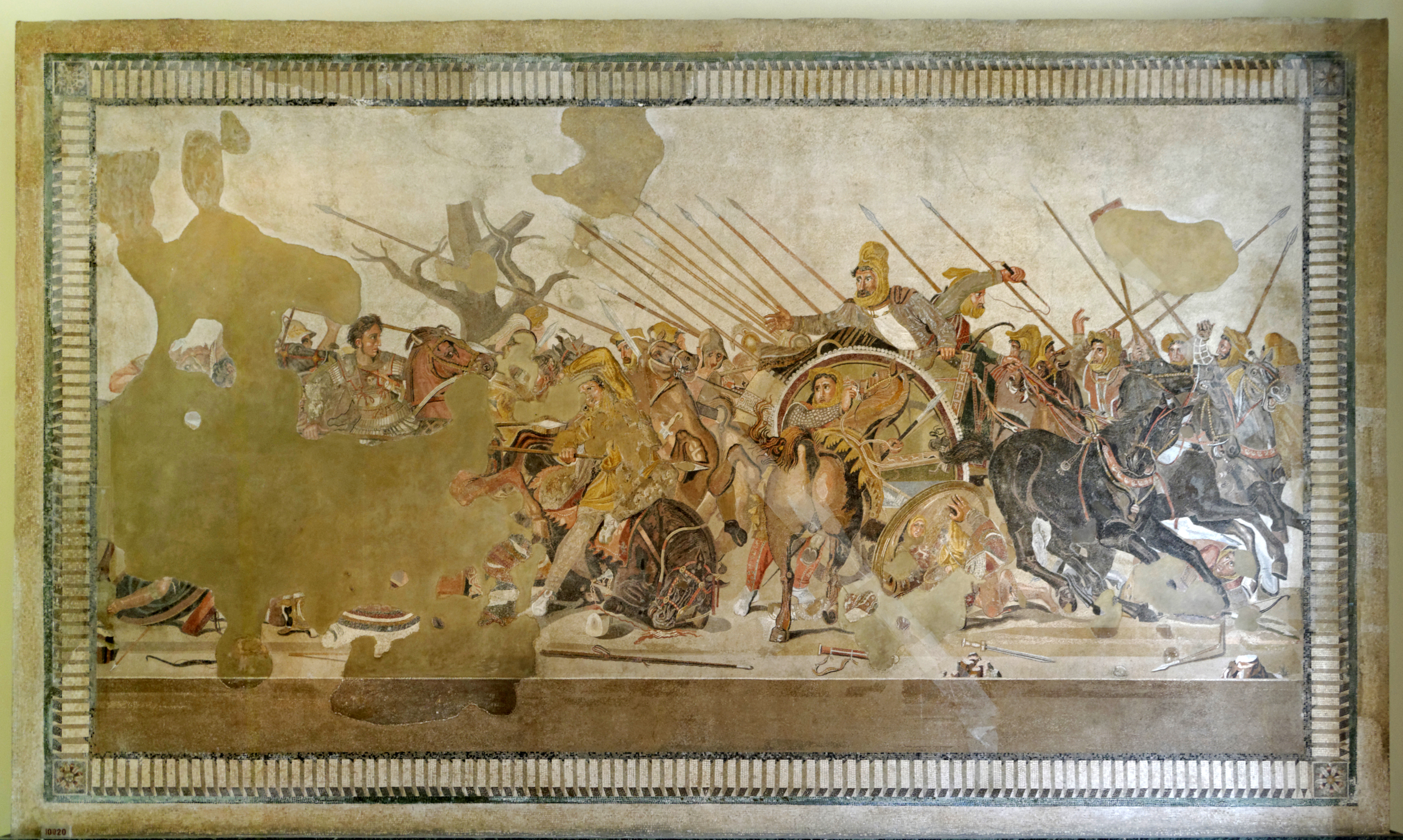
His success against the Persians can be explained in part by the fact that the Persian technique of calling up their armies was too slow. Even though Alexander had arrived in Anatolia with only 45,000 men, against a potential Persian army of close to 300,000, far fewer troops were actually available to the Persians at any one time during the first years of Alexander’s campaign. Instead, the first two years of the invasion consisted of highly skilled Macedonian and Greek forces/hoplites engaging with smaller Persian armies, some of which even included Greek mercenaries. Alexander’s forces succeeded in conquering Persian territory piecemeal, taking key fortresses and cities, seizing supplies, and fighting off Persian counter-attacks; even with its overall military superiority, the Persian Empire could not focus its full might against the Greeks until much of the western empire had already been lost. In addition, Alexander was happy to offer alliances and concessions to Persian subjects who surrendered, sometimes even gifting lands and positions to those who had fought against him and lost honorably. In sum, conquest by Alexander was not experienced as a disaster for most Persian subjects, merely a shift in rulership.
In 332 BCE, the Persian king, Darius III, tried to make peace with Alexander and (supposedly – there is reason to believe that this episode was invented by Greek propagandists afterwards) offered him his daughter in marriage, along with the entire western half of the Persian Empire. Alexander refused and marched into Egypt, where he was welcomed as a divine figure and liberator from Persia. Alexander made a point of visiting the key Egyptian temples and paying his respects to the Egyptian gods (he identified the chief Egyptian deity Amun-Ra with Zeus, father of the Greek gods), which certainly eased his acceptance by the Egyptians. In the meantime, Darius III succeeded in raising the entire strength of the Persian army, knowing that a final showdown was inevitable.
From Egypt, the Greek armies headed east, defeating the Persians at two more major battles, culminating in 330 BCE when they seized Persepolis, the Persian capital city. There, the Greek armies looted the entire palace complex before burning it to the ground; historians have concluded that Alexander ordered the burning to force the remaining Persians who were resistant to his conquest to acknowledge its finality. The wealth of Persepolis and the surrounding Persian cities paid for the entire Greek army for years to come and inspired a renaissance of building back in Greece and Macedon, paid for with Persian gold. For example, the Egyptian city of Tyre that Alexander levelled was rebuilt as a magnificent Hellenistic capital, Alexandria. Darius III fled to the east but was murdered by Persian nobles, who hoped to hold on to their own independence (this did not work – Alexander painstakingly hunted down the assassins over the next few years).
Alexander After the Conquest of Persia
Alexander paused his campaign to pay his men and allow some of his troops to return to Greece. He then arranged for thousands of his Greek and Macedonian officers to marry Persian noblewomen in an effort to formally and permanently fuse together the Greek and Persian civilizations. His goal was not to devastate the empire, but to become the next “Great King” to whom all other leaders had to defer. He maintained the Persian bureaucracy and enlisted thousands of Persian soldiers who joined his campaign as his armies moved even farther east. He also made a show of treating Darius’s family with respect and honor, demonstrating that he wanted to win the Persians over rather than humiliate them. Alexander declared that the ancient city of Babylon would be his new capital.
Even though he now ruled over the largest empire in the world, Alexander remained unsatisfied, and soon set off to conquer lands his new Persian subjects told him about beyond the borders of the empire. Alexander headed east with his armies, defeating the tribesmen of present-day Afghanistan and then fighting a huge battle against the forces of the Indian king Porus in the northern Indus River Valley in 327 BCE. He pressed on into India for several months, following the Indus south, but finally his loyal but exhausted troops refused to go on. Alexander had heard of Indian kingdoms even farther east (i.e. toward the Ganges River Valley, completely unknown to the Greeks before this point) and, being Alexander, he wanted to conquer them too. His men, however, were both weary and rich beyond their wildest dreams. Few of them could see the point of further conquests and wanted instead to return home and enjoy their hard-won loot. Some of his followers were now over 65 years old, having fought for both Philip II and then Alexander, and they concluded that it was high time to go home.
With soldiers’ complaints in his ear, and after marching for 70 days through monsoon rainfall, Alexander consulted an oracle that confirmed that disaster would strike if he crossed the next river, so after sulking in his tent for a week, he finally relented. To avoid the appearance of a retreat, however, he insisted that his armies fight their way down the Indus river valley and then across the southern part of the former Persian Empire on their way back to Mesopotamia. Unfortunately, Alexander made a major tactical error when he reached the Indian Ocean, splitting his forces into a fleet and a land force that would travel west separately. The fleet survived unscathed, but the army had to cross the brutally difficult Makran desert (in the southern part of present-day Pakistan and Iran), which cost Alexander’s forces more lives than had the entire Indian campaign.


The return journey was arduous, and it took years to get back to the heartland of Persia. During the return, Alexander began to experience great anxiety regarding his position and support. He feared many allies were really rivals and put multiple men through conspiracy trials, purges, and assassinations to ensure no one could touch his power. In one of the most spectacular, and clearly extra-legal episodes, he had a drunken quarrel with one of his senior commanders named Cleitus (also possibly one of his lovers) in which he accused him of rebellion and murdered him. He also began to make his subjects treat him like a semi-god. He had both Greeks and Macedonians bow down before him. He even began to believe that he was the son of Zeus. This precedent of deification continued from the Hellenistic Age into the Roman Empire.
In 323 BCE, his armies finally arrived in Babylon. Alexander was exhausted and plagued by injuries from the many battles he had fought, but Macedonian and Greek tradition required him to drink to excess with his generals. Part of the celebrations included a great banquet for 9,000 at which time he prayed for “concord and a partnership in rule between Greeks and Persians,” reinforcing his policy of fusion between the Greeks and the Persians begun years earlier. Such actions were a sharp divide from the traditional Greek belief in their superiority. Aristotle, for example, had referred to the peoples of western Asia as fit only to be slaves. Alexander’s policy of fusion/inclusion was revolutionary, but it probably had more to do with a desire for a new power base independent of the Macedonian nobility, who he did not trust. He already had begun training an army of 30,000 Iranians to replace all the Macedonian troops he dismissed.
But, Alexander’s reign soon came to an end. Shortly after returning to Babylon, he died suddenly after only a few days illness. Some combination of his injuries, alcohol, and exhaustion finally caught up with him. Supposedly, while he lay on his deathbed, his generals asked who would follow him as Great King and he replied “the strongest,” then died. The results were predictable: decades of fighting as each general tried to take over the huge empire Alexander had forged.
How did Alexander die? One of the largest mysteries of Alexander’s life was his death, or the cause of his death, which only adds to the mystique of this historical figure. One theory behind his demise is malaria or dengue as he had just marched through several tropical regions rife with mosquito born illnesses. Additionally, in the days prior to his death he suffered from a high fever. Another speculated cause was alcoholism/alcohol poisoning exacerbated by a mental disorder like depression or anxiety. Finally, many suspected poisoning, either as a power grab or due to displeasure among Alexander’s men resulting from his forced changes and upheaval in the military.


The true legacy of Hellenistic civilization was not Alexander’s wars, as remarkable as they were, but their aftermath. During his campaigns, Alexander founded numerous new cities that were to be colonies for his victorious Greek soldiers, all of which were named Alexandria except for ones that he named after his horse, Bucephalus, and his dog, Peritas. For almost 100 years, Greeks and Macedonians streamed to these colonies, which resulted in a tremendous spread and growth of Greek culture across the entire ancient world. They also came to settle in conquered Persian cities. Everywhere, Greeks became a new elite class, establishing Greek laws and Greek buildings and amenities. At the same time, the Greeks were always a small minority in the lands of the east, a fact that Alexander certainly recognized. To deal with the situation, not only did he encourage inter-marriage, but he simply took over the Persian system of governance, with its royal road, its regional governors, and its huge and elaborate bureaucracy.
The Legacy of Alexander the Great & the Hellenistic Kingdoms
Alexander died in June 323 BCE, just one month before his 33rd birthday. In failing to name an heir, Alexander almost guaranteed that his empire would collapse as his generals turned on each other. Indeed, within a year of his death the empire plunged into civil war, even with the birth of Alexander’s son, peace could not be secured. In fact, Alexander’s son paid the price himself, when he was assassinated by one of the competing generals. It took until 280 BCE for the fighting to cease and three major kingdoms to be established, founded by the generals Antigonus, Ptolemy, and Seleucus.
The kingdoms that emerged from the fighting were known as the Hellenistic Kingdoms. To begin, though, what does Hellenistic mean and why were these kingdoms labelled as such? Hellenistic means “Greek-like” and tries to illustrate/convey the unique cultures that emerged in the wake of Alexander’s conquests. These civilizations were a fusion (like Alexander’s policy) and mixture of Mediterranean cultures with those to their east. In these kingdoms one can see both the adoption of Greek cultural elements in parts of Asia as well as the spread of eastern ideas to the Mediterranean. For example, monarchy returned to Greece for the first time since the fall of the Mycenaeans. And of course, as ideas and practices moved, they evolved. Greek culture most influenced Egypt and southwestern Asia, the most successful and stable of the Hellenistic Kingdoms.


The Antigonids ruled over Macedon and Greece. Despite controlling the Macedonian heartland and Greece itself, the Antigonids were the weakest of the Hellenistic monarchies. Both areas were depopulated by the wars; many thousands of soldiers and their families emigrated to the new military colonies established by Alexander, weakening Greece and, of course, its tax base. Over time, the Antigonids had to fight to hold on to power in Greece alone and they ultimately saw many of the Greek poleis achieve independence from their rule.
The Ptolemies ruled over Egypt. The Ptolemies were very powerful and, perhaps more importantly, they had the benefit of ruling over a coherent, unified state that had ancient traditions of kingship. Once they cemented their control, the Ptolemies were able to simply act as pharaohs, despite remaining ethnically and linguistically Macedonian Greek. In their state, the top levels of rule and administration were Greek, but the bulk of the royal bureaucracy was Egyptian. There were long-term patterns of settlement and integration, but right up to the end, the dynasty remained fiercely proud of its Greek heritage, with Greek soldier colonies providing the backbone of the Ptolemaic military. Ptolemy had been a close friend and trusted general of Alexander, and he took Alexander’s body to Egypt and buried it in a magnificent tomb in Alexandria, thereby asserting a direct connection between his regime and Alexander himself. In the end, the Ptolemies were the longest-lasting of the Hellenistic dynasties.
The Seleucids ruled over Mesopotamia and Persia. Despite the vast wealth of the Seleucid kingdom, it was the most difficult one to govern effectively. There was a relative scarcity of Greeks vis-à-vis the native populations, and it was thus also the most diverse. It proved impossible in the long term for the Seleucid kings to hold on to the entire expanse of territories originally conquered by Alexander. Seleucus himself gave his Indian territory back to an Indian king, Chandragupta, in 310 BCE in return for some elephants. In 247 BCE a former Seleucid general based in the region of Parthia destroyed Seleucid control in the old Persian heartland, in the process founding a new Persian empire (remembered as the Parthian Empire for the region its rulers originally governed). Nevertheless, the Seleucid kingdom held on until its remnants were defeated in 63 BCE by Pompey the Great of Rome, one-time ally and subsequent enemy of Julius Caesar.
Each of the successor kingdoms was ruled by Greeks and Macedonians but the bureaucracies were staffed in large part by “natives” of the area. A complex relationship emerged between the cultures and languages of the kingdoms. Greek remained the language of state and the language of the elites, the Persian trade language of Aramaic was still used across most of the lands, and then a host of local tongues existed as the vernacular. The kings often did not speak a word of the local languages; as an example, Cleopatra VII (the famous Cleopatra and last ruler of Egypt before its conquest by Rome) was the first Ptolemaic monarch to speak Egyptian.
The Ptolemaic kingdom is particularly noteworthy: starting with Ptolemy himself, the existing Egyptian bureaucracy was expanded and its middle and upper ranks staffed entirely by Greeks (and Macedonians), who developed obsessively detailed records on every sheaf of wheat owed to the royal treasury. So much papyrus was used in keeping records that old copies had to be dumped unceremoniously in holes in the desert to make room for new ones – quite a lot of information about the Ptolemaic economy survived in these dumps to be discovered by archaeologists a few thousand years later. Likewise, the abundance of the Nile was carefully managed to produce the greatest yields in history, so large that even after numerous taxes were taken, Egyptian wheat was still the cheapest available everywhere from Spain to Mesopotamia (the same held true with papyrus, a royal monopoly used everywhere in the Hellenistic world). Under the Ptolemies, Egypt was in many ways at its most prosperous in history, outstripping even the incredible bounty of the Old, Middle, and New Kingdoms centuries earlier.
While not as politically stable, the Seleucid Kingdom left a lasting mark on the region by consolidating long-distance trade. The Silk Road that linked China, India, the Middle East, and Europe truly began during the Hellenistic period and the Seleucids did everything in their power to support trade in their territories. They supervised the construction of roads and canals useful to merchants and derived much of their revenue from silk textiles. Even though raw silk (from silkworms) was only available from China, subjects of the Seleucids in Mesopotamia did master the production of textiles from the raw material, creating an enormously valuable commodity to markets farther west. Thus, even though Seleucid political control was somewhat haphazard overall, it did at least play a role in encouraging the east/west trade that would only grow in the following centuries.
Hellenistic Culture
One of the remarkable aspects of the Hellenistic age was the extent to which the people of Greece and the Middle East started exploring beyond the confines of the ancient world as they had known it. The Ptolemies supported trading posts along the Red Sea and as far south as present-day Eritrea and Ethiopia, trading for ivory and gold from the African interior. Explorers tried, but did not quite succeed, to circumnavigate Africa itself. In addition to accounts by explorers, the Greeks of the Hellenistic lands enjoyed histories and accounts of foreign lands written by the natives of those lands. Major histories of Mesopotamia, Persia, and Egypt were written during the Hellenistic period and translated into Greek. Ambassadors from the Hellenistic kingdoms in foreign lands sometimes wrote accounts of the customs of those lands (such as India). In short, it was a period when knowledge of the world greatly expanded.
How to Be Greek
The core of the Hellenistic kingdoms were the new cities founded by Alexander or, later, by the Hellenistic monarchs. The largest was Alexandria in Egypt, but there were equivalently grandiose cities in the other kingdoms. The new cities were built on grid-pattern streets with various Greek amenities like public forums, theaters, and temples. Likewise, citizenship, which had been the basic unit of political currency in the ancient poleis, became instead a mark of elite membership that could be won in multiple cities at the same time.
Many Greeks and Macedonians emigrated from home during the 4th and 3rd centuries, we do not know how many, but the evidence we have suggests a significant number. This was a type of colonizing impulse. Greek and Macedonian migrants also sought dreams of prosperity and adventure by going abroad. They served in the highest levels of administration in both Ptolemaic and Seleucid realms. But locals also served in these governments, providing good will and information to the new Greek rulers regarding the peoples they had conquered. Colonists also served as the core of the militaries, though by the 2nd century natives were also serving, receiving land, tax breaks, and the right to call themselves Hellenes or Greeks.
Here we see how Greek migrants, and those who they colonized, took advantage of a new definition of being Greek that began to emerge during Alexander’s conquests. Disappointed by the narrow and self-destructive localism of the Greek city-states, and truly how this localism had ripped them apart at the end of the 5th century via the Peloponnesian War, some thinkers began to seek a wider horizon and definition of Greek identity. They promoted the idea that Greece was not a collection of city-states in a specific geographic location, but a civilization. One philosopher wrote “The people we call Hellenes are those who have the same culture as us, not the same blood.” This new definition and ideal of Greek culture made it easier for colonists who left Greece to maintain a Greek identity. For that matter it was now possible for foreigners to become Greek by learning the Greek language, literature, philosophy, and general culture. The number of Hellenized foreigners was relatively small, yet there very existence marked a break from the Classical polis, where even a resident genius such as Aristotle could not obtain Athenian citizenship because he was not of Athenian descent.
The Greek language, in particular, served as a common denominator and unifier (along with Aramaic) becoming the language of trade and politics in the eastern Mediterranean. By the 2nd century, most people with even a little bit of education could speak Greek. In fact it is directly due to the conquest of Egypt by Alexander that we can understand/translate Egyptian hieroglyphics. Before the discovery of the Rosetta Stone, a granodiorite stele inscribed with a decree on behalf of King Ptolemy V, no one could decipher hieroglyphics. The decree appears in three scripts: the upper text is Ancient Egyptian hieroglyphs, the middle portion Demotic script, and the lowest Ancient Greek. Because it presents essentially the same text in all three scripts, it provided the key to the modern understanding of Egyptian hieroglyphs.
One of the most important artifacts of the Ptolemaic era is the Rosetta Stone, the object that enabled the translation of Egyptian hieroglyphics. Written during Ptolemaic rule, the stone consists of a single royal proclamation from 196 BCE in two hieroglyphic alphabets as well as ancient Greek.
Although it is believed to have originally been displayed within a temple, possibly at nearby Sais, the stone was probably moved during the early Christian or medieval period and was eventually used as building material in the construction of Fort Julien near the town of Rashid (Rosetta) in the Nile Delta. It was rediscovered there in 1799 by a soldier, Pierre-François Bouchard, of the Napoleonic expedition to Egypt. When the British defeated the French, they took the stone to London where it remains to this day on display in the British Museum.


Despite these novel ideas about expanding citizenship and mixing of cultures, there were still ongoing problems for the Hellenistic ruling class, the most important of which was the continued stratification between Greeks and their non-Greek subjects. Greeks in the Hellenistic kingdoms felt that they were the heirs to Alexander’s conquests and that they were thus justified in occupying most, if not all, of the positions of political power. Especially in places like Egypt and Mesopotamia that had enormous non-Greek populations, resentment could easily turn into outright rebellion. Various works emerged among the subjects of the Hellenistic kingdoms predicting the downfall of their Greek rulers; Mesopotamian priests, Zoroastrians in Persia, and Egyptian religious leaders all wrote works of prophecy claiming that the Greeks were in league with evil forces and would eventually be deposed. The Jews also struggled with their Greek overlords, a problem exacerbated by the fact that they were ruled first by the Ptolemies and then by the Seleucids. While the Ptolemaic kingdom remained relatively stable until its takeover by the Romans in 30 BCE, both the Antigonid and Seleucid kingdoms lost ground over the years, largely due to a failure to quell native revolts, ultimately ruling over a fraction of their former territories by the time the Romans began encroaching in the second century BCE.
Unrelated to the struggle between Greeks and non-Greeks, the Hellenistic period saw a significant shift in gender relations. Simply put, the Greek obsession with maintaining not just a strict sexual hierarchy but an attempt to separate men and women socially that reached its zenith in Classical Athens loosened enormously in the Hellenistic age. Women were praised for fulfilling social and familial duties, for carrying out religious ceremonies, borrowing and lending money, and even for their political savvy in the case of noteworthy queens (like Alexander’s mother Olympias or, much later, the famous Cleopatra VII).
The general pattern appears to be that women in Greece itself faced greater legal restrictions than those living in Greek colonies elsewhere in the Hellenistic world, which is unsurprising since the older Greek poleis had centuries of both law and tradition in place enforcing sexual divisions. The Macedonian society represented by Alexander and his companions had always been less restrictive, with women exercising much more autonomy than in the Greek poleis to the south, and that cultural value was clearly imprinted along with Macedonian rule itself across the Hellenistic world. Back in Greece, Sparta stood apart as the one polis that exceeded even Macedonian gender standards: Spartan women were fully autonomous economically, owning two-fifths of the land overall, and asserting considerable political influence.
As usual when discussing gender in the pre-modern period, however, it is necessary to provide some caveats about greater periods of freedom and autonomy for women. With very few exceptions (once again, Cleopatra VII is the outstanding example), men continued to control politics. The laws of the Hellenistic kingdoms did protect and recognize women in various ways, but men were always given the greater legal role and identity. Analysis of birth rates suggests that infanticide was common, with girl babies often left to die both out of a general preference for boys and because the dowry the girl would have to be provided with at marriage was a burdensome expense for the family. Most male intellectuals continued to insist on the desirability of female submission, and with a few great exceptions, the bulk of the literature and philosophy from the period was written by men.
Hellenistic Philosophy and Science
Hellenistic philosophy largely shifted away from the concerns of Greek philosophers of the Classical Age. Because philosophers were discouraged from studying politics, as had Socrates, Plato, and Aristotle, they turned instead to investigations of personal ethics, of how to live one’s life to be happy, even if a larger kind of social justice remained elusive. All of the major schools of Hellenistic philosophy shared the same pursuit, albeit in different ways: to live in pleasure and tranquility. Three are of particular note: the Epicureans, Stoics, and Cynics.
The Epicureans, named after their founder Epicurus, believed that humans ought to turn their backs on the pointless drama of politics and social competition and retire to a kind of inner contemplation. Epicurus taught that even if gods existed, they clearly had no interest in human affairs and thus did not need to be feared. Death was final and total, representing release and peace, not an afterlife of torment or work, so there was no need to worry about it, either. In short, the Epicureans believed in a virtuous renunciation of earthly cares and an indulgence in pleasure. Pleasure was not about overindulgence, however (which led to suffering – think of indigestion and hangovers), but a refined enjoyment of food, drink, music, and sex, although one interesting aspect of this philosophy was the idea that sexual pleasure was fine, but emotional love was to be avoided since it was too likely to result in suffering. To this day, the word “epicurean” as it is used in English means someone who enjoys the finer things in life, especially in terms of good food and wine.
The Cynics believed that social conventions were unfortunate byproducts of history that distracted people from the true source of virtue and happiness: nature. In turn, the only route to happiness was a more aggressive rejection of social life than that espoused by the Epicureans (who, again, were quite sedate). They advocated a combination of asceticism and naturalism, indulging in one’s physical needs without regard to social convention. Practically speaking, this involved deliberately flouting social mores, sometimes in confrontational or even disgusting ways: Diogenes, founder of the Cynics, notoriously masturbated and defecated in public. Most Cynics were slightly more restrained, but took great pleasure in mocking people in positions of political authority, and they also belittled the members of other philosophical schools for their overly rigid systems of thought. One story had it that Alexander sought out Diogenes and found him lying in the street in a suburb of the polis of Corinth, asking him what he, the king, might do for him, the philosopher. The Cynic replied “stop standing in my sunbeam.”
Originally an offshoot of the Cynics, the Stoics became philosophers of fate and rationality. Unlike the Epicureans, Stoics believed that humans had an obligation to engage in politics, which formed part of a great divine plan, something linked to both fate and nature. As participants in the natural order, humans ought to learn to accept the trials and tribulations of life rationally, without succumbing to emotion (hence the contemporary meaning of the word “stoic”: someone who is indifferent in the face of pain or discomfort). The Stoics accepted the necessity of being part of a society and of fulfilling social obligations, but they warned against excesses of pride and greed. Instead, a Stoic was to do his duty in his social roles without the distraction of luxury or indulgence. They were one possible version of a philosophy that believes in the existence of fate, of accepting one’s place in a larger scheme instead of resisting it, and they also celebrated the idea that the rational mind was always more powerful than emotional reactions.
What these three schools of philosophy had in common, despite their obvious differences, is that they all represented different approaches to accepting the (political) status quo. The Epicureans avoided politics, the Stoics supported existing political structures, and the Cynics mocked everything without offering positive suggestions for change. This was a far cry from the earnest inquiry of a Socrates, a Plato, or an Aristotle in trying to establish a virtuous form of politics. While Greek culture enjoyed a period of unprecedented influence during the Hellenistic period, its experiments in rational (let alone democratic) political analysis were not a major component of that influence.
While political philosophy did not enjoy a period of growth during the Hellenistic period, there were significant accomplishments in science and mathematics. The most important Hellenistic mathematicians were Euclid and Archimedes. Euclid was the inventor of the mathematical discipline of geometry. He was the first to use obvious starting points called axioms – for instance, the idea that two parallel lines will never intersect – to be able to deduce more complex principles called theorems. Euclid’s work on geometry, The Elements, was still used as the standard textbook in many courses on mathematics well into the twentieth century CE, thousands of years after it was composed. Archimedes was also a geometrician, best remembered for his applications of geometry to engineering. He discovered the principle of using the displacement of water to calculate the specific gravity of objects, and he devised a number of complex war machines used against Roman forces when his home city of Syracuse, in Sicily, was under attack (including, according to some accounts, a giant mirror used to focus the sun’s rays on Roman ships and set them on fire). He also first calculated the approximate value of pie (the ratio of a circle’s circumference to its diameter).
Hellenistic thinkers also made important discoveries in astronomy, most notably the fact that certain astronomers determined that the sun was the center of the solar system. Hellenistic astronomers also refined the calculations associated with the size of the Earth; one astronomer named Eratosthenes calculated the circumference of the Earth that was only off by 200 miles. Another astronomer named Hipparchus created the first star charts that included precise positions for stars over the course of the year, and to help keep track of their positions he created the first system of longitudes and latitudes.
Hellenistic medicine also thrived in Alexandria. Both Greece and Egypt had long-established medical traditions. Egyptian drugs, and possibly Egyptian doctors’ knowledge of the eye as well as their emphasis on measurement, helped stimulate Alexandrian medical progress, as no doubt did the mere fact of cross-cultural fertilization. The key to medical advance was the dissection of human cadavers in Alexandria, a first in the history of science. In Greece, as in many ancient societies, religious tradition demanded that dead bodies not be mutilated. But in the frontier atmosphere of early Alexandria, this traditional taboo lost much of its force. Although Egyptians did not practice dissection, they did practice embalming, which may have helped Alexandrian Greeks overcome the prohibition against cutting open the human body. Ever supportive of research, the Ptolemies provided corpses to Greek scientists for dissections. Indeed, they had condemned criminals sent from prison for LIVE dissection by scientists. The practice was only a short-lived experiment, as many philosophers and even doctors wrote against it, describing it as an atrocity. But, before the practice was disavowed, the scientists discovered that the Brain was the center of the nervous system, not the heart.
Perhaps the most memorable achievement in scholarship during the period was the institutional form it took at the Library of Alexandria and its associated Mouseion, often considered to be the first research university in the western world. Funded directly by the Ptolemaic government, the Library collected and translated every scrap of available scholarship from the Hellenistic world and played host to scholars who based their own work on its archives. It housed lecture halls as well, representing the preeminent site of learning in the Hellenistic world as a whole. It was eventually destroyed, although to this day there are competing versions of who was to blame for its destruction (ranging from the forces of Julius Caesar during his involvement in an Egyptian civil war to either Christian or Muslim crusaders centuries later).


Hellenistic Art & Architecture
Hellenistic art is richly diverse in subject matter and in stylistic development. It was created during an age characterized by a strong sense of history. For the first time, there were museums and great libraries, such as those at Alexandria and Pergamon. Hellenistic artists copied and adapted earlier styles, and also made great innovations. Representations of Greek gods took on new forms. The popular image of a nude Aphrodite, for example, reflects the increased secularization of traditional religion. Also prominent in Hellenistic art are representations of Dionysus, the god of wine and legendary conqueror of the East, as well as those of Hermes, the god of commerce. In strikingly tender depictions, Eros, the Greek personification of love, is portrayed as a young child.
One of the immediate results of the new international Hellenistic milieu was the widened range of subject matter that had little precedent in earlier Greek art. There are representations of unorthodox subjects, such as grotesques, and of more conventional inhabitants, such as children and elderly people. These images, as well as the portraits of ethnic people, especially those of Africans, describe a diverse Hellenistic populace; regular people not just gods and/or royalty. These statues and sculptures also depicted people’s emotions for the first time. Art was meant to show internal feelings and not just physical perfection.


Beyond the new focus on secular and diverse subjects, featuring emotions, Hellenistic art demonstrated the mixing of ideas and religions. Two of the most popular of these new, mixed or syncretized cults were the Hellenized Egyptian cults of Serapis and of Isis. Created under Ptolemy I, Serapis was meant to combine Osiris, the Egyptian god of the afterlife with Apis, the god of the Nile flood. Serapis also suggested Pluto, the Greek god of the underworld. Serapis was even named in the official descriptions of Alexander’s death. Hence Serapis was an early example of the common Hellenistic practice of religious syncretism. As the Hellenistic kingdoms grew and evolved, the mixing of ideas and religions became even more widespread. A perfect example is Greco-Buddhist art that developed in a northern province of present day India (Gandhara) combining Buddhism and Greek culture beginning around 200 BCE.


In addition to the new types and themes of sculpture and painting, Hellenistic architecture reached new heights and innovations. This is best seen in the innovative type of architecture, Monumentalism. The revolutionary sculptures and buildings were meant to showcase the wealth and success of the new Hellenistic leaders. By and large they also reinforced Greek identity and cultures, promoting the story of Alexander as supreme conqueror, and his successors as superior to locals. Thus, the monuments were to inspire awe in their viewers while also legitimizing the rule of new Hellenistic kings, showing the gods’ support of the Hellenistic rulers.
An excellent example of Monumental architecture was the Colossus of Rhodes, a statue of the Greek titan-god of the sun Helios, erected in the city of Rhodes, on the Greek island of the same name in 280 BCE. It is considered one of the Seven Wonders of the Ancient World. The statue was constructed to celebrate Rhodes’ victory over the ruler of Cyprus, Antigonus I, whose son unsuccessfully besieged Rhodes in 305 BCE. The construction began in 292 BCE. Ancient accounts, which differ to some degree, describe the structure as being built with iron tie bars to which brass plates were fixed to form the skin. The majority of the building materials were repurposed from the weapons abandoned in the wake of the battle or siege of Rhodes. The interior of the structure, which stood on a 15-meter (49-foot) high white marble pedestal near the harbor entrance, was then filled with stone blocks as construction progressed. Other sources place the Colossus on a breakwater in the harbor. The statue itself was over 30 meters (98 feet) tall. Upper portions were built with the use of a large earthen ramp. During the building, workers would pile mounds of dirt on the sides of the colossus. Upon completion all of the dirt was removed and the colossus was left to stand alone. After twelve years, in 280 BC, the statue was completed.

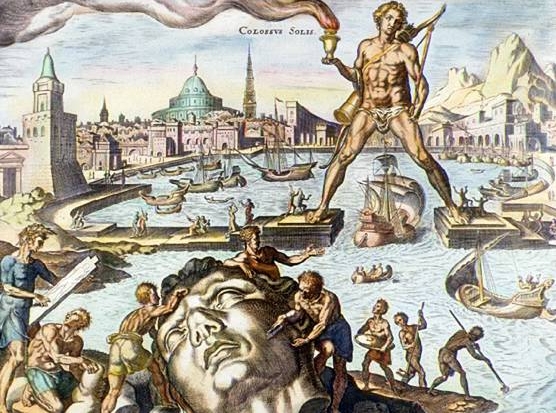
Unfortunately, the structure did not stand the test of time and was destroyed, at least partially in an earthquake in 226 BCE. Under stress from the shaking earth, the statue broke at the knees and fell over onto land. Ptolemy III offered to pay for the reconstruction of the statue, but the Oracle of Delphi made the Rhodians fear that they had offended the god Helios. Their punishment then was the destruction of the statue among other structures during the earthquake, and fearing further retribution, they declined to rebuild it. The remains then lay on the ground for over 800 years and, even broken, they were so impressive that many travelled to see them.
One such visitor was Greek geographer, philosopher, and historian Strabo. In approximately 64 BCE he described the city and the remains of the Colossus as the following:
The city of the Rhodians lies on the eastern promontory of Rhodes; and it is so far superior to all others in harbors and roads and walls and improvements in general that I am unable to speak of any other city as equal to it, or even as almost equal to it, much less superior to it. It is remarkable also for its good order, and for its careful attention to the administration of affairs of state in general; and in particular to that of naval affairs, whereby it held the mastery of the sea for a long time and overthrew the business of piracy, and became a friend to the Romans and to all kings who favoured both the Romans and the Greeks. Consequently, it not only has remained autonomous but also has been adorned with many votive offerings, which for the most part are to be found in the Dionysium and the gymnasium, but partly in other places. The best of these are, first, the Colossus of Helius, of which the author of the iambic verse says, “seven times ten cubits in height, the work of Chares the Lindian”; but it now lies on the ground, having been thrown down by an earthquake and broken at the knees. In accordance with a certain oracle, the people did not raise it again. This, then, is the most excellent of the votive offerings. (Strabo, Geography, Book XIV)
Another example of Monumentalist architecture was the Lighthouse at Alexandria. The lighthouse was constructed in the 3rd century BCE. After Alexander the Great died mysteriously at age 32, the first Ptolemy announced himself king in 305 BCE, and commissioned its construction shortly thereafter. The building was finished during the reign of his son, Ptolemy II. It took 12 years to complete and served as a prototype for all later lighthouses in the world. The light was produced by a furnace at the top and the tower was said to have been built mostly with solid blocks of limestone. When complete the lighthouse stood between 393 and 450 ft (120 and 137 m) tall. It was one of the tallest man-made structures on Earth for many centuries, and, like the Colossus was regarded as one of the Seven Wonders of the Ancient World. It too suffered damage by not one, but three earthquakes between 956 and 1323 CE, finally abandoned in the 14th century. It was the third longest surviving ancient wonder (after the Mausoleum at Halicarnassus and the still extant Great Pyramid of Giza). In 1994, French archaeologists discovered some remains of the lighthouse on the floor of Alexandria’s Eastern Harbor.


While Alexander the Great is a well-known figure from ancient history, the Hellenistic period as a whole is not. The reason for that relative neglect (in popular culture and in many history surveys, at least those at the pre-college level) is that the Hellenistic age is overshadowed by what was happening simultaneously to the west: the rise of Rome. In precisely the same period in which Alexander and his successors first conquered then ruled the territories of the former Persian Empire, Rome was in the process of evolving from a town in central Italy to the center of what would eventually be one of the greatest and longest-lasting empires in world history. That is the subject of the next few chapters.
This page titled Chapter 6: The Fall of Athens and the Hellenistic Age was last modified on Sun, 04 Oct 2026 05:56:48 GMT and is shared under a CC BY-NC-SA 4.0 license and was authored, remixed, and/or curated by Erin Stone via source content that was edited to the style and standards of the LibreTexts platform.
The book could not be loaded just now.