Opening the book…
Learning Objectives
- Describe the emergence of “Pink Collar” jobs during the latter half of the 19th century.
- Explain how “Pink Collar” work reinforced the patriarchy.
- Analyze how the Cult of Domesticity influenced the development of teaching, nursing, and social work as “Pink Collar” occupations.
Pink Collar Jobs
During the Gilded Age, retail and office work transformed, creating jobs that became synonymous with women workers because they involved serving others. Department stores developed and grew during the latter half of the 19th century and into the 20th century, relying on young, pretty, and fashionable women to sell their products while offices began to employ women as bookkeepers, secretaries, and telephone operators. As the nation’s population increased, particularly in immigrant neighborhoods, the need for teachers, nurses, and a new discipline, social work, also increased, and women continued to fulfill this demand. These occupations came to be known as Pink Collar jobs.
Sales Girls and the Freedom of the Department Store
Before the Civil War, people tended to purchase items that they needed from local businesses and craftsmen, who made them to order; only the wealthy engaged in what is commonly referred to today as shopping, or browsing for items to purchase. However, by the late 19th century, the mass production of items such as clothing and shoes meant that people with means could purchase an item off the rack from among a choice of premade items. In large cities, stores began employing pretty young women as sales girls to assist the wealthy in choosing the right item and to convince them to buy more than what they needed. These salesgirls were often paid by commission, or by sale, which encouraged them to sell more to their customers.

Retail work was a golden opportunity for working-class girls to leave the factory or domestic service and work in a clean, respectable environment. Second-generation immigrant girls, who had been raised in the US and spoke English well, viewed a sales clerk position as far more desirable than a dangerous factory or working as a domestic servant. While the positions did not pay well, they afforded the girls the opportunity to work amongst fashionable garments and accessories and to remain relatively clean and safe throughout their workday. Girls flocked to apply for these positions, using them as a stepping stone out of the tenements and into the upper working class or even the lower middle class.
In addition to providing a new and respectable occupation for working-class women, department stores provided freedom now previously known to most women, regardless of class. Because the spaces were female-dominated, women could go shopping and spend an entire day among other women, having lunch or tea, trying on garments, or purchasing items for their household with their female friends and being waited on by women. Shopping was a way women could spend time outside of the home without threatening men’s position in society the way that activism often did, and because the stores were occupied only by other women, they were safe spaces where women could be themselves.
Office Work
The end of the Civil War gave rise to more and larger businesses, which required more men to manage the workforce and the day-to-day operations. These new opportunities for men also opened up opportunities for women to work as bookkeepers, typists, and secretaries. Office work tended to reinforce the patriarchy of the home as women were expected to act as domestic help or junior partners to their male bosses.
Bookkeepers and Typists
The typewriter and the adding machine became staples of the office workspace by the end of the 19th century, and almost immediately, women were stereotyped as best for these jobs because they required fine dexterity but were also viewed as low skill. Office managers viewed women’s domestic skills, such as sewing, as a good preparation for learning to type on a typewriter or adding machine. Women were also already skilled in maintaining a household budget, so those same skills were applied to the business world. For more than a century before computers, typing, record keeping, filing, and other menial but important office jobs were performed by women who earned little pay and received little respect, although, like retail, these jobs were viewed as a step above factory and domestic service.


Secretaries
Like bookkeepers and typists, secretaries were a vital position in most offices beginning in the mid-19th century. Secretaries employed at small businesses were often the typist and bookkeeper, but at large businesses, secretaries worked in a large office with other women, answering phones, making appointments, and performing other organizational tasks for their male employers.
Personal secretaries, on the other hand, were the highest level of office worker, often having other secretaries working under her while performing a myriad of tasks for her male boss, who was often high in management. In addition to organizing their boss’s work day, a personal secretary was expected to fetch meals and drinks and perform other personal errands for her manager. In many ways, working as a personal secretary was the pinnacle of a woman’s place in the office environment, but they were still viewed as little more than a domestic servant by the men in charge.


Hello Girls
For the first century after the invention of the telephone, switchboard operators, nearly all female, connected callers from private numbers or within a large business. Like other Pink Collar jobs during the 19th century, the pay was low, but it allowed a young woman to work off her feet in a clean space, often amongst other women. Early on after the telephone was invented, few American families had one, and so the operator was not particularly busy. But by the early 20th century, more American households had a telephone, making the job of the operator extremely important to the community and leading to an expansion of the job throughout the United States. In small towns, the operator was usually well known by name, and she often knew all of the gossip since she was able to eavesdrop undetected on the calls she connected. In larger cities, operators worked in large rooms and oversaw dozens of call lines, which did not allow for much eavesdropping. Although it was an extremely important job, telephone operators were viewed as menial workers with low pay, but it was still a vast improvement over factory work.


The Caring Professions
Teachers and Librarians
Before the Civil War, women were making major inroads into education, both as students and as teachers. The ideal of Republican Womanhood that followed the Revolution combined with the Cult of Domesticity that developed in the Antebellum period to cement in the minds of most people in the United States that women were the best teachers, particularly of young children. Male and female educators encouraged women to enter education as an extension of the home and motherhood, especially if a woman was unmarried or widowed. Then, during the Civil War, men left teaching in droves to join the army and most chose not to return because of the business and work opportunities afforded them during the Gilded Age. By the late 19th century, most teachers in the United States were female, and it has continued that way up to the present day. Many districts had strict requirements for their female teachers, such as rules regarding appearing in public spaces with men, courtship, and most required women to step down or be fired from their jobs if they married. A teacher’s day started at dawn, when she arrived at the school to sweep; clean the desks, chalkboard, and slates; and start the fire in the classroom stove. She alone supervised the children, who usually ranged in age from 6 to 16 in one classroom, including during recess and lunch, and meted out discipline ranging from verbal admonishments to the switch. Once the children left for the day, she spent several hours cleaning the classroom and stove again before retiring for the day. If the teacher worked in a rural district, her home may have been a small room off the classroom in the same building, or she may have boarded with one of her students. In larger and urban districts, home was likely a boarding house or a house she shared with other teachers that was built by the district.
Even before the Civil War, middle- and upper-class women collected money to purchase books for local lending libraries as an extension of their domestic sphere under the Cult of Domesticity. However, after the Civil War, local governments and philanthropists became involved in creating libraries that were accessible to all, regardless of age or income. As with teaching, women were the natural choice for library work due to their image as mothers, caring and supportive, and so the library became another extension of the domestic sphere. Librarians worked in city libraries, guiding patrons to find the right book and promoting literacy, and in rural environments, often taking the library to the people in horse-drawn wagons or on pack mules. Once automobiles became readily available, mobile libraries were commonplace in small towns and rural communities across the United States, driven by female librarians, encouraging literacy and connecting people to books as never before.
Schools and libraries provided women with respectable jobs that could lead them to a good marriage or allowed them to support themselves and serve their communities. They could also enter leadership positions without threatening men, since public education was considered an appropriate realm for women. For example, Mary Foy became the first female head librarian of the Lost Angeles Public Library in 1880, at the tender age of 18. She held the post for just four years, but during that time, she expanded women’s access to library collections and set up the card catalog. She went on to teach elementary and high school throughout Los Angeles county and was a local supporter of women’s suffrage.
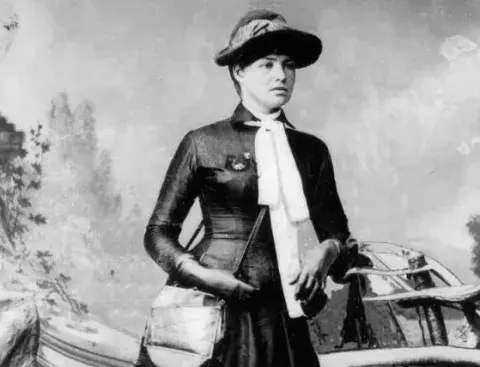
By the early 20th century, women were firmly established as teachers and librarians in the United States just as compulsory schooling for children through 8th grade was becoming common. Because they involved children and education, they were viewed as an extension of the domestic sphere and provided respectable work for single women, one of the “caring professions.”
Nursing
Women have always been nurses for their families and neighbors, caring for their husbands and children, and helping neighbors do the same. They learned, largely through trial and error or from other women, how to treat illnesses, bring down a high fever, set broken bones, and maintain a sanitary environment in order to help their family stay healthy. However, most nursing in hospitals was done by members of religious orders, such as the Daughters of Charity, who founded hospitals in Europe in the 1600s, the Sisters of Saint Joseph in France, or the Sisters of Mercy, who founded the first hospital in the United States in the 1830s. It was considered unseemly and unladylike for women outside of religious orders to care for sick men who were not their family members, and the few who did were often looked down upon as prostitutes. This attitude changed gradually thanks to the Cult of Domesticity and the necessity of war.
In 1856, the Crimean War broke out in Eastern Europe and thousands of men served in a way that resembled the Civil War that broke out in the U.S. five years later. The tactics used by officers were outdated and no longer fit the weapons being used, and diseases swept through military camps as men from all parts of Europe were crammed into close quarters. Deaths due to disease were a major problem, just as they would be in the Civil War. Men and women from religious orders established hospitals to help the wounded and sick, as they had done for centuries, but this time they were joined by a group of Middle Class women led by Florence Nightingale, who had put out a call in the papers for women to extend their domestic sphere to the battlefield, serving their country as they served their family, and over two hundred women heeded her call. Five years later, Middle and Upper Class women in the United States, inspired by Nightingale and her troop of nurses, organized and operated hospitals, worked as nurses, and even attended to the wounded on the battlefield while bullets flew around them. While we remember these women as heroes today, saving the lives of thousands of men, at the time they had to fight for the work they were doing. Doctors, officers, soldiers, and politicians complained about their presence, especially in camp and field hospitals. After the war, many of them continued working as nurses and created a new career path for women.
One of the most famous Civil War nurse, Clara Barton, went on to found the American Red Cross in 1881, an organization whose mission was, and still is, to assist in times of disaster and peril, from natural disasters to warfare. Still other nurses went on to teach in the nursing schools that were beginning to pop up throughout the Northeast, the first being the New England Hospital for Women and Children, which created a year-long training for nurses. In 1885, Clara S. Weeks Shaw wrote A Textbook of Nursing, which was the first nursing textbook in the United States. Scores of nurses studied Weeks Shaw’s textbook in school and used it as a reference on the job.
As Jim Crow segregation grew after the Civil War, many Black women became nurses as a career choice and also because it helped their communities, who in many cases were not allowed in a “White” hospital. In 1879, Mary Eliza Mahoney became the first African American woman to graduate from nursing school, having attended the New England Hospital for Women and Children. Like the female nurses serving in Crimea and the Civil War, she experienced discrimination not only for her sex but also for her race, and although she was able to work as a private nurse for several wealthy white families, she noted that she was often treated as a household servant rather than a professional nurse. In 1896, Mahoney became the first Black nurse in the Nurses Associated Alumnae of the United States, later the American Nurses Association, where she continued to advocate for nurses of color. She went on to found the National Association of Colored Graduate Nurses in 1908, where her work on behalf of nurses of color continued.


By the end of the 19th century, women were firmly established in the field of nursing, although it would be decades still for them to be able to practice medicine as doctors. Nursing was considered an extension of the domestic role of motherhood, joining teaching as another “caring profession” that unmarried women were able to perform with respectability.
Social Work
The increase in immigration in the latter half of the 19th century meant more people crowded into urban areas and a higher concentration of poverty in the cities than before the Civil War. Similar to nursing, charity for the poor was traditionally managed by churches, who worked in their local communities to help poor families and individuals, often women and children, who had fallen on hard times. As urban centers grew, the need outgrew individual churches’ abilities and new ideas about how to help the poor emerged during the Gilded Age.
Most religiously based charities were managed by women of the Middle and Upper Classes because they had the time and money to spend on helping others and because helping poor women and children was considered an extension of the domestic sphere. Secular charity boards, those not connected to a religious institution, were often filled with the names of local businessmen’s wives, who used their husband’s money to help the poor and furthered his influence and reputation in the process. As the 19th century progressed and more middle- and upper class women became educated, some chose to remain single and move into community service occupations such as Charity Organizations Societies and Settlement Houses, both of which served the urban poor through education and health care.
One of the founders of social work as a scientific discipline was Mary Ellen Richmond, who spent decades helping the urban poor and wrote five books describing not only her experiences but also the methods she used to help them. Her early work was as a caseworker, called Friendly Visitor at the time, and required her to visit needy women and children within her community, ascertain their needs, and attempt to secure help for them. From this work, Richmond wrote Friendly Visiting Among the Poor, which provided a handbook for charity workers, identifying specific behaviors and situations they needed to look for and laying out her ideas about social circumstances that caused poverty rather than the individual’s weakness or vice. She eventually moved into a leadership role at the Russell Sage Foundation, an organization founded by Margaret Sage to research social problems using the scientific method. With the support of the Russell Sage Foundation, Mary was able to publish several more books in which she explained data collection and research methods and focused more on her ideas about the circumstances that cause poverty. Mary Richmond’s works developed social work as an academic discipline but also as another “caring profession” extension of domesticity.


Conclusion
The Gilded Age was a time of tremendous change and growth for the United States, but it also provided opportunities for women to move outside of their traditional roles as wives and mothers. Young working class women were able to move from factory and domestic work to telephone operator, secretary, or department store sales girl. While these jobs didn’t necessarily pay better than factory work, they were cleaner, safer, and offered a step towards the Middle Class. Women from the Middle and Upper Class had more access to education than ever before, and many used this access to become teachers, nurses, and social workers, extending the domestic sphere into the “caring professions” that women still dominate today.
Question to Consider
What other occupations are considered “Pink Collar” today, and why?
This page titled 4.3: Pink Collar Jobs was last modified on Thu, 03 Sep 2026 02:04:45 GMT and is shared under a CC BY 4.0 license and was authored, remixed, and/or curated by Rene Miller Paredes via source content that was edited to the style and standards of the LibreTexts platform.
The book could not be loaded just now.