Opening the book…
Learning Objectives
- Define and explain the four pillars of True Womanhood.
- Explain how the Mosher Survey of the late 19th century assists historians in understanding the concept of “purity” in the Victorian Era.
- Explain the role of the media and social pressure in conforming women to True Womanhood.
The time period between the Revolution and the Civil War is often referred to as the Antebellum period, meaning the time or era between the wars. It is a time of tremendous change as the United States grows from 13 states located East of the Mississippi River to more than 30 states stretching to the Pacific Ocean. Arguments over the future of slavery divided Americans North and South and eventually exploded into the most destructive war in U.S. history, the Civil War. Economically, the country entered the Industrial Revolution, which began in Great Britain in the 18th century but spread to the across the Atlantic, moving production from homes to factories, moving people from rural to urban communities, and further stratifying society by expanding the Middle Class and its influence. As the country expanded westward, people moved with it, removing the indigenous populations they saw as a barrier to their domination, and taking with them enslaved people who had no choice in the matter. It is within this dynamic era that women recreate ideas about womanhood and begin to transform their roles within society.
Following the American Revolution, women worked to create a different role for themselves in society, one that focused on their influence as wives and mothers. Beginning with Republican Motherhood, women argued that they should have access to education in order to be better mothers to the next generation of American men. Further, women also began to argue that their inherently feminine traits were a benefit to their families and that the household was the cornerstone of American culture and society. Out of these arguments came the ideal historians refer to as the Cult of Domesticity or the Cult of True Womanhood. Simply put, the Cult of Domesticity glorified the woman’s realm, the home, and placed mothers on the highest pedestal of womanhood, held in place by the four pillars of True Womanhood: Piety, Purity, Domesticity, and Submission.
Piety
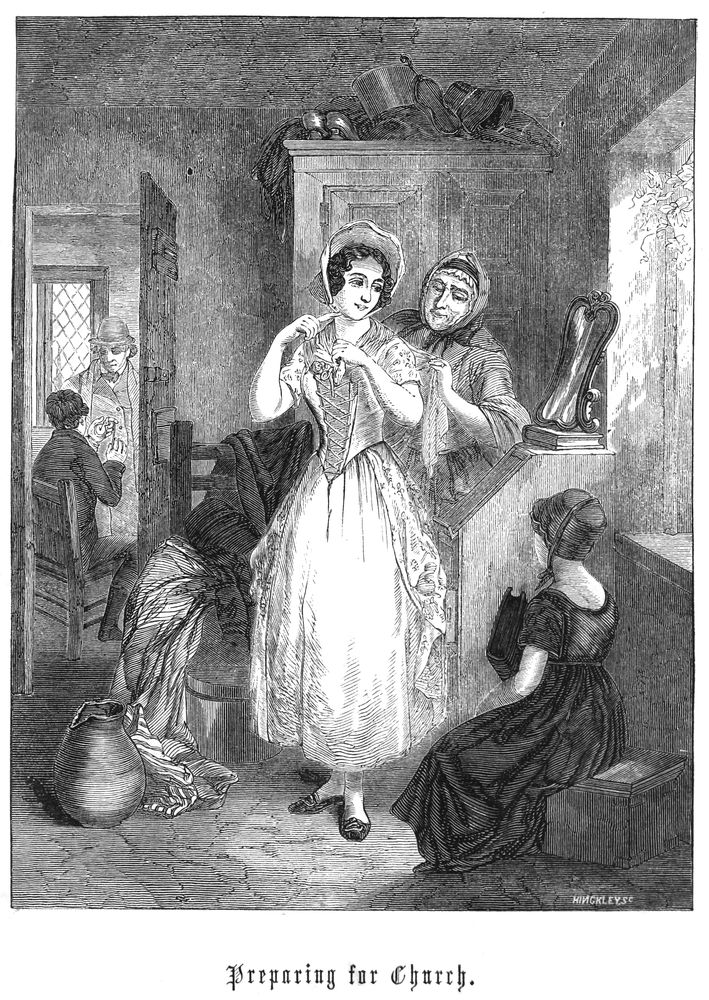
In simplest terms, piety refers to dedication to God and His work; therefore, a pious woman has faith in God and behaves in a manner that is pleasing to God. She attends church, Bible studies and is active in her church community, perhaps by teaching Sunday School or collecting money for the poor. Before the American Revolution, women were often encouraged to learn to read so that they could read the Bible, and this encouragement continued during the Antebellum period, as women were encouraged to be the moral compass for their families. Although women were not allowed to become ministers in most religions, church work was considered an appropriate public space for women and women would go on to use the pillar of piety to defend their activities in social reform movements such as abolition, temperance, and suffrage.
Purity
Closely related to piety is purity, or the idea that a woman should remain sexually pure until marriage and sexually loyal to her husband during marriage. Beginning in the Antebellum period, sometimes referred to as the Victorian Age after Great Britain’s Queen Victoria, the idea of purity took on a more extreme meaning, that of a woman’s “passionlessness” or lack of any sexual feelings whatsoever.
Unlike the Colonial period, when it was believed that women were just as interested in sex as men, Antebellum society developed the belief that women were not sexual beings. Women were taught that sex was something to be endured rather than enjoyed, for the sake of becoming a mother, which elevated her to the pinnacle of womanhood. Men, on the other hand, were sexual beings and physically needed sex. The biological differences between men and women necessitated differences in sexuality as well.
The fact that women took the message of purity to heart during the 19th century is evident in the premarital pregnancy rate, which was far lower than that of the Colonial period. During the 18th century, men and women were expected to wait until marriage to have sex, but premarital relations were tolerated so long as the couple was engaged. This practice was referred to as Betrothal Sex and was so common that one in three brides were pregnant on their wedding day during the Colonial period. By contrast, only about 10% of brides were pregnant during the Antebellum period. Birth control was unreliable at best and deadly at worst during this time, which suggests that women were abstaining from premarital sex far more during the Antebellum period than they had the previous century (Gardner 2007).
The Reality of Purity: The Mosher Survey
In the 1890s, Dr. Clelia Duel Mosher, while attending Stanford University, conducted a number of studies regarding women’s health and hygiene. Dr. Mosher studied several dozen women from age 30-50s, surveying them about a variety of taboo topics ranging from menstruation to orgasms. Her goal was to disprove many of the beliefs regarding women’s sexual health that were widely held by 19th-century male doctors.
Dr. Mosher began by studying the idea that women and men breathed differently, thus causing men to be more intelligent and physically fit than women. Male doctors commonly believed that women breathed using their upper chests while men breathed using their diaphragms, an observation that turned out to be correct. However, Dr. Mosher proposed that women used their upper chests to breathe due to the constrictions of their clothing, specifically corsets, which had been commonly worn throughout the 19th century, and “Hobble skirts,” which were tight-fitting and difficult to move around in. Thus, she proved that women breathed differently than men, not because they were women, but because of their clothing.
Eventually, Dr. Mosher would survey dozens of women in the San Francisco, California area, asking them a variety of questions regarding menstruation, sexual interest, sexual encounters, frequency of sex, and details about orgasms. It is worth noting that the surveys were completed, despite all of the surveyed women being raised with the idea that women are to be passionless and pure. The survey results yielded some expected results but also some that were quite shocking. For example, most of the women surveyed admitted that they knew nothing or very little about sex before their wedding night. However, they indicated that they believed sex was not simply for reproduction but also served the purpose of bonding a husband and wife and relieving stress. Most women also said that they had had at least one orgasm, although most also indicated that they rarely had them. Upon further study of the results, Mosher concluded that women knew very little about their own bodies; therefore, they could neither understand what gave them pleasure nor communicate this with their husbands.
The Mosher Survey was the largest survey of its kind until the 1920s and is notable not only for the fact that it was conducted by a female doctor but also for the fact that its subjects were open and honest with their responses. This suggests that women likely had honest conversations about their sexuality and reproduction with one another, but that men, who were the record keepers of the day, were rarely privy to them. Women had internalized the messages of their childhood regarding purity and understood the importance of showing, at least to society, that they were following the rules. In fact, Dr. Mosher never published the survey herself; it was published more than 30 years after her death in 1940.


Domesticity
During the Antebellum period, the economy of the United States changed dramatically and this led to a change in the way society viewed the home and women’s place within it. Throughout most of human history, the home and workplace were one and the same, whether it was a farm, blacksmith shop, or other business, families lived and worked together in the same space. The Industrial Revolution, which began in the late 18th century, changed this dynamic and created the idea of two spheres, a public and private one. The public sphere was the world of men and involved business and politics while the private sphere was the world of women and involved peace and morality. Thus the third pillar of True Womanhood, domesticity, meant far more than the endless drudgery of housework from morning til night. Rather, domesticity referred to women’s role as homemaker, peace keeper, and moral compass for the family.
Submission
The final pillar of True Womanhood, submission, was connected to both the legal and social status of women during the Antebellum period. As with the Colonial period, women were legally defined as either Feme Sole, legally autonomous, or Feme Covert, legally covered by a male relative. Therefore, the concept of submission applied to a woman’s relationship to a man, such as her husband, father, or brother, and she submitted her will to his in all things because he is the head of the family. However, submission did not mean that she was powerless in the relationship; she could wield considerable influence over her menfolk due to her piety and purity.
The media of the time period often contained stories, poetry, prose, and the like that instructed women on the appropriate level of influence they could wield over their male relatives. An example is The Lady’s Amaranth, published in 1838 by Joseph Torr: “The man bears rule over his wife’s person and conduct. She bears rule over his inclinations: he governs by law, she by persuasion…. The empire of woman is the empire of softness…her commands are caresses, her menaces are tears.” (Torr 1838)
While the above quote recognized the legal power of husbands over wives during the Antebellum period, it equally recognized that a wife should rule over her husband’s “inclinations” through the powers of persuasion. Wives should not challenge their husbands directly but should work to change their minds through kindness or even through crying. A woman may be submissive, but that did not mean she was altogether powerless.
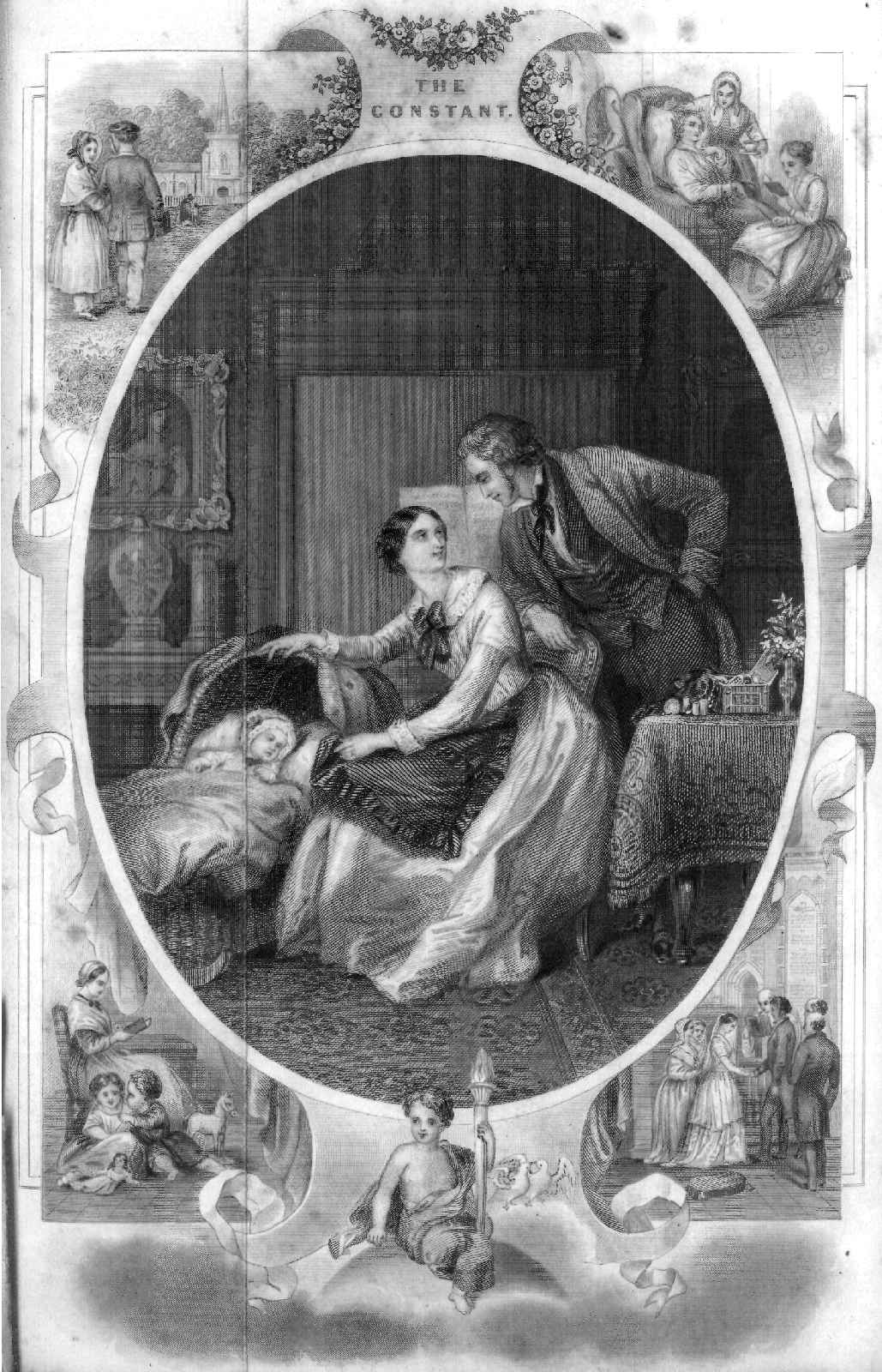
The image below is from an 1851 issue of Godey’s Lady’s Book and it accompanied a short story by Alice B. Neal about marriage and fidelity to one’s husband.
The Media
The Antebellum period witnessed the introduction of mass media in the United States through the publication of journals and magazines focused on specific populations and interests, particularly women. The early 19th century saw the rise of several popular publications for women, such as the Lady’s Amaranth and the Ladies’ Magazine, but by the 1850s, the most popular publication for women was Godey’s Lady’s Book, edited by Sarah Josepha Hale, who had previously edited the Ladies’ Magazine. Hale, who became a widow with five children at the age of 34, supported her family with her writing, including Poems for Our Children, which featured “Mary Had a Little Lamb.” However, it was her work editing magazines for women that proved most significant for 19th century culture. From fashion to housecleaning, literature to feminine behavior, Godey’s wielded a tremendous influence over women throughout the 19th century.


Subscribers to Godey’s Lady’s Book eagerly looked forward to the monthly publication, and women read it cover to cover, then gave it to their daughters and friends to read. Sarah Hale recognized the popularity of the magazine and wrote or edited many of its stories and articles with the intent of not only influencing women’s behavior but also appearing to be non-threatening to their menfolk. Thus, a father or husband who wished to ensure that his wife or daughter was not being led astray was assured that Godey’s was appropriate. The young bride read articles about how to plan a dinner party or prepare a recipe that was sure to please her new husband, while a young, unmarried girl found advice on courtship and the importance of avoiding unsavory men who preyed on the innocent. Both wealthy women and those of little means found photos and patterns of the latest fashions, as well as the rules regarding their wear.
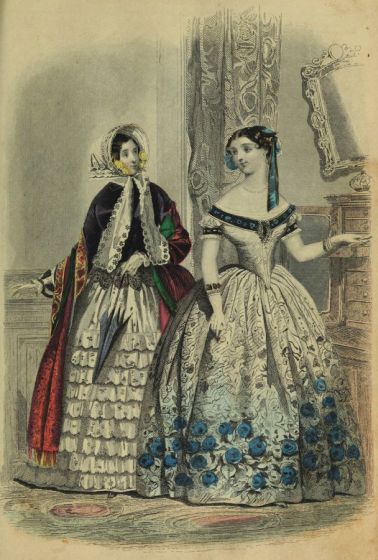


These fashion plates were painted by hand on copper plates by a group of about 150 women, making Godey’s not only an important influence on women but also an important employer of them. The plates were accompanied by detailed descriptions of the recommended fabric for each dress shown as well as the pattern to make it. Fabric was sold by bolt during the 19th century, and it took between 5 and 10 yards of fabric to make each dress, which was very costly. Therefore, most women had only three or four dresses, one for daily work, one for visiting, and one for attending church on Sundays. When their work dress wore out, women recycled it into aprons or curtains and purchased or made a Sunday dress, shifting the Sunday dress to visiting and the visiting dress to work. Only upper-class women could afford to have several dresses made of fine fabric, such as silk or muslin. Regardless of wealth or status, women were expected to present a clean and fashionable appearance.
Separate Spheres and Women’s Friendships
The Cult of Domesticity and 19th century media encouraged women to keep to their proper space or sphere, which was the home, while men were expected to leave the home to work, socialize, and engage in politics or business. This meant that women spent most of their time together and without the company of men, performing household chores, reading, or running errands. While images in Godey’s and other publications touted marriage as romantic and the relationship between husband and wife as central to the family, the reality for most women was that their female relatives were much more important to them than their male ones, even their husbands. Literature of the day, when written by women, discussed their love for their mother, sisters, aunts, cousins, and female friends. One of the best examples of this is Little Women by Louisa May Alcott. As the title suggests, the story is about the March sisters, Meg, Jo, Beth, and Amy, as they navigate the Civil War era in their home in Massachusetts. The sisters have an unshakable bond and while they all recognize the importance of getting married and starting a family of their own, they are also afraid to lose one another. When Meg marries John, Alcott describes the girls’ behavior, “Mother and sisters gathered close, as if loath to give Meg up” (Alcott 1868, ch. 25). When women left home to attend school or work in factories, they were often taken in by older girls, who acted as older sisters to them in the absence of their own family.
Women wrote letters to one another that describe how much they love and miss one another, often using terms we might consider romantic today. An example of this is the friendship between Sarah Butler Wister and Jeannie Field Musgrove, who became friends at the ages of 16 and 14, respectively, and the women remained friends for the rest of their lives. Although Sarah married and had children, she and Jeannie continued to write letters and visit one another into old age. One letter in particular from Sarah to Jeannie after she visited shows the intensity of her feelings, “I shall be entirely alone (this coming week). I can give you no idea how desperately I shall want you….” Jeannie’s response read, “Dear darling Sarah! How I love you & how happy I have been! You are the joy of my life…. I cannot tell you how much happiness you gave me, nor how constantly it is all in my thoughts. ….My darling how I long for the time when I shall see you…” (Smith-Rosenberg 1975, 4) In other letters, Jeannie called Sarah “my dearest lover” and told her goodnight with “A thousand kisses.” (Smith-Rosenberg 1975, 4-5). Some historians have argued that letters such as the ones between Sarah and Jeannie are examples of same-sex relationships between women during the 19th century and in fact, letters like these were not particularly unusual between women.
Conclusion
In conclusion, the Cult of Domesticity or True Womanhood called on women to be pious, pure, domestic and submissive, to remain within their sphere, and the media of the day reinforced those values through articles, stories, and fashion plates. While the pillars of True Womanhood were only attainable by a small number of women, mostly middle- and upper-class housewives, women from all socioeconomic backgrounds were exposed to them, and many aspired to fulfill them. Still others found these virtues constricting or simply impractical and chose to forge their own paths, which will be discussed in the next section.
Question to Consider
How does the media today influence women’s behavior?
This page titled 3.1: Cult of Domesticity was last modified on Thu, 03 Sep 2026 02:04:41 GMT and is shared under a CC BY 4.0 license and was authored, remixed, and/or curated by Rene Miller Paredes via source content that was edited to the style and standards of the LibreTexts platform.
The book could not be loaded just now.