Opening the book…
Learning Objectives
- Evaluate the impact Westward expansion had on the Indigenous and Hispanic women who already lived there.
- Analyze the ways in which White women’s ideals about True Womanhood transformed as they moved West.
- Evaluate how moving West impacted enslaved women.
- Compare the experiences of Asian women with those of other women of color in the Far West.
Acquiring and colonizing lands west of the Mississippi River was a primary driver of the United States’ foreign policy and economic growth during the 19th century. When the century began, the country stretched from the Atlantic to the Mississippi, but by the middle of the century, it stretched to the Pacific Ocean. Expansion began in 1803 when the U.S. purchased the Louisiana Territory from France, doubling its size with the stroke of a pen and adding the vast areas of the Great Plains and prairie as well as thousands of Indigenous people and about 10,000 French citizens to the United States. The government used the plains and prairie as reservation land for Eastern tribes such as the Cherokee, Creek, Chickasaw, Choctaw, Seminole, Sac, Fox, Shawnee, Miami, Delaware, Wyandotte, Peori, and the Potawatami, who were rounded up from their ancestral homelands and moved to assigned regions west of the Mississippi, mostly in modern day Oklahoma and Kansas. In 1836, White American settlers in Tejas joined with discontented Tejanos in a revolt against Mexico which resulted in its claim to be the Republic of Texas before it was annexed into the United States in 1845. This act of aggression led to the U.S.-Mexican War, which resulted in Mexico ceding half of its northern territories to the United States in the Treaty of Guadalupe-Hidalgo in 1848. Over 100,000 Mexican citizens and tens of thousands of Indigenous people were added to the country. The treaty required that the government protect the rights of the former Mexican, now American, citizens and respect their culture and language in the law. At the same time that the United States was at war with Mexico, it settled its dispute with Great Britain over the Pacific Northwest when it signed the Treaty of Oregon and established the border between Canada and what would become the states of Washington and Idaho. This treaty brought tens of thousands of Indigenous peoples into the United States.


While we often view the story of Westward expansion as a male story involving rugged cowboys, grizzled gold miners, and pitched battles between the U.S. Army and various Native American tribes, that is only part of the story. Like the east coast of the United States before the English arrived, the Trans-Mississippi West was home to tens of thousands of Indigenous women from myriad cultures and ways of life, some of whom had already learned to navigate European colonizers from France and Spain before the United States acquired their homelands in the Louisiana Purchase, Treaty of Guadalupe Hidalgo, and Treaty of Oregon. Spain colonized the region we refer to today as the Southwest and California from 1609 through 1821, during which time they established missions and presidios to subdue and colonize the Indigenous populations and created ranches and towns where families settled. In 1821, the region became a part of a newly independent Mexico. Once the U.S. took these regions over, White families moved west, bringing the ideals of womanhood with them, along with enslaved people who were taken west against their will. During the California Gold Rush, women from all over the world, especially Asia, immigrated to the region, adding another group to the diverse landscape of the Far West.
Indigenous Women in the Far West
French Colonization
As you can see in the above map, the territory of Louisiana encompassed the Great Plains and northern prairies. The French first sent explorers and fur traders into this region in the 1600s, making alliances with several local tribes in order to hunt and trade fur along the Great Lakes and its tributaries, a trade that they dominated even after the Louisiana Purchase in 1803. During these two centuries, fur traders, who were almost exclusively male, often married into allied tribes and had bi-cultural children who often grew up to become fur traders themselves. Some native peoples converted to Catholicism and took on French culture or blended their indigenous cultures with that of the French and French fur traders were usually adopted as members of allied tribes. Perhaps the most famous of these bi-culture marriages was that of Sacagawea and Toussaint Charbonneau.
Sacagawea
Sacagawea’s story is similar to that of Pocahontas and the Indian Princess trope in that it was written exclusively by European men, in this case her husband and William Clark of the Corp of Discovery, and it involves her helping and protecting White men. According to Clark’s diary, Sacagawea was from the Shoshoni tribe, who occupied modern day Idaho along the Snake River and on both sides of the Rocky Mountains but was kidnapped as a child, then sold to Charbonneau. She spoke several indigenous languages and was crucial as an interpreter, particularly since her husband did not speak any indigenous language as well as he claimed when they were hired as a guide at Fort Mandan in modern day North Dakota. She earned the admiration of Lewis and Clark when she saved journals and other important items from a capsized canoe. When the Corp of Discovery came to Shoshoni land, they found that Sacagawea’s brother was chief and she was able to negotiate for horses to carry them over the Rockies. She continued on with them to the Pacific, stayed through the winter, then traveled back to Fort Mandan. Sacagawea had a son while on the journey to the Pacific, so all that she did should take into account that she had a baby with her. However, there are major problems with translation throughout the journey and Clark’s diary is likely inaccurate. Sacagawea is claimed by both the Shoshoni and Hidatsa and each have conflicting stories about her life and death. It is therefore impossible to know for sure who she truly was or what happened to her based upon the wide variety of stories about her. However, it is certain that Sacagawea was a crucial member of the Corp of Discovery.


Spanish Colonization
While Spain’s empire in North America was centered in Mexico City, the former Aztec capital of Tenochtitlan, they sent expeditions north into what is today the West Coast and Desert Southwest United States to lay claim to these areas as well. Expeditions to El Norte, as the Spanish called it, consisted of the Spanish Army, Catholic priests, and civilians who supported these groups, including the wives and children of army officers and skilled craftsmen and camp followers. They founded missions and presidios (military forts) then civilian communities throughout the region, the first of which was Santa Fe, founded in 1608 in what is today New Mexico and among the last were the 21 missions along the California coast. Regardless of where they were located, the military, church, and civilian populations worked together to bring the Indigenous populations under control, forcing them to build, then live at the missions, become Catholic, and forsake their own cultures and traditions.
Mission Life
The Spanish soldiers and priests worked together to take the local native peoples from their villages and force them to live and work at the missions. Men and women were segregated at the mission and the women were locked into their dormitories at night, supposedly for their own protection, although the rape of native women at the missions was very common. In addition to sexual violence and exploitation, indigenous women were forced to give up their traditional culture, language, and religion in favor of Catholicism and Spanish culture and language. They lost their traditional roles within their tribes as healers, political leaders, and respected elders and because women were the keepers of culture, they were no longer able to pass along their culture to the next generation. Death at the missions was also very common, as European diseases such as smallpox and influenza decimated the people because they lacked immunity and were crowded into mission dormitories. The indigenous population of California before the Spanish arrived is estimated to have been about 300,000 but by 1848, it was estimated at 150,000. Tribal communities in the Southwest, such as the Zuni and Hopi (whom the Spanish called Pueblos because they lived in towns) were similarly decimated due to the mission system, diseases, and war brought by the Spanish.
Piu-uina
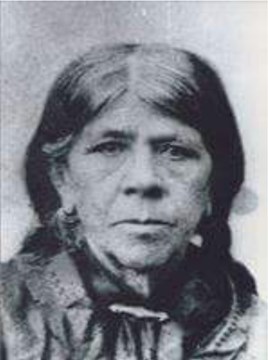
Native women did fight against the usurpation of their authority and culture. Piu-uina (Josefa) of the Chalon nation in California, lived at Mission Soledad as a young girl and married a Chalon man, then when he died, she remarried a Spanish soldier, Martin Olivera, with whom she had nine children over their twenty year marriage. Piu-uina taught her children the Chalon language and culture while traveling with her husband from Soledad to Carmel to San Miguel, serving the community as a midwife. Although she was killed, along with one of her daughters and grandchild, by Anglo-American men in 1848, the rest of her children survived and continued to pass on the culture and language that Piu-uina taught them.
United States’ Colonization
The policy of the United States towards the various indigenous tribes within its borders would not be much different than its attitude during the colonial era. While some people supported the idea of teaching Native Americans English, converting them to Christianity, and incorporating them into the general population, many more viewed them as people who could never become part of the United States, could never become “civilized.” So while some church groups sent missionaries out to convert the indigenous population and teach them to be White, the government itself developed a program in which Native people would be taken from their ancestral homes east of the Mississippi river and placed on reservations throughout the Great Plains and prairie of the Louisiana territory. This policy not only disrupted the cultures of the Eastern tribes, but also that of the people who already lived in the Louisiana territory. These tribes, like the Osage and Kansa, would also be rounded up and forced to live on reservations.
This pattern continued across the Great Plains during and after the Civil War, when the government sponsored the extermination of the buffalo in order to bring nomadic tribes like the Lakota and Comanche onto reservations, eventually taking their children into boarding schools in order to “kill the Indian in him, and save the man.” (Pratt 1892, 46). In California, the Gold Rush of 1849 brought tens of thousands of people from all over the world into the state and its government ushered in a policy of genocide against the Native California population, reducing it from 150,000 in 1848 to less than 30,000 by 1900. While some of this was due to disease, the state government paid bounties for scalps belonging to Indigenous men, women, and children, and looked the other way as women and children were raped and trafficked into prostitution. Indigenous women throughout the Far West were under assault in every form for over a century and they are just beginning to rebuild what was lost.
Spanish and Mexican Women in the Far West
Women were a part of the settlement of the Southwest and California by the Spanish and later Mexican governments. Women came to El Norte with their husbands and fathers serving in the Spanish army or as civilian skilled craftsmen and businessmen. Over time, these women created a society on the edges of the Spanish empire and enjoyed certain legal privileges that their sisters in the English colonies did not.
Frontier Duality
Spanish women rebuilt European style communities on the frontier while navigating the social expectations of their day. On the one hand, they were expected to be soft, feminine, and dependent on men, but on the other hand, circumstances demanded that they be strong, resilient, and self-reliant. Men were often gone serving with the army or away on business, leaving their wives and daughters alone for weeks at a time to care for and defend themselves. These women managed businesses and ranches on their own, often performing men’s chores that would have been considered unfeminine in Europe. Of course, society was still socially stratified and the wives of wealthy men, doñas, usually managed households while poor women performed the housework.
Legal Rights
Spanish law, which would be adopted by Mexico when it became independent in 1821, allowed women more legal rights than did English law. For example, women were allowed to own property and retained control over it after they married. They were also able to access the courts, to sue and be sued, having a legal identity of their own outside of their husband’s and father’s. On the frontier, women could and did hold land grants in their own name, operating ranches and other businesses in many parts of El Norte. Women even owned and operated cantinas without social stigma, very different from the English colonies.
Maria Ygnacia López de Carrillo
Maria Ygnacia was born in San Diego, California, the daughter of a Spanish soldier and a half African, half European mother. She went on to marry another soldier, Joaquin Carrillo, with whom she had 12 surviving children. When her husband died, she took her 9 minor children and moved in with her daughter, who was married to Mariano Vallejo, a local politician and future California governor. With the help of her son and son-in-law, she was able to secure a land grant of nearly 9,000 acres in 1841 on which she established Rancho Cabeza de Santa Rosa, which eventually became the city of Santa Rosa, California. Her children would go on to become prominent in state politics for several decades.


Doña Tules
Maria Gertrudis Barceló owned and operated a cantina in New Mexico, capitalizing on local trade routes on the Santa Fe Trail. Although she was married, she operated the business on her own and continued to use her maiden name. She amassed a fortune catering to miners, businessmen, traders, and other travelers, having more than $10,000 and owning several homes when she died in 1852. Newspapers in the United States at the time painted her as a gambler, drinker, smoker, prostitute, and madam and criticized her wealth as ill-gotten gains. In spite of this, she lent the U.S. Army money to help fund its invasion and occupation of New Mexico in 1846 and she even exposed a plot that would have killed hundreds of soldiers. Sadly, there are no known photos of Doña Tules.
Treaty of Guadalupe Hidalgo
After the war between the United States and Mexico, the two countries signed the Treaty of Guadalupe Hidalgo, which ceded El Norte to the United States and guaranteed citizenship to the 100,000 or so Mexican citizens who lived there. However, as the territory changed hands, the laws that governed women changed as well. El Norte had been under Spanish law, which allowed women, regardless of marital status, a legal identity but the law of the United States was still largely influenced by English Common Law, which did not recognize women as legally independent in most cases. As more White settlers moved into the region, especially during and after the Gold Rush in 1849, many Anglo American men married Mexican American women, thus acquiring their property under U.S. law. Still others squatted (illegally built homes) on the lands of Mexican American women, who then had to fight in U.S. courts to remove them.
In addition to the loss of legal rights, the racist attitudes of most White settlers negatively impacted Mexican American women. While wealthy doñas were often viewed as genteel ladies, similar to Southern planters’ wives, poor women were usually viewed as exotic sirens or sexually available, which often subjected them to discrimination and violence. One such woman was Josefa, also known as Juanita.
“Juanita”
Josefa lived in a Sierra mining camp called Downieville during the height of the Gold Rush. Almost nothing is known of her life before the day she was killed by a mob, not even her last name or the exact story of her alleged crime. According to the men who served as her jury and executioners, she was a murderer who had stabbed an Australian man called Cannon in the heart. Josefa and her husband, Jose, claimed that a drunk Cannon had burst through their front door the night before and when they confronted him the following day, he attempted to enter their home a second time when Josefa stabbed him. Josefa was arrested, charged with murder, tried, convicted and sentenced to die by hanging in the space of several hours on July 5, 1851. Before her sentence could be carried out by the law, she was seized by the mob and hung from the span of a bridge just outside of town. Her husband, Jose, was found not guilty but told to get out of town that same day. Josefa’s death is commemorated near Downieville today, where the historical marker refers to her a “Juanita,” which was a derogatory term commonly used in Gold Rush California to refer to any woman of Mexican heritage.


White Women in the Far West
Once the United States acquired lands in the Far West, White families began moving into the area. Our imaginations often conjure up images of covered wagons drawn by yokes of oxen trudging across a vast prairie, driven by a man with a small woman beside him and several children peeking out from under the canvas. The reality, of course, was very different. Many women did come to the Far West as part of a nuclear or extended family, while others heeded Catharine Beecher’s call to become teachers, and still others were drawn by the opportunity to break with the rigid social norms of the East and chart a path of their own. While White settlers moved across the Mississippi river to settle in places like Missouri, Arkansas, and Iowa, the big push to the Far West came with news of gold in California.
Trials of the Trail
Although gold was actually discovered along the American River in 1848, news reached the world outside of California in 1849 and Gold Fever swept the country and many parts of the world, bringing millions into the newly acquired territory in just a few years. The Gold Rush itself was a very male affair, over 90% of the population of California were men during the early 1850s. When men heard about gold out west, many left their families to seek their fortune, while others dragged them along. One woman set fire to her family’s wagon along the trail and another sat down on the ground and refused to move. But many women looked forward to moving west, either for their health, for a better life for their families, or because of their sense of adventure. Some were able to influence their final destination, encouraging their husbands to go to Oregon for farmland rather than to California for gold. We know this because many women kept diaries of their journey west, either on the California or Oregon Trail. The journey along the trails took between four and six months and were filled with exhausting physical labor, emotional suffering, illness, and death. Life went on for these women, who gave birth to and buried children along the way.
Mining Camps
Although fewer families traveled to California than Oregon, many did choose to try their luck at striking it rich in the gold fields. However, once arrived, most found that there were few jobs in mining but a lot of opportunity in providing services for the miners, such as cooking and laundry, as Luzena Stanley Wilson found out when a miner approached her as she was making dinner for her family outside of Sacramento in September, 1849, ““I’ll give you five dollars, ma’am, for them biscuit.” It sounded like a fortune to me, and I looked at him to see if he meant it. And as I hesitated at such, to me, a very remarkable proposition, he repeated his offer to purchase, and said he would give ten dollars for bread made by a woman, and laid the shining gold piece in my hand.” (Wilson Wright 1937, 10). Luzena and her husband sold their oxen and bought a hotel in which they fed and housed miners until a flood wiped them out. They moved to Nevada City and set up another hotel, which burned down, and so they ended up with a third hotel in the hills between San Francisco and Sacramento, and founded the town of Vacaville.
Dame Shirley
A great deal of what we know of life in mining camps comes from the letters of Louise Clappe, who wrote and published under the pen name “Dame Shirley.” From September, 1851 to November, 1852 she wrote more than 20 letters to her sister Molly in which she described her life in mining camps along the Feather River. Her letters are sometimes serious, often humorous, and filled with details of daily life and the people she interacted with. In January, 1852, Louise wrote to describe the way the winter holidays were celebrated in the camp. She described a party that went on for several days, with dancing, eating, and a great deal of drinking. In another letter, she tells her sister that there were 29 murders the previous month, pointing out that the month had 30 days, and so they were still a day ahead. The fact that she is able to joke about murders as well as parties gives us a window into Louise’s personality but also into the attitude she had to have in such rough conditions.


Farming and Ranching
Most women who moved to the Far West settled on farms or ranches with their husbands and raised families. Like Spanish women before them, they learned to be self-reliant as their menfolk were gone all day in the fields or on business. Running a farm or ranch was difficult work, but it was not much different than what they had done as farmers’ wives in the East. Women took pride in recreating domesticity in the rough log cabins and sod houses they found themselves in, creatively using worn out blankets as area rugs and pieces of old dresses as curtains. Some had carried a single doll or tea pot over the trail and were thrilled to be able to display these symbols of domestic life in their new homes. However, many women commented in their diaries and letters how lonely they were because their nearest neighbors were often 10 to 20 miles away. They talk about the isolation they felt, especially during pregnancy and childbirth, and they lamented that they had no friends. Nellie Wetherbee wrote in her diary: “I have been very blue for I cannot make a friend like mother out of Henry…It’s a bore.” (Sanchez 2000, 65). Sarah Hively wrote simply, “I never was so lonely and homesick in all my life.” (Sanchez 2000, 65).
Some women moved to the Far West with other women to build their own lives separate from men altogether. After the Homestead Act of 1862, several groups of women applied for and acquired homesteads of their own, without the aid of a man, because the law allowed anyone, male or female, to apply. Still others began their lives in the Far West as part of a family but through the deaths of husband or father, inherited a farm or ranch and operated it alone. One of the earliest women to do this was Sally Scull, who moved to Texas while it was still a part of Spain and eventually owned a horse ranch where she employed vaqueros who were skilled in horsemanship. She reportedly wore pants and was an excellent markswoman. Other renowned cattlewomen include Elizabeth Johnson Williams, Margaret Heffernan Borland, and Susan McSween.


Legal Rights
White women who moved to the Far West brought the ideas they learned about true womanhood with them, continued to subscribe to Godey’s, and adjusted the ideal to fit their new surroundings. Local governments trying to create safe, stable communities noted that where there were more women and families, there was less crime and lawlessness. In short, the west was a bit less wild. With this in mind, states and territories in the Far West gradually expanded women’s rights throughout the 19th century, leading for some to even give women the right to vote long before the 19th amendment. For example, when Louise Clapp and her husband decided to separate in 1852, she eventually petitioned and was granted a divorce from a California judge, something virtually unheard of at the time. States began allowing women to own land and businesses regardless of their marital status, giving them a legal identity outside of their husband’s and father’s for the first time. In 1869, Wyoming gave women the right to vote and in 1898, Utah gave women the right to serve on a jury. While these milestones may seem slow and small, they were part of a steady march to social, economic, and political equality that moved from West to East.
African American Women in the Far West
The French and Spanish allowed slavery in their territories, so there were already a number of enslaved Africans in Texas, Louisiana, Arkansas, and Missouri before the United States acquired these areas by treaty and they would not become free until after the Civil War in 1865. Before emancipation, most of the African Americans who moved to the Far West were taken against their will by their enslavers and, depending upon where they were taken, remained enslaved until 1865 as well. When the Cherokee, Creek, and other Southeastern tribes were removed to Oklahoma in the 1830s, they took their slaves with them, forcing hundreds of enslaved African Americans onto reservations where they continued to be enslaved until the 1890s when the Federal government began the Indian Census Rolls. However, some states and territories in the Far West did not allow slavery and when enslaved people were taken to those areas, they were technically free. Claiming their freedom, however, was a different matter.
Biddy Mason
Born into slavery in Georgia, Biddy Mason and her family were sold to the Smith family in Mississippi, then taken to Utah in the Mormon Exodus and finally to California in 1852. California had outlawed slavery when it became a state in 1850, so it was illegal for Smith to keep Mason and her family enslaved. However, Biddy had to go to court for her freedom, which proved difficult because she lacked money and education, but also because it was illegal in California for a black person to testify against a white person. When she filed her petition, her enslaver failed to show up to court, and in 1856, Judge Benjamin Hayes granted Biddy and her family their freedom. Biddy used her skills as a nurse and midwife in the Los Angeles area, saving enough money to buy land, eventually owning several homes and businesses throughout the area. She was active in her community, helped the poor, and helped to found the first African Methodist Episcopal Church in Los Angeles. She was well known in the area for her kindness and generosity: “”If you hold your hand closed, nothing good can come in. The open hand is blessed, for it gives in abundance, even as it receives.” (Weiler 2020)


Once the Civil War ended in 1865, the 13th amendment abolished slavery nationwide and over 3.5 million enslaved people became free. Most remained in the South until the early 20th century, when they moved north and west in the Great Migration. However, some moved to the Far West and worked as cowboys and ranch hands while others established communities of the formerly enslaved and their descendants. These communities gave African American women new opportunities as teachers, librarians, nurses, and shopkeepers, allowing them the freedom to control their own lives.
Asian Women in the Far West
The early 1800s saw small numbers of Asian immigrants from China, the Philippines, and South Asia, but their numbers dramatically increased beginning with the California Gold Rush in 1849. Gold Fever was so strong that Filipino sailors jumped ship in San Francisco and impoverished Chinese men left their homes and families with the hope of earning enough money to return home to give them a better life. By comparison, few Asian women immigrated to the Far West during this time, but those who did were often assumed to be prostitutes, although many were the wives and daughters of businessmen, traders, and miners, not unlike Spanish and White women. The first documented Chinese woman to arrive in the United States was Afong Moy, who was brought in by White traders and used as an “exotic” prop to sell their goods before being sold to P. T. Barnum as a sideshow. She was degraded, dehumanized, and sexualized in the circus displays, which encouraged people to see Chinese women as exotic, foreign, and possibly dangerous. While Moy was the first Chinese woman to be abused in such a way, she would not be the last. Chinese women were sometimes sold into prostitution by their families because of abject poverty and many others were kidnapped by traders and sold to brothels in port towns and mining camps throughout the Far West. They were often popular with White customers, a fact that Ah Toy, a madame of her own brothel in San Francisco, took advantage of. She began her sex work by charging an ounce of gold for a “lookee,” which was just a short peep show, and increased her fees from there. Although some Chinese women, like Ah Toy, became successful businesswomen, the overwhelming majority of Chinese women in sex work lived brutally short lives due to violence and disease.
While not all Chinese women were prostitutes, the stereotype that they were ultimately led to the passage of the Page Act of 1875, which barred Chinese prostitutes from entering the country, although since most Chinese women were assumed to be prostitutes, this meant a ban of Chinese women altogether. Then in 1882, the Chinese Exclusion Act was passed, barring not only Chinese but many other Asian people from immigrating to the United States or becoming citizens. These two laws, plus the anti-miscegenation laws that prevented interracial marriage, the Chinese population dropped dramatically over the coming decades.


Conclusion
The Far West lives in the modern imagination as the “wild west,” a place where men gambled, drank, mined, ranched, and drove cattle and the only women were saloon girls and prostitutes. This fantasy excludes the large number of Indigenous women who had called the Far West home for millennia and whose lives were permanently upended by European and American colonization. It also excludes the Spanish, White, and Asian women who immigrated to the region and built homes, schools, churches, and communities as well as the African American women who were taken against their will yet managed to survive and rebuild their lives after freedom.
Question to Consider
How does the idea of the Far West that is portrayed in films and television shows compare with the reality, particularly for women?
This page titled 3.6: Women in Westward Expansion was last modified on Thu, 03 Sep 2026 02:04:43 GMT and is shared under a CC BY 4.0 license and was authored, remixed, and/or curated by Rene Miller Paredes via source content that was edited to the style and standards of the LibreTexts platform.
The book could not be loaded just now.