Opening the book…
Country Music
https://upload.wikimedia.org/wikipedia/commons/6/62/Hank_Williams_Promotional_Photo.jpg
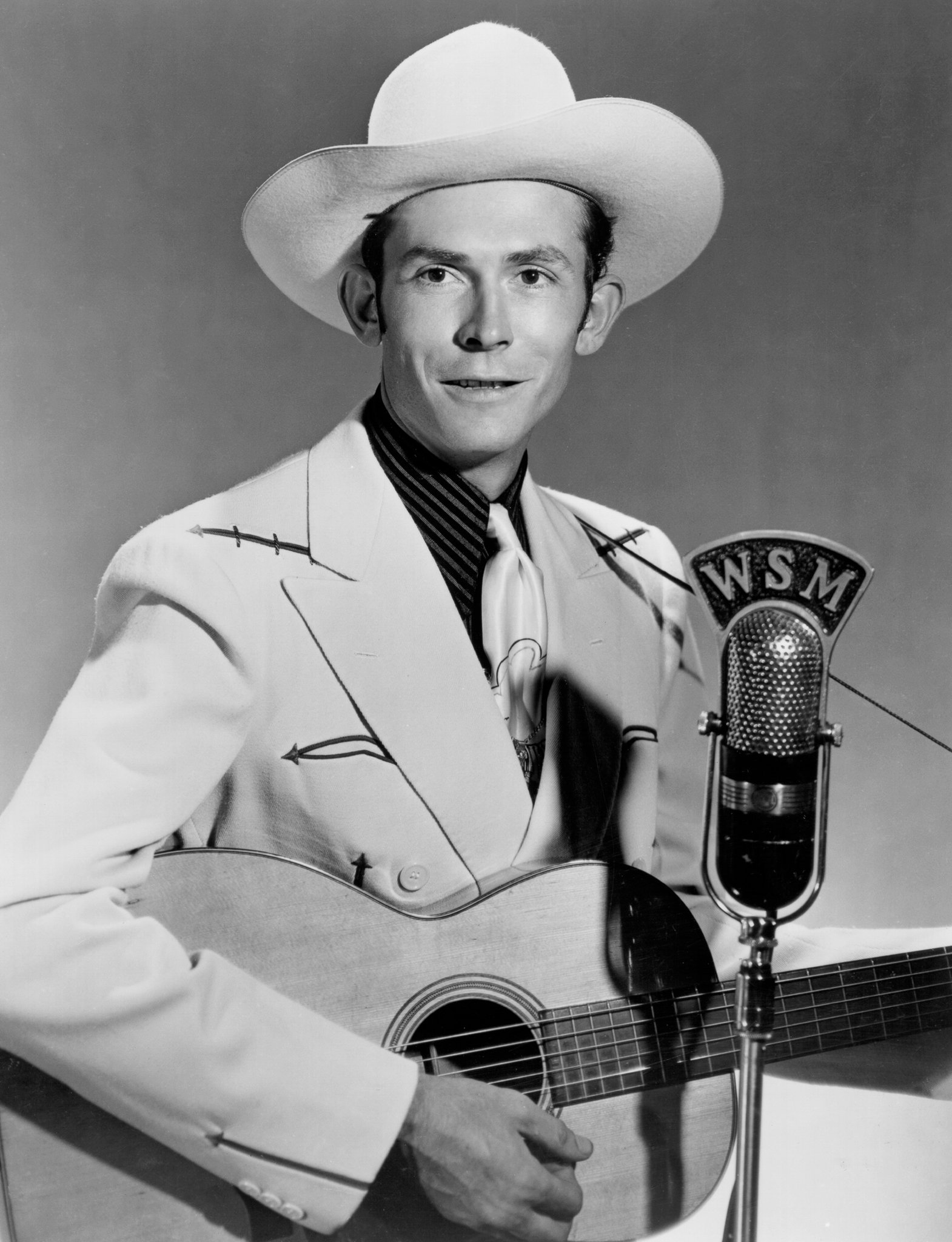
Like many musical terms discussed in this chapter, country music has come to define a broad variety of musical styles encompassing bluegrass, hillbilly music, contemporary country, and others. Generally speaking, most types of music that fall under this category originated in the American South, although it also encompasses Western swing and cowboy songs. Country music often features a singing style with a distinctly rural Southern accent, as well as instrumentation that favors string instruments such as the banjo, guitar, or fiddle.
Bluegrass and Hillbilly Music
https://upload.wikimedia.org/wikipedia/commons/f/f1/Bill_Monroe_in_1946.jpg

Bluegrass
Bluegrass music is a variation of country music that developed largely in the Appalachian region; it features fiddle, guitar, mandolin, bass guitar, and the five-string banjo. Often associated with Appalachia, bluegrass combines many of the song forms that are common in the region’s Scottish and English musical heritage. For example, bluegrass blends the Scottish and English ballad with blues inflections. Some bluegrass songs are fast instrumental pieces featuring amazing technique by the performers.
Ricky Skaggs — “Bluegrass Breakdown”
Hillbilly Music
Hillbilly music was an alternative to the jazz and dance music of the 1920s. It was portrayed as wholesome and as the music of the “good old days.” Nashville’s Grand Ole Opry radio show became a very successful weekly network radio broadcast heard nationwide. Noticing an opportunity, record companies soon opened offices in Nashville. Country music became a source of big money for producers, songwriters, and artists.
The Hillbillies — “Cluck Old Hen” [1927]
Honky-Tonk and Western Music
https://upload.wikimedia.org/wikipedia/commons/8/88/Hank_Williams_MGM_Records_publicity_photo.jpg

Honky-Tonk
Honky-tonk music developed as hillbilly music went west to entertain in saloons called “honky tonks.” Many of the songs dealt with subjects associated with honky tonks, such as infidelity and drinking. Although the first use of the term “honky tonk” referred to a ragtime-like piano style, it later came to refer to a country combo style that became quite popular in the 1940s and 1950s.
Hank Williams — “Honky Tonkin’” [1948]
Western Music and Western Swing
Western music refers to music composed about the Great American West, such as the cowboy songs heard in movies of the 1930s and 1940s by singers such as Gene Autry and Roy Rogers.
One variation of this genre, Western swing, developed in Austin, Texas, and other western cities and borrowed instruments from the dance band, including saxophones, trombones, trumpets, piano, bass, and drums.
Mitch Ballard & The Western Swing Machine — “Ace in the Hole”
Contemporary Country Music
https://upload.wikimedia.org/wikipedia/commons/e/e7/Carrie_Underwood_November_2016.jpg

Contemporary country music has become a mixture of rock rhythm sections and a singer singing with a country accent about many of the same topics that traditional country singers have used over the decades. Contemporary country artists often use electric guitars, electric steel guitar, electric bass, keyboards (often synthesizers), and drum set. Country music is still big business, selling millions of units per year.
Carrie Underwood and Miranda Lambert — “Something Bad”
This page titled 5.5.5: Country Music was last modified on Sun, 23 Aug 2026 00:58:47 GMT and is shared under a CC BY-SA 4.0 license and was authored, remixed, and/or curated by Clark, Heflin, Kluball, and Kramer (GALILEO Open Learning Materials) via source content that was edited to the style and standards of the LibreTexts platform.
The book could not be loaded just now.