Opening the book…
What Is the Renaissance?
The term Renaissance literally means “rebirth.” As a historical and artistic era in Western Europe, the Renaissance spanned from the late 1400s to the early 1600s. The Renaissance was a time of waning political power in the church, somewhat as a result of the Protestant Reformation. Also during this period, the feudal system slowly gave way to developing nation-states with centralized power in the courts. This period was one of intense creativity and exploration. It included such luminaries as Leonardo da Vinci, Christopher Columbus, Ferdinand Magellan, Nicolaus Copernicus, and William Shakespeare. The previous medieval period was suppressive, firmly established, and pious. The Renaissance however, provided the thinkers and scholars of the day with a revival of Classical (Greek and Roman) wisdom and learning after a time of papal restraint. This “rebirth” laid the foundation for much of today’s modern society, where humans and nature rather than religion become the standard for art, science, and philosophy.
https://upload.wikimedia.org/wikiped..._of_Athens.jpg
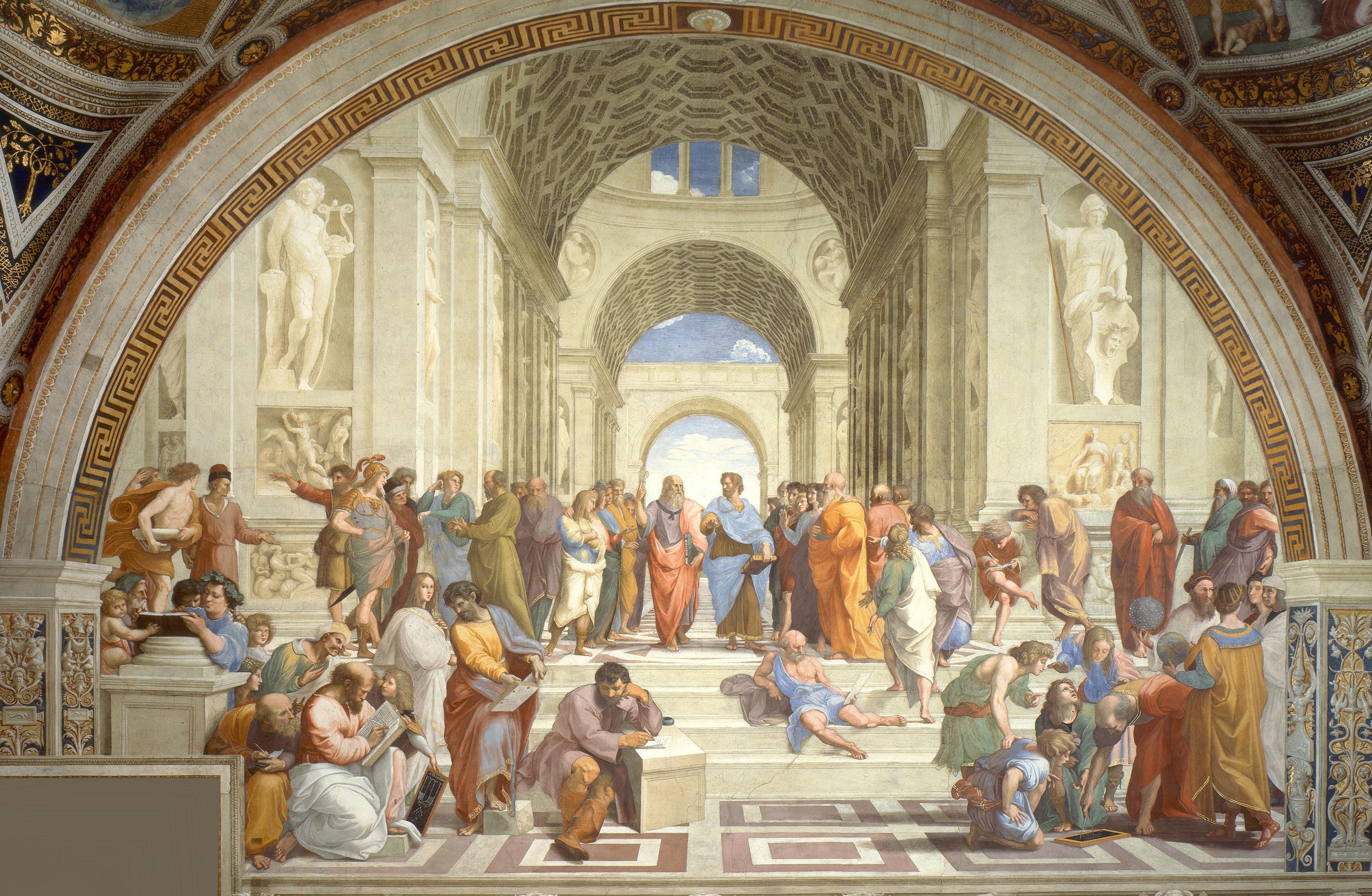
Occurrences at the end of the Middle Ages accelerated a series of intellectual, social, artistic, and political changes and transformation that resulted in the Renaissance.
By the 1500s, Catholic liturgical music had become extremely complex and ornate. Composers such as Josquin des Prez and Palestrina were composing layered Masses that utilized musical textures such as polyphony and imitative counterpoint (more on these techniques later). The mass is a sacred choral composition historically composed as worship liturgy.
The complexity of the music in the Catholic Mass garnered criticism from Martin Luther, a Roman Catholic priest and the eventual father of the Protestant Reformation, who complained that the meaning of the words of the mass, formal worship liturgy, were lost in the beautiful polyphony of the music. Also, Catholic Masses were always performed in Latin, a language seldom used outside the church. Early Protestant hymns stripped away contrapuntal textures, utilized regular beat patterns, and set biblical texts in German. Martin Luther himself penned a few hymns, many of which the great classic composer Johann Sebastian Bach would revisit about 125 years later.
The School of Athens (1505), Figure 3.1.1, by Raphael demonstrates the strong admiration, influence, and interest in previous Greek and Roman culture. The painting depicts the Greek philosophers Aristotle and Plato (center), with Plato depicted in the likeness of Leonardo da Vinci.
Musical Timeline
| Sort Year | Date | Type (History & Society / Music) | Title | Description | Image URL | Image Alt Text | Further Study Link |
|---|---|---|---|---|---|---|---|
| 1440 | 1440 | History & Society | Gutenberg’s printing press | Movable-type printing accelerates the circulation of books, ideas, and eventually printed music. | https://upload.wikimedia.org/wikipedia/commons/9/96/Gutenberg_press.png | Replica of a Gutenberg-style movable-type printing press. | |
| 1453 | 1453 | History & Society | Fall of Constantinople | The Ottoman conquest reshapes trade, politics, and the movement of Greek scholarship into Western Europe. | https://upload.wikimedia.org/wikipedia/commons/f/fa/Constantinople_1453.jpg | Fifteenth-century manuscript image depicting the Ottoman siege of Constantinople in 1453. | |
| 1456 | 1456 | History & Society | Gutenberg Bible | One of Europe’s first major books printed with movable type demonstrates the new power of mass reproduction. | https://upload.wikimedia.org/wikipedia/commons/6/6c/Loc-gutenberg-bible.jpg | A copy of the 42-line Gutenberg Bible displayed at the Library of Congress. | |
| 1475 | c. 1475 | Music | Josquin des Prez: Ave Maria | Imitative polyphony becomes a defining Renaissance sound as voices enter with related melodic ideas. | https://upload.wikimedia.org/wikipedia/commons/8/8e/Josquin_des_Prez.jpg | Early printed portrait traditionally identified as Renaissance composer Josquin des Prez. | |
| 1482 | c. 1482 | Music | Botticelli: La Primavera | Classical mythology and human-centered beauty become major subjects in Renaissance visual art. | https://upload.wikimedia.org/wikipedia/commons/8/88/Primavera_(Botticelli).jpg | Sandro Botticelli's Primavera, showing mythological figures in a garden. | |
| 1492 | 1492 | History & Society | Columbus reaches the Americas | European Atlantic expansion begins a new era of colonization, exchange, exploitation, and cultural contact. | https://upload.wikimedia.org/wikipedia/commons/b/b4/Landing_of_Columbus_(2).jpg | Historical depiction of Christopher Columbus landing in the Americas. | |
| 1503 | c. 1503 | Music | Leonardo da Vinci: Mona Lisa | Renaissance artists pursue lifelike human expression, proportion, and spatial realism. | https://upload.wikimedia.org/wikipedia/commons/7/73/Leonardo_da_Vinci_-_Mona_Lisa_(Louvre,_Paris).jpg | Leonardo da Vinci's Mona Lisa. | |
| 1504 | 1504 | Music | Michelangelo: David | The monumental nude revives Classical ideals while celebrating the expressive power of the human body. | https://upload.wikimedia.org/wikipedia/commons/a/a3/EB1911_Plate_I._24,_Fig_5.jpg | Head of Michelangelo’s David, emphasizing the sculpture’s focused expression. | |
| 1505 | c. 1505 | Music | Raphael: The School of Athens | Ancient Greek philosophy is recast as a Renaissance ideal of learning, reason, balance, and perspective. | https://upload.wikimedia.org/wikipedia/commons/f/f2/The_School_of_Athens_by_Raffaello_Sanzio_da_Urbino.jpg | Raphael's School of Athens, with philosophers gathered in a monumental classical interior. | |
| 1517 | 1517 | History & Society | Martin Luther and the Ninety-Five Theses | Luther’s challenge to Catholic authority helps ignite the Protestant Reformation and transforms European worship. | https://upload.wikimedia.org/wikipedia/commons/b/b7/Martin_Luther_by_Cranach-restoration.jpg | Portrait of Martin Luther associated with Lucas Cranach the Elder. | |
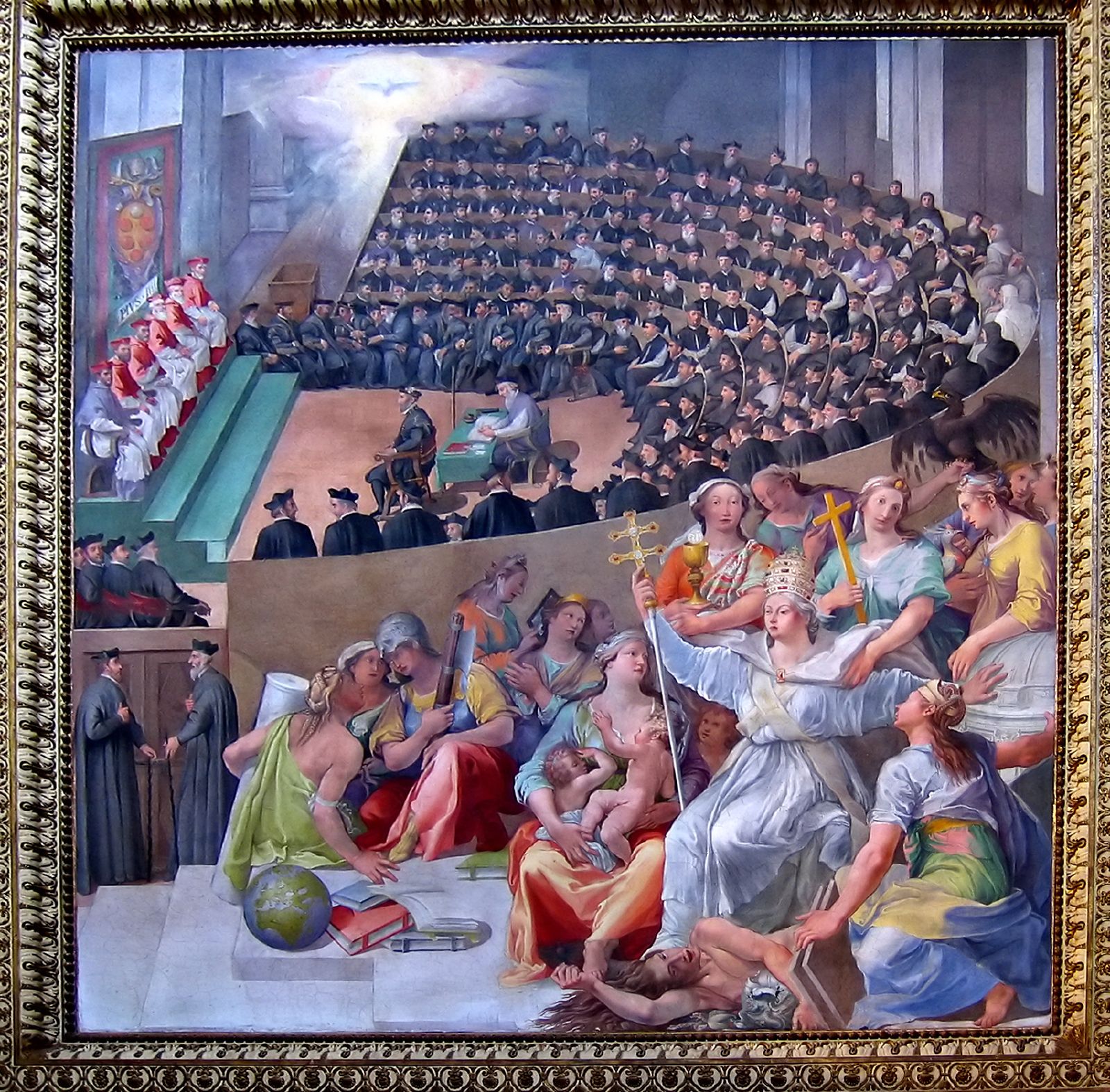
| 1545 | 1545–1563 | History & Society | Council of Trent | Catholic leaders respond to the Reformation and debate doctrine, worship, and the role of sacred music. | https://upload.wikimedia.org/wikipedia/commons/e/e6/Council_of_Trent_by_Pasquale_Cati.jpg | Pasquale Cati's depiction of the Council of Trent. | |
| 1558 | 1558–1603 | History & Society | Elizabeth I rules England | England’s political and religious identity stabilizes under a Protestant monarch while court culture flourishes. | https://upload.wikimedia.org/wikipedia/commons/7/7d/Elizabeth_I_Darnley_portrait_crop.jpg | The Darnley Portrait of Queen Elizabeth I of England. | |
| 1563 | 1563 | Music | Palestrina: Pope Marcellus Mass | Clear text setting and controlled polyphony become emblematic of Catholic sacred music after the Reformation. | https://upload.wikimedia.org/wikipedia/commons/1/18/Giovanni_Pierluigi_da_Palestrina.jpg | Portrait of Renaissance composer Giovanni Pierluigi da Palestrina. | |
| 1570 | c. 1570 | Music | Titian: Venus and the Lute Player | Classical subject matter, sensuality, and music meet in the visual culture of the late Renaissance. | https://upload.wikimedia.org/wikipedia/commons/4/45/Titian_-_Venus_and_the_lute_player_-_with_frame.jpg | Titian and workshop's Venus and the Lute Player. | |
| 1588 | 1588 | History & Society | Spanish Armada defeated | England’s defeat of the Spanish Armada shifts the balance of European political and naval power. | https://upload.wikimedia.org/wikipedia/commons/5/59/The_Spanish_Armada.jpg | Historical painting of the Spanish Armada and English fleet in 1588. | |
| 1597 | 1597 | Music | Shakespeare: Romeo and Juliet | Renaissance theater turns human desire, conflict, and tragedy into popular public entertainment. | https://upload.wikimedia.org/wikipedia/commons/a/a2/Shakespeare.jpg | The Chandos portrait, traditionally identified as William Shakespeare. | |
| 1601 | 1601 | Music | Thomas Weelkes: As Vesta Was Descending | The English madrigal combines word painting, lively imitation, and secular poetry for skilled amateur singers. | https://upload.wikimedia.org/wikipedia/commons/5/5f/Thomas_Morley-Madrigals_(1601).jpg | Title page of The Triumphs of Oriana, the 1601 madrigal collection containing Thomas Weelkes's As Vesta Was from Latmos Hill Descending. |




Renaissance Humanism
https://upload.wikimedia.org/wikiped...avid_plate.jpg

The Humanism movement is one which expressed the spirit of the Renaissance era that took root in Italy after eastern European scholars fled from Constantinople to the region bringing with them books, manuscripts, and the traditions of Greek scholarship. Humanism is a major paradigm shift from the ways of thought during the medieval era where a life of penance in a feudal system was considered the accepted standard of life. As a part of this ideological change there was a major intellectual shift from the dominance of scholars/clerics of the medieval period (who developed and controlled the scholastic institutions) to the secular men of letters. Men of letters were scholars of the liberal arts who turned to the classics and philosophy to understand the meaning of life.
Humanism has several distinct attributes as it focuses on human nature, its diverse spectrum, and all its accomplishments. Humanism syncretizes all the truths found in different philosophical and theological schools. It emphasizes and focuses on the dignity of man, and studies mankind’s struggles over nature.
Rebirth of Ancient Civilizations
Predecessors to the Renaissance and the Humanist movement include Dante and Petrarch. In 1452, after the fall of Constantinople, there was considerable boost in the Humanist movement. Humanism was accelerated by the invention of
the printing press, which permitted mass reproduction of the classical text—once only found in hand-written manuscripts—the availability of literature improved immensely. Thus, literacy among the common people increased dramatically. The scholastic and intellectual stimulation of the general public facilitated by Humanism initiated a power and knowledge shift from the land-owning upper class and the church to the individual. This shift facilitated and contributed to the beginning of the Reformation. As mentioned above, Martin Luther was a leading religious re- former who challenged the authority of the central Catholic Church and its role in governance, education, and religious practices. Like most other European groups of the era, the Humanists at the time, were divided in their support of the Reformation and counter-reformation movements.
Renaissance Art & the Human Figure
https://upload.wikimedia.org/wikiped...Fir_JBU001.jpg

Symmetry and Perspective
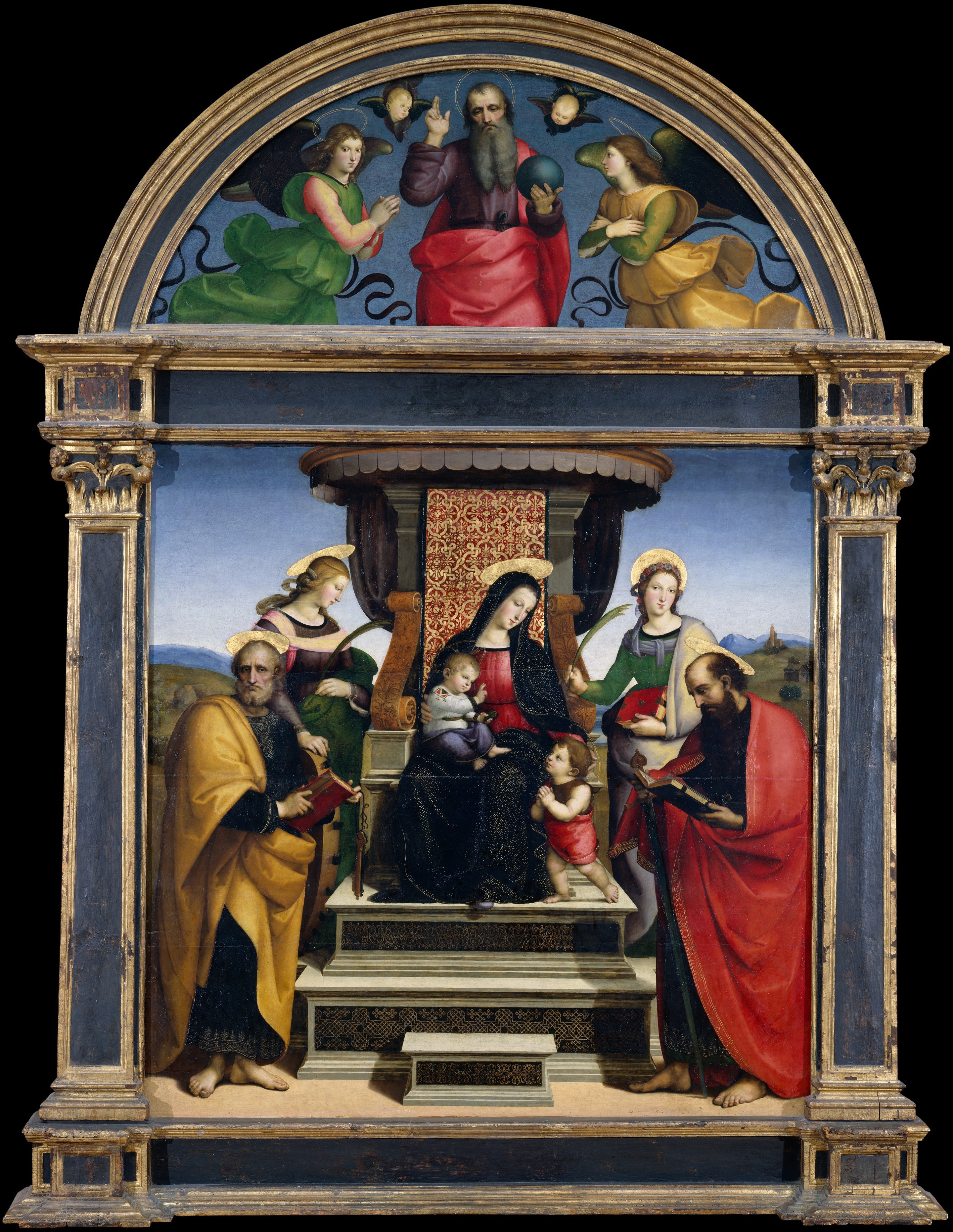
The shift away from the power and authority of the church between the Medieval period and the Renaissance period is not only evident in music but is also found in the visual arts. Artists and authors of the Renaissance became interested in classical mythology and literature. Artists created sculptures of the entire human body, demonstrating a direct lineage from ancient Greek culture to the Renaissance. In the Middle Ages, such depictions of the nude body were thought to be objects of shame or in need of cover. Artists of the Middle Ages were more focused on religious symbolism than the lifelike representation created in the Renaissance era. Medieval artists perceived the canvas as a flat medium/surface on which subjects are shown very two dimensionally. Painters of the Renaissance were more interested in portraying real life imagery in three dimensions on their canvas. See the evolution of the Virgin Mary from the Medieval period to the Renaissance period. You can see the shift from the religious symbolism to the realistic depiction of the human body features.
Raphael and Leonardo da Vinci focused on portraying realism, utilizing linear perspective and creating illusions of space in their works. A geometric system was effectively used to create space and the illusion of depth. This shift from the religious symbolism to the real portrayal of the human is representative of the decline of the church in the arts as well as music. Music outside of the church, secular music, increased in importance.
https://upload.wikimedia.org/wikiped...ith_Saints.jpg


Reformation, Print & Expansion
https://upload.wikimedia.org/wikipedia/commons/b/b7/Martin_Luther_by_Cranach-restoration.jpg
The Protestant Reformation
In the Middle Ages, people were thought to be parts of a greater whole: members of a family, trade guild, nation, and church. At the beginning of the Renaissance, a shift in thought led people to think of themselves as individuals, sparked by Martin Luther’s dissent against
several areas and practices within the Catholic Church. On October 31, 1517, Luther challenged the Catholic Church by posting The Ninety-Five Theses on the doors of the Castle Church in Wittenberg, Germany. The post stated Luther’s various beliefs and interpretations of Biblical doctrine which challenged the many practices of the Catholic Church in the early 1500s. Luther felt that educated/literate believers should be able to read the scriptures and become individual church entities themselves. With the invention of the Gutenberg Press, copies of the scriptures and hymns became available to the masses which helped spread the Reformation. The empowerment of the common worshiper or middle class continued to fuel the loss of authority of the church and upper class.
The Gutenberg Press
Few inventions have had the significance to modernization as the Gutenberg Press. Up until the invention of the press, the earliest forms of the books with edge bounding, similar to the type we have today, called codex books were hand produced by monks. This process was quite slow, costly, and laborious, often taking months to produce smaller volumes and years to produce a copy of the Bible and hymn books of worship.
Gutenberg’s invention of a much more efficient printing method made it possible to distribute a large amount of printed information at a much accelerated and labor efficient pace. The printing press enabled the printing of hymn books for the
middle class and further expanded the involvement of the middle class in their worship service-a key component in the reformation. Gutenberg’s press served as a major engine for the distribution of knowledge and contributed to the Renaissance, Scientific Revolution, and Protestant reformation.
Columbus’s Voyage and Renaissance Expansion
Columbus’s discovery of the New World in 1492 also contributed to the spirit and spread of the Humanist movement. The discovering of new land and the potential for colonization of new territory added to the sense of infallibility and ego of the human race. The human spirit of all social classes was invigorated. The invigoration of the middle class influenced the arts and the public’s hunger for art and music for the vast middle class population.
This page titled 1.5.1: Introduction & Historical Context was last modified on Sun, 23 Aug 2026 01:16:18 GMT and is shared under a CC BY-SA 4.0 license and was authored, remixed, and/or curated by Clark, Heflin, Kluball, and Kramer (GALILEO Open Learning Materials) via source content that was edited to the style and standards of the LibreTexts platform.
The book could not be loaded just now.