Opening the book…

Anatomy of the human eye

Anatomy of the human eye
The eye works like a Camera Obscura – a small, almost spherical chamber (Figure 2.43) where light enters via the cornea and through a small hole (the pupil). The iris controls how much light enters the eye through the pupil. Light then passes through a lens which can change shape to focus the image. The image is projected through a transparent, gel-like substance (vitreous humour) to the back of the eye (retina and macula), which contains light-sensitive cells. The retina is connected to the brain via the optic nerve.
Just like in a camera obscura, the image projected onto the retina is upside-down and reversed, but we learn to interpret the visual input the right way around.
What is perhaps the most interesting part of eye biology for colour theorists is how the cells in the retina are sensitive to light and colour and how this information is transmitted to the brain.

Figure 2.44. Overview of the retina photoreceptors. Schematic view of the eye with the retina at the back of the eye (the fundus), containing cones, rods and the intrinsically photosensitive retinal ganglion cells (ipRGCs) expressing the photopigment melanopsin. Image by Christine Blume, Corrado Garbazza & Manuel Spitschan on Wikimedia Commons, licensed under CC BY 4.0.
Retinal cells
Photons of light falling on the light-sensitive cells of the retina are converted into electrical signals that are transmitted to the brain by the optic nerve (Figures 2.44 and 2.45). The brain interprets this information as vision.

Figure 2.45. Photographic image of rod and cone cells of the retina. Image by: Helga Kolb, Rrods and cones of the primate retina, CC BY-SA 4.0, on Wikimedia Commons
There are three types of cells in the retina that convert light energy into electrical energy.
Rods
These cells respond to low-intensity light and help us to see low-resolution, black-and-white images – it’s why we can still see things in very low light. Animals that can see in the dark have more rods than we do.
Cones
These cells respond to high-intensity light and enable us to see high-resolution, coloured images.
Photosensitive ganglion cells
These cells respond to a full range of light intensities and help the eye adjust the amount of light that enters the eye and reaches the retina. Ganglion cells help define what we see – especially when it comes to recognising edges and borders.
Ganglion cells have also been discovered to regulate the hormone melatonin, and the circadian rhythm, which both help us have a regular sleep cycle. This is why it’s not good to look at your screen devices late at night because the blue light stimulates these cells and can inhibit natural sleep processes.
Cones – how do they detect colour?
There are two current theories about how cone cells detect colour, and they can both help us understand how colour vision works.
Trichromatic colour vision theory
Trichromatic theory of colour vision tells us that we have three different types of cone cells in our eyes – one each for red, green and blue. These cells are stimulated by different ranges of light waves, and it’s the combination of information from all three types of cells that makes up the millions of colours our brains can perceive. However, it doesn’t fully explain phenomena like how we can’t see “yellowish-blue” or “reddish-green”.
Opponent and complementary colour theories
The opponent process theory of colour tries to describe how the cone cells are more complicated than just red, green, and blue receptive. Instead, the cones have opposite reactions. Originally the opponent pairs were thought to be red-green, blue-yellow and black-white. But in recent times, complementary colour theory shows us that the three “opponent” pairs are red-cyan, green-magenta, and blue-yellow.
These are very complex theories that attempt to explain all the weird things that we see, like afterimage optical illusions. None of the theories described here are able to explain all of our visual experiences, but research continues to explore how our eyes and brain work together to see colour.
You can test the afterimage and complementary colour theory now – all you need is a white piece of paper or wall and the image in Figure 2.46.
Activity – afterimage optical illusion
Stare at the image in Figure 2.46 for 20 seconds (red square with a smaller white interior square). Then quickly look at a piece of white paper or a white wall and stare at the white area for a while.


Figure 2.46. Red Square with white interior. Image attribution: Red Square with white interior by Lisa Cianci, Creative Commons licence CC BY-NC-SA 4.0What you might briefly see is a faint afterimage of the opposite colours – a blurry cyan square with a smaller dark square inside it, as in Figure 2.47.This optical illusion can be explained by opponent theory. By staring at the red square for a long time, the cone cells become weaker at detecting red (or transmitting the red vision signal to the brain). Therefore, when you look away to the white paper, the white colour doesn’t register properly as white, it leaves out the red part of white light, and you only see the opposite colour – cyan.After a while, this illusion fades and your vision will return to normal.Figure 2.47. Red afterimage: cyan square with grey interior. Image attribution: Red afterimage: cyan square with grey interior by Lisa Cianci, Creative Commons licence CC BY-NC-SA 4.0
Chimerical colours – impossible or imaginary colours.
The afterimage in the experiment above is also known as a chimerical colour, after the mythical beast, the Chimera. Objects around us do not have imaginary colours, we use that term to describe colours we might see that are not part of normal vision. However, theoretically, there are mathematical descriptions of colours that are outside the visual colour space.
The cone cells in our eyes have sensitivities to short, medium and long wavelengths, and these sensitivities overlap a bit. We don’t usually see colour with only one type of cone at a time – it’s usually a mixture. An impossible colour might occur, for example, if we only saw green with the medium-length cone – we might see it as an extremely intense green. Something outside of the range of the CIELAB colour space.
Types of Chimerical colours (Figure 2.48)
Stygian
Stygian colours are both dark and impossibly saturated. You could see “stygian blue” by staring at bright yellow (to cause a dark blue afterimage), then looking at a deep black surface. The blue afterimage is viewed over the black, and simultaneously as dark as the black.
Self-luminous
The experiment using Figure 2.46 is an example of self-luminous colour. The cyan afterimage is self-luminous and might appear even brighter than the white paper you are looking at.
Hyperbolic
This is an impossibly highly saturated colour (hyperbolic means exaggerated). You can try an example of this more intense and highly saturated colour by changing the experiment using Figure 2.46.
Try the experiment again, and this time, after you focus on the red square (Figure 2.46), look straight at the blurry cyan square below it (Figure 2.47). You should see an impossibly bright cyan – brighter than any colour you could see with normal light.
Eye fatigue template for impossible colours

Figure 2.48. Diagram for viewing “impossible” chimerical colours that are only accessible via fatigue effects in the human eye. Image attribution: Lisa Cianci, adapted from an image by Zowie at English Wikipedia, Chimerical-color-demo, CC BY-SA 3.0, on Wikimedia Commons
How the brain interprets colour information
Binocular vision
As stated in the Optics section on 3D glasses, we have two eyes, yet only see one image. The brain processes a lot of visual information that comes from two sources at the same time, and it puts this all together to make one image that allows us to interact with the world around us. There are many complex processes happening very quickly, all at once. It is thought that around 40% of the brain’s function is used for processing vision.

Figure 2.49. Human brain, adapted from an image by Patrick J. Lynch via Wikimedia Commons, licensed under CC BY 2.5.
The optic nerve connects the retina at the back of the eye to a part of the brain called the thalamus (Figure 2.49). The thalamus processes the information from both eyes and sends it to another part of the brain – the visual cortex in the occipital lobe. The visual cortex contains cells that detect different kinds of visual information, like colour, form and movement. It puts all of this information together into what we perceive as an image. This image is then sent to the prefrontal cortex, which processes that information along with other information, like emotions and memories. This all helps us to not only see but to understand what we are seeing and make sense of objects, movement, depth perception, light and colour.
Watch this video for more information
Media attribution: How Your Eyes Make Sense of the World | Decoder, National Geographic, on YouTube
The way we perceive colour is subjective and can depend on how we are seeing the environment, the lighting, and the positioning of colours next to each other. This relates to the content in chapter 1, section 1.3 colour aesthetics, and the creative experiments done by artists and theorists like Johannes Itten and Josef Albers.
Is Magenta a real colour?
There was a recent online article claiming that magenta isn’t a real colour because it doesn’t exist on the colour spectrum. Of course, you could say that about any colour that isn’t visible on the spectrum as a single wavelength (like brown, for example) because our brains interpret many light wavelengths from the visible spectrum and mix the wavelengths for red and blue to make a colour that we see as magenta.
Read this Ars Technica article to understand the whole story.
Optical illusions
Optical illusions can tell us a lot about how our brains make sense of the light waves that enter our eyes. One of the most common illusions relates to relative colour and lightness. A colour can look completely different depending on what’s next to it.
The animation in Figure 2.50 is a good example of the concept. The moving square does not change colour at all, but our perception of the colour changes as the background colour blends from pink to green.
[Content couldn't be imported.]
It also helps explains recent viral social media phenomena like the striped dress – is it blue and black or white and gold?
Learn more about optical illusions here and watch this video for more information.
Media attribution: Optical Illusions show how we see | Beau Lotto, Ted on YouTube
This video discusses how what we see is subjective – can you really trust what you see?
Media attribution: Everything You See is Fake | Fractured Realities, BBC Earth Lab on YouTube
Colour blindness
Colour blindness is usually a genetic condition that you are born with. It is often a hereditary condition, which means that it is passed down from your parents, but there are other ways that people can become colour blind, including through disease or injury.
Colour blindness affects colour perception – most people with colour blindness can see clearly and can see some colours, but not all colours of the visible spectrum. Some forms of colour blindness affect more males than females. For example, the gene mutation responsible for red/green colour blindness is carried on the X chromosome. Males only have one X chromosome, and females have two, which means that females are less likely to have colour blindness because even if they have the mutated gene on one X chromosome, they have another one which may not have the mutation.

Figure 2.51. Comparisons of vision differences: normal trichromacy, deuteranopia, tritanopia and monochromacy. Image attributions:Q-lieb-in, Вечір на “інтегралі” – річка Південний Буг, CC BY-SA 4.0, Tohaomg, Deuteranopia sight, CC BY-SA 4.0, Tohaomg, Tritanopia sight, CC BY-SA 4.0, Tohaomg, Monochromacy sight, CC BY-SA 4.0
Types of colour blindness
Normal colour vision is called Trichromacy (tri means three, chroma means colour) where all three types of cone cells function properly.
Anomalous trichromacy is where normal trichromatic vision doesn’t work properly (Figure 2.51). The cones might still perceive light, but they are not perceiving the right range of light wavelengths. This can also have different levels of severity. Some people with anomalous trichromacy might not have trouble seeing a full range of colours, while others will have noticeable vision differences.
Types of anomalous trichromacy
- protanomaly – reduced sensitivity to red light
- deuteranomaly – reduced sensitivity to green light
- tritanomaly – reduced sensitivity to blue light (the rarest form)
Dichromacy (di means two) is where only two types of cone cells function properly. This means that there are parts of the visible spectrum that can’t be perceived by the brain.
Types of Dichromacy:
- protanopia – unable to see red light
- deuteranopia – unable to see green light
- tritanopia – unable to see blue light (the rarest form)
A common type of colour blindness is red/green colour blindness, but it’s more complex than not being able to see red or green. The type and severity may be different for each person. Learn more about red/green and other types of colour blindness here.
Monochromacy (achromatopsia)
Monochromacy (mono means one) is where no colour can be seen at all – everything appears to be in black and white with shades of grey. This form of colour blindness is rarer than Dichromacy (Figure 2.52).

Figure 2.52. A comparison of the visible colour spectrum in common types of colour blindness. diagram. Image attribution: SyntaxTerror, Color blindness, marked as public domain, more details on Wikimedia Commons
Watch this video for more information about colour blindness:
[Content couldn't be imported.]
How do I know if I am colour blind?
Some people may not be aware that they have colour blindness – especially if it’s not severe. Other people may find out early or late in their lives. If you think you might be colour blind, there are websites with online tests that you can try for red/green colour blindness, but not for blue colour blindness.
You can see your doctor if you think you may have colour blindness or vision difference. Professional testing is recommended for certain professions like pilots, astronauts, truck drivers, and designers or creative people working with colour. One of the disadvantages of colour blindness, apart from not seeing a full spectrum of colours, is understanding common communication devices, like traffic lights, which are red, amber and green.
Activities – test yourself
The Ishihara 38 plate CVD test is a popular test you can try now for red/green colour blindness (Figure 2.53). It uses circles with coloured dots that display numbers or lines. If you have a red/green colour vision problem, you may find it difficult to see the numbers and lines in many of these circles.
Ishihara Plate 9 – Can you see a number in this image?


Figure 2.53. Ishihara Plate 9. Image attribution: Original: Shinobu Ishihara creator QS:P170,Q530761 Derivative work: Pbrks, Ishihara 9, marked as public domain, more details on Wikimedia Commons

The Farnsworth-Munsell hue test is for the arrangement of colours – whether you can see the slight differences in a gradient between two colours can tell you if you have a colour deficiency.
These resources contain information and self-test activities to learn more about colour blindness.
Vision difference: tetrachromacy and synesthesia
Not everyone sees the same colours or perceives the world around us in the same way. Here are two examples of vision difference:
Tetrachromacy
Tetrachromacy (tetra means four and chroma means colour) is the name for having four types of cone cells in the eye to perceive colour. It is common in the animal world, but not normal in humans. However, some female humans are tetrachromats and can see a wider range of colours than normal trichromats.
Research is ongoing to determine how this works. One theory suggests that it’s related to colour blindness, and the reason it only affects females is because they have two X chromosomes. If a person has one X chromosome with the mutant gene for colour blindness, and the second X chromosome is normal, then this might cause tetrachromacy. This theory speculates that if a person has two different kinds of red/green cone cells that detect different wavelengths of light, they will have the ability to see more colours. Some tetrachromats may also be able to see better in low light conditions.
Watch this video to learn about an artist with tetrachromacy:
Media attribution: Seeing colours nobody else can – Incredible Medicine: Dr Weston’s Casebook | Episode 2 – BBC 2, BBC on YouTube
Synesthesia and colour sensory perception
Synesthesia is a neurological condition where you experience one sense through another. An example of synesthesia is hearing music and seeing coloured shapes or for some synesthetes, associating certain numbers or words with particular colours. It’s not only colour-related, though. For some people, hearing certain sounds causes tingling sensations in different parts of their bodies. There are many different kinds of synesthesia.
Synesthesia is a type of neurodiversity, and appears at a higher rate in people with other types of neurodiversity such as Autism Spectrum Disorder, or people who identify as transgender or gender variant. Quite a few visual artists and musicians have synesthesia – it’s possible this cross-wiring of the senses can be a benefit to creative practitioners. Some people with synesthesia have incredible memories too, which could be due to how the brain associates sensory input and how it is stored in memory.
Two of the more common forms of synesthesia are:
- Chromesthesia – Sound to colour
- Grapheme-colour synesthesia – letters and numbers to colour
Watch this video for more information:
Media attribution: What color is Tuesday? Exploring synesthesia – Richard E. Cytowic, Ted Ed on YouTube
Synesthesia and creativity
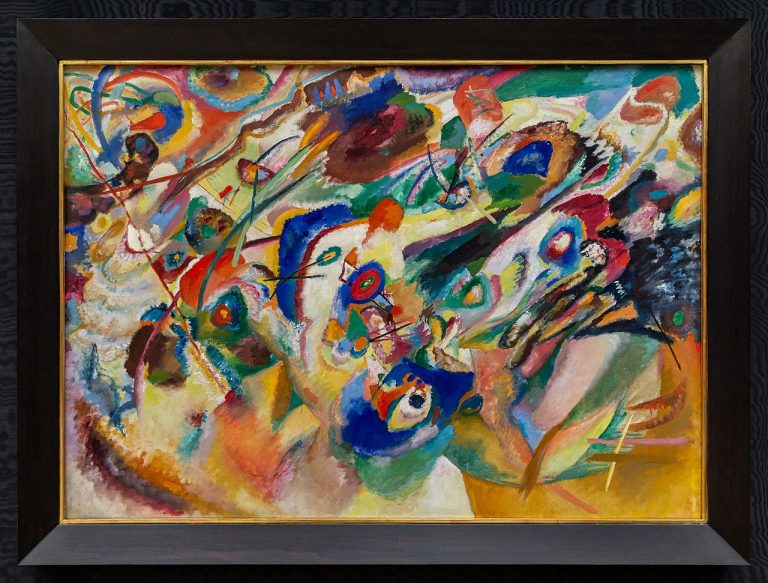
Visual artists from history who were known to have Chromesthesia (sound to colour) include: Wassily Kandinsky (Figure 2.54), Vincent Van Gogh, David Hockney, and Arcimboldo (he had vision and taste Synesthesia also).

Learn more from these links:
Contemporary artists with synesthesia
There are many popular musicians who also have chromesthesia – can you search the Internet and find some that you know about?
This synesthesia FAQ (frequently asked questions ) web page has some useful information if you want to learn more.
Note: A study that indicated more females have synesthesia than males may not be accurate due to the bias that more females would be likely to self-refer for the study.[1]
Accessible colour
Using accessible colour is important in the media and objects we interact with in everyday life. This enables the greatest number of people to see and understand what is communicated. As explained in the previous sections about vision difference, not everyone can see the same range of colour or light, and some people have other vision problems that make it difficult to see. This is particularly relevant for reading text and for viewing visual communications content like maps, diagrams, charts and infographics that present information in very visual and colourful ways.
If you are a designer working with print or digital media, knowing about accessibility and how to make sure your content is accessible is very useful for creating content that can engage with a wide audience, and promote values like equality and fairness in branding for products and services.

Universal, Inclusive and Equity focused design – what are they?
Universal, inclusive and equity-focused design are concepts and principles that can assist you as a designer. They can ensure you consider all user needs when creating all kinds of products, buildings, online content, and anything that goes through a design process.
- Universal design principles are about making sure your design is accessible to everyone.
- Inclusive design principles include focusing on user groups that might have special needs or who might be otherwise excluded.
- Equity-focused design principles are proactive in working with user groups who are minorities or have special needs to create solutions and form ongoing relationships with those communities.
You can use one or more of these as part of your design methodology. Read this article for more information: Universal, Inclusive and Equity-Focused Design: Why They are Critical for Your Website.
What does this mean for accessible colour in art and design?
Planning your colour schemes and relationships for creative work should involve careful consideration of accessibility issues that might impact your audience. Examples of accessible colour for both print and digital media include:
- using appropriate contrast (light and dark) in text and background colour
- using colour combinations (hue, saturation and lightness) in text and graphics that people with colour blindness can see
- having enough space around colour elements so they are not confusing to understand
- having text at the appropriate size and weight, or allowing resizable text
- including warnings for moving or flashing colours and images that can trigger seizures in some people.
Example of good and bad colour combination for accessibility
| Red text is bad on black | Yellow text is good on black |
|---|---|
| Cyan text is bad on orange | Black text is good on orange |
| Magenta text is bad on green | Black text is good on green |
| Green text is bad on blue | White text is good on blue |
| Grey text is bad on grey | White text is good on grey |
Figure 2.56. Examples of good and bad colour combinations for accessibility. Image attribution: image by Lisa Cianci, Creative Commons licence Attribution-Non-commercial-ShareAlike-4.0. Select image to enlarge.
This Mozilla article gives a good overview of understanding colour accessibility for the Web.
The World Wide Web Consortium (W3C) has a Web Accessibility Initiative (WAI), which develops standards and support materials to help you understand and implement accessibility in your online content.
Activities: using tools and resources for accessible art and design
Activity 1.
Try testing the colours of your own website or print graphics to see if they have good accessibility. If not, how can you tweak your colour palette to have more accessible text and graphics?
There are many free online tools that you can use in your art and design work to check that the colour combinations you are using are accessible and comply with W3C standards. Most of these are checking foreground and background colour contrast for text and graphics. Here are three examples:
Activity 2.
If you’re planning an exhibition or creative event, whether online or in a physical space, make a checklist based on information in the resources listed here. You can work through each item in your checklist to ensure your event has the best accessibility you are able to provide. That might include things like the colour of signs and labels, easy-to-read instructions with adequate fonts, lighting, arrangement of artworks, etc.
These links and resources for artists and designers can help make your creative work more accessible:
- Access Arts resources
- Accessible Arts -accessible exhibition design
- Tangled art & disability – resources
- Arts Access Victoria
- Creative User Projects (Canada)
- Centre for Inclusive Design
- The A11y Project – resources
- W3C standards – accessibility
Activity 3.
Explore this topic further in a real world context in Learning Lab Contextualised Content
How animals see colour
The ideal gas law is easy to remember and apply in solving problems, as long as you get the proper values a

Figure 2.57. Spotted eagle owl. Image by jeanvdmeulen via Pixabay, licensed under CC0.
We humans are mammals and primates. The way we see colour is similar to many other animals. However, there is a wide range of colour vision in the animal kingdom, and many different kinds of eyes or “vision systems”. This is due to animals’ biological makeup, environment, and evolutionary history.
This page gives a short introduction to some of the weird and wonderful ways living creatures have evolved over millions of years to detect light and colour, and why it is useful to have colour vision. Studying colour vision in the animal world helps us understand visual systems and could lead to new discoveries in fields such as optics, chemistry and biology.
Topics covered on this page
As explained in other parts of this resource, colour is not a fixed attribute of an object. Colour is a property of the “visual system” of the animal that sees it. The same light wavelengths reflected or emitted from an object can be seen differently depending on the anatomy of an animal’s vision.[1]
Primates and other mammals

Primates mostly have good trichromatic colour vision, and humans may have the best colour vision of all primates. Most mammals have a mixture of rod and cone cells in the retina of the eye – just like humans – but the amounts of each type of light-detecting (photoreceptive) cells may differ between species. It is thought that being able to see colour is an advantage when searching for food. Being able to tell the difference between ripe (red and orange) and unripe (green) fruit on trees and plants, for example, makes it much easier to find things to eat.
Many mammals like cats, dogs, rabbits, cattle, sheep, and goats can only see a small amount of colour. These animals are mostly dichromats (they can only see two colours) and may only see pastel shades of blue and yellow. This means they have protanopia (red–green colour blindness).
Some mammals (like cats and wolves) have evolved so that their eyes contain more rods than cones, allowing them to see and hunt in the dark. It’s not much use having good colour vision in the dark (as explained in Why are things different colours? in this resource), but having lots of rods that can perceive subtle differences between light and dark is much better for detecting the movement of prey in dark environments.
Some sea mammals, like dolphins, can detect blue light very well – which is useful when underwater, but cannot differentiate between colours at all. Dolphin eye lenses can change shape to be able to see well both above and below water – they can do something called “spy-hopping”, where they raise their heads above water vertically to see their surroundings , accessed 12/01/2023">[2].
Birds, reptiles and sea creatures

Birds of prey, such as eagles and hawks, have excellent colour vision, with four types of cone cells (tetrachromacy), allowing them to see the visible spectrum plus ultraviolet light, which we humans cannot see. This ability helps these birds to locate prey from great distances. For other birds, tetrachromatic colour vision makes it easier to locate specific flowers, nectar and fruits, and is important in mating behaviours. Pigeons have five types of cone cells (pentachromacy), but owls, as nocturnal predators, have very little colour vision. Early research suggested that owls were completely colour blind, relying only on highly sensitive rod cells to detect light and dark. However, more recent studies have found that owls do have some colour vision. They have the ability to see ultraviolet at night and most likely do see some the visible spectrum during the dayUV-sensitive cone opsin and red oil droplets, but see UV light at night: Retinal transcriptomes and ocular media transmittance', Vision Research, Vol 158, Pages 109-119, https://doi.org/10.1016/j.visres.2019.02.005. (https://www.sciencedirect.com/science/article/pii/S0042698919300471), accessed 12/01/2023" data-quail-id="672">[3].
The gecko is a type of lizard that has a complex colour vision system, which has been the subject of many research studies. One of the most impressive features of gecko eyes is their excellent colour vision at night. Unlike many other lizards, which have only two types of cone cells (dichromacy), some gecko species have four types of cones (tetrachromacy), allowing them to perceive a wider range of colours.
Another interesting feature of gecko vision is the presence of oil droplets within the cone cells. These droplets act as filters, absorbing certain wavelengths of light and enabling a greater sensitivity to other wavelengths[4]. The exact function of these oil droplets in gecko colour vision is still not fully understood, but they are thought to play a role in improving the ability to tell the difference between colours, even in low-light environments.
Chameleons are well known for their ability to change colour, but they also have very good colour vision – possibly the best vision of all lizards. Chameleons have “double cones” and four types of single cone cells, but very few rod cells, which means they don’t see well in the dark. The cone cells also contain oil droplets like geckos. Chameleons can see a wider range of colours than humans can, including ultraviolet light, and their eyes can move and focus together or independently of each other (monocular and binocular vision). They can focus on objects at great distances because of the shape of their corneas and lenses. Chameleons (and certain other animals) also have a layer in their eyes called the tapetum lucidum, which reflects light and enhances their vision in low-light conditions.
Snakes do not have colour vision in the usual sense. They are able to distinguish between light and dark, but they cannot perceive different colours. However, some species of snakes have specialised receptors in pit organs on their faces that allow them to ‘see’ (or sense) infrared light, which helps them locate warm-blooded prey. This is not the same as photoreceptors in the eyes. However, it is a means of detecting wavelengths of electromagnetic radiation.
Octopuses and squids (cephalopod species) have good vision – although cannot detect colour. Their eyes are more similar to those of humans and other vertebrates than those of most other invertebrates, with a single lens and a retina that contains photoreceptor cells. However, the way these photoreceptor cells function in cephalopods is quite different from that of humans and other vertebrates. They also have a unique type of photoreceptor cell called a rhabdom that helps to detect polarised light, which is important for things like communication, navigation, and camouflage. If you’re wondering how colour changing octopus can detect colour in its surroundings to camouflage itself without seeing colour with its eyes, see this page: Colour chemistry 1: animals that can change colour (hint: they have special cells in their skin that can produce colour to mimic their environment)
In fish, the number and distribution of cone cells for colour vision vary depending on the species and the environment in which they live. For example, fish that live in shallow water with a lot of sunlight tend to have more cone cells than those that live in deeper water with less light. Some fish also have rhabdom cells that allow them to see polarised light, which they use for navigation and communication.
Crustaceans have a more complex visual system than fish, with a wider range of visual pigments and photoreceptor cells. Some crustaceans, like the mantis shrimp, also have a type of compound eye (like insects) called an apposition eye, which allows them to have high spatial resolution and sensitivity to small changes in light intensity. Mantis shrimp also have 12 types of cones – although these cones only show very narrow bands of light wavelengths, so they don’t see more colours than we do. Like fish and cephalopods, crustaceans also have rhabdom cells that allow them to see polarised light, and are also used for navigation and communication.
Insects, arachnids and other creepy crawlies

Insects and arachnids have evolved to have different types of colour vision. Insects, for example, have trichromatic colour vision, which allows them to see three primary colours: ultraviolet, blue, and green. In contrast, arachnids, such as spiders and scorpions, generally have dichromatic colour vision, which allows them to see two primary colours: blue and green – although there are exceptions to this.
Insects usually have compound eyes, which are made up of many tiny lenses called ommatidia. Some insects can have over 20,000 ommatidia in each compound eye, which can give them an almost 360-degree range of vision. Each ommatidium contains a single photoreceptor, and the brain processes the signals from many ommatidia to create an image. Most insects can see ultraviolet light, which is used to detect nectar and pollen and is also used in mating behaviours. For example, bumblebees are trichromats, like humans, but the light wavelengths their photoreceptors detect are in a different range to ours – closer to ultraviolet light.
Most spiders have eight eyes, and each eye has a single photoreceptor. Some spiders can only detect light, but cannot see in colour. However, some species of jumping spiders have excellent colour vision, with four types of photoreceptors (tetrachromacy).
It is thought that some species of butterflies have the most photosensitive receptors of all insects.
The bluebottle butterfly has 15 types of photoreceptor! With one type of cone stimulated by ultraviolet, another by violet, three by varying shades of blue, one blue-green, four by green and five by red light, the common bluebottle butterfly has five times as many colour photoreceptors as we do.[…] Researchers believe the butterflies only use four of their photoreceptors for day-to-day colour vision, while the others[sic] 11 are used in specific environments, such as picking out objects hidden in vegetation. viewed 12/01/2023">[5]
The exact anatomy and systems of colour vision in many different kinds of animals are still being studied. There is much that is not yet fully understood. We can study the anatomy of different eyes and how they detect light and colour, but we don’t exactly know how each animal’s brain interprets the information from photoreceptor cells like rods and cones.
The research to date has provided valuable insights into the evolution and function of colour vision in these animals. You can find out more about how different animals see colour by starting your own research online. You can visit the links on this page or search online or at the library to find books, journal articles and videos on this topic.
Media attribution: Watch: How Animals and People See the World Differently, National Geographic, on YouTube
Further reading on colour vision in animals
Color Matters – How animals see color
Wikipedia – Evolution of color vision
Ask A Biologist – Colors animals see
Cosmos Magazine – The incredible and bizarre spectrum of animal colour vision
Queensland Brain Institute – Colour vision in animals: a comprehensive overview
Natural History Museum UK, How do other animals see the world?
Natural History Museum UK, Amazing eyes: 17 vision champions
Gerl, E.J. and Morris, M.R. The Causes and Consequences of Color Vision. Evo Edu Outreach 1, 476–486 (2008). https://doi.org/10.1007/s12052-008-0088-x, accessed 12/01/2023
Kelber A. and Osorio D. 2010, From spectral information to animal colour vision: experiments and concepts, Proceedings of the Royal Society B., Biological Sciences, 277: pp.1617–1625 DOI:http://doi.org/10.1098/rspb.2009.2118, accessed 12/01/2023
- Gerl, E.J. and Morris, M.R. The Causes and Consequences of Color Vision. Evo Edu Outreach 1, 476–486 (2008). https://doi.org/10.1007/s12052-008-0088-x, accessed 12/01/2023
- Scoggins, J. 2016, "Colour and Vision in Dolphins", Sea Watch Foundation, <https://www.seawatchfoundation.org.uk/colour-and-vision-in-dolphins/>, accessed 12/01/2023
- Höglund J., Mitkus M., Olsson P., Lind O., et al (2019), 'Owls lack UV-sensitive cone opsin and red oil droplets, but see UV light at night: Retinal transcriptomes and ocular media transmittance', Vision Research, Vol 158, Pages 109-119, https://doi.org/10.1016/j.visres.2019.02.005. (https://www.sciencedirect.com/science/article/pii/S0042698919300471), accessed 12/01/2023
- Bowmaker, James & Loew, Ellis & Ott, Matthias. (2005). The cone photoreceptors and visual pigments of chameleons. Journal of comparative physiology. A, Neuroethology, sensory, neural, and behavioral physiology. 191. 925-32. https://doi.org/10.1007/s00359-005-0014-4., accessed 12/01/2023
- Smith, B. 2016 "The spectrum of animal colour vision", Cosmos Magazine, <https://cosmosmagazine.com/science/biology/the-incredible-and-bizarre-spectrum-of-animal-colour-vision/> viewed 12/01/2023
Test yourself: the eye – how we see colour
A multiple choice quiz to test your understanding of how the eye sees colour
(5 minutes or less)
How did you go?
If you need to learn more about this topic, you can read this section again: 2.3 The eye – how we see colour
This page titled 2.4: The Eye- How We See Colour was last modified on Fri, 23 Oct 2026 01:00:27 GMT and is shared under a CC BY-NC 4.0 license and was authored, remixed, and/or curated by Lisa Cianci.
The book could not be loaded just now.