Opening the book…
by DR. STEVEN ZUCKER and DR. BETH HARRIS
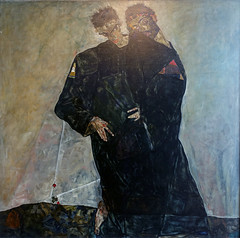
Video \(\PageIndex{1}\): Egon Schiele, The Hermits, 1912, oil on canvas, 71-1/4 x 71-1/4″ (Leopold Museum, Vienna)
Key points:
- The use of gold and fractured appearance of the background recall religious art of the medieval period, uniting the spiritual concerns of the past with the psychic interests of the modern age.
- Schiele’s visible use of paint creates an agitated feeling, reflecting Expressionism’s interest in our inner states of anxiety and tension.
- The figure on the right could reference the older Austrian artist Gustave Klimt. Since he has no eyes, he may also symbolize a prophet who possesses inner vision.
- Schiele described The Hermits as a poetic summary of his own experience, perhaps implying that the artist serves as a prophet in the modern age.
Smarthistory images for teaching and learning:


This page titled 3.2.10.3: The Hermits was last modified on Sun, 22 Jan 2023 02:57:13 GMT and is shared under a CC BY-NC-SA 4.0 license and was authored, remixed, and/or curated by Dr. Steven Zucker and Dr. Beth Harris, "Egon Schiele, The Hermits," in Smarthistory, November 28, 2015, accessed August 9, 2020, smarthistory.org/egon-schiele-hermits/. via source content that was edited to the style and standards of the LibreTexts platform.
The book could not be loaded just now.