5.10: Art and the individual

SmartHistory of Art IV - Africa · LibreTexts

0%

Contents

    Text

    Size
    100%
    Theme
    Typeface
    Line length
    Spacing

    Read aloud

    How

    Speed: 1×
    Light up
    Highlight

    Symbols: Mulberry Symbols, © 2018–2026 Steve Lee, CC BY-SA 4.0 (licence, the set), the site's own copies.

    From LibreTexts, under CC BY-NC-SA 4.0, as the source states it; its equations are written in TeX, which the PDF shows typeset. This page at LibreTexts.

    5.10: Art and the individual

    by DR. CHRISTA CLARKE

    Zlan of Belewale, Ceremonial Ladle (Wakemia or Wunkirmian), before 1960, Dan peoples, wood, fiber, metal, pigment, 13.3 × 58.4 cm (The Metropolitan Museum of Art)
    Figure \(\PageIndex{1}\): Zlan of Belewale, Ceremonial Ladle (Wakemia or Wunkirmian), before 1960, Dan peoples, wood, fiber, metal, pigment, 13.3 × 58.4 cm (The Metropolitan Museum of Art)

    While many kinds of African art are employed in communal contexts, others serve the needs of individuals. Domestic furnishings and objects of personal use, while practical in purpose, also have an aesthetic dimension. The artistic enhancement of objects of utilitarian function reflect and reinforce an individual’s standing and status in society. Details of form and decoration personalize an object, marking it as the property of a specific individual and, occasionally, providing information about ethnic affiliation, social status, or rank. At the same time, the artistic inventiveness and careful execution of such works clearly indicate a desire to integrate aesthetics into daily life.

    Detail, Pair of Diviner's Figures, Côte d'Ivoire, central Côte d'Ivoire, Baule peoples, wood, pigment, beads and iron, 55.4 x 10.2 x 10.5 cm (The Metropolitan Museum of Art)
    Figure \(\PageIndex{2}\): Côte d’Ivoire, central Côte d’Ivoire, Baule peoples, wood, pigment, beads and iron, 55.4 x 10.2 x 10.5 cm (The Metropolitan Museum of Art)

    Personal adornment and dress are important forms of aesthetic expression. Scarification and hairstyle, in particular, are regarded by Africans as means by which the body is refined and civilized. Specifics of bodily ornamentation are often depicted in fine detail on masks and figurative sculpture, indicating their importance as symbols of cultural, personal, and/or professional identity (example above). Dress is also a means of self-expression and definition. Certain forms of textiles identify the wearer by age or status and may also convey personal identity as well (example below). Textiles have also historically been conceived as a form of wealth and their extensive use comments upon the wearer’s access to riches.

    Married Woman's Apron (Ijogolo), 19th-20th century, South Africa, Ndebele peoples, leather, beads and thread, 75.6 x 67.3cm (The Metropolitan Museum of Art)
    Figure \(\PageIndex{3}\): Married Woman’s Apron (Ijogolo), 19th-20th century, South Africa, Ndebele peoples, leather, beads and thread, 75.6 x 67.3cm (The Metropolitan Museum of Art)

    Smarthistory images for teaching and learning:

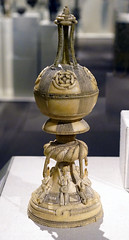
    Lidded Saltcellar

    Seated Figure (Tumba)

    Buli Master, possibly Ngongo ya Chintu, Prestige Stool
    Click on image for larger picture (External link to flickr)
    Lidded Saltcellar

    Ceremonial Palm Wine Vessel

    Ceremonial Palm Wine Vessel
    Click on image for larger picture (External link to flickr)
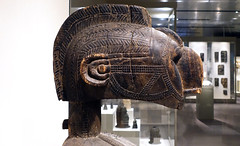
    Headdress: Female Bust (D'mba)

    Male and Female Poro Altar Figures (Ndeo)

    Ceremonial Palm Wine Vessel
    Click on image for larger picture (External link to flickr)
    Seated Figure (Tumba)

    Male and Female Poro Altar Figures (Ndeo)

    Buli Master, possibly Ngongo ya Chintu, Prestige Stool
    Click on image for larger picture (External link to flickr)
    Lidded Saltcellar

    Lidded Saltcellar

    Click on image for larger picture (External link to flickr)

    This page titled 5.10: Art and the individual was last modified on Sat, 06 Aug 2022 03:24:32 GMT and is shared under a CC BY-NC-SA 4.0 license and was authored, remixed, and/or curated by Smarthistory.