Opening the book…
“I can shake off everything as I write; my sorrows disappear, my courage is reborn.”
Anne Frank
To embrace feature writing is to abandon the rules that governed us in news: write short and tight, keep vocabulary simple. Feature writing still relies on facts, but now they are wrapped in more detail and narrative, the storytelling that brings in readers and keeps them reading.
Consider how you might approach a breaking news story, like a shooting outside a campus-area McDonald’s. The first story presents the facts: “A man is in critical condition after being shot in the parking lot of a campus-area McDonald’s early Sunday morning.” The story would give facts, with quotes from police and witnesses.
A follow-up feature, however, might tackle the story from the student’s point of view, describing in the lede how Joe Smith had stopped by the McDonald’s after a night out with friends.
Smith was just stepping up to the counter to place his order of a Big Mac and large fries when he heard it — pop, pop pop, like fireworks.
Only he knew it wasn’t fireworks.
And it wasn’t a backfiring car.
It was gunshots. And they were right outside.
We would follow with the who, what, when, where and how of this story — namely that 24 hours after a shooting near campus, students are still shaken by the crack in their perception of campus as a safe environment.
Notice that the writer will have central characters who we get to know and care about. This is feature writing.
The writing hourglass
Unlike news articles, in which the most important information is told first, followed by the next most important info, then the next most important information, all the way down to the least important information, features are written to be read from beginning to end.
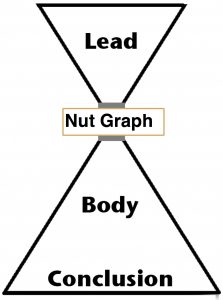
To do that, we have to write differently. And so we craft the feature writing hourglass.
The top of the hourglass is a narrative lede, pouring information and emotion toward a focused point that tells us what the article is about, which we call the nut graph.
Once the story passes through that nut graph juncture, it is clarified and focused and the body that follows (the bottom of the hourglass) supports the nut graph through examples and sources and anecdotes. The strong base of the hourglass holds up the story, providing a broad and fulfilling finish that is often a quote or anecdote.
The key to this structure is understanding how all aspects of the story are tied together and contained within the hourglass framework.
We can’t get into the story without a smooth flow of the lede toward and through the nut graph, which serves as the connector between the lede and the body. The body must then allow the ideas presented in the nut graph to broaden, but they have to stay connected to what is presented in the nut graph. No sand can flow outside of the hourglass, and no ideas can leave the framework presented in the nut graph.
The conclusion then lets the whole enterprise settle to completion and holds up the feeling of the story as being complete.
This page titled 3.2: Writing it Out was last modified on Sun, 05 Dec 2021 09:30:18 GMT and is shared under a CC BY-NC license and was authored, remixed, and/or curated by Nicole Kraft (Ohio State University Libraries) .
The book could not be loaded just now.