Opening the book…
The Current Interpretation
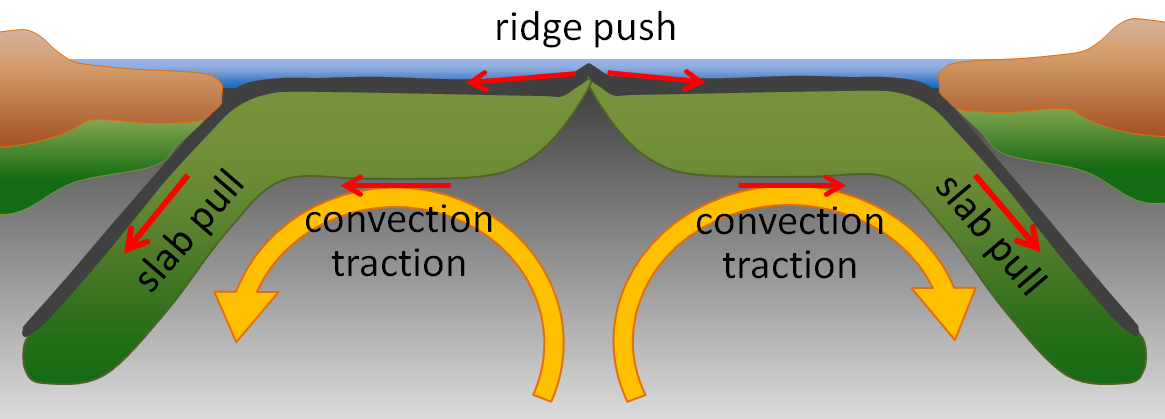
While there is still debate about the exact mechanisms for plate motion, the current interpretation calls for three factors: mantle convection, ridge push, and slab pull. Convection of the mantle, not unlike convection in a pot of water on the stove, circulates mantle material. Traction between the convecting mantle allows the overlying lithospheric plates to move.
Ridge push and slab pull are likely also key factors in plate motion: Ridge-push refers to gravity causing the lithosphere to slide down and away from the elevated mid-ocean ridges. Slab-pull also refers to gravity as the weight of the subducting slab drags the rest of the plate down into the mantle. (Figure \(\PageIndex{1}\))

Watch the following video to learn more about what drives plate motion:
Although ridge-push/slab-pull is the widely favored mechanism for plate motion, it’s important not to underestimate the role of mantle convection. Without convection, there would be no ridges to push from because upward convection brings hot buoyant rock to the surface.
References
- Kearey, P., & Vine, F. (1996). Global Tectonics (2nd E.). Oxford: Blackwell Science Ltd.
3.3: Mechanisms for Plate Motion is shared under a CC BY-NC license and was authored, remixed, and/or curated by Allison Jones.
The book could not be loaded just now.