Opening the book…
Most systems tend toward a state of equilibrium where system inputs are balanced by system outputs. Though natural systems change over long periods of time, on the scale of a human lifetime they appear to be static. In reality, the state of natural systems oscillates around a mean condition a state known as dynamic equilibrium. For instance, the abundance and type of animal species in an ecosystem may fluctuate over a time, but the overall diversity remains constant. The Earth's atmospheric temperature has remained fairly constant through long periods of Earth history, even though at shorter time intervals, geologically speaking, the temperature has risen or fallen. If one or more controlling variables (climate, vegetation, soil, man) imposes a long-term stress to the system it will seek to establish a new state. A steady-state equilibrium is reached when the rates of system inputs and outputs are equal, and the amount of material stored in the system is constant over time.
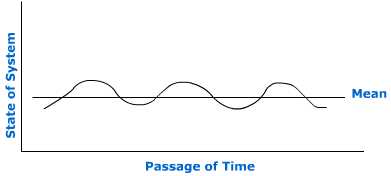
The state of the system is a result of feedback mechanisms between system components.
This page titled 2.3.4: System Regulation was last modified on Tue, 01 Sep 2026 02:23:54 GMT and is shared under a CC BY-SA 4.0 license and was authored, remixed, and/or curated by Michael E. Ritter (The Physical Environment) via source content that was edited to the style and standards of the LibreTexts platform.
The book could not be loaded just now.