Opening the book…
The carbon backbone of polyacetylene consists of alternating single and double bonds. Thus, there are two possible configurations: single-double-single-double or double-single-double-single.
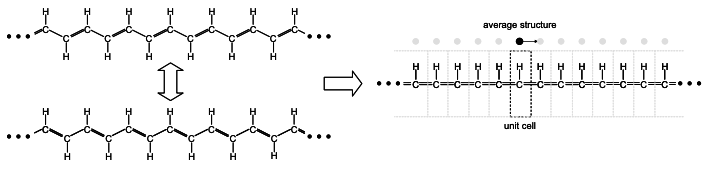
The simplest model assumes that every carbon atom in polyacetylene is identical. The carbon-carbon bonds are then an average of single and double, and the unit cell is a single carbon atom and its associated hydrogen atom. Under this model, to construct a polyacetylene chain, we should translate the primitive unit cell a distance \(a_{0}\). Thus the primitive lattice vector is \(\bf{\tilde{a_{1}}} = a_{0}\tilde{x}\), where we arbitrarily positioned the chain parallel to the x-axis.
6.10: Polyacetylene (average bond model) is shared under a CC BY-NC-SA 4.0 license and was authored, remixed, and/or curated by LibreTexts.
The book could not be loaded just now.