Opening the book…
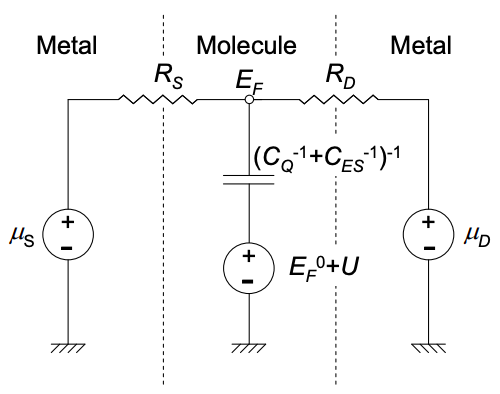
In the discussion of the establishment of equilibrium between a contact and a molecule we introduced a generalized circuit model where each node potential is the Fermi level, not the electrostatic potential as in a conventional electrical circuit.
We can extend the model to two terminal, and even three terminal devices. It must be emphasized, however, that the model is only valid for small signals. In particular, the model is constrained to small \(V_{DS}\). We assume that the density of states is constant and the modulation in \(V_{DS}\) must be smaller than \(kT/q\) so that we can ignore the tails of the Fermi distribution.
Let's consider current injected by the source
\[ I_{S} = \frac{q}{\tau_{S}}(N_{S}-N) \nonumber \]
This can be rewritten as
\[ I_{S} = \frac{q}{\tau_{S}}\int^{+\infty}_{-\infty} g(E-U)(f(E,\mu_{S})-f(E,E_{F}))dE \nonumber \]
For small differences between the source and drain potentials, and at T = 0K, we get
\[ I_{S} = \frac{C_{Q}}{\tau_{S}}\frac{(\mu_{S}-E_{F})}{q} \nonumber \]
Thus, each contact/molecule interface is Ohmic in the small signal limit. Defining \(R_{S} = \tau_{S}/C_{Q}\), and \(R_{D} = \tau_{D}/C_{Q}\).We can model the contact/molecule/contact as shown in Figure 3.9.1.
This page titled 3.9: A small signal circuit model was last modified on Sun, 22 May 2022 21:20:21 GMT and is shared under a CC BY-NC-SA 4.0 license and was authored, remixed, and/or curated by Marc Baldo (MIT OpenCourseWare) via source content that was edited to the style and standards of the LibreTexts platform.
The book could not be loaded just now.