Opening the book…
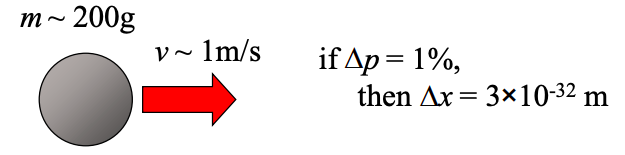
The uncertainty principle is not usually significant in every day life. For example, if the uncertainty in momentum of a 200g billiard ball traveling at a velocity of 1m/s is 1%, we can in principle know its position to \(\Delta x = (\hbar/2)/(0.2/100) = 3 \times 10^{-32} m\).
In nanoelectronics, however, the uncertainty principle can play a role.
For example, consider a very thin wire through which electrons pass one at a time. The current in the wire is related to the transit time of each electron by

\[ I =\frac{q}{\tau} \nonumber \]
where q is the charge of a single electron.
To obtain a current of I = 0.1 mA in the wire the transit time of each electron must be
\[ \tau = \frac{q}{I} \approx 1.6fs \nonumber \]
The transit time is the time that electron exists within the wire. Some electrons may travel through the wire faster, and some slower, but we can approximate the uncertainty in the electron's lifetime, \(\Delta t = \tau = 1.6fs\).\(^{†}\)
From Equation (1.19.1) we find that \(\Delta E = 0.2\ eV\). Thus, the uncertainty in the energy of the electron is equivalent to a random potential of approximately \(0.2 V.^{\S}\) As we shall see, such effects fundamentally limit the switching characteristics of nano transistors.
\(^{†}\) Another way to think about this is to consider the addition of an electron to the nanowire. If current is to flow, that electron must be able to move from the wire to the contact. The rate at which it can do this (i.e. its lifetime on the wire) limits the transit time of an electron and hence the current that can flow in the wire.
\(^{\S}\) Recall that modern transistors operate at voltages ~ 1V. So this uncertainty is substantial.
This page titled 1.20: Application of the Uncertainty Principle was last modified on Sun, 22 May 2022 21:20:22 GMT and is shared under a CC BY-NC-SA 4.0 license and was authored, remixed, and/or curated by Marc Baldo (MIT OpenCourseWare) via source content that was edited to the style and standards of the LibreTexts platform.
The book could not be loaded just now.