Opening the book…
For many materials loaded in uniaxial tension, the tensile stress on the material, σ, is directly proportional to the tensile strain , ε.
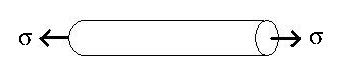
A sample loaded in uniaxial tension
The linear relationship between stress and strain is known as Hooke's Law,
σ ∝ ε
The constant of proportionality in this equation for simple tension is the Young Modulus of the material, E:
\[E=\frac{\sigma}{\varepsilon}\]
The Young Modulus of a material has values ranging from approx. 0.01 GPa for rubbers to approx. 1000 GPa for diamond.
Hooke's Law further states that the stress response of a material is independent of time and that the strain of a material disappears completely on removal of the applied stress (i.e. a Hookean material shows elastic deformation ).
This leads to a linear stress-strain curve with a gradient of E. Loading and unloading occur along the same curve.
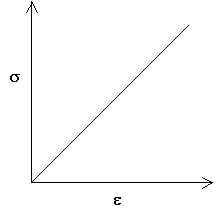
A stress-strain curve for a Hookean material
Most materials are Hookean only at small strains (typically less than 1%). Metals, for which fully elastic behaviour is only for very small strains (typically <0.2%), show Hookean behaviour. In this region, the extension is usually both linear and recoverable. At larger strains, extension is non-Hookean (i.e. either non-recoverable, or non-linear, or both).
Although many materials used in engineering applications show Hookean behaviour, only a few biomaterials approximate to it (wood and bone being the two most common). Many biomaterials exhibit a J-shaped stress-strain curve, but firstly, we shall consider the S-shaped stress-strain curve seen in rubbery materials.
This page titled 23.2: Hookean Elasticity was last modified on Thu, 24 Aug 2023 21:19:53 GMT and is shared under a CC BY-NC-SA 2.0 license and was authored, remixed, and/or curated by Dissemination of IT for the Promotion of Materials Science (DoITPoMS) via source content that was edited to the style and standards of the LibreTexts platform.
The book could not be loaded just now.