Opening the book…
In 1913, Inglis calculated what the stresses and strains were in an elastic plate containing an elliptical crack, with semi-axes b and c, and under an applied stress σ - applied vertically in this case.
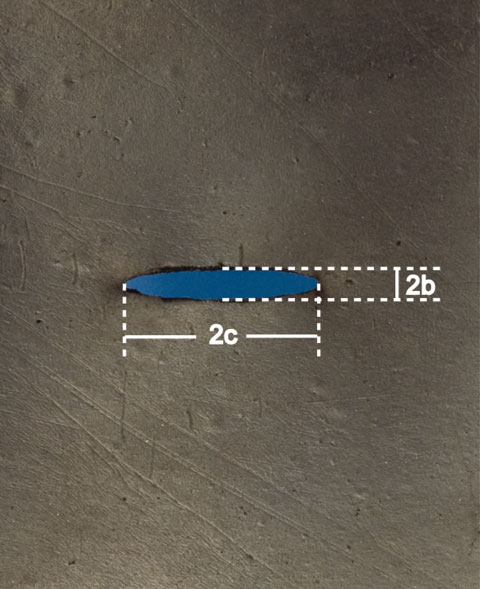
He found that the stress at the crack tip, σt , was given by
\[\sigma_{\mathrm{t}}=\sigma\left(1+2 \frac{c}{b}\right)\]
For a sharp crack, i.e. c >> b, the stress would be much greater at the crack tip So failure could occur by cracking because it’s only at a crack tip that the stress required to break a bond, or simultaneously break a given number of bonds in a unit area of material, is reached.
So far, so good, but σt depends on the SHAPE of the crack, i.e. c / b – and we know that the length is important.
By looking at crack tip stress fields using photoelasticity, we can see that stresses are indeed concentrated at crack tips. Inglis was correct about this.
It's the idea that a critical stress to break a bond is needed that is wrong.
This page titled 9.4: Inglis and the crack tip stress idea was last modified on Thu, 24 Aug 2023 21:19:46 GMT and is shared under a CC BY-NC-SA 2.0 license and was authored, remixed, and/or curated by Dissemination of IT for the Promotion of Materials Science (DoITPoMS) via source content that was edited to the style and standards of the LibreTexts platform.
The book could not be loaded just now.