Opening the book…
The rotational symmetry of a crystal places constraints on the shape of the conventional unit cell we choose to describe the structure. On this basis we divide all structures into one of 7 crystal systems. For example, for crystals with 4 fold symmetry it will always be possible to choose a unit cell that has a square base with a = b and γ = 90°:
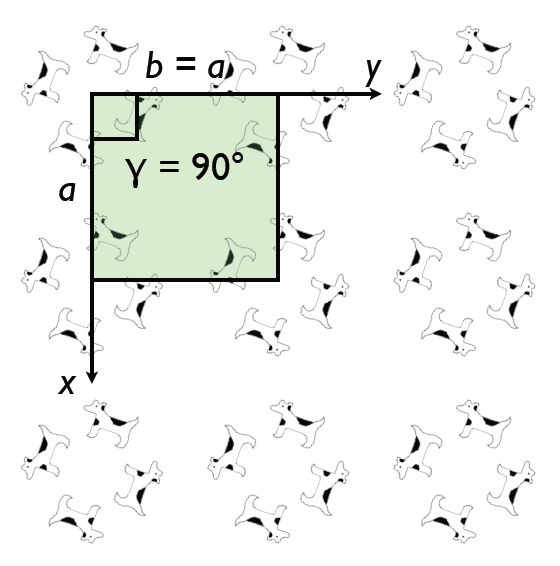
There are 14 unique combinations of the 7 crystal systems with the possible types of primitive and non-primitive lattices. These are referred to as the 14 Bravais lattices.
Crystal systems, lattices and symmetry elements
|
Crystal System |
Defining Symmetry |
Unit Cell Geometry |
|
|---|---|---|---|
|
Triclinic |
Translational Only |
a≠b≠c; α≠β≠γ |
|
|
Monoclinic |
A diad axis |
a≠b≠c; α=γ=90°; β>90° |
|
|
Orthorhombic |
3 diads |
a≠b≠c; α=β=γ=90° |
|
|
Trigonal For more information click here |
1 triad |
a=b≠c; α=β=90°; |
|
|
Hexagonal |
1 hexad (parallel to [001]) |
a=b≠c; α=β=90°; |
|
|
Tetragonal |
One tetrad |
a=b≠c; α=β=γ=90° |
|
|
Cubic |
4 triads |
a=b=c; α=β=γ=90° |
|
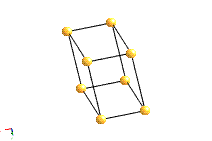
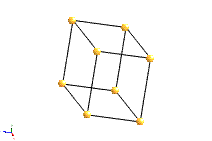
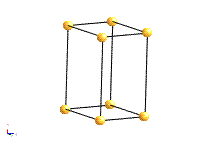
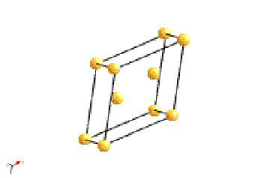
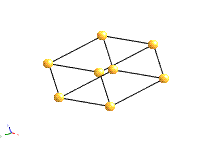
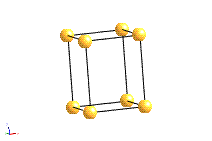
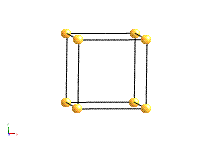
Bravais Lattice Structures
|
|
|
|
|
|
|
|
|
|
|
|
|
|
|
|
|
|
|
And you can use the Wolfram Demonstration Project Viewer to look at the Bravais lattices
This page titled 15.9: Crystal Systems was last modified on Thu, 24 Aug 2023 21:17:35 GMT and is shared under a CC BY-NC-SA 2.0 license and was authored, remixed, and/or curated by Dissemination of IT for the Promotion of Materials Science (DoITPoMS) via source content that was edited to the style and standards of the LibreTexts platform.
The book could not be loaded just now.