Opening the book…
After completing this section, you will be able to
- Describe the steps in the patent application process.
- Discuss the importance of proper claims drafting.
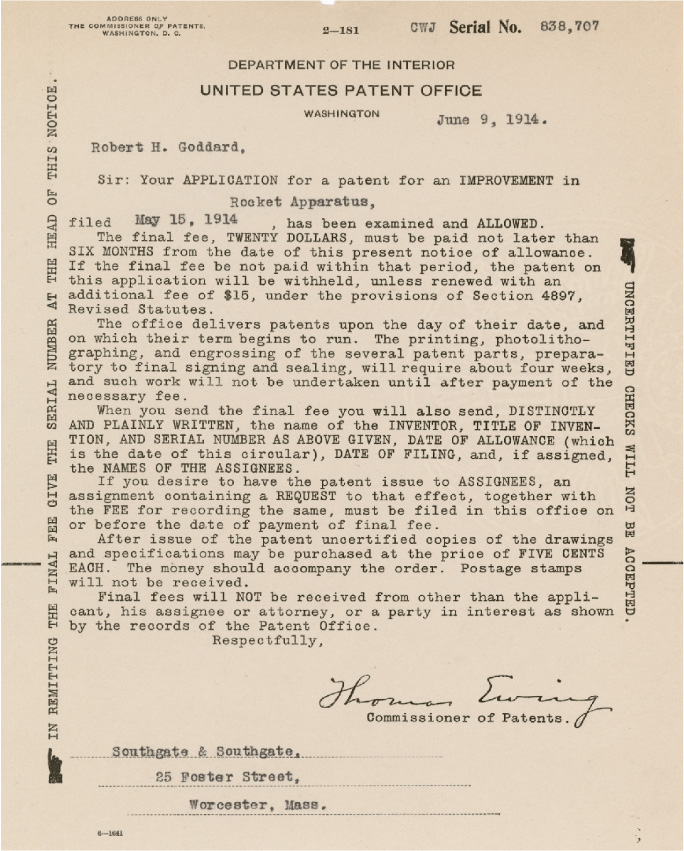
Figure \(\PageIndex{1}\): Notice of Examination and Approval of Patent Application. (credit: National Archives and Records Administration via Wikimedia Commons / Public domain)
Figure \(\PageIndex{1}\) is an image of an approved patent letter. The beginning of the letter to Robert H. Goggard reads "Your application for improvement in Rocket Apparatus dated May 15, 1914 has been examined and allowed."
Applying for a Patent
Much is at stake in the process of applying for a patent. Depending upon how you draft the claims and write the specification of your application, you could win or lose patent rights at any point in the examination process. In addition, any patent rights you win can be worth a considerable amount of money, and can be enforced by the U.S. federal courts.
An applicant must first determine whether to file an application for a utility, design, or plant patent. Then, the applicant must determine their filing status: large entity, small entity, or the new category of micro entity created by the America Invents Act of 2011 (AIA)(opens in new window). Small entities, which are universities, non-profits, and small businesses with fewer than 500 employees who also meet certain other criteria, receive a 50 percent discount on the application fees paid by large entities. Micro entities, which are small entities who have a gross income less than three times U.S. median household income or meet certain other criteria, receive a 75 percent discount. These discounts on United States Patent and Trademark Office (USPTO) fees for small and micro entities do not apply to the attorneys’ fees often involved in applying for a patent, which can be significant.
A utility patent is a type of patent that may be granted to anyone who invents or discovers a new and useful process, machine, article of manufacture, or composition of matter, or any new and useful improvements of these.[1]
A design patent is a type of patent that may be granted to anyone who has invented a new, original ornamental design for an article of manufacture. The ornamental characteristics must be embodied in or applied to such an article. The subject matter may relate to the configuration or shape of an article, surface ornamentation applied to it, or the combination of both. A surface ornamentation design is inseparable from the article to which it is applied and cannot exist alone. It must be a definite pattern applied to an article of manufacture.[1]
Provisional vs. Nonprovisional Patent Application
Finally, the applicant must decide whether to file an abbreviated, “provisional” patent application or a complete, “nonprovisional” one. A provisional application consists only of the specification describing the invention for which a patent is sought, as well as any drawings that might be necessary to understand the invention. A provisional application is not subject to examination, and is viable for one year.
The chief benefits of a provisional application are twofold. It is much less expensive to file than a regular nonprovisional application—only $1,000 in official fees for large entities, $500 for small entities, and $250 for micro entities. It also gives the inventor the benefit of the earlier provisional filing date of the nonprovisional application based on the same specification, while measuring the term of the patent from the nonprovisional application’s filing date.
In a sense, the provisional application serves as a placeholder for up to one year while the inventor does all the prior art searching, claims drafting, and other work required of a full and complete nonprovisional application. This priority date placeholder function can be important given that many companies and inventors are working on new products and services aimed at the same markets. This is especially so under the United States’ new “first inventor to file” rather than “first to invent” priority regime, which some fear may give an edge to large companies with the legal and financial resources to file early and often. To the extent this concern may be valid, provisional applications can serve to mitigate any large company filing advantage.
The main disadvantage of a provisional application is that because the written description cannot be changed when filing the follow-on, nonprovisional application, all the subsequent claims in that follow-on application must be completely consistent with the earlier description language. As most inventors can attest, the understanding of an invention and its potential market—as well as the claims best suited to protect it—inevitably evolves and matures over time.
Here’s how an experienced entrepreneur describes the value of a provisional application in the “first inventor to file” environment:
“What I recommend to every entrepreneur is that if you write a new, non-obvious, and useful line of code, put it in the specification of a provisional patent application and file it. It only costs $1,000 at most. You then have a year in which to honestly evaluate where the industry is going, where the market is going, and whether your invention is truly valuable enough to pursue a patent for it.”
A year might not seem very long. But a lot can happen to markets and to technology in that amount of time. Thanks to the rapid rise of smartphones, for example, it took merely a year for netbooks to go from the “next big thing” to “who cares?”
The specification of a nonprovisional utility patent application should have the following sections in order:
- Title of the invention — should be as short and specific as possible (no more than 500 characters), should appear as a heading on the first page of the specification (if not otherwise appearing at the beginning of the application).
- Cross-reference to related application, if any (may be listed on a data sheet, either instead of or along with being listed in the specification).
- Statement of federally sponsored research or development (if any) — for an invention made with U.S. government support and for which the U.S. government has certain rights, 35 U.S.C. 202(c)(6) and 37 CFR 401.14(f)(4) require the specification to contain a statement that the invention was made with such support. Here’s a sample wording: “This invention was made with government support under [identify the contract] awarded by [identify the federal agency]. The government has certain rights in the invention.”
- Names of the parties to a joint research agreement, if the claimed invention resulted from activities within the scope of such an agreement.
- Reference to a “sequence listing,” table, or computer program listing appendix submitted on an optical disc or via the USPTO electronic filing system and an incorporation by reference of the material on the optical disc. The total number of discs, including duplicates and the files on each disc, must be specified.
- Background on the invention.
- Brief summary of the invention — indicating its nature and substance (which may include a statement of the object of the invention), preceding the detailed description. The summary should be commensurate with the invention as claimed, and any object recited should be that of the invention as claimed.
- Brief description of views of the drawing (if any) — a description of the drawing views by specifying the numbers of the figures.
- Detailed description of the invention — description of the invention including the manner and process of its making and use;
- Required in full, clear, concise, and exact terms so that anyone skilled in the technology area to which the invention belongs or is most nearly connected to, can make and use it.
- Set forth the precise invention for which a patent is requested, distinguishing it from other inventions and from what is old. It must describe completely a specific embodiment of the process, machine, manufacture, composition of matter, or improvement invented; and must explain the best mode of carrying out the invention.
- For an improvement, the specification must point out the part(s) of the process, machine, manufacture, or composition of matter to which the improvement relate(s). The description should be confined to the specific improvement and to the parts that necessarily cooperate with it or are necessary to a complete understanding or description.
- At least one claim — particularly pointing out and distinctly claiming the subject matter regarded as the invention. The portion of the application setting forth the claims defines the scope of the patent protection and which questions of infringement are judged by the courts.
- More than one claim may be presented (they must differ substantially and not unduly multiplied). One or more claims may be presented in dependent form, referring back to and further limiting other claims in the same application. Any dependent claim referring back to more than one other claim is called a “multiple dependent claim.”
- Multiple dependent claims shall refer to such other claims in the alternative only. A multiple dependent claim shall not serve as a basis for another multiple dependent claim. Claims in dependent form will be understood to include all limitations of the claim referenced by the dependent claim. A multiple dependent claim will be considered to incorporate all the limitations of each of the particular claims in relation to which it is being considered.
- The claims must conform to the invention as set forth in the rest of the specification, and any wording in the description must be clearly supported so that their meaning may be understood in reference to the description.
- Brief abstract of the disclosure — must appear on a separate page (preferably following the claims), should be a single paragraph (150 words or less) under the heading “Abstract of the Disclosure.”
- Sequence listing (if any).[1]
The Critical Importance of the Claims
When it comes to filing a full nonprovisional application, the most critical task of the inventor (and patent attorney) is to draft the claims. This is an art in and of itself, one that will determine the inventor’s rights and an infringer’s liability.
Each claim serves as a stand-alone definition of the patent coverage—as a sort of mini-patent unto itself. After a patent is granted, a claim is the only thing that someone can be accused of infringing. Accordingly, broad claim language is essential if a commercially meaningful patent is to be obtained.
On the other hand, the broader the claim, the more likely it is that prior art may exist somewhere that anticipates the claim or renders it obvious and, therefore, invalidates the claim. So the competent draftsperson submits a dozen or more claims, typically moving from broader to narrower scope, in case the broader claims turn out to be disallowed by the USPTO or later invalidated by a court.
Some applicants make the opposite mistake and draft claims that are too narrow—“a programmable multifunction computer in the shape of a metal clamshell,” for example. Such a claim is of little value because others can easily design around it simply by using plastic or other nonmetal materials in the design. Some claims are so narrow they are even referred to as “picture claims” because they paint a literal and limiting picture of the invention. You may get a patent with such picture claims, but it probably won’t be worth the paper it’s printed on.
The strongest claims usually define powerful functionality. They capture something fundamental or seminal in the functioning of the invention.
A good example is the claims in the aforementioned Amazon one-click patent. The algorithms for “one-click” shopping are not very complicated. Yet the claims capture a very profound functionality—the idea that a user should not have to type in credit card and shipping information every time he or she wants to buy something. The consumer-friendly functionality captured in that patent’s claims has won Amazon a lot of customers and made it a lot of money.
Reviewing the Patent Application
Once the patent application with all necessary forms is filed and all fees are paid, the patent examiner will review the patent application to determine if the invention meets the statutory requirements for patentability. The examiner will also conduct a search of patent and other databases to determine if the invention appears to be truly novel and non-obvious. Once a determination has been made, the patent examiner will send the applicant a document known as a first office action, in which the patent examiner approves, rejects, or requires additional information about the claims and/or other elements of the application.
If all the claims are allowed, which is rare in a first office action, the patent prosecution process is complete. A more common next step requires the applicant to respond to the patent examiner’s rejections and requests for more information. In this response, the applicant will address all of the examiner’s concerns and either rebut them or amend the application, typically by revising some or all of the claims.
But according to the Manual of Patenting Examination Procedure (MPEP) Section 1.121, “No amendment may introduce new matter into the disclosure of an application.”li Thus, an applicant cannot file an application disclosing a new compound and how to make it, and then later, after discovering that the compound’s structure and method are incorrect, amend the description.
After responding to the office action by perhaps amending the application, the examination process continues until the patent examiner either allows all of the claims or finally rejects them. If all claims are allowed, then the patent prosecution process is complete. If some claims are finally rejected, then the applicant’s options at this point are more limited.
According to MPEP Section 706.07, “In the second or any subsequent examination or consideration by the examiner, the rejection can be made final.”lii At that point, the applicant must usually choose one of three approaches: Cancel the rejected claims, leaving only allowed claims to issue as a patent; continue the fight by filing what is called a “continuation application” and drafting new claims; or appeal to the Patent Trial and Appeals Board arguing that the patent examiner erred in not allowing the claims.liii Any appeal to the Patent Trial and Appeals Board, as with any other office action, must occur within six months.liv
Finally, if the patent has been vetted through the patent prosecution process and is ready for issuance, the patent holder must pay the applicable fee. If the applicant pays the issue fee, the USPTO will issue the patent in due course. Additionally, utility patents are subject to maintenance fees. These fees are due 3 years and 6 months, 7 years and 6 months, and 11 years and 6 months from the date of the original patent grant. Plant and design patents are also required to pay maintenance fees.lv
Footnotes
- United States Patent and Trademark Office. (2010, July 21). Manual of Patent Examining Procedure § 1.121. Retrieved from USPTO 1.121.
- United States Patent and Trademark Office. (2010, July 21). Manual of Patent Examining Procedure §.0 Retrieved from USPTO 706.07.
- 37 CFR Part 41. Department of Commerce, United States Patent and Trademark Office. (2008). Rules of practice before the board of patent appeals and interferences in ex parte appeals. Retrieved from website: USPTO rules of practice.
- 37 CFR § 1.134
- 37 CFR § 1.362
References
- Applying for Patents | USPTO. Accessed March 14, 2026.
Terms of Use for USPTO websites | USPTO.
Pursuant to federal law, most government-produced materials appearing on this website are not subject to copyright restrictions within the United States and are therefore in the public domain. Public domain information may be freely distributed and copied, but it is requested that in any subsequent use the United States Patent and Trademark Office (USPTO) be given appropriate acknowledgement (e.g., “Source: United States Patent and Trademark Office, USPTO link”). The USPTO reserves the right to assert copyright protection internationally.
Changes made:
- Converted Figures to Libtretexts Template format.
- Spelled out United States Patent and Trademark Office (USPTO.
- Added definitions of utility and design patents.
- Added the structure of a patent.
- Deleted the image of the board game patent.
- Changed Reference list to a numbered list per accessibility review.
This page titled 4.7.1.1: The Patenting Process was last modified on Sat, 19 Sep 2026 22:48:55 GMT and is shared under a CC BY 4.0 license and was authored, remixed, and/or curated by OpenStax via source content that was edited to the style and standards of the LibreTexts platform.
The book could not be loaded just now.