Opening the book…
Introduction
In this national and global emergency, time was of the essence. As the pandemic spread, there was intense pressure to have therapeutics to help those infected by the virus, to develop vaccines to deter the spread of the virus, to supplement the medical infrastructure that needed more ventilators/respirators, and to obtain large supplies of Personal Protective Equipment (PPE) to protect first responders, medical staff, and the general populace. PPE included:
- N95 masks and respirators
- Disposable gowns
- Eye protection (goggles, face shields)
- Gloves.
In this case study, we are primarily focusing on vaccines, but Operation Warp Speed needed to address a larger scope.
In times of emergency (national health emergencies or stresses in a competitive marketplace, it is not unusual for executives to press for seemingly impossible project completion dates. The project team may be asked to cut corners, “bend the laws of physics”, etc. in times of war and other emergencies (e.g., “Manhattan Project”). Project managers that are accustomed to following a standard process for decades may have trouble “tailoring the process” to accommodate the emergencies.
We will be looking at the following in subsections of this section:
- Risk management,
- Project activity sequencing, and
- Project acceleration techniques.
Relevance of the Project Management Triangle
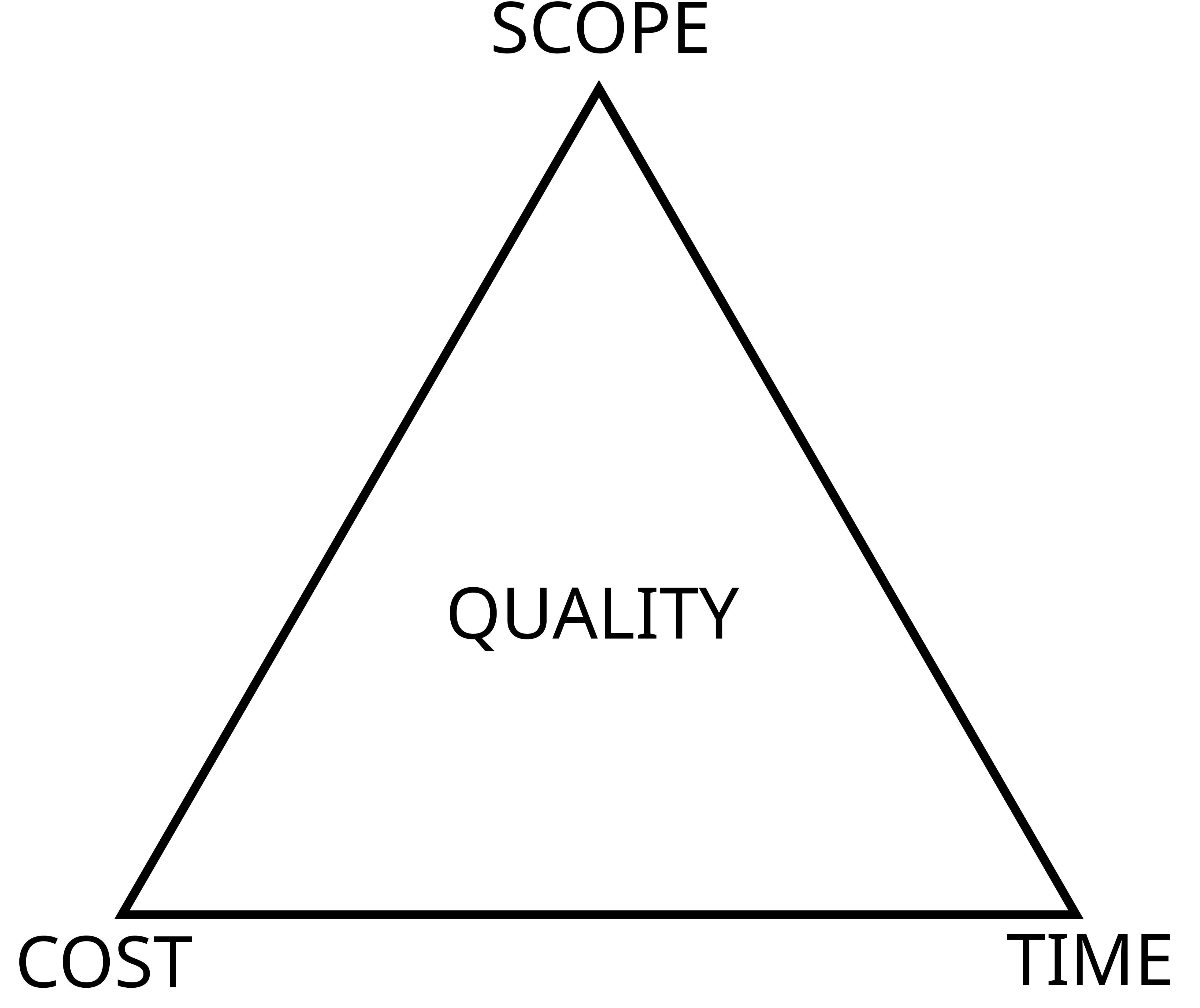
Figure \(\PageIndex{1}\): Project Management Triangle. (Public domain[8])
The project management triangle is a model of the constraints experienced when conducting project management. Its premises are:
- The quality (depicted in the center of the triangle) of work is constrained by the project's cost (budget), time (deadlines), and scope (features) that are shown at the vertices of the triangle.
- Scope, time, and cost are interdependent and the project manager can trade between the constraints.
- Changes in one constraint necessitate changes in others to compensate, otherwise quality will suffer.[5]
The time constraint refers to the amount of time available to complete a project. The cost constraint refers to the budgeted amount of money available for the project. The scope constraint refers to what must be done to produce the project's end result(s) or deliverables. These three constraints are often competing constraints. For example, an increase in project scope typically means an elongated schedule (increase in time) and and increase in cost (project budget). A tight time constraint could mean increased costs to try to accomplish all the work within that amount of time) and potentially a reduction in project scope to more comfortably complete the work within the time constraint. A tight budget could result in a reduction of project scope or increased time.[5]
In the case of Operation Warp Speed time was likely deemed the paramount constraint due to the loss of life caused by the spread of the virus. There was clearly flexibility on the cost side as the government had virtually unlimited ability to fund what was necessary and hedged its bets by investing in several vaccines concurrently. There was flexibility in scope in terms of the order in which vaccines would be provided to segments of the population, as discussed below in the subsection on phased rollout.
In the case of a pharmaceutical company developing and manufacturing a vaccine, time was similarly the major constraint, so the earlier that therapeutics and vaccines could be made available, the better. There was flexibility in cost due to the US government stepping forward and executing contracts, as we will see in detail in the section on Legal Considerations. There was some flexibility in scope that would allow addressing subsets of the overall population in initial human clinical trials, and cover the remainder subsequently (for example, younger people).
OPERATION WARP SPEED
Let's take a quick look at how tiered project management might have been handled.
- Portfolio Management
- Which COVID-19 vaccine candidates to fund to hedge bets with different technologies with different risk profiles. BARDA managed the contracts with the pharmaceutical companies.
- Program Management
- Vaccines (oversight of)
- Ventilators (accelerate production by existing vendors, pursue other options).
- Personal Protective Equipment (PPE): ramp up production of N95 masks, protective clothing, gloves.
- Project Management
- Oversight of individual projects
- Operations
- Vaccine volume manufacturing scale-up (oversight of)
- Vaccine distribution logistics, including refrigeration equipment, air and ground transportation.
- Management of cold chain logistics
Moderna Contract overview
The Moderna contract will be examined in more detail in the "Legal Considerations" section.
A review of the US government's contract with one mRNA vaccine provider provides insight onto some of the project management techniques that might have been employed.
"The Department of Health and Human Services (HHS), Office of the Assistant Secretary for Preparedness and Response (ASPR), Biomedical Advanced Research and Development Authority (BARDA) requires the contractor(s) to develop a mRNA vaccine to licensure for the prevention of COVID-19. The project will entail pre-clinical and Phase 2 and Phase 3 clinical studies sufficient to demonstrate the safety and efficacy of the proposed vaccine(s); CMC development, scale-up, scale-out and validation of manufacturing capacities, including bulk drug substance and fill and finished drug product, with a capacity of 100 million doses by 2021 and all program management and regulatory activities necessary to achieve FDA licensure of the vaccine. The project shall be accomplished on an accelerated timeline, with parallel activity WBS, aggressive manufacturing scale-up, risk management, and taking advantage of any regulatory flexibilities. Contract terms include a requirement for domestic production of vaccine and assurance of material sourcing for vaccine production during execution of the project."[4, page 4]
The statement "The project will entail pre-clinical and Phase 2 and Phase 3 clinical studies..." does not require Phase 1 clinical studies. Phase 1 was already underway at the time the contract was executed.
The phrase "parallel activity WBS" likely means that project management "fast-tracking" techniques were used. There will be more on this later.
In this section of Project Management Considerations (and subsequent subsections) we will focus on some of the content of the statement: "The project shall be accomplished on an accelerated timeline, with parallel activity WBS, aggressive manufacturing scale-up, risk management, and taking advantage of any regulatory flexibilities."[4, page 4]
The full WBS and project schedule are redacted from the publicly available contract, so we can only infer the character of what was done rather than what was actually done.
Use of Earned Value Management (EVM)
The contract also calls for the use of Earned Value Management "Lite" as stated in Section B.4.3 of the contract and elaborated on in Attachment 11 of the contract. [4]
B.4.3 Earned Value Management (EVM) Lite Requirements
The Contractor shall use an Earned Value Management (EVM) System for all retrofit and development activities of the anticipated requirement, that is consistent with the "7 Principles of Earned Value Management Tier 2 System Implantation [sic, should say Implementation] Intent Guide" attached to this contract. Alternative systems may be submitted to the Contracting Officer for consideration and approval.[4]
The "7 Principles of Earned Value Management Tier 2 System Implementation Intent Guide"[6] states the seven EVM principles (with supplemental information integrated) as follows:
- Principle 1: Plan all Work Scope
- This includes a Statement of Work (SOW), a Work Breakdown Structure (WBS), and a WBS dictionary.
- Principle 2: Break Work into Finite Pieces and Define Person/Organization Responsible for Work
- For Tier 2 the control account and activities/work packages are at at least at level 4 and potentially level 5. It requires running critical path analysis.
- The schedule needs to include at least the following:
- WBS number
- Control Account number
- Work package number
- Task name
- Duration
- Baseline Start and Finish Dates
- Actual Start and Finish Dates
- Forecast Start and Finish Dates
- Predecessors/Successors
- Activity Percent Complete
- Principle 3a: Integrate Scope. Schedule and Budget into a Performance Measurement Baseline
- This can be done by resource loading in a project management tool such as Microsoft Project (resource names, loaded rates for the resources).
- Reporting needs to include Earned Value (EV) or Budgeted Cost of Work Performed (BCWP) and Actual Costs of Work Performed (ACWP).
- Principle 3b: Control Changes to the Baseline
- Principle 4: Use Actual Costs Incurred and Recorded in Accomplishing the Work Performed
- Principle 5: Objectively Assess Accomplishments at the Work Performance Level
- Principle 6a: Analyze Significant Variances From the Plan
- This includes calculating:
- Cost Variance (CV): Budgeted Cost of Work Performed (BCWP) minus Actual Cost of Work Performed (ACWP)
- Schedule Variance (SV): Budgeted Cost of Work Performed (BCWP) minus Budgeted Cost of Work Schedule (BCWS)
- Cost Performance Index (CPI): BCWP divided by ACWP
- Schedule Performance Index (SPI): BCWP divided by BCWS
- To-Complete Performance Index (TCPI) that calculates the cost performance at which the control account activities need to perform in order to complete the work within the current reported Estimate at Completion (EAC). EAC is ACWP plus the Estimate to Complete (ETC). ETC is an estimate of the cost of the work that still needs to be performed to complete a task.
- Reporting should include the current Budget at Completion (BAC) and the current Estimate at Completion (EAC).
- This includes calculating:
- Principle 6b: Prepare an Estimate at Completion Based on Performance to Date and Work to be Performed
- Principle 7: Use EVMS Information in the Company's Management Processes.
In BARDA's tiered approach to EVM, Tier 2 is defined as:[6]
For countermeasure research and development contracts that have a [sic] total acquisition costs greater than or equal to $25 million and have a Technical Readiness Level (TRL) of less than 7 will apply EVM principle for tracking cost, schedule and technical performance that comply with the 7 Principles of EVM Implementation.[6]
BARDA defines Technical Readiness levels.[7]
Medical Countermeasures | ABOUT THE TECHNOLOGY READINESS LEVELS (TRLs)
Risk Management
There was significant scientific risk in the use of mRNA vaccines against COVID-19.
“…despite extensive previous research attempts to produce safe, effective vaccines against coronaviruses, such as SARS and MERS, all vaccine candidates for coronavirus infections have failed during clinical research, and no vaccine exists to prevent any coronavirus infection.”[1]
Another large risk was in overlapping volume manufacturing ramp up with clinical trials. This will be covered in a subsequent section.
Project Acceleration Techniques
We will examine in a subsequent section some potential schedule improvement techniques:
- Crashing
- Fast tracking
- Combining Clinical Trials Phase 1 and 2
- Overlapping Clinical Trials Phase 2 and 3
- Overlapping Clinical Trial Phase 3 and Manufacturing volume production ramp
- Adaptive clinical trial design: if the clinical trial testing data is excellent, adjustments in schedule are possible. For example, trial durations can be reduced. Moderna's Phase 3 was eight weeks. Additionally, one might use fewer participants.
Phased-Rollout (CDC Playbook)[3]
Since it was obvious that over 330 million doses of COVID-19 vaccines were not going to be available initially, advance planning guidance from the Centers for Disease Control (CDC) called for a three phase approach for allocating vaccine doses as they became available from manufacturers.
A key point to consider is that vaccine supply will be limited at the beginning of the program, so the allocation of doses must focus on vaccination providers and settings for vaccination of limited critical populations as well as outreach to these populations. The vaccine supply is projected to increase quickly over the proceeding months, allowing vaccination efforts to be expanded to additional critical populations and the general public.[3]
Populations of focus for initial COVID-19 vaccination may include:
- Healthcare personnel likely to be exposed to or treat people with COVID-19.
- People at increased risk for severe illness from COVID-19, including those with underlying medical conditions and people 65 years of age and older
- Other essential workers

Figure \(\PageIndex{1}\): CDC Vaccination Playbook. (Centers for Disease Control and Prevention (CDC), COVID-19 Vaccination Program Interim Playbook for Jurisdiction Operations, September 16, 2020, p11)
The CDC advises that jurisdictions should be planning in terms of three phases:[3]
- Phase 1: Potentially limited supply of COVID-19 vaccine doses available
- Focus initial efforts on reaching the critical populations listed above. Ensure vaccination locations selected can reach populations, manage cold chain requirements, and meet reporting requirements for vaccine supply and uptake.
- Phase 2: Large number of vaccine doses available
- Focus on ensuring access to vaccine for members of Phase 1 critical populations who were not yet vaccinated as well as for the general population; expand provider network.
- Phase 3: Sufficient supply of vaccine doses for entire population (surplus of doses)
- Focus on ensuring equitable vaccination access across the entire population. Monitor vaccine uptake and coverage; reassess strategy to increase uptake in populations or communities with low coverage.
Critical Populations
The CDC identified critical populations as follows (not in any particular order):[3. page 14]
- Critical infrastructure workforce
- Healthcare personnel (i.e., paid and unpaid personnel working in healthcare settings, which may include vaccinators, pharmacy staff, ancillary staff, school nurses, and EMS personnel)
- Other essential workers (see additional guidance from the Cybersecurity and Infrastructure Security Agency [CISA])
- Note: The critical infrastructure workforce varies by jurisdiction. Each jurisdiction must decide which groups to focus on when vaccine supply is limited by determining key sectors that may be within their populations (e.g., port-related workers in coastal jurisdictions)
- People at increased risk for severe COVID-19 illness
- LTCF residents (i.e., nursing home, assisted living, independent living facility residents)
- People with underlying medical conditions that are risk factors for severe COVID-19 illness
- People 65 years of age and older
- People at increased risk of acquiring or transmitting COVID-19
- People from racial and ethnic minority groups
- People from tribal communities
- People who are incarcerated/detained in correctional facilities
- People experiencing homelessness/living in shelters
- People attending colleges/universities
- People who work in educational settings (e.g., early learning centers, schools, and colleges/universities)
- People living and working in other congregate settings
- •People with limited access to routine vaccination services
- People living in rural communities
- People with disabilities
- People who are under- or uninsured
Vaccine Allocation
The federal government will determine the amount of COVID-19 vaccine designated for each jurisdiction. The jurisdiction’s immunization program will then be responsible for managing and approving orders from enrolled providers within their jurisdiction using this allotment.[3, page 24]
Ordering
COVID-19 vaccination providers enrolled by the jurisdiction will order COVID-19 vaccine through their jurisdiction’s immunization program. Most jurisdictions will ask COVID-19 vaccination providers to place orders using systems and procedures routinely used for ordering publicly funded vaccines (e.g., IIS/ExIS upload to CDC’s VTrckS for provider direct order entry), though some jurisdictions may have augmented systems.[3, page 24]
Ancillary supplies will be packaged in kits and will be automatically ordered in amounts to match vaccine orders in VTrckS. Each kit will contain supplies to administer 100 doses of vaccine, including:
- Needles, 105 per kit (various sizes for the population served by the ordering vaccination provider)
- Syringes, 105 per kit
- Alcohol prep pads, 210 per kit
- 4 surgical masks and 2 face shields for vaccinators, per kit
- COVID-19 vaccination record cards for vaccine recipients, 100 per kit
Vaccine Distribution[3, pages 25 and 26]
COVID-19 vaccines and ancillary supplies will be procured and distributed by the federal government at no cost to enrolled COVID-19 vaccination providers. CDC will use its centralized distribution contract to fulfill orders for most vaccine products and associated ancillary supplies. Some vaccine products, such as those with ultra-cold temperature requirements, will be shipped directly from the manufacturer to the vaccination provider site.
Jurisdictions should ensure accurate and complete shipping information (e.g., shipment address, provider contact information, shipping hours) is available in the VTrckS system for all vaccine shipments to enrolled vaccination providers.
COVID-19 vaccine (and diluent or adjuvant, if required) will be shipped to vaccination provider sites enrolled by the jurisdiction’s immunization program within 48 hours of order approval. Because of cold chain requirements, ancillary supply kits (and diluent, if applicable) will ship separately from vaccine but should arrive before or on the same day as vaccine.
The federally contracted vaccine distributor uses validated shipping procedures to maintain COVID-19 vaccine cold chain and minimize the likelihood of vaccine loss or damage during shipment. Once a vaccine product has been shipped to a COVID-19 vaccination provider site, the federal government will neither redistribute the product nor take financial responsibility for its redistribution.
Whenever possible, vaccine should be shipped to the location where it will be administered to minimize potential breaks in the cold chain. However, there may be circumstances where COVID-19 vaccine needs to be redistributed beyond the identified primary CDC ship-to sites (i.e., for orders smaller than the minimum order size or for large organizations whose vaccine is shipped to a central depot and requires redistribution to additional clinic locations). In these instances, vaccination provider organizations/facilities, third-party vendors, and other vaccination providers may be allowed, if approved by the jurisdiction’s immunization program, to redistribute COVID-19 vaccine, if validated cold-chain procedures are in place in accordance with the manufacturer's instructions and CDC’s guidance on COVID-19 vaccine storage and handling. These entities must sign and agree to conditions in the CDC COVID-19 Vaccine Redistribution Agreement for the sending facility/organization and have a fully completed and signed CDC COVID-19 Vaccination Provider Profile form for each receiving location. Jurisdictions should be extremely judicious in allowing redistribution and limit any redistribution to refrigerated vaccines only.
Vaccine Storage and Handling[3, page 27]
COVID-19 vaccine products are temperature-sensitive and must be stored and handled correctly to ensure efficacy and maximize shelf life. Proper storage and handling practices are critical to minimize vaccine loss and limit risk of administering COVID-19 vaccine with reduced effectiveness. Jurisdictions should work with staff at each COVID-19 vaccination provider site to ensure appropriate vaccine storage and handling procedures are established and followed.
It is expected that cold chain storage and handling requirements for COVID-19 vaccine products will vary in temperature from refrigerated (2°C to 8°C) to frozen (-15 to -25°C) to ultra-cold (-60°C to -80°C in the freezer or within the dry ice shipping container in which product was received). Ongoing stability testing may impact these requirements. Note: These temperatures are based on information available as of 9/04/2020. Updated information will be provided as it becomes available.
For a reliable cold chain, three elements must be in place:
- Well-trained staff
- Reliable storage and temperature monitoring equipment
- Accurate vaccine inventory management
The cold chain begins at the COVID-19 vaccine manufacturing plant, includes delivery to and storage at the COVID-19 vaccination provider site, and ends with administration of COVID-19 vaccine to a person. Jurisdictions and vaccination providers are responsible for maintaining vaccine quality from the time a shipment arrives at a vaccination provider site until the dose is administered. To minimize opportunities for breaks in the cold chain, most COVID-19 vaccine will be delivered from CDC’s centralized distributor directly to the location where the vaccine will be stored and administered, although some vaccine may be delivered to secondary depots for redistribution. Certain COVID-19 vaccine products, such as those with ultra-cold temperature requirements, will be shipped directly from the manufacturer to the vaccination provider site. If redistributing vaccine, jurisdictions must adhere to all cold chain requirements and should limit transport of frozen or ultra-cold vaccine products.
Emergency Use Authorization[3, page 39]
Initially available COVID-19 vaccines may be authorized for use under an EUA issued by FDA or approved as licensed vaccines.
Please remember these items as project deliverables when preparing your WBS and project schedule.
Emergency Use Authorization Fact Sheets
The EUA authority allows FDA to authorize either (a) the use of an unapproved medical product (e.g., drug, vaccine, or diagnostic device) or (b) the unapproved use of an approved medical product during an emergency based on certain criteria. The EUA will outline how the COVID-19 vaccine should be used and any conditions that must be met to use the vaccine. FDA will coordinate with CDC to confirm these “conditions of authorization.” Vaccine conditions of authorization are expected to include distribution requirements, reporting requirements, and safety and monitoring requirements. The EUA will be authorized for a specific time period to meet response needs (i.e., for the duration of the COVID-19 pandemic).
- Product-specific EUA fact sheet for COVID-19 vaccination providers will be made available that will include information on the specific vaccine product and instructions for its use.
- An EUA fact sheet for vaccine recipients will also be developed, and both will likely be made available on the FDA website and through the CDC website. Jurisdictions should ensure providers know where to find both the provider and recipient fact sheets, have read and understand them, and are clear on the requirement to provide the recipient fact sheet to each client/patient prior to administering vaccine.
Students sometimes confuse the use of Clinical Trials phase names: Phase 1, Phase 2, Phase 3, and Phase 4 with the project life cycle that employs phase gate reviews with a project steering committee after the following project phase gate names: Phase 0, Phase 1, Phase 2, Phase 3, and Phase 4.
References
- Wikipedia - Operation Warp Speed. August 24, 2020.
- Jenni Fink, Newsweek, "Fauci calls naming of Trump administration's Operation Warp Speed unfortunate, says it implies reckless speed." August 14, 2020.
- Centers for Disease Control and Prevention (CDC), COVID-19 Vaccination Program Interim Playbook for Jurisdiction Operations, September 16, 2020. Page 11 for the allocation of vaccines in phases.
- HHS-BARDA-Moderna-Contract-75A50120C00034-16April2020-Version8Feb2021. HHS/ASPR/BARDA-Moderna Contract 75A50120C00034. Moderna Contract. April 16, 2020. (Less redacted version obtained via FOIA lawsuit on February 8, 2021).
- Wikipedia - Project Management Triangle. Accessed January 23, 2026.
- HHS-BARDA-Moderna-Contract-75A50120C00034-16April2020-Version8Feb2021. HHS/ASPR/BARDA-Moderna Contract 75A50120C00034. Moderna Contract. April 16, 2020. (Less redacted version obtained via FOIA lawsuit on February 8, 2021). Specifically, Attachment#11: Department of Health & Human Services HHS, Office of the Assistant Secretary for Preparedness and Readiness ASPR, Biomedical Advanced Research and Development Authority BARDA. "7 Principles of Earned Value Management Tier 2 System Implementation Intent Guide", 21 December 2011.
- Technology Readiness Levels. Accessed January 31, 2026.
- Wikimedia Illustration of Project Management Triangle.

2.14: Project Management Considerations is shared under a CC BY 4.0 license and was authored, remixed, and/or curated by LibreTexts.
The book could not be loaded just now.