Opening the book…
Connecting and Operating a Normally Closed (N.C.) Single-Acting Cylinder Using a 3/2 DCV
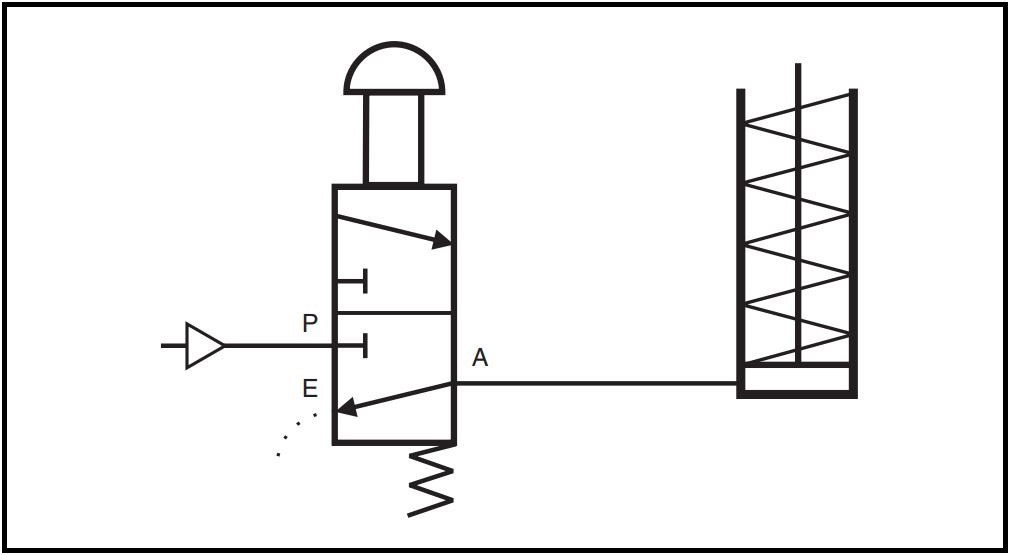
De-energized Condition: Initially, when the push button of the 3/2 DCV is not pressed, the valve remains in its de-energized position. In this state, the supply pressure from port P is blocked, and port A (connected to the cylinder) is open to the atmosphere through the exhaust port (E). The spring inside the cylinder holds the rod in its retracted position.

Energizing the Cylinder: When the operator presses the push button of the 3/2 DCV, the valve shifts, and air flows from port P to port A, powering the cylinder to extend. As the cylinder extends, the internal spring compresses, but its force is significantly less than the air pressure, so it does not interfere with the extension.
De-energizing and Retracting: Releasing the button returns the valve to its de-energized position. This action blocks port P, and port A is connected to port E, allowing the air in the cylinder’s cap end to vent to the atmosphere. The spring then retracts the cylinder rod as the pressure on the cap end drops to zero.
7.3: Operation of a N.C. 3/2 DCV Connected to a Single-Acting Cylinder is shared under a not declared license and was authored, remixed, and/or curated by LibreTexts.
The book could not be loaded just now.