Opening the book…
- Chapter 1: The Chemical World
- 1.1: The Scope of Chemistry
- 1.2: Chemicals Compose Ordinary Things
- 1.3: Hypothesis, Theories, and Laws
- 1.4: The Scientific Method: How Chemists Think
- 1.5: A Beginning Chemist: How to Succeed
- Chapter 2: Measurement and Problem Solving
- 2.1: Taking Measurements
- 2.2: Scientific Notation: Writing Large and Small Numbers
- 2.3: Significant Figures: Writing Numbers to Reflect Precision
- 2.4: Significant Figures in Calculations
- 2.5: The Basic Units of Measurement
- 2.6: Problem Solving and Unit Conversions
- 2.7: Solving Multistep Conversion Problems
- 2.8: Units Raised to a Power
- 2.9: Density
- 2.10: Numerical Problem-Solving Strategies and the Solution Map
- 2.E: Measurement and Problem Solving (Exercises)
- Chapter 3: Matter and Energy
- 3.1: In Your Room
- 3.2: What is Matter?
- 3.3: Classifying Matter According to Its State: Solid, Liquid, and Gas
- 3.4: Classifying Matter According to Its Composition
- 3.5: Differences in Matter: Physical and Chemical Properties
- 3.6: Changes in Matter: Physical and Chemical Changes
- 3.7: Conservation of Mass: There is No New Matter
- 3.8: Energy
- 3.9: Energy and Chemical and Physical Change
- 3.10: Temperature: Random Motion of Molecules and Atoms
- 3.11: Temperature Changes: Heat Capacity
- 3.12: Energy and Heat Capacity Calculations
- 3.E: Exercises
- Chapter 4: Atoms and Elements
- 4.1: Experiencing Atoms at Tiburon
- 4.2: Indivisible: The Atomic Theory
- 4.3: The Nuclear Atom
- 4.4: The Properties of Protons, Neutrons, and Electrons
- 4.5: Elements: Defined by Their Numbers of Protons
- 4.6: Looking for Patterns: The Periodic Law and the Periodic Table
- 4.7: Ions: Losing and Gaining Electrons
- 4.8: Isotopes: When the Number of Neutrons Varies
- 4.9: Atomic Mass: The Average Mass of an Element’s Atoms
- Chapter 5: Molecules and Compounds
- 5.1: Sugar and Salt
- 5.2: Compounds Display Constant Composition
- 5.3: Chemical Formulas: How to Represent Compounds
- 5.4: A Molecular View of Elements and Compounds
- 5.5: Writing Formulas for Ionic Compounds
- 5.6: Nomenclature: Naming Compounds
- 5.7: Naming Ionic Compounds
- 5.8: Naming Molecular Compounds
- 5.9: Naming Acids
- 5.10: Nomenclature Summary
- 5.11: Formula Mass: The Mass of a Molecule or Formula Unit
- Chapter 6: Chemical Composition
- 6.1: How Much Sodium?
- 6.2: Counting Nails by the Pound
- 6.3: Counting Atoms by the Gram
- 6.4: Counting Molecules by the Gram
- 6.5: Chemical Formulas as Conversion Factors
- 6.6: Mass Percent Composition of Compounds
- 6.7: Mass Percent Composition from a Chemical Formula
- 6.8: Calculating Empirical Formulas for Compounds
- 6.9: Calculating Molecular Formulas for Compounds
- Chapter 7: Chemical Reactions
- 7.1: Grade School Volcanoes, Automobiles, and Laundry Detergents
- 7.2: Evidence of a Chemical Reaction
- 7.3: The Chemical Equation
- 7.4: How to Write Balanced Chemical Equations
- 7.5: Aqueous Solutions and Solubility: Compounds Dissolved in Water
- 7.6: Precipitation Reactions: Reactions in Aqueous Solution That Form a Solid
- 7.7: Writing Chemical Equations for Reactions in Solution: Molecular, Complete Ionic, and Net Ionic Equations
- 7.8: Acid–Base and Gas Evolution Reactions
- 7.9: Oxidation–Reduction Reactions
- 7.10: Classifying Chemical Reactions
- 7.11: The Activity Series
- Chapter 8: Quantities in Chemical Reactions
- 8.1: Climate Change: Too Much Carbon Dioxide
- 8.2: Stoichiometry
- 8.3: Making Molecules: Mole-to-Mole Conversions
- 8.4: Making Molecules: Mass-to-Mass Conversions
- 8.5: Limiting Reactant, Theoretical Yield, and Percent Yield
- 8.6: Limiting Reactant, Theoretical Yield, and Percent Yield from Initial Masses of Reactants
- 8.7: Enthalpy: A Measure of the Heat Evolved or Absorbed in a Reaction
- Chapter 9: Electrons in Atoms and the Periodic Table
- 9.1: Blimps, Balloons, and Models of the Atom
- 9.2: Light: Electromagnetic Radiation
- 9.3: The Electromagnetic Spectrum
- 9.4: The Bohr Model: Atoms with Orbits
- 9.5: The Quantum-Mechanical Model: Atoms with Orbitals
- 9.6: Quantum-Mechanical Orbitals and Electron Configurations
- 9.7: Electron Configurations and the Periodic Table
- 9.8: The Explanatory Power of the Quantum-Mechanical Model
- 9.9: Periodic Trends: Atomic Size, Ionization Energy, and Metallic Character
- Chapter 10: Chemical Bonding
- 10.1: Bonding Models and AIDS Drugs
- 10.2: Representing Valence Electrons with Dots
- 10.3: Lewis Structures of Ionic Compounds: Electrons Transferred
- 10.4: Covalent Lewis Structures: Electrons Shared
- 10.5: Writing Lewis Structures for Covalent Compounds
- 10.6: Resonance: Equivalent Lewis Structures for the Same Molecule
- 10.7: Predicting the Shapes of Molecules
- 10.8: Electronegativity and Polarity: Why Oil and Water Don’t Mix
- Chapter 11: Gases
- 11.1: Extra-Long Straws
- 11.2: Kinetic Molecular Theory: A Model for Gases
- 11.3: Pressure: The Result of Constant Molecular Collisions
- 11.4: Boyle’s Law: Pressure and Volume
- 11.5: Charles’s Law: Volume and Temperature
- 11.6: Gay-Lussac's Law: Temperature and Pressure
- 11.7: The Combined Gas Law: Pressure, Volume, and Temperature
- 11.8: Avogadro’s Law: Volume and Moles
- 11.9: The Ideal Gas Law: Pressure, Volume, Temperature, and Moles
- 11.10: Mixtures of Gases: Why Deep-Sea Divers Breathe a Mixture of Helium and Oxygen
- 11.11: Gases in Chemical Reactions
- Chapter 12: Liquids, Solids, and Intermolecular Forces
- 12.1: Interactions between Molecules
- 12.2: Properties of Liquids and Solids
- 12.3: Intermolecular Forces in Action: Surface Tension and Viscosity
- 12.4: Evaporation and Condensation
- 12.5: Melting, Freezing, and Sublimation
- 12.6: Types of Intermolecular Forces: Dispersion, Dipole–Dipole, Hydrogen Bonding, and Ion-Dipole
- 12.7: Types of Crystalline Solids: Molecular, Ionic, and Atomic
- 12.8: Water: A Remarkable Molecule
- Chapter 13: Solutions
- 13.1: Prelude - Tragedy in Cameroon
- 13.2: Solutions: Homogeneous Mixtures
- 13.3: Solutions of Solids Dissolved in Water: How to Make Rock Candy
- 13.4: Solutions of Gases in Water: How Soda Pop Gets Its Fizz
- 13.5: Solution Concentration: Mass Percent
- 13.6: Solution Concentration: Molarity
- 13.7: Solution Dilution
- 13.8: Solution Stoichiometry
- 13.9: Freezing Point Depression and Boiling Point Elevation: Making Water Freeze Colder and Boil Hotter
- 13.10: Osmosis: Why Drinking Salt Water Causes Dehydration
- Chapter 14: Acids and Bases
- 14.1: Sour Patch Kids and International Spy Movies
- 14.2: Acids: Properties and Examples
- 14.3: Bases: Properties and Examples
- 14.4: Molecular Definitions of Acids and Bases
- 14.5: Reactions of Acids and Bases
- 14.6: Acid–Base Titration: A Way to Quantify the Amount of Acid or Base in a Solution
- 14.7: Strong and Weak Acids and Bases
- 14.8: Water: Acid and Base in One
- 14.9: The pH and pOH Scales: Ways to Express Acidity and Basicity
- 14.10: Buffers: Solutions That Resist pH Change
- Identify the reactants and products in any chemical reaction.
- Convert word equations into chemical equations.
- Use the common symbols, \(\left( s \right)\), \(\left( l \right)\), \(\left( g \right)\), \(\left( aq \right)\), and \(\rightarrow\) appropriately when writing a chemical reaction.
In a chemical change, new substances are formed. In order for this to occur, the chemical bonds of the substances break, and the atoms that compose them separate and rearrange themselves into new substances with new chemical bonds. When this process occurs, we call it a chemical reaction. A chemical reaction is the process in which one or more substances are changed into one or more new substances.
Reactants and Products
To describe a chemical reaction, we need to indicate what substances are present at the beginning and what substances are present at the end. The substances that are present at the beginning are called reactants and the substances present at the end are called products.
Sometimes when reactants are put into a reaction vessel, a reaction will take place to produce products. Reactants are the starting materials, that is, whatever we have as our initial ingredients. The products are just that—what is produced—or the result of what happens to the reactants when we put them together in the reaction vessel. If we think about baking chocolate chip cookies, our reactants would be flour, butter, sugar, vanilla, baking soda, salt, egg, and chocolate chips. What would be the products? Cookies! The reaction vessel would be our mixing bowl.
\[ \underbrace{\text{Flour} + \text{Butter} + \text{Sugar} + \text{Vanilla} + \text{Baking Soda} + \text{Eggs} + \text{Chocolate Chips}}_{\text{Ingredients = Reactants}} \rightarrow \underbrace{\text{Cookies}}_{\text{Product}} \nonumber \]
Writing Chemical Equations
When sulfur dioxide is added to oxygen, sulfur trioxide is produced. Sulfur dioxide and oxygen, \(\ce{SO_2} + \ce{O_2}\), are reactants and sulfur trioxide, \(\ce{SO_3}\), is the product.
\[ \underbrace{\ce{2 SO2(g) + O2(g) }}_{\text{Reactants}} \rightarrow \underbrace{\ce{2SO3(g)}}_{\text{Products}} \nonumber \]
In chemical reactions, the reactants are found before the symbol "\(\rightarrow\)" and the products are found after the symbol "\(\rightarrow\)". The general equation for a reaction is:
\[\text{Reactants } \rightarrow \text{Products} \nonumber \]
There are a few special symbols that we need to know in order to "talk" in chemical shorthand. In the table below is the summary of the major symbols used in chemical equations. Table \(\PageIndex{1}\) shows a listing of symbols used in chemical equations.
| Symbol | Description | Symbol | Description |
|---|---|---|---|
| \(+\) | used to separate multiple reactants or products | \(\left( s \right)\) | reactant or product in the solid state |
| \(\rightarrow\) | yield sign; separates reactants from products | \(\left( l \right)\) | reactant or product in the liquid state |
| \(\rightleftharpoons\) | replaces the yield sign for reversible reactions that reach equilibrium | \(\left( g \right)\) | reactant or product in the gas state |
| \(\overset{\ce{Pt}}{\rightarrow}\) | formula written above the arrow is used as a catalyst in the reaction | \(\left( aq \right)\) | reactant or product in an aqueous solution (dissolved in water) |
| \(\overset{\Delta}{\rightarrow}\) | triangle indicates that the reaction is being heated |
Chemists have a choice of methods for describing a chemical reaction.
1. They could draw a picture of the chemical reaction.
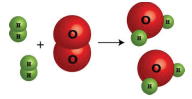
2. They could write a word equation for the chemical reaction:
"Two molecules of hydrogen gas react with one molecule of oxygen gas to produce two molecules of water vapor."
3. They could write the equation in chemical shorthand.
\[2 \ce{H_2} \left( g \right) + \ce{O_2} \left( g \right) \rightarrow 2 \ce{H_2O} \left( g \right) \nonumber \]
In the symbolic equation, chemical formulas are used instead of chemical names for reactants and products, while symbols are used to indicate the phase of each substance. It should be apparent that the chemical shorthand method is the quickest and clearest method for writing chemical equations.
We could write that an aqueous solution of calcium nitrate is added to an aqueous solution of sodium hydroxide to produce solid calcium hydroxide and an aqueous solution of sodium nitrate. Or in shorthand we could write:
\[\ce{Ca(NO_3)_2} \left( aq \right) + 2 \ce{NaOH} \left( aq \right) \rightarrow \ce{Ca(OH)_2} \left( s \right) + 2 \ce{NaNO_3} \left( aq \right) \nonumber \]
How much easier is that to read? Let's try it in reverse. Look at the following reaction in shorthand and write the word equation for the reaction:
\[\ce{Cu} \left( s \right) + \ce{AgNO_3} \left( aq \right) \rightarrow \ce{Cu(NO_3)_2} \left( aq \right) + \ce{Ag} \left( s \right) \nonumber \]
The word equation for this reaction might read something like "solid copper reacts with an aqueous solution of silver nitrate to produce a solution of copper (II) nitrate with solid silver."
To turn word equations into symbolic equations, we need to follow the given steps:
- Identify the reactants and products. This will help you know which symbols go on each side of the arrow and where the \(+\) signs go.
- Write the correct formulas for all compounds. You will need to use the rules you learned in Chapter 5 (including making all ionic compounds charge balanced).
- Write the correct formulas for all elements. Usually this is given straight off of the periodic table. However, there are seven elements that are considered diatomic, meaning that they are always found in pairs in nature. They include those elements listed in the table.
| Element Name | Hydrogen | Nitrogen | Oxygen | Fluorine | Chlorine | Bromine | Iodine |
|---|---|---|---|---|---|---|---|
| Formula | \(H_2\) | \(N_2\) | \(O_2\) | \(F_2\) | \(Cl_2\) | \(Br_2\) | \(I_2\) |
Transfer the following symbolic equations into word equations or word equations into symbolic equations.
- \(\ce{HCl} \left( aq \right) + \ce{NaOH} \left( aq \right) \rightarrow \ce{NaCl} \left( aq \right) + \ce{H_2O} \left( l \right)\)
- Gaseous propane, \(\ce{C_3H_8}\), burns in oxygen gas to produce gaseous carbon dioxide and liquid water.
- Hydrogen fluoride gas reacts with an aqueous solution of potassium carbonate to produce an aqueous solution of potassium fluoride, liquid water, and gaseous carbon dioxide.
Solution
a. An aqueous solution of hydrochloric acid reacts with an aqueous solution of sodium hydroxide to produce an aqueous solution of sodium chloride and liquid water.
b. Reactants: propane (\(\ce{C_3H_8}\)) and oxygen (\(\ce{O_2}\))
Product: carbon dioxide (\(\ce{CO_2}\)) and water (\(\ce{H_2O}\))
\[\ce{C_3H_8} \left( g \right) + \ce{O_2} \left( g \right) \rightarrow \ce{CO_2} \left( g \right) + \ce{H_2O} \left( l \right) \nonumber \]
c. Reactants: hydrogen fluoride and potassium carbonate
Products: potassium fluoride, water, and carbon dioxide
\[\ce{HF} \left( g \right) + \ce{K_2CO_3} \left( aq \right) \rightarrow \ce{KF} \left( aq \right) + \ce{H_2O} \left( l \right) + \ce{CO_2} \left( g \right) \nonumber \]
Transfer the following symbolic equations into word equations or word equations into symbolic equations.
- Hydrogen gas reacts with nitrogen gas to produce gaseous ammonia.
- \(\ce{HCl} \left( aq \right) + \ce{LiOH} \left( aq \right) \rightarrow \ce{LiCl} \left( aq \right) + \ce{H_2O} \left( l \right)\)
- Copper metal is heated with oxygen gas to produce solid copper(II) oxide.
- Answer a
- \(H_2 (g) + N_2 (g) \rightarrow NH_3 (g)\)
- Answer b
- An aqueous solution of hydrochloric acid reacts with an aqueous solution of lithium hydroxide to produce an aqueous solution of lithium chloride and liquid water.
- Answer c
- \(Cu (s) + O_2 (g) \rightarrow CuO (s)\)
Summary
- A chemical reaction is the process by which one or more substances are changed into one or more new substances.
- Chemical reactions are represented by chemical equations.
- Chemical equations have reactants on the left, an arrow that is read as "yields", and the products on the right.
7.3: The Chemical Equation is shared under a CC BY-NC-SA 4.0 license and was authored, remixed, and/or curated by LibreTexts.
The book could not be loaded just now.