Opening the book…
- Chapter 1: The Chemical World
- 1.1: The Scope of Chemistry
- 1.2: Chemicals Compose Ordinary Things
- 1.3: Hypothesis, Theories, and Laws
- 1.4: The Scientific Method: How Chemists Think
- 1.5: A Beginning Chemist: How to Succeed
- Chapter 2: Measurement and Problem Solving
- 2.1: Taking Measurements
- 2.2: Scientific Notation: Writing Large and Small Numbers
- 2.3: Significant Figures: Writing Numbers to Reflect Precision
- 2.4: Significant Figures in Calculations
- 2.5: The Basic Units of Measurement
- 2.6: Problem Solving and Unit Conversions
- 2.7: Solving Multistep Conversion Problems
- 2.8: Units Raised to a Power
- 2.9: Density
- 2.10: Numerical Problem-Solving Strategies and the Solution Map
- 2.E: Measurement and Problem Solving (Exercises)
- Chapter 3: Matter and Energy
- 3.1: In Your Room
- 3.2: What is Matter?
- 3.3: Classifying Matter According to Its State: Solid, Liquid, and Gas
- 3.4: Classifying Matter According to Its Composition
- 3.5: Differences in Matter: Physical and Chemical Properties
- 3.6: Changes in Matter: Physical and Chemical Changes
- 3.7: Conservation of Mass: There is No New Matter
- 3.8: Energy
- 3.9: Energy and Chemical and Physical Change
- 3.10: Temperature: Random Motion of Molecules and Atoms
- 3.11: Temperature Changes: Heat Capacity
- 3.12: Energy and Heat Capacity Calculations
- 3.E: Exercises
- Chapter 4: Atoms and Elements
- 4.1: Experiencing Atoms at Tiburon
- 4.2: Indivisible: The Atomic Theory
- 4.3: The Nuclear Atom
- 4.4: The Properties of Protons, Neutrons, and Electrons
- 4.5: Elements: Defined by Their Numbers of Protons
- 4.6: Looking for Patterns: The Periodic Law and the Periodic Table
- 4.7: Ions: Losing and Gaining Electrons
- 4.8: Isotopes: When the Number of Neutrons Varies
- 4.9: Atomic Mass: The Average Mass of an Element’s Atoms
- Chapter 5: Molecules and Compounds
- 5.1: Sugar and Salt
- 5.2: Compounds Display Constant Composition
- 5.3: Chemical Formulas: How to Represent Compounds
- 5.4: A Molecular View of Elements and Compounds
- 5.5: Writing Formulas for Ionic Compounds
- 5.6: Nomenclature: Naming Compounds
- 5.7: Naming Ionic Compounds
- 5.8: Naming Molecular Compounds
- 5.9: Naming Acids
- 5.10: Nomenclature Summary
- 5.11: Formula Mass: The Mass of a Molecule or Formula Unit
- Chapter 6: Chemical Composition
- 6.1: How Much Sodium?
- 6.2: Counting Nails by the Pound
- 6.3: Counting Atoms by the Gram
- 6.4: Counting Molecules by the Gram
- 6.5: Chemical Formulas as Conversion Factors
- 6.6: Mass Percent Composition of Compounds
- 6.7: Mass Percent Composition from a Chemical Formula
- 6.8: Calculating Empirical Formulas for Compounds
- 6.9: Calculating Molecular Formulas for Compounds
- Chapter 7: Chemical Reactions
- 7.1: Grade School Volcanoes, Automobiles, and Laundry Detergents
- 7.2: Evidence of a Chemical Reaction
- 7.3: The Chemical Equation
- 7.4: How to Write Balanced Chemical Equations
- 7.5: Aqueous Solutions and Solubility: Compounds Dissolved in Water
- 7.6: Precipitation Reactions: Reactions in Aqueous Solution That Form a Solid
- 7.7: Writing Chemical Equations for Reactions in Solution: Molecular, Complete Ionic, and Net Ionic Equations
- 7.8: Acid–Base and Gas Evolution Reactions
- 7.9: Oxidation–Reduction Reactions
- 7.10: Classifying Chemical Reactions
- 7.11: The Activity Series
- Chapter 8: Quantities in Chemical Reactions
- 8.1: Climate Change: Too Much Carbon Dioxide
- 8.2: Stoichiometry
- 8.3: Making Molecules: Mole-to-Mole Conversions
- 8.4: Making Molecules: Mass-to-Mass Conversions
- 8.5: Limiting Reactant, Theoretical Yield, and Percent Yield
- 8.6: Limiting Reactant, Theoretical Yield, and Percent Yield from Initial Masses of Reactants
- 8.7: Enthalpy: A Measure of the Heat Evolved or Absorbed in a Reaction
- Chapter 9: Electrons in Atoms and the Periodic Table
- 9.1: Blimps, Balloons, and Models of the Atom
- 9.2: Light: Electromagnetic Radiation
- 9.3: The Electromagnetic Spectrum
- 9.4: The Bohr Model: Atoms with Orbits
- 9.5: The Quantum-Mechanical Model: Atoms with Orbitals
- 9.6: Quantum-Mechanical Orbitals and Electron Configurations
- 9.7: Electron Configurations and the Periodic Table
- 9.8: The Explanatory Power of the Quantum-Mechanical Model
- 9.9: Periodic Trends: Atomic Size, Ionization Energy, and Metallic Character
- Chapter 10: Chemical Bonding
- 10.1: Bonding Models and AIDS Drugs
- 10.2: Representing Valence Electrons with Dots
- 10.3: Lewis Structures of Ionic Compounds: Electrons Transferred
- 10.4: Covalent Lewis Structures: Electrons Shared
- 10.5: Writing Lewis Structures for Covalent Compounds
- 10.6: Resonance: Equivalent Lewis Structures for the Same Molecule
- 10.7: Predicting the Shapes of Molecules
- 10.8: Electronegativity and Polarity: Why Oil and Water Don’t Mix
- Chapter 11: Gases
- 11.1: Extra-Long Straws
- 11.2: Kinetic Molecular Theory: A Model for Gases
- 11.3: Pressure: The Result of Constant Molecular Collisions
- 11.4: Boyle’s Law: Pressure and Volume
- 11.5: Charles’s Law: Volume and Temperature
- 11.6: Gay-Lussac's Law: Temperature and Pressure
- 11.7: The Combined Gas Law: Pressure, Volume, and Temperature
- 11.8: Avogadro’s Law: Volume and Moles
- 11.9: The Ideal Gas Law: Pressure, Volume, Temperature, and Moles
- 11.10: Mixtures of Gases: Why Deep-Sea Divers Breathe a Mixture of Helium and Oxygen
- 11.11: Gases in Chemical Reactions
- Chapter 12: Liquids, Solids, and Intermolecular Forces
- 12.1: Interactions between Molecules
- 12.2: Properties of Liquids and Solids
- 12.3: Intermolecular Forces in Action: Surface Tension and Viscosity
- 12.4: Evaporation and Condensation
- 12.5: Melting, Freezing, and Sublimation
- 12.6: Types of Intermolecular Forces: Dispersion, Dipole–Dipole, Hydrogen Bonding, and Ion-Dipole
- 12.7: Types of Crystalline Solids: Molecular, Ionic, and Atomic
- 12.8: Water: A Remarkable Molecule
- Chapter 13: Solutions
- 13.1: Prelude - Tragedy in Cameroon
- 13.2: Solutions: Homogeneous Mixtures
- 13.3: Solutions of Solids Dissolved in Water: How to Make Rock Candy
- 13.4: Solutions of Gases in Water: How Soda Pop Gets Its Fizz
- 13.5: Solution Concentration: Mass Percent
- 13.6: Solution Concentration: Molarity
- 13.7: Solution Dilution
- 13.8: Solution Stoichiometry
- 13.9: Freezing Point Depression and Boiling Point Elevation: Making Water Freeze Colder and Boil Hotter
- 13.10: Osmosis: Why Drinking Salt Water Causes Dehydration
- Chapter 14: Acids and Bases
- 14.1: Sour Patch Kids and International Spy Movies
- 14.2: Acids: Properties and Examples
- 14.3: Bases: Properties and Examples
- 14.4: Molecular Definitions of Acids and Bases
- 14.5: Reactions of Acids and Bases
- 14.6: Acid–Base Titration: A Way to Quantify the Amount of Acid or Base in a Solution
- 14.7: Strong and Weak Acids and Bases
- 14.8: Water: Acid and Base in One
- 14.9: The pH and pOH Scales: Ways to Express Acidity and Basicity
- 14.10: Buffers: Solutions That Resist pH Change
- Learn and apply Charles's Law.
Everybody enjoys the smell and taste of freshly-baked bread. It is light and fluffy as a result of the action of yeast on sugar. The yeast converts the sugar to carbon dioxide, which at high temperatures causes the dough to expand. The end result is an enjoyable treat, especially when covered with melted butter.
Charles's Law
French physicist Jacques Charles (1746-1823) studied the effect of temperature on the volume of a gas at constant pressure. Charles's Law states that the volume of a given mass of gas varies directly with the absolute temperature of the gas when pressure is kept constant. The absolute temperature is temperature measured with the Kelvin scale. The Kelvin scale must be used because zero on the Kelvin scale corresponds to a complete stop of molecular motion.
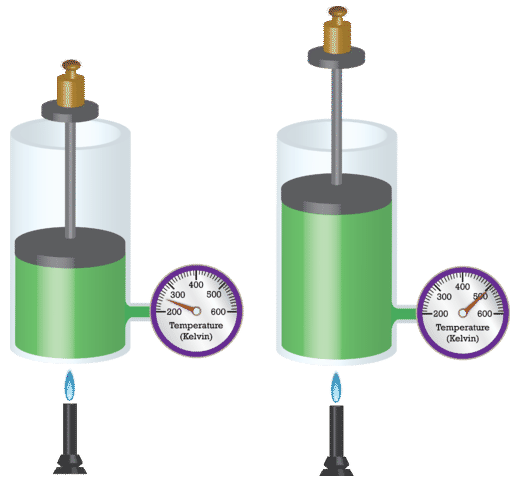
Mathematically, the direct relationship of Charles's Law can be represented by the following equation:
\[\dfrac{V}{T} = k \nonumber \]
As with Boyle's Law, \(k\) is constant only for a given gas sample. The table below shows temperature and volume data for a set amount of gas at a constant pressure. The third column is the constant for this particular data set and is always equal to the volume divided by the Kelvin temperature.
| Temperature \(\left( \text{K} \right)\) | Volume \(\left( \text{mL} \right)\) | \(\dfrac{V}{T} = k\) \(\left( \dfrac{\text{mL}}{\text{K}} \right)\) |
|---|---|---|
| 50 | 20 | 0.40 |
| 100 | 40 | 0.40 |
| 150 | 60 | 0.40 |
| 200 | 80 | 0.40 |
| 300 | 120 | 0.40 |
| 500 | 200 | 0.40 |
| 1000 | 400 | 0.40 |
When this data is graphed, the result is a straight line, indicative of a direct relationship, shown in the figure below.
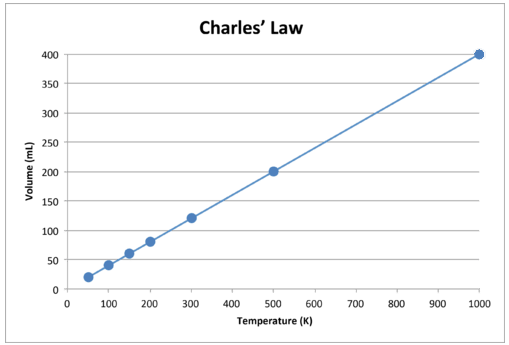
Notice that the line goes exactly toward the origin, meaning that as the absolute temperature of the gas approaches zero, its volume approaches zero. However, when a gas is brought to extremely cold temperatures, its molecules would eventually condense into the liquid state before reaching absolute zero. The temperature at which this change into the liquid state occurs varies for different gases.
Charles's Law can also be used to compare changing conditions for a gas. Now we use \(V_1\) and \(T_1\) to stand for the initial volume and temperature of a gas, while \(V_2\) and \(T_2\) stand for the final volume and temperature. The mathematical relationship of Charles's Law becomes:
\[\dfrac{V_1}{T_1} = \dfrac{V_2}{T_2} \nonumber \]
This equation can be used to calculate any one of the four quantities if the other three are known. The direct relationship will only hold if the temperatures are expressed in Kelvin. Temperatures in Celsius will not work. Recall the relationship that \(\text{K} = \: ^\text{o} \text{C} + 273\).
A balloon is filled to a volume of \(2.20 \: \text{L}\) at a temperature of \(22^\text{o} \text{C}\). The balloon is then heated to a temperature of \(71^\text{o} \text{C}\). Find the new volume of the balloon.
Solution
| Steps for Problem Solving | |
|---|---|
| Identify the "given" information and what the problem is asking you to "find." |
Given: \(V_1 = 2.20 \: \text{L}\) and \(T_1 = 22^\text{o} \text{C} = 295 \: \text{K}\) \(T_2 = 71^\text{o} \text{C} = 344 \: \text{K}\) Find: V2 = ? L |
| List other known quantities. | The temperatures have first been converted to Kelvin. |
| Plan the problem. |
First, rearrange the equation algebraically to solve for \(V_2\). \[V_2 = \dfrac{V_1 \times T_2}{T_1} \nonumber \] |
| Cancel units and calculate. |
Now substitute the known quantities into the equation and solve. \[V_2 = \dfrac{2.20 \: \text{L} \times 344 \: \cancel{\text{K}}}{295 \: \cancel{\text{K}}} = 2.57 \: \text{L} \nonumber \] |
| Think about your result. | The volume increases as the temperature increases. The result has three significant figures. |
If V1 = 3.77 L and T1 = 255 K, what is V2 if T2 = 123 K?
- Answer
-
1.82 L
A sample of a gas has an initial volume of 34.8 L and an initial temperature of −67°C. What must be the temperature of the gas for its volume to be 25.0 L?
Solution
| Steps for Problem Solving | |
|---|---|
| Identify the "given" information and what the problem is asking you to "find." |
Given: Given:T1 = -27oC and V1 = 34.8 L V2 = 25.0 L Find: T2 = ? K |
| List other known quantities. | K = -27oC + 273 |
| Plan the problem. |
1. Convert the initial temperature to Kelvin 2. Rearrange the equation algebraically to solve for \(T_2\). \[T_2 = \dfrac{V_2 \times T_1}{V_1} \nonumber \] |
| Cancel units and calculate. |
1. −67°C + 273 = 206 K 2. Substitute the known quantities into the equation and solve. \[T_2 = \dfrac{25.0 \: \cancel{\text{L}} \times 206 \: \text{K}}{34.8 \: \cancel{\text{L}}} = 148 \: \text{K} \nonumber \] |
| Think about your result. | This is also equal to −125°C. As temperature decreases, volume decreases—which it does in this example. |
If V1 = 623 mL, T1 = 255°C, and V2 = 277 mL, what is T2?
- Answer
-
235 K, or −38°C
Summary
- Charles’s Law relates the volume and temperature of a gas at constant pressure and amount.
11.5: Charles’s Law- Volume and Temperature is shared under a CC BY-NC-SA 4.0 license and was authored, remixed, and/or curated by LibreTexts.
The book could not be loaded just now.