Opening the book…
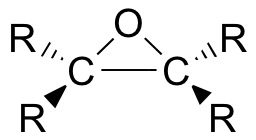
Epoxides (also known as oxiranes) are three-membered ring structures in which one of the vertices is an oxygen and the other two are carbons. 
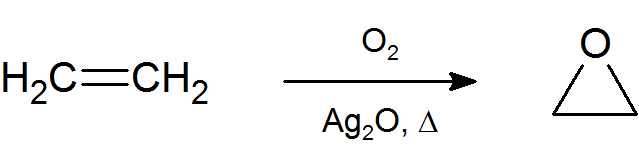
The most important and simplest epoxide is ethylene oxide which is prepared on an industrial scale by catalytic oxidation of ethylene by air.
Ethylene oxide is used as an important chemical feedstock in the manufacturing of ethylene glycol, which is used as antifreeze, liquid coolant and solvent. In turn, ethylene glycol is used in the production of polyester and polyethylene terephthalate (PET) the raw material for plastic bottles.
Peroxyacid reactions with Alkenes
Oxacyclopropane synthesis by peroxycarboxylic acid requires an alkene and a peroxycarboxylic acid as well as an appropriate solvent. The peroxycarboxylic acid has the unique property of having an electropositive oxygen atom on the COOH group. The reaction is initiated by the electrophilic oxygen atom reacting with the nucleophilic carbon-carbon double bond. The mechanism involves a concerted reaction with a four-part, circular transition state. The result is that the originally electropositive oxygen atom ends up in the oxacyclopropane ring and the COOH group becomes COH.

Intramolecular Williamson Ether Synthesis via Halohydrins
Epoxides can also be synthesized by the treatment of a halohydrin with a base. This causes an intramolecular Williamson ether synthesis.
Exercise
8. What reagents would you use to perform the following transformations?
(a)
(b)
(c)
(d)
- Answer
-
8.
(a)
(b)
Note the cis addition
(c)
An oxidation to an alcohol through hydroboration, and subsequent substitution with 2-bromopropane could also work, but this route provides the least likelihood of an elimination reaction occurring.
(d)
Lindlar's catalyst reduces alkynes to cis/Z alkenes. This stereochemistry is retained after epoxidation.
Contributors and Attributions
15.7: Synthesis of Epoxides is shared under a CC BY-NC-SA 4.0 license and was authored, remixed, and/or curated by LibreTexts.
The book could not be loaded just now.