Opening the book…
13C NMR Chemical Shifts
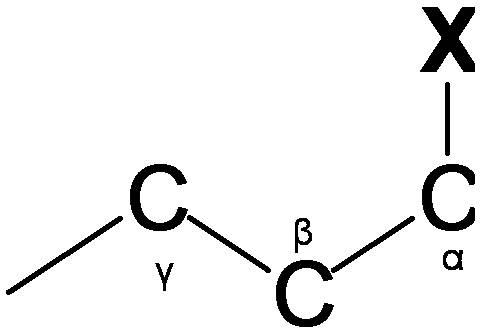
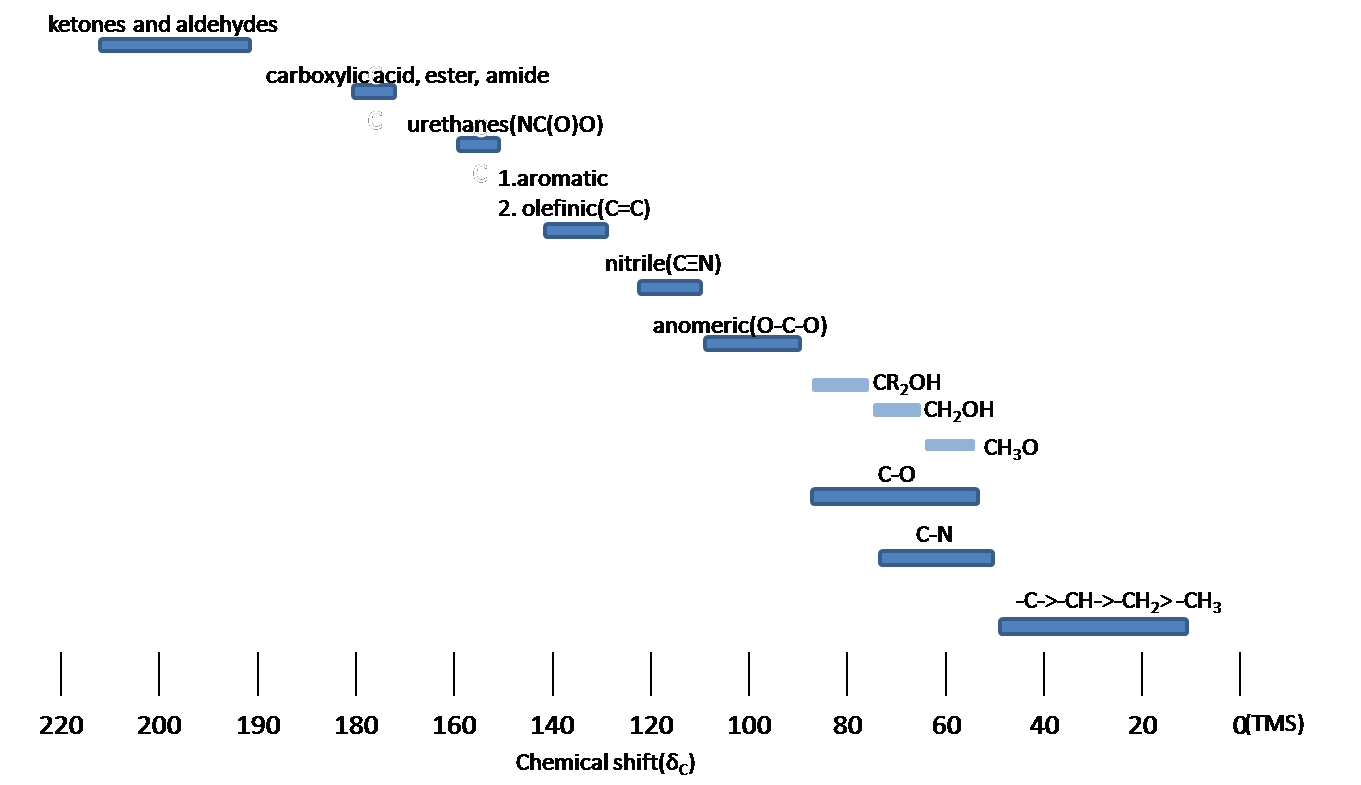
The Carbon NMR is used for determining functional groups using characteristic shift values. 13C chemical shift is affect by electronegative effect and steric effect. If an H atoms in an alkane is replace by substituent X, electronegative atoms (O, N, halogen), ?-carbon and ?-carbon shift to downfield (left; increase in ppm) while ?-carbon shifts to upfield. The steric effect is observed in acyclic and clyclic system, which leads to downshifted chemical shifts. Figure 9 shows typical 13C chemical shift regions of the major chemical class.
Spin-Spin splitting
Comparing the 1H NMR, there is a big difference thing in the 13C NMR. The 13C-13Cspin-spin splitting rarely exit between adjacent carbons because 13C is naturally lower abundant (1.1%)
- 13C-1H Spin coupling: 13C-1H Spin coupling provides useful information about the number of protons attached a carbon atom. In case of one bond coupling (1JCH), -CH, -CH2, and CH3 have respectively doublet, triplet, quartets for the 13C resonances in the spectrum. However, 13C-1H Spin coupling has an disadvantage for 13C spectrum interpretation. 13C-1H Spin coupling is hard to analyze and reveal structure due to a forest of overlapping peaks that result from 100% abundance of 1H.
- Decoupling: Decoupling is the process of removing 13C-1H coupling interaction to simplify a spectrum and identify which pair of nuclei is involved in the J coupling. The decoupling 13C spectra shows only one peak(singlet) for each unique carbon in the molecule(Fig 10.). Decoupling is performed by irradiating at the frequency of one proton with continuous low-power RF.

Fig 10. Decoupling in the 13C NMR
Contributors and Attributions
Prof. Steven Farmer (Sonoma State University)
Organic Chemistry With a Biological Emphasis by Tim Soderberg (University of Minnesota, Morris)
Chris P Schaller, Ph.D., (College of Saint Benedict / Saint John's University)
12.11: Chemical Shifts and Interpreting ¹³C NMR Spectra is shared under a CC BY-NC-SA 4.0 license and was authored, remixed, and/or curated by LibreTexts.
The book could not be loaded just now.