Opening the book…
Ester, Acid Chloride, and Nitrile Reduction to form Aldehydes
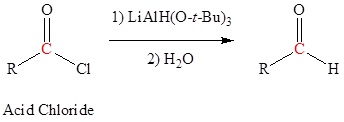
The reduction of esters, acid chlorides, and nitriles require reducing agents that are derivatives of lithium aluminum hydride (LiAlH4). For esters and nitriles, LiAlH4 is modified into the organometallic reagent diisobutyl aluminum hydride which can be represented as DIBAL or DIBAL-H or DIBAH or DIBALH. To reduce acid chlorides, t-butoxide groups are combined with LiAlH4 to form lithium tritert-butoxy aluminum hydride.
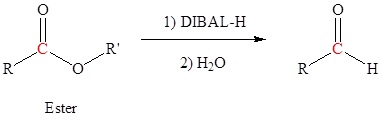
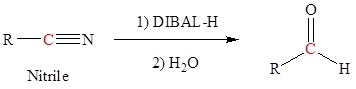
Carboxylic Acids can be converted to Aldehydes
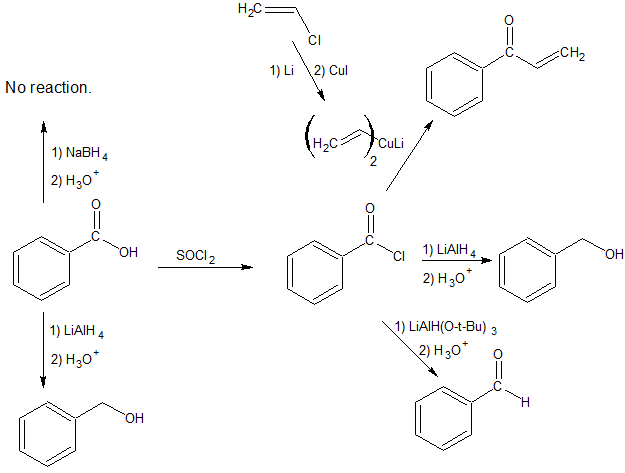
Carboxylic acids cannot be reduced directly to aldehydes. Carboxylic acids can be converted to acid chlorides using thionyl chloride which can then be reduced to aldehydes using LiAlH(O-t-Bu)3.

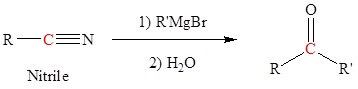
Grignard reagents react with Nitriles to form Ketones
Nitriles can also be used to synthesize ketones when they react with Grignards as shown below.
Organocuprate reagents react with Acid Chlorides to form Ketones
Organocuprate reagents are the least reactive of the organometallic reagents studied so far. While we learned to synthesize alcohols by reacting Grignard reagents with aldehydes and ketones, organocuprates will not react with aldehydes and ketones.
Grignard reagents will keep reacting with the product of the acid chloride reaction.

Organocuprate reactions with acid chlorides stop at the ketone as shown below.

Exercise
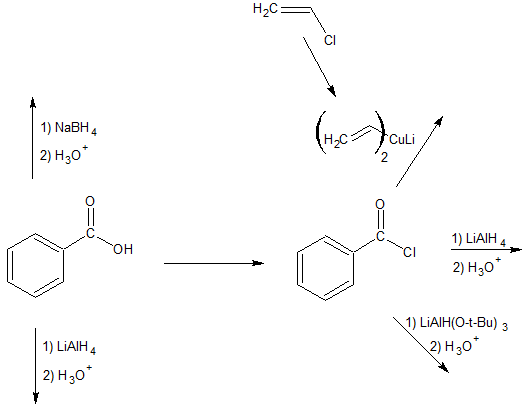
3. Complete the reaction map below.
- Answer
-
3.
Contributors and Attributions
19.4: 19.4 New Synthesis of Aldehydes and Ketones is shared under a CC BY-NC-SA 4.0 license and was authored, remixed, and/or curated by LibreTexts.
The book could not be loaded just now.