Opening the book…
By the end of this section, you will have background information that will help you to be able to:
- Classify substances as acids (strong or weak), bases (strong or weak), amphoteric, or neither according to Brønsted-Lowry theory.
Acid–base reactions are essential in both biochemistry and industrial chemistry. Moreover, many of the substances we encounter in our homes, the supermarket, and the pharmacy are acids or bases. For example, aspirin is an acid (acetylsalicylic acid), and antacids are bases. In fact, every amateur chef who has prepared mayonnaise or squeezed a wedge of lemon to marinate a piece of fish has carried out an acid–base reaction. Before we discuss the characteristics of such reactions, let’s first describe some of the properties of acids and bases.
Definitions of Acids and Bases
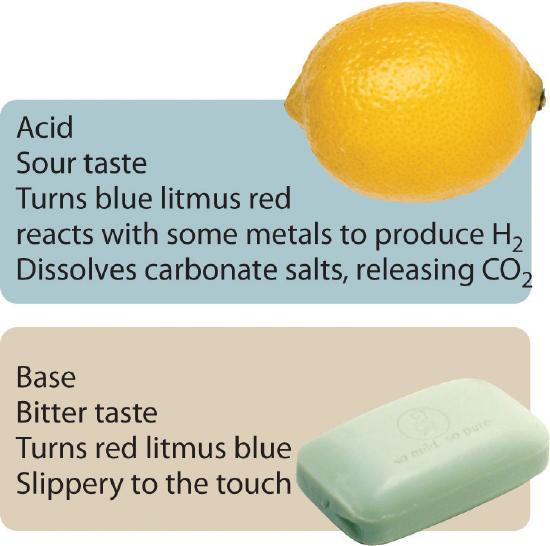
Although the general properties of acids and bases have been known for more than a thousand years, the definitions of acid and base have changed dramatically as scientists have learned more about them. In ancient times, an acid was any substance that had a sour taste (e.g., vinegar or lemon juice), caused consistent color changes in dyes derived from plants (e.g., turning blue litmus paper red), reacted with certain metals to produce hydrogen gas and a solution of a salt containing a metal cation, and dissolved carbonate salts such as limestone (CaCO3) with the evolution of carbon dioxide. In contrast, a base was any substance that had a bitter taste, felt slippery to the touch, and caused color changes in plant dyes that differed diametrically from the changes caused by acids (e.g., turning red litmus paper blue). Although these definitions were useful, they were entirely descriptive.
The Arrhenius Definition of Acids and Bases (not used in this class)
The first person to define acids and bases in detail was the Swedish chemist Svante Arrhenius (1859–1927; Nobel Prize in Chemistry, 1903). According to the Arrhenius definition, an acid is a substance like hydrochloric acid that dissolves in water to produce H+ ions (protons; Equation \(\PageIndex{1}\) ), and a base is a substance like sodium hydroxide that dissolves in water to produce hydroxide (OH−) ions (Equation \(\PageIndex{2}\) ):
\[ \underset{an\: Arrhenius\: acid}{HCl_{(g)}} \xrightarrow {H_2 O_{(l)}} H^+_{(aq)} + Cl^-_{(aq)} \]
\[ \underset{an\: Arrhenius\: base}{NaOH_{(s)}} \xrightarrow {H_2O_{(l)}} Na^+_{(aq)} + OH^-_{(aq)} \]
According to Arrhenius, the characteristic properties of acids and bases are due exclusively to the presence of H+ and OH− ions, respectively, in solution. Although Arrhenius’s ideas were widely accepted, his definition of acids and bases had two major limitations:
- First, because acids and bases were defined in terms of ions obtained from water, the Arrhenius concept applied only to substances in aqueous solution.
- Second, and more important, the Arrhenius definition predicted that only substances that dissolve in water to produce \(H^+\) and \(OH^−\) ions should exhibit the properties of acids and bases, respectively. For example, according to the Arrhenius definition, the reaction of ammonia (a base) with gaseous HCl (an acid) to give ammonium chloride (Equation \(\PageIndex{3}\) ) is not an acid–base reaction because it does not involve \(H^+\) and \(OH^−\):
\[ NH_{3\;(g)} + HCl_{(g)} \rightarrow NH_4Cl_{(s)} \]
The Brønsted–Lowry Definition of Acids and Bases (used in this class)
Because of the limitations of the Arrhenius definition, a more general definition of acids and bases was needed. One was proposed independently in 1923 by the Danish chemist J. N. Brønsted (1879–1947) and the British chemist T. M. Lowry (1874–1936), who defined acid–base reactions in terms of the transfer of a proton (H+ ion) from one substance to another.
According to Brønsted and Lowry, an acid (A substance with at least one hydrogen atom that can dissociate to form an anion and an \(H^+\) ion (a proton) in aqueous solution, thereby forming an acidic solution) is any substance that can donate a proton, and a base (a substance that produces one or more hydroxide ions (\(OH^-\) and a cation when dissolved in aqueous solution, thereby forming a basic solution) is any substance that can accept a proton. The Brønsted–Lowry definition of an acid is essentially the same as the Arrhenius definition, except that it is not restricted to aqueous solutions. The Brønsted–Lowry definition of a base, however, is far more general because the hydroxide ion is just one of many substances that can accept a proton. Ammonia, for example, reacts with a proton to form \(NH_4^+\), so in Equation \(\PageIndex{3}\), \(NH_3\) is a Brønsted–Lowry base and \(HCl\) is a Brønsted–Lowry acid. Because of its more general nature, the Brønsted–Lowry definition is used throughout this text unless otherwise specified.
Polyprotic Acids
Acids differ in the number of protons they can donate. For example, monoprotic acids (a compound that is capable of donating one proton per molecule) are compounds that are capable of donating a single proton per molecule. Monoprotic acids include HF, HCl, HBr, HI, HNO3, and HNO2. All carboxylic acids that contain a single −CO2H group, such as acetic acid (CH3CO2H), are monoprotic acids, dissociating to form RCO2− and H+ (section 4.6). A compound that can donate more than one proton per molecule. can donate more than one proton per molecule. For example, H2SO4 can donate two H+ ions in separate steps, so it is a diprotic acid (a compound that can donate two protons per molecule in separate steps) and H3PO4, which is capable of donating three protons in successive steps, is a triprotic acid (a compound that can donate three protons per molecule in separate steps), (Equation \(\PageIndex{4}\), Equation \(\PageIndex{5}\), and Equation \(\PageIndex{6}\) ):
\[ H_3 PO_4 (l) \overset{H_2 O(l)}{\rightleftharpoons} H ^+ ( a q ) + H_2 PO_4 ^- (aq) \tag{8.7.4}\]
\[ H_2 PO_4 ^- (aq) \rightleftharpoons H ^+ (aq) + HPO_4^{2-} (aq) \tag{8.7.5}\]
\[ HPO_4^{2-} (aq) \rightleftharpoons H^+ (aq) + PO_4^{3-} (aq) \tag{8.7.6}\]

In chemical equations such as these, a double arrow is used to indicate that both the forward and reverse reactions occur simultaneously, so the forward reaction does not go to completion. Instead, the solution contains significant amounts of both reactants and products. Over time, the reaction reaches a state in which the concentration of each species in solution remains constant. The reaction is then said to be in equilibrium (the point at which the rates of the forward and reverse reactions become the same, so that the net composition of the system no longer changes with time).
Strengths of Acids and Bases
Strong acids react essentially completely with water) to give \(H^+\) and the corresponding anion. The equilibrium constant for the reaction of a strong acid with water is much larger than 1. See Table \(\PageIndex{1}\) a list of six (6) strong acids to memorize.
Similarly, strong bases dissociates essentially completely in water) to give \(OH^-\) and the corresponding cation. Strong bases are the hydroxides of the alkali metals and the heavier alkaline earths (Ca, Sr, and Ba).
Table \(\PageIndex{1}\) Common Strong Acids and Bases
| Strong Acids | Strong Bases | ||
|---|---|---|---|
| Hydrogen Halides | Oxoacids | Group 1 Hydroxides | Hydroxides of the Heavier Group 2 Elements |
| HCl | HNO3 | LiOH | Ca(OH)2 |
| HBr | H2SO4 | NaOH | Sr(OH)2 |
| HI | HClO4 | KOH | Ba(OH)2 |
| RbOH | |||
| CsOH | |||
All other acids and bases are considered weak acids or weak bases. These do not dissociate completely in water and the equilibrium constant for the dissolution process is less than one. Note that an acid's strength or weakness is not correlated with its solubility. For example, acetic acid is very soluble in water, but almost all of the acetic acid in solution exists in the form of neutral molecules (less than 1% dissociates). Another example is the common weak base ammonia, which reacts with water to form small amounts of hydroxide ion:
\[ NH_3 (g) + H_2 O(l) \rightleftharpoons NH_4^+ (aq) + OH^- (aq) \]
Most of the ammonia (>99%) is present in the form of NH3(g). Amines, which are organic analogues of ammonia, are also weak bases, as are ionic compounds that contain anions derived from weak acids (such as S2−).
Classify each compound as a strong acid, a weak acid, a strong base, a weak base, or none of these.
- CH3CH2CO2H
- CH3OH
- Sr(OH)2
- CH3CH2NH2
- HBrO4
Given: compound
Asked for: acid or base strength
Strategy:
A Determine whether the compound is organic or inorganic.
B If inorganic, determine whether the compound is acidic or basic by the presence of dissociable H+ or OH− ions, respectively. If organic, identify the compound as a weak base or a weak acid by the presence of an amine or a carboxylic acid group, respectively. Recall that all polyprotic acids except H2SO4 are weak acids.
Solution
- A This compound is propionic acid, which is organic. B It contains a carboxylic acid group analogous to that in acetic acid, so it must be a weak acid.
- A CH3OH is methanol, an organic compound that contains the −OH group. B As a covalent compound, it does not dissociate to form the OH− ion. Because it does not contain a carboxylic acid (−CO2H) group, methanol also cannot dissociate to form H+(aq) ions. Thus we predict that in aqueous solution methanol is neither an acid nor a base.
- A Sr(OH)2 is an inorganic compound that contains one Sr2+ and two OH− ions per formula unit. B We therefore expect it to be a strong base, similar to Ca(OH)2.
- A CH3CH2NH2 is an amine (ethylamine), an organic compound in which one hydrogen of ammonia has been replaced by an R group. B Consequently, we expect it to behave similarly to ammonia (Equation 8.6.7), reacting with water to produce small amounts of the OH− ion. Ethylamine is therefore a weak base.
- A HBrO4 is perbromic acid, an inorganic compound. B It is not listed in Table 8.3 as one of the common strong acids, but that does not necessarily mean that it is a weak acid. If you examine the periodic table, you can see that Br lies directly below Cl in group 17. We might therefore expect that HBrO4 is chemically similar to HClO4, a strong acid—and, in fact, it is.
Classify each compound as a strong acid, a weak acid, a strong base, a weak base, or none of these.
- Ba(OH)2
- HIO4
- CH3CH2CH2CO2H
- (CH3)2NH
- CH2O
- Answer
-
- strong base
- strong acid
- weak acid
- weak base
- none of these; formaldehyde is a neutral molecule
Summary
Acid–base reactions require both an acid and a base. In Brønsted–Lowry terms, an acid is a substance that can donate a proton (H+), and a base is a substance that can accept a proton. All acid–base reactions contain two acid–base pairs: the reactants and the products. Acids can donate one proton (monoprotic acids), two protons (diprotic acids), or three protons (triprotic acids). Compounds that are capable of donating more than one proton are generally called polyprotic acids. Acids also differ in their tendency to donate a proton, a measure of their acid strength. Strong acids react completely with water to produce H3O+(aq) (the hydronium ion), whereas weak acids dissociate only partially in water. Conversely, strong bases react completely with water to produce the hydroxide ion, whereas weak bases react only partially with water to form hydroxide ions.
Conceptual Problems
-
Why was it necessary to expand on the Arrhenius definition of an acid and a base? What specific point does the Brønsted–Lowry definition address?
-
State whether each compound is an acid, a base, or a salt.
- CaCO3
- NaHCO3
- H2SO4
- CaCl2
- Ba(OH)2
-
State whether each compound is an acid, a base, or a salt.
- NH3
- NH4Cl
- H2CO3
- CH3COOH
- NaOH
-
Classify each compound as a strong acid, a weak acid, a strong base, or a weak base in aqueous solution.
- sodium hydroxide
- acetic acid
- magnesium hydroxide
- tartaric acid
- sulfuric acid
- ammonia
- hydroxylamine (NH2OH)
- hydrocyanic acid
-
Decide whether each compound forms an aqueous solution that is strongly acidic, weakly acidic, strongly basic, or weakly basic.
- propanoic acid
- hydrobromic acid
- methylamine
- lithium hydroxide
- citric acid
- sodium acetate
- ammonium chloride
- barium hydroxide
-
What is the relationship between the strength of an acid and the strength of the conjugate base derived from that acid? Would you expect the CH3CO2− ion to be a strong base or a weak base? Why? Is the hydronium ion a strong acid or a weak acid? Explain your answer.
Answer
-
- weakly acidic
- strongly acidic
- weakly basic
- strongly basic
- weakly acidic
- weakly basic
- weakly acidic
- strongly basic
This page titled 11.2: Definitions of Acids and Bases was last modified on Thu, 13 Aug 2026 01:22:52 GMT and is shared under a CC BY-NC-SA 3.0 license and was authored, remixed, and/or curated by Staff.
The book could not be loaded just now.