5.13: Coordinate Covalent Bonding is Different

CHEM 111 and CHEM 113 (General Chemistry I and II) · LibreTexts

0%

Contents

    Text

    Size
    100%
    Theme
    Typeface
    Line length
    Spacing

    From LibreTexts, under CC BY 4.0, as the source states it; its equations are written in TeX, which the PDF shows typeset. This page at LibreTexts.

    5.13: Coordinate Covalent Bonding is Different
    Learning Objectives

    By the end of this section, you will be able to:

    • Predict the oxidation state, coordination number, spin state, magnetic properties, or color of a coordinate covalent complex.

    The hemoglobin in your blood, the chlorophyll in green plants, vitamin B-12, and the catalyst used in the manufacture of polyethylene all contain coordination compounds. Ions of the metals, especially the transition metals, are likely to form complexes. Many of these compounds are highly colored (Figure \(\PageIndex{1}\)). In the remainder of this chapter, we will consider the structure and bonding of these remarkable compounds.
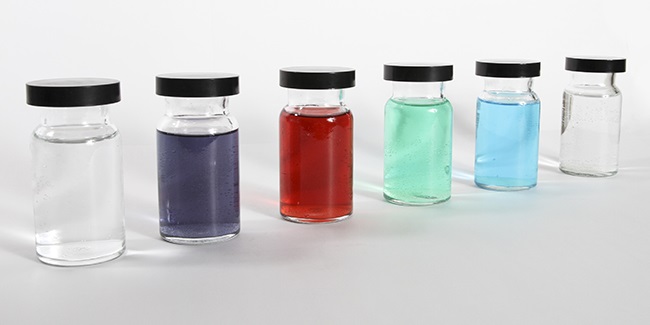
    This figure shows six containers. Each is filled with a different color liquid. The first appears to be clear; the second appears to be purple; the third appears to be red; the fourth appears to be teal; the fifth appears to be blue; and the sixth also appears to be clear.
    Figure \(\PageIndex{1}\): Metal ions that contain partially filled d subshell usually form colored complex ions; ions with empty d subshell (d0) or with filled d subshells (d10) usually form colorless complexes. This figure shows, from left to right, solutions containing [M(H2O)6]n+ ions with M = Sc3+(d0), Cr3+(d3), Co2+(d7), Ni2+(d8), Cu2+(d9), and Zn2+(d10). (credit: Sahar Atwa)

    Remember that in most main group element compounds, the valence electrons of the isolated atoms combine to form chemical bonds that satisfy the octet rule. For instance, the four valence electrons of carbon overlap with electrons from four hydrogen atoms to form CH4. The one valence electron leaves sodium and adds to the seven valence electrons of chlorine to form the ionic formula unit NaCl (Figure \(\PageIndex{2}\)). Transition metals do not normally bond in this fashion. They primarily form coordinate covalent bonds, a form of the Lewis acid-base interaction in which both of the electrons in the bond are contributed by a donor (Lewis base) to an electron acceptor (Lewis acid). The Lewis acid in coordination complexes, often called a central metal ion (or atom), is often a transition metal or inner transition metal, although main group elements can also form coordination compounds. The Lewis base donors, called ligands, can be a wide variety of chemicals—atoms, molecules, or ions. The only requirement is that they have one or more electron pairs, which can be donated to the central metal. Most often, this involves a donor atom with a lone pair of electrons that can form a coordinate bond to the metal.

    Three electron dot models are shown. To the left, a central C atom is shown with H atoms bonded above, below, to the left, and to the right. Between the C atom and each H atom are two electron dots, one red, and one black, next to each other in pairs between the atoms. The second structure to the right shows N superscript plus sign followed by a C l atom in brackets. This C l atom has pairs of electron dots above, below, left, and right of the element symbol. A single electron dot on the left side of the symbol is shown in red. All others are black. Outside the brackets to the right, a negative sign appears as a superscript. The third structure on the far right has a central S c atom. This atom is surrounded by six pairs of evenly-spaced electron dots. These pairs of dots are positioned between the S c atom and each of the O atoms from six H subscript 2 O molecules. This entire structure is within brackets to the right of which is the superscript 3 plus.
    Figure \(\PageIndex{2}\): (a) Covalent bonds involve the sharing of electrons, and ionic bonds involve the transferring of electrons associated with each bonding atom, as indicated by the colored electrons. (b) However, coordinate covalent bonds involve electrons from a Lewis base being donated to a metal center. The lone pairs from six water molecules form bonds to the scandium ion to form an octahedral complex. (Only the donated pairs are shown.)

    The coordination sphere consists of the central metal ion or atom plus its attached ligands. Brackets in a formula enclose the coordination sphere; species outside the brackets are not part of the coordination sphere. The coordination number of the central metal ion or atom is the number of donor atoms bonded to it. The coordination number for the silver ion in [Ag(NH3)2]+ is two (Figure \(\PageIndex{3}\)). For the copper(II) ion in [CuCl4]2−, the coordination number is four, whereas for the cobalt(II) ion in [Co(H2O)6]2+ the coordination number is six. Each of these ligands is monodentate, from the Greek for “one toothed,” meaning that they connect with the central metal through only one atom. In this case, the number of ligands and the coordination number are equal.

    Three structures are shown. In a, a central A g atom has N atoms bonded to the left and right as indicated by line segments. Three H atoms are similarly bonded to each N atom extending out and up, out to the side, and out and below each N atom. The structure is enclosed in brackets with a superscript plus sign to the right of the brackets. In b, a C u atom is at the center of the structure. Line segments indicate bonds to two C l atoms, one above and the other below and to the left of the central atom. To the right, a dashed wedge, narrow toward the C u atom and widening toward a C l atom, is shown at the right side of the central C u atom. A solid wedge is similarly directed toward a C l atom below and slightly right of the central C u atom. This structure is enclosed in brackets with a superscript 2 negative sign present to the right of the brackets. In c, a structure is shown with a central C o atom. From the C o atom, line segments indicate bonds to H subscript 2 O molecules above and below the structure. Above and to both the right and left, dashed wedges indicate bonds to two H subscript 2 O molecules. Similarly, solid wedges below to both the right and left indicate bonds to two more H subscript 2 O molecules. Each bond in this structure is directed toward the O atom in each H subscript 2 O structure. This structure is enclosed in brackets. Outside the brackets to the right is a superscript 2 plus sign.
    Figure \(\PageIndex{3}\): The complexes (a) [Ag(NH3)2]+, (b) [Cu(Cl)4]2−, and (c) [Co(H2O)6]2+ have coordination numbers of two, four, and six, respectively. The geometries of these complexes are the same as we have seen with VSEPR theory for main group elements: linear, tetrahedral, and octahedral.

    Many other ligands coordinate to the metal in more complex fashions. Bidentate ligands are those in which two atoms coordinate to the metal center. For example, ethylenediamine (en, H2NCH2CH2NH2) contains two nitrogen atoms, each of which has a lone pair and can serve as a Lewis base (Figure \(\PageIndex{4}\)). Both of the atoms can coordinate to a single metal center. In the complex [Co(en)3]3+, there are three bidentate en ligands, and the coordination number of the cobalt(III) ion is six. The most common coordination numbers are two, four, and six, but examples of all coordination numbers from 1 to 15 are known.

    Two structures are shown. In a, H subscript 2 N appears at the left end of the structure. A short line segment extends up and to the right from the N atom to a C atom in a C H subscript 2 group. A short line segment extends down and to the right to another C atom in a C H subscript 2 group. A final short line segment extends from this C H subscript 2 group up and to the right to the N atom of an N H subscript 2 group. Each N atom in the structure has a pair of electron dots at its top. In b, a central C o atom has six N H subscript 2 groups attached with single bonds. These bonds are indicated with line segments extending above and below, dashed wedges extending up and to the left and right, and solid wedges extending below and to the left and right. The bonds to these groups are all directed toward the N atoms. The N H subscript 2 groups are each connected to C atoms of C H subscript 2 groups extending outward from the central C o atom. These C H subscript 2 groups are connected in pairs with bonds indicated by short line segments, forming 3 rings in the structure. This entire structure is enclosed in brackets. Outside the brackets to the right is a superscript 3 plus sign.
    Figure \(\PageIndex{4}\): (a) The ethylenediamine (en) ligand contains two atoms with lone pairs that can coordinate to the metal center. (b) The cobalt(III) complex contains three of these ligands, each forming two bonds to the cobalt ion.

    Any ligand that bonds to a central metal ion by more than one donor atom is a polydentate ligand (or “many teeth”) because it can bite into the metal center with more than one bond. The term chelate (pronounced “KEY-late”) from the Greek for “claw” is also used to describe this type of interaction. Many polydentate ligands are chelating ligands, and a complex consisting of one or more of these ligands and a central metal is a chelate. A chelating ligand is also known as a chelating agent. A chelating ligand holds the metal ion rather like a crab’s claw would hold a marble. Figure \(\PageIndex{4}\): showed one example of a chelate. The heme complex in hemoglobin is another important example (Figure \(\PageIndex{5}\)). It contains a polydentate ligand with four donor atoms that coordinate to iron.

    A structure is shown for the single ligand heme. At the center of this structure is an F e atom. From this atom, four single bonds extend up and to the right and left and below and to the right and left to four N atoms which are shown in red. Each N atom is a component of a 5 member ring with four C atoms. Each of these rings has a double bond between the C atoms that are not bonded to the N atom. The C atoms that are bonded to N atoms are connected to C atoms that serve as links between the 5-member rings. The bond to the C atom clockwise from the 5-member ring in each case is a double bond. The bond to the C atom counterclockwise from the 5-member ring in each case is a single bond. To the left of the structure, two of the C atoms in the 5-member rings that are not bonded to N are bonded to C H subscript 3 groups. The other carbons in these rings that are not bonded to N atoms are bonded to groups above and below. Above is a C H group double bonded to a C H subscript 2 group. Below is a C H subscript 2 group bonded to another C H subscript 2 group, which is bonded to a C O subscript 2 H group. At the right side of the structure, the C atoms in the 5-member rings that are not bonded to N atoms are bonded to additional structures. The C atom at to the right in the 5-member ring at the upper right is bonded to a C H group which is in turn double bonded to a C H subscript 2 group. Similarly, the right most C atom from the 5-member ring in the lower right is bonded to a C H subscript 3 group. The C atom from the 5-member ring not bonded to an N atom in the upper right region of the structure is bonded to a C H subscript 3 group above. Similarly, the C atom on the 5-member ring not bonded to an N atom in the lower right region of the structure is bonded to a C H subscript 2 group that is bonded to another C H subscript 2 group, which is bonded to a C O subscript 2 H group below.
    Figure \(\PageIndex{5}\): The single ligand heme contains four nitrogen atoms that coordinate to iron in hemoglobin to form a chelate.

    Polydentate ligands are sometimes identified with prefixes that indicate the number of donor atoms in the ligand. As we have seen, ligands with one donor atom, such as \(\ce{NH3}\), \(\ce{Cl^{−}}\), and \(\ce{H2O}\), are monodentate ligands. Ligands with two donor groups are bidentate ligands. Ethylenediamine, \(\cE{H2NCH2CH2NH2}\), and the anion of the acid glycine, \(\ce{NH2CH2CO2^{−}}\) (Figure \(\PageIndex{6}\)) are examples of bidentate ligands. Tridentate ligands, tetradentate ligands, pentadentate ligands, and hexadentate ligands contain three, four, five, and six donor atoms, respectively. The ligand in heme (Figure \(\PageIndex{5}\)) is a tetradentate ligand.

    A structure is shown. At the center of this structure is an P t atom. From this atom, two single bonds extend up and to the right and below and to the left to two O atoms which are shown in red. Similarly, two bonds extend up and to the left and down and to the right to N atoms in N H subscript 2 groups. The N atoms in these groups are in red. The N atoms are bonded to C H subscript 2 groups, which in turn are bonded to C atoms. These C atoms have doubly bonded O atoms bonded and oriented toward the outside of the structure. They are also singly bonded to the O atoms in the structure forming two rings connected by the central P t atom.
    Figure \(\PageIndex{6}\): Each of the anionic ligands shown attaches in a bidentate fashion to platinum(II), with both a nitrogen and oxygen atom coordinating to the metal.

    The Structures of Complexes

    For transition metal complexes, the coordination number determines the geometry around the central metal ion. The most common structures of the complexes in coordination compounds are square planar, tetrahedral, and octahedral, corresponding to coordination numbers of four, four, and six, respectively. Coordination numbers greater than six are less common and yield a variety of structures (see Figure \(\PageIndex{7}\) and Table \(\PageIndex{5}\)):

    This figure contains three diagrams in black and white. The first is labeled, “Pentagonal Bipyramid.” It has 10 isosceles triangle faces, five at the top, joined at a vertex, making a point projecting upward at the top of the figure, and five below, joined at a vertex, making a point projecting downward, at the base of the figure. The second is labeled, “Square Antiprism.” It has flat upper and lower square surfaces and sides made up of 8 equilateral triangles. The sides alternate in orientation between pointing up and pointing down. The third diagram is labeled, “Dodecahedron.” It has twelve isosceles triangle faces.
    Figure \(\PageIndex{7}\): These are geometries of some complexes with coordination numbers of seven and eight.
    Table \(\PageIndex{5}\): Coordination Numbers and Molecular Geometry
    Coordination Number Molecular Geometry Example
    2 linear [Ag(NH3)2]+
    3 trigonal planar [Cu(CN)3]2−
    4 tetrahedral(d0 or d10), low oxidation states for M [Ni(CO)4]
    4 square planar (d8) [Ni(CN)4]2−
    5 trigonal bipyramidal [CoCl5]2−
    5 square pyramidal [VO(CN)4]2−
    6 octahedral [CoCl6]3−
    7 pentagonal bipyramid [ZrF7]3−
    8 square antiprism [ReF8]2−
    8 dodecahedron [Mo(CN)8]4−
    9 and above more complicated structures [ReH9]2−

    Unlike main group atoms in which both the bonding and nonbonding electrons determine the molecular shape, the nonbonding d-electrons do not change the arrangement of the ligands. Octahedral complexes have a coordination number of six, and the six donor atoms are arranged at the corners of an octahedron around the central metal ion. Examples are shown in Figure \(\PageIndex{8}\). The chloride and nitrate anions in [Co(H2O)6]Cl2 and [Cr(en)3](NO3)3, and the potassium cations in K2[PtCl6], are outside the brackets and are not bonded to the metal ion.

    Three structures are shown. In a, a structure is shown with a central C o atom. From the C o atom, line segments indicate bonds to H subscript 2 O molecules above and below the structure. Above and to both the right and left, dashed wedges indicate bonds to two H subscript 2 O molecules. Similarly, solid wedges below to both the right and left indicate bonds to two more H subscript 2 O molecules. Each bond in this structure is directed toward the O atom in each H subscript 2 O structure. This structure is enclosed in brackets. Outside the brackets to the right is the superscript 2 plus. Following this to the right appears 2 C l superscript negative sign. In b, a central C r atom has six N H subscript 2 groups attached with single bonds. These bonds are indicated with line segments extending above and below, dashed wedges extending up and to the left and right, and solid wedges extending below and to the left and right. The bonds to these groups are all directed toward the N atoms. The N H subscript 2 groups are each connected to C atoms of C H subscript 2 groups extending outward from the central C o atom. These C H subscript 2 groups are connected in pairs with bonds indicated by short line segments. This entire structure is enclosed in brackets. Outside the brackets to the right is the superscript 3 plus. Following to the right is 3 N O subscript 3 superscript negative sign. In c, 2 K superscript plus is followed by a structure in brackets. Inside the brackets is a central P t atom. From the P t atom, line segments indicate bonds to C l atoms above and below the structure. Above and to both the right and left, dashed wedges indicate bonds to C l atoms. Similarly, solid wedges below to both the right and left indicate bonds to two more C l atoms. This structure is enclosed in brackets. Outside the brackets to the right is the superscript 2 negative sign.
    Figure \(\PageIndex{8}\): Many transition metal complexes adopt octahedral geometries, with six donor atoms forming bond angles of 90° about the central atom with adjacent ligands. Note that only ligands within the coordination sphere affect the geometry around the metal center.

    For transition metals with a coordination number of four, two different geometries are possible: tetrahedral or square planar. Unlike main group elements, where these geometries can be predicted from VSEPR theory, a more detailed discussion of transition metal orbitals (discussed in the section on Crystal Field Theory) is required to predict which complexes will be tetrahedral and which will be square planar. In tetrahedral complexes such as [Zn(CN)4]2− (Figure \(\PageIndex{9}\)), each of the ligand pairs forms an angle of 109.5°. In square planar complexes, such as [Pt(NH3)2Cl2], each ligand has two other ligands at 90° angles (called the cis positions) and one additional ligand at an 180° angle, in the trans position.

    Two structures are shown. In a, inside of brackets, a central Z n atom is bonded to 4 C atoms in a tetrahedral spatial arrangement. Short line segments are used to represent a bond extending above and down and to the left of the Z n atom. A dashed wedge with the vertex at the Z n atom and wide end at the C atom is used to represent a bond down and to the right of the Z n atom. The final bond is indicated by a similar solid wedge again directed down and only slightly right of the center beneath the Z n atom. Four groups of three parallel short line segments are shown indicating triple bonds extending from each C atom opposite the bond with Z n to an associated N atom. Outside the brackets a superscript of 2 negative is shown. In b, at the center of this structure is a P t atom. From this atom, a single bond represented by a dashed wedge extends from a vertex at the P t atom up and to the right to the N atom of an N H subscript 3 group. Similarly, a single bond represented by a solid wedge extends from a vertex at the P t atom down and to the right to the N atom of an N H subscript 3 group. Another single bond represented by a dashed wedge extends from a vertex at the P t atom up and to the left to a C l atom. Similarly, a single bond represented by a solid wedge extends from a vertex at the P t atom down and to the left to a C l atom.
    Figure \(\PageIndex{9}\): Transition metals with a coordination number of four can adopt a tetrahedral geometry (a) as in K2[Zn(CN)4] or a square planar geometry (b) as shown in [Pt(NH3)2Cl2].


    Coordination Complexes in Nature and Technology

    Chlorophyll, the green pigment in plants, is a complex that contains magnesium (Figure \(\PageIndex{14}\)). This is an example of a main group element in a coordination complex. Plants appear green because chlorophyll absorbs red and purple light; the reflected light consequently appears green. The energy resulting from the absorption of light is used in photosynthesis.

    Structural formulas are shown for two complex molecules. The first has a central M g atom, to which N atoms are bonded above, below, left, and right. Each N atom is a component of a 5 member ring with four C atoms. Each of these rings has a double bond between the C atoms that are not bonded to the N atom. The C atoms that are bonded to N atoms are connected to C atoms that serve as links between the 5-member rings. The bond to the C atom clockwise from the 5-member ring in each case is a double bond. The bond to the C atom counterclockwise from the 5-member ring in each case is a single bond. To the left of the structure, two of the C atoms in the 5-member rings that are not bonded to N atoms are bonded to C H subscript 3 groups. The other carbons in these rings that are not bonded to N atoms are bonded to groups above and below. A variety of groups are attached outside this interconnected system of rings, including four C H subscript 3 groups, a C H subscript 2 C H subscript 2, C O O C subscript 20, H subscript 39 group, a C H C H subscript 2 group with a double bond between the C atoms, additional branching to form a five-member carbon ring to which an O atom is double bonded and a C O O C H subscript 3 group is attached. The second structure has a central C u atom to which four N atoms that participate in 5-member rings with C atoms are bonded. Unlike the first molecule, these 5-member rings are joined by N atoms between them, with a double bond on the counter clockwise side and a single bond on the clockwise side of each of the four N atoms that link the rings. On the side of each 5-member ring opposite its N atom, four additional carbon atoms are bonded, forming 6-member carbon rings with alternating double bonds. The double bonds are not present on the bonds that are shared with the 5-member rings.
    Figure \(\PageIndex{14}\): (a) Chlorophyll comes in several different forms, which all have the same basic structure around the magnesium center. (b) Copper phthalocyanine blue, a square planar copper complex, is present in some blue dyes.
    Chemistry in Everyday Life: Transition Metal Catalysts

    One of the most important applications of transition metals is as industrial catalysts. As you recall from the chapter on kinetics, a catalyst increases the rate of reaction by lowering the activation energy and is regenerated in the catalytic cycle. Over 90% of all manufactured products are made with the aid of one or more catalysts. The ability to bind ligands and change oxidation states makes transition metal catalysts well suited for catalytic applications. Vanadium oxide is used to produce 230,000,000 tons of sulfuric acid worldwide each year, which in turn is used to make everything from fertilizers to cans for food. Plastics are made with the aid of transition metal catalysts, along with detergents, fertilizers, paints, and more (see Figure \(\PageIndex{15}\)). Very complicated pharmaceuticals are manufactured with catalysts that are selective, reacting with one specific bond out of a large number of possibilities. Catalysts allow processes to be more economical and more environmentally friendly. Developing new catalysts and better understanding of existing systems are important areas of current research.

    This figure includes three photographs. In a, a photo shows store shelving filled with a variety of brands of laundry detergent. In b, a photo shows a can of yellow paint being stirred. In c, a bag of fertilizer is shown.
    Figure \(\PageIndex{15}\): (a) Detergents, (b) paints, and (c) fertilizers are all made using transition metal catalysts. (credit a: modification of work by “Mr. Brian”/Flickr; credit b: modification of work by Ewen Roberts; credit c: modification of work by “osseous”/Flickr)
    Portrait of a Chemist: Deanna D’Alessandro

    Dr. Deanna D’Alessandro develops new metal-containing materials that demonstrate unique electronic, optical, and magnetic properties. Her research combines the fields of fundamental inorganic and physical chemistry with materials engineering. She is working on many different projects that rely on transition metals. For example, one type of compound she is developing captures carbon dioxide waste from power plants and catalytically converts it into useful products (see Figure \(\PageIndex{16}\)).

    An image is shown of a catalytic converter. At the upper left, a blue arrow pointing into a pipe that enters a larger, widened chamber is labeled, “Dirty emissions.” A small black arrow that points to the lower right is positioned along the upper left side of the widened region. This arrow is labeled, “Additional oxygen from air pump.” The image shows the converter with the upper surface removed, exposing a red-brown interior. The portion of the converter closes to the dirty emissions inlet shows small, spherical components in an interior layer. This layer is labeled, “Three-way reduction catalyst.” The middle region shows closely packed small brown rods that are aligned parallel to the dirty emissions inlet pipe. The final nearly quarter of the interior of the catalytic converter again shows a layer of closely packed small, red-brown circles. Two large light grey arrows extend from this layer to the open region at the lower right of the image to the label, “Clean emissions.”
    Figure \(\PageIndex{16}\): Catalytic converters change carbon dioxide emissions from power plants into useful products, and, like the one shown here, are also found in cars.

    Another project involves the development of porous, sponge-like materials that are “photoactive.” The absorption of light causes the pores of the sponge to change size, allowing gas diffusion to be controlled. This has many potential useful applications, from powering cars with hydrogen fuel cells to making better electronics components. Although not a complex, self-darkening sunglasses are an example of a photoactive substance.

    Watch this video to learn more about this research and listen to Dr. D’Alessandro (shown in Figure \(\PageIndex{17}\)) describe what it is like being a research chemist.

    This is a photo of doctor Deanna D’Alessandro.
    Figure \(\PageIndex{17}\): Dr. Deanna D’Alessandro is a functional materials researcher. Her work combines the inorganic and physical chemistry fields with engineering, working with transition metals to create new systems to power cars and convert energy (credit: image courtesy of Deanna D'Alessandro).

    Many other coordination complexes are also brightly colored. The square planar copper(II) complex phthalocyanine blue (from Figure \(\PageIndex{14}\)) is one of many complexes used as pigments or dyes. This complex is used in blue ink, blue jeans, and certain blue paints.

    The structure of heme (Figure \(\PageIndex{18}\)), the iron-containing complex in hemoglobin, is very similar to that in chlorophyll. In hemoglobin, the red heme complex is bonded to a large protein molecule (globin) by the attachment of the protein to the heme ligand. Oxygen molecules are transported by hemoglobin in the blood by being bound to the iron center. When the hemoglobin loses its oxygen, the color changes to a bluish red. Hemoglobin will only transport oxygen if the iron is Fe2+; oxidation of the iron to Fe3+ prevents oxygen transport.

    A colorful model of a hemoglobin structure is shown. The molecule has four distinct quadrants that are filled with spiral, ribbon-like regions. The upper right quadrant is lavender, lower right is gold, lower left is light blue, and upper left is green. In each of these regions, clusters of approximately 25 red dots in nearly linear arrangements are present near the center.
    Figure \(\PageIndex{18}\): Hemoglobin contains four protein subunits, each of which has an iron center attached to a heme ligand (shown in red), which is coordinated to a globin protein. Each subunit is shown in a different color.

    Complexing agents often are used for water softening because they tie up such ions as Ca2+, Mg2+, and Fe2+, which make water hard. Many metal ions are also undesirable in food products because these ions can catalyze reactions that change the color of food. Coordination complexes are useful as preservatives. For example, the ligand EDTA, (HO2CCH2)2NCH2CH2N(CH2CO2H)2, coordinates to metal ions through six donor atoms and prevents the metals from reacting (Figure \(\PageIndex{19}\)). This ligand also is used to sequester metal ions in paper production, textiles, and detergents, and has pharmaceutical uses.

    This structure shows a metal atom, represented by M in red. Single bonds extending from the M are also shown in red. Bonds are indicated with O atoms by line segments extending above and below. Dashed wedges extend up and to the left to an N atom and up and to the right to an O atom, and solid wedges extend below and to the left to an N atom and below and to the right to an O atom. The O atoms bonded to the M atom each have a negative sign associated with them and they are each bonded to a C atom which is in turn double bonded to an O atom and single bonded to a C atom in a C H subscript 2 group. This last C atom in each case is single bonded to one of the N atoms, resulting in two five-member rings of which the M atom is a part. To the left of each N atom, are single bonds to the C in C H subscript 2 groups, which in turn are connected with a single bond, forming another five-member ring with the two N atoms and the M atom. Extending up and to the left of the upper N atom is a bond to the C atom of another C H subscript 2 group. This group is in turn bonded to a C atom which is double bonded to an O atom and single bonded to the O atom that is bonded to the M atom at the top of the structure, again forming a five-member ring. The same bonding structure repeats at the bottom of the structure extending from the N atom bonded at the lower left of the M atom. All single bonded O atoms in this structure have negative charges associated with them.
    Figure \(\PageIndex{19}\): The ligand EDTA binds tightly to a variety of metal ions by forming hexadentate complexes.

    Complexing agents that tie up metal ions are also used as drugs. British Anti-Lewisite (BAL), HSCH2CH(SH)CH2OH, is a drug developed during World War I as an antidote for the arsenic-based war gas Lewisite. BAL is now used to treat poisoning by heavy metals, such as arsenic, mercury, thallium, and chromium. The drug is a ligand and functions by making a water-soluble chelate of the metal; the kidneys eliminate this metal chelate (Figure \(\PageIndex{20}\)). Another polydentate ligand, enterobactin, which is isolated from certain bacteria, is used to form complexes of iron and thereby to control the severe iron buildup found in patients suffering from blood diseases such as Cooley’s anemia, who require frequent transfusions. As the transfused blood breaks down, the usual metabolic processes that remove iron are overloaded, and excess iron can build up to fatal levels. Enterobactin forms a water-soluble complex with excess iron, and the body can safely eliminate this complex.

    This figure includes two structures. In a, a five member ring is shown with an S atom at the top with additional atoms single bonded in the following order clockwise around the pentagonal ring; M atom, S atom, C atom of a C H subscript 2 group, followed by a C atom of a C H group. The final C atom is bonded to the original S atom completing the ring. The C in the C H group is at the upper left of the structure. This C has a C H subscript 2 group bonded above to which an O H group is bonded to the right. In b, a complex structure is shown. It has an open central region and multiple ring structures. A single F e atom is included, appearing to be bonded to six O atoms. Fifteen total O atoms are bonded into the structure along with three N atoms and multiple C atoms and H atoms. Nine O atoms are single bonded and are incorporated into rings and six are double bonded, extending outward from ring structures.
    Figure \(\PageIndex{20}\): Coordination complexes are used as drugs. (a) British Anti-Lewisite is used to treat heavy metal poisoning by coordinating metals (M), and enterobactin (b) allows excess iron in the blood to be removed.

    Ligands are also used in the electroplating industry. When metal ions are reduced to produce thin metal coatings, metals can clump together to form clusters and nanoparticles. When metal coordination complexes are used, the ligands keep the metal atoms isolated from each other. It has been found that many metals plate out as a smoother, more uniform, better-looking, and more adherent surface when plated from a bath containing the metal as a complex ion. Thus, complexes such as [Ag(CN)2]− and [Au(CN)2]− are used extensively in the electroplating industry.

    In 1965, scientists at Michigan State University discovered that there was a platinum complex that inhibited cell division in certain microorganisms. Later work showed that the complex was cis-diamminedichloroplatinum(II), [Pt(NH3)2(Cl)2], and that the trans isomer was not effective. The inhibition of cell division indicated that this square planar compound could be an anticancer agent. In 1978, the US Food and Drug Administration approved this compound, known as cisplatin, for use in the treatment of certain forms of cancer. Since that time, many similar platinum compounds have been developed for the treatment of cancer. In all cases, these are the cis isomers and never the trans isomers. The diammine (NH3)2 portion is retained with other groups, replacing the dichloro [(Cl)2] portion. The newer drugs include carboplatin, oxaliplatin, and satraplatin.

    Footnotes

    • 1National Council against Health Fraud, NCAHF Policy Statement on Chelation Therapy, (Peabody, MA, 2002).

    This page titled 5.13: Coordinate Covalent Bonding is Different was last modified on Thu, 13 Aug 2026 01:22:23 GMT and is shared under a CC BY 4.0 license and was authored, remixed, and/or curated by OpenStax via source content that was edited to the style and standards of the LibreTexts platform.