Opening the book…
By the end of this section, you will have background information that will help you to be able to:
- Use the 1st, 2nd, and 3rd laws of thermodynamics to explain key relationships between heat, work, and physical or chemical processes.
- Use appropriate mathematical expressions (stoichiometry, Hess’s Law) and relevant experimental data (calorimetry, bond energies, formation ΔH/ΔG, standard molar entropy, definition of free energy) to calculate ΔH, ΔS, and ΔG for a chemical reaction.
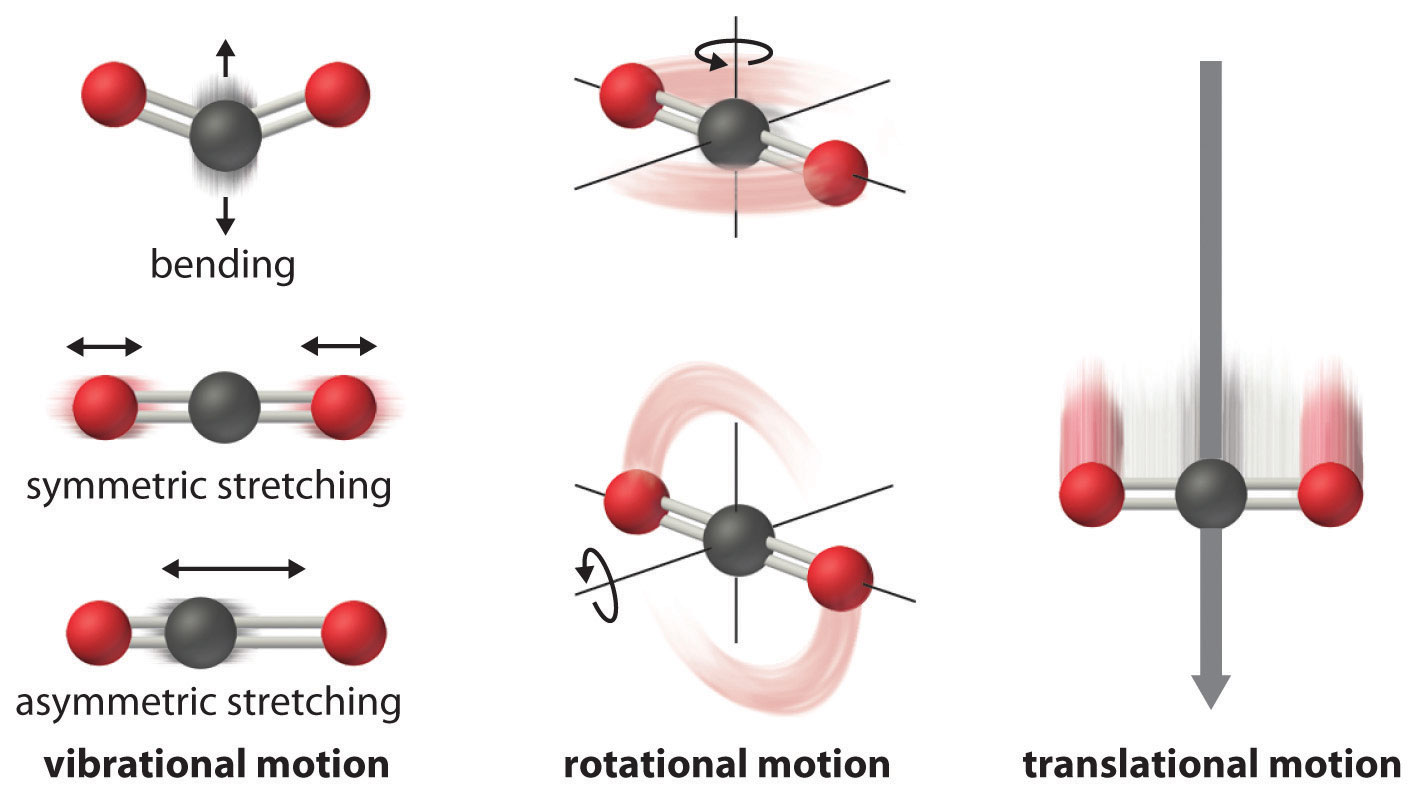
The atoms, molecules, or ions that compose a chemical system can undergo several types of molecular motion, including translation, rotation, and vibration (Figure \(\PageIndex{1}\)). The greater the molecular motion of a system, the greater the number of possible microstates and the higher the entropy. A perfectly ordered system with only a single microstate available to it would have an entropy of zero. The only system that meets this criterion is a perfect crystal at a temperature of absolute zero (0 K), in which each component atom, molecule, or ion is fixed in place within a crystal lattice and exhibits no motion (ignoring quantum effects). Such a state of perfect order (or, conversely, zero disorder) corresponds to zero entropy. In practice, absolute zero is an ideal temperature that is unobtainable, and a perfect single crystal is also an ideal that cannot be achieved. Nonetheless, the combination of these two ideals constitutes the basis for the third law of thermodynamics: the entropy of any perfectly ordered, crystalline substance at absolute zero is zero.
The entropy of any perfectly ordered, crystalline substance at absolute zero is zero.
The third law of thermodynamics has two important consequences: it defines the sign of the entropy of any substance at temperatures above absolute zero as positive, and it provides a fixed reference point that allows us to measure the absolute entropy of any substance at any temperature. In practice, chemists determine the absolute entropy of a substance by measuring the molar heat capacity (Cp) as a function of temperature and then plotting the quantity Cp/T versus T. The area under the curve between 0 K and any temperature T is the absolute entropy of the substance at T. In contrast, other thermodynamic properties, such as internal energy and enthalpy, can be evaluated in only relative terms, not absolute terms.
Comparing Standard Molar Entropy Values
We can use the third law to calculate and tabulate values of the standard molar entropy (S°), which is the entropy of 1 mol of a substance at a standard temperature of 298 K; the units of S° are J/(mol•K). That calculation is beyond the scope of this class. However, we can observe some general trends in standard molar entropy values.
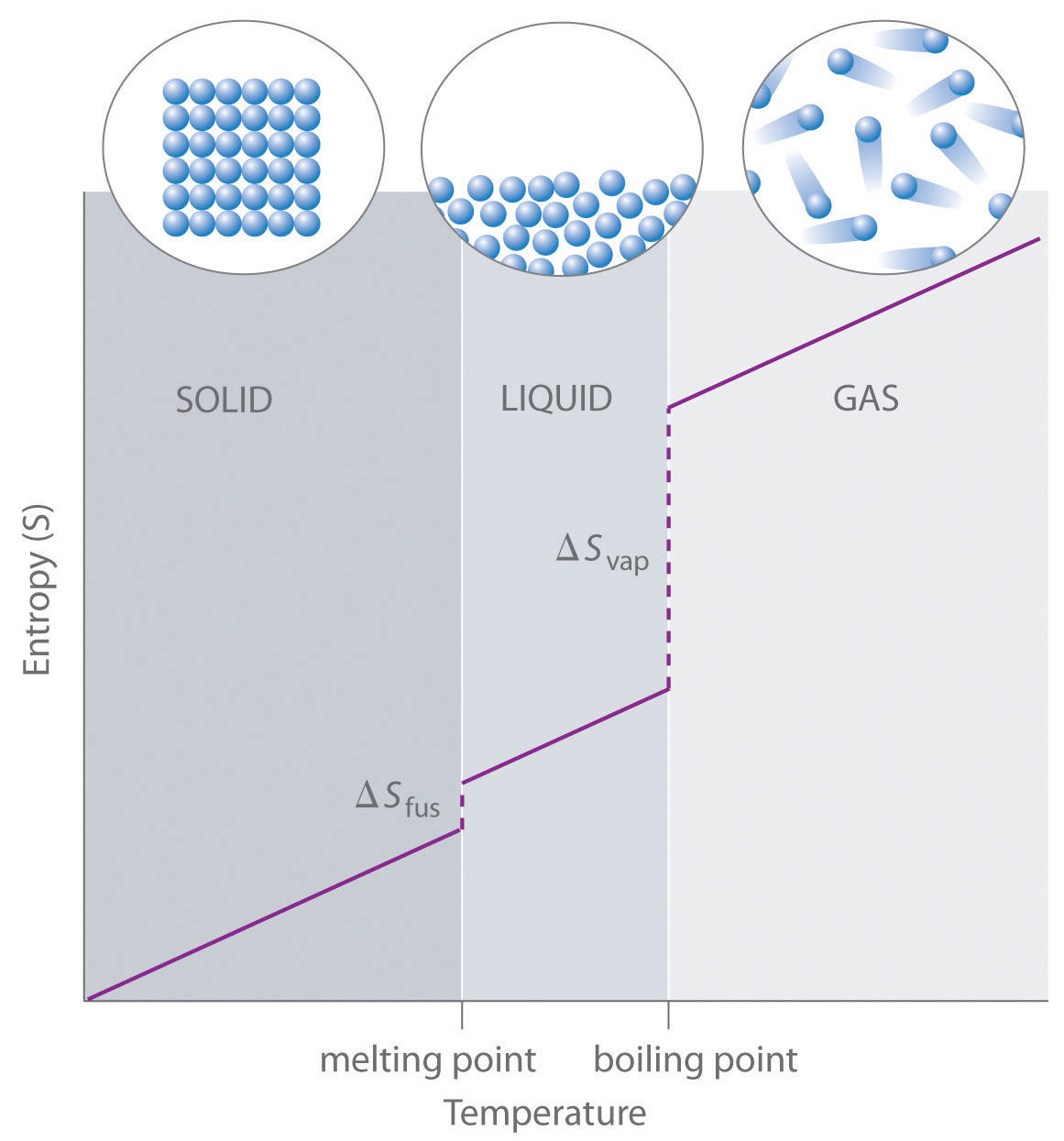
As shown in Table \(\PageIndex{1}\), for substances with approximately the same molar mass and number of atoms, S° values fall in the order S°(gas) > S°(liquid) > S°(solid). For instance, S° for liquid water is 70.0 J/(mol•K), whereas S° for water vapor is 188.8 J/(mol•K). Likewise, S° is 260.7 J/(mol•K) for gaseous I2 and 116.1 J/(mol•K) for solid I2. This order makes qualitative sense based on the kinds and extents of motion available to atoms and molecules in the three phases. The correlation between physical state and absolute entropy is illustrated in Figure \(\PageIndex{2}\), which is a generalized plot of the entropy of a substance versus temperature.
| Gases | Liquids | Solids | |||
| Substance | S° [J/(mol•K)] | Substance | S° [J/(mol•K)] | Substance | S° [J/(mol•K)] |
| He | 126.2 | H2O | 70.0 | C (diamond) | 2.4 |
| H2 | 130.7 | CH3OH | 126.8 | C (graphite) | 5.7 |
| Ne | 146.3 | Br2 | 152.2 | LiF | 35.7 |
| Ar | 154.8 | CH3CH2OH | 160.7 | SiO2 (quartz) | 41.5 |
| Kr | 164.1 | C6H6 | 173.4 | Ca | 41.6 |
| Xe | 169.7 | CH3COCl | 200.8 | Na | 51.3 |
| H2O | 188.8 | C6H12 (cyclohexane) | 204.4 | MgF2 | 57.2 |
| N2 | 191.6 | C8H18 (isooctane) | 329.3 | K | 64.7 |
| O2 | 205.2 | NaCl | 72.1 | ||
| CO2 | 213.8 | KCl | 82.6 | ||
| I2 | 260.7 | I2 | 116.1 | ||
Entropy increases with softer, less rigid solids, solids that contain larger atoms, and solids with complex molecular structures.
A closer examination of Table \(\PageIndex{1}\) also reveals that substances with similar molecular structures tend to have similar S° values. Among crystalline materials, those with the lowest entropies tend to be rigid crystals composed of small atoms linked by strong, highly directional bonds, such as diamond [S° = 2.4 J/(mol•K)]. In contrast, graphite, the softer, less rigid allotrope of carbon, has a higher S° [5.7 J/(mol•K)] due to more disorder in the crystal. Soft crystalline substances and those with larger atoms tend to have higher entropies because of increased molecular motion and disorder. Similarly, the absolute entropy of a substance tends to increase with increasing molecular complexity because the number of available microstates increases with molecular complexity. For example, compare the S° values for CH3OH(l) and CH3CH2OH(l). Finally, substances with strong hydrogen bonds have lower values of S°, which reflects a more ordered structure.
ΔS° for a reaction can be calculated from absolute entropy values using the same “products minus reactants” rule used to calculate ΔH°.
Calculating ΔS from Standard Molar Entropy Values
To calculate ΔS° for a chemical reaction from standard molar entropies, we use the familiar “products minus reactants” rule, in which the absolute entropy of each reactant and product is multiplied by its stoichiometric coefficient in the balanced chemical equation. Example \(\PageIndex{1}\) illustrates this procedure for the combustion of the liquid hydrocarbon isooctane (C8H18; 2,2,4-trimethylpentane).
Use the data in Table \(\PageIndex{1}\) to calculate ΔS° for the reaction of liquid isooctane with O2(g) to give CO2(g) and H2O(g) at 298 K.
Given: standard molar entropies, reactants, and products
Asked for: ΔS°
Strategy:
Write the balanced chemical equation for the reaction and identify the appropriate quantities in Table \(\PageIndex{1}\). Subtract the sum of the absolute entropies of the reactants from the sum of the absolute entropies of the products, each multiplied by their appropriate stoichiometric coefficients, to obtain ΔS° for the reaction.
Solution:
The balanced chemical equation for the complete combustion of isooctane (C8H18) is as follows:
We calculate ΔS° for the reaction using the “products minus reactants” rule, where m and n are the stoichiometric coefficients of each product and each reactant:
\begin{align}\Delta S^\circ_{\textrm{rxn}}&=\sum mS^\circ(\textrm{products})-\sum nS^\circ(\textrm{reactants})
\\ &=[8S^\circ(\mathrm{CO_2})+9S^\circ(\mathrm{H_2O})]-[S^\circ(\mathrm{C_8H_{18}})+\dfrac{25}{2}S^\circ(\mathrm{O_2})]
\\ &=\left \{ [8\textrm{ mol }\mathrm{CO_2}\times213.8\;\mathrm{J/(mol\cdot K)}]+[9\textrm{ mol }\mathrm{H_2O}\times188.8\;\mathrm{J/(mol\cdot K)}] \right \}
\\ &-\left \{[1\textrm{ mol }\mathrm{C_8H_{18}}\times329.3\;\mathrm{J/(mol\cdot K)}]+\left [\dfrac{25}{2}\textrm{ mol }\mathrm{O_2}\times205.2\textrm{ J}/(\mathrm{mol\cdot K})\right ] \right \}
\\ &=515.3\;\mathrm{J/K}\end{align}
ΔS° is positive, as expected for a combustion reaction in which one large hydrocarbon molecule is converted to many molecules of gaseous products.
Use the data in Table \(\PageIndex{1}\) to calculate ΔS° for the reaction of H2(g) with liquid benzene (C6H6) to give cyclohexane (C6H12).
Answer: −361.1 J/K
This page titled 8.11: Entropy Changes and the Third Law of Thermodynamics was last modified on Thu, 13 Aug 2026 01:22:37 GMT and is shared under a CC BY-NC-SA 3.0 license and was authored, remixed, and/or curated by Staff.
The book could not be loaded just now.