Opening the book…
How do Dipoles Form?
Although we defined covalent bonding as electron sharing, the electrons in a covalent bond are not always shared equally by the two bonded atoms. Unless the bond connects two atoms of the same element, there will always be one atom that attracts the electrons in the bond more strongly than the other atom does, as shown in Figure 4.5. When such an imbalance occurs, there is a resulting buildup of some negative charge (called a partial negative charge and designated δ−) on one side of the bond and some positive charge (designated δ+) on the other side of the bond. A covalent bond that has an unequal sharing of electrons, as in part (b) of Figure 4.3.1, is called a polar covalent bond. A covalent bond that has an equal sharing of electrons (part (a) of Figure 4.3.1) is called a nonpolar covalent bond.

Figure \(\PageIndex{1}\): Polar versus Nonpolar Covalent Bonds. (a) The electrons in the covalent bond are equally shared by both hydrogen atoms. This is a nonpolar covalent bond. (b) The fluorine atom attracts the electrons in the bond more than the hydrogen atom does, leading to an imbalance in the electron distribution. This is a polar covalent bond.
Any covalent bond between atoms of different elements is a polar bond, but the degree of polarity varies widely. Some bonds between different elements are only minimally polar, while others are strongly polar. Ionic bonds can be considered the ultimate in polarity, with electrons being transferred completely rather than shared. To judge the relative polarity of a covalent bond, chemists use electronegativity, which is a relative measure of how strongly an atom attracts electrons when it forms a covalent bond.
There are various numerical scales for rating electronegativity. Figure 4.6 shows one of the most popular—the Pauling scale. The polarity of a covalent bond can be judged by determining the difference in the electronegativities between the two atoms making the bond. The greater the difference in electronegativities, the greater the imbalance of electron sharing in the bond.

Figure \(\PageIndex{2}\): Electronegativities of Various Elements. The Pauling Scale for electronegativities has the value for fluorine atoms set at 4.0, the highest value.
Although there are no hard and fast rules, the general rule is that a difference in electronegativity less than 0.4 indicates the bond is nonpolar; when the difference is greater than 0.4, the bond is considered polar. When the difference in electronegativities is large enough (generally greater than about 1.8), the resulting compound is considered ionic rather than covalent. An electronegativity difference of zero, of course, indicates a nonpolar covalent bond. Examples of electronegativity difference are shown in Figure 4.3.3.
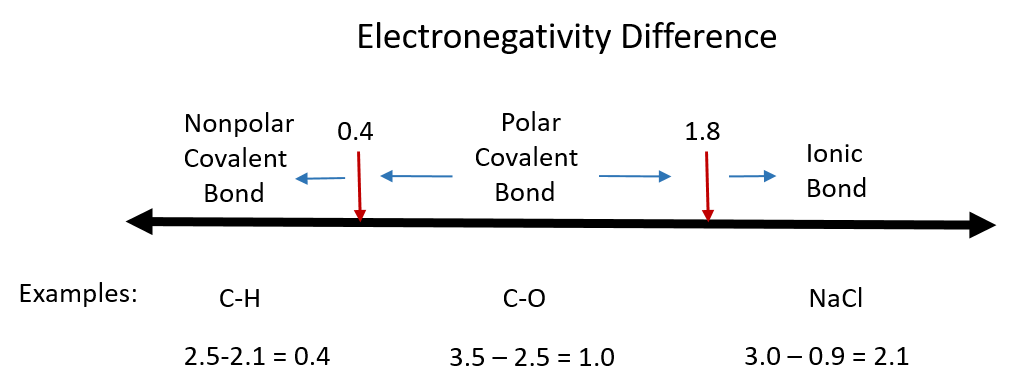
Figure \(\PageIndex{3}\): Electronegativity Difference Diagram. The diagram above is a guide for discerning what type of bond forms between two different atoms. By taking the difference between the electronegativity values for each of the atoms involved in the bond, the bond type and polarity can be predicted. Note that full ionic character is rarely reached, however when metals and nonmetals form bonds, they are named using the rules for ionic bonding.
When a molecule’s bonds are polar, the molecule as a whole can display an uneven distribution of charge, depending on how the individual bonds are oriented. For example, the orientation of the two O–H bonds in a water molecule (Figure 4.3.4) is bent: one end of the molecule has a partial positive charge, and the other end has a partial negative charge. In short, the molecule itself is polar. The polarity of water has an enormous impact on its physical and chemical properties. (For example, the boiling point of water [100°C] is high for such a small molecule and is due to the fact that polar molecules attract each other strongly.) In contrast, while the two C=O bonds in carbon dioxide are polar, they lie directly opposite each other in the molecule and so cancel each other’s effects. Thus, carbon dioxide molecules are nonpolar overall. This lack of polarity influences some of carbon dioxide’s properties. (For example, carbon dioxide becomes a gas at −77°C, almost 200° lower than the temperature at which water boils.)

Figure \(\PageIndex{4}\): Physical Properties and Polarity. The physical properties of water (a) and carbon dioxide (b) are affected by their molecular polarities. Note that the arrows in the diagram always point in the direction where the electrons are more strongly attracted. In this diagram, the delta symbol (δ) is used with a (+) or (-) symbol to represent partial positive and partial negative charge distribution in polar covalent bonds. Note that the electrons shared in polar covalent bonds will be attracted to and spend more time around the atom with the higher electronegativity value. When the polarity is equal and directly opposing, as in the case of carbon dioxide (b), the overall molecule will have no overall charge.
Describe the electronegativity difference between each pair of atoms and the resulting polarity (or bond type)
- C and N
- H and H
- Na and F
- O and H
Solution
- The electronegativity difference between Nitrogen (3.0) and Carbon (2.5) is 0.5. Based on our scale, this would represent a Nonpolar to only slightly Polar bond
- Both hydrogen atoms have an electronegativity of 2.1. Thus, the difference is 0 (zero). This bond is nonpolar.
- Sodium has an electronegativity of 0.9 and fluorine's is 4.0. Thus, the difference between the two is 3.1, which falls into the category of ionic bond (ie the most polar bond possible where full charges form).
- Oxygen has an electronegativity of 3.5 and hydrogen is 2.1. The difference between the two is 1.4 which falls into the polar bond category.
Test Yourself: Describe the electronegativity difference between each pair of atoms and the resulting polarity (or bond type)
- C and P
- K and Br
- N and N
- Cs and F
This page titled 4.3: Electronegativity and Bond Polarity was last modified on Tue, 11 Aug 2026 18:40:36 GMT and is shared under a CC BY-NC-SA 4.0 license and was authored, remixed, and/or curated by Hadeel Abozenadah, Adam Bishop, Scott Bitner, Kaysha Lehman and Patricia Flatt.
The book could not be loaded just now.