Opening the book…
The elements on the right side of the periodic table, nonmetals, gain the electrons necessary to reach the stable electron configuration of the nearest noble gas. Elements on the left side of the periodic table, metals, lose the electrons necessary to reach the electron configuration of the nearest noble gas. Transition elements can vary in how they move toward lower energy configurations.
Common Cations
Group IA elements form ions with a +1 charge. They lose one electron upon ionization, moving into the electron configuration of the previous noble gas. For example as shown in Figure 3.2.1, when a sodium (Na) atom is ionized, it loses one of its 11 electrons, becoming a sodium ion (Na+) with the electron configuration that looks like the previous noble gas, neon. The sodium ion has one fewer electron than it has protons, so it has a single positive charge and is called a cation.

Figure \(\PageIndex{1}\): Formation of a Sodium Ion. Sodium tends to lose it’s valence shell electron in the third shell during ionic bond formation. It is left with a full octet in the second shell and now has the electron configuration of neon. Note that it still has the same number of protons (11) as the original sodium atom and retains the identity of sodium. However, there are now only 10 electrons within the electron cloud, resulting in a net positive (+1) charge.
Upon losing that electron, the sodium ion now has an octet of electrons from the second principal energy level. The equation below illustrates this process.
\[ \Large\boldsymbol{ \begin{aligned} \mathrm{Na} &\quad\longrightarrow\quad \mathrm{Na}^{+} +\mathrm{e}^{-} \\[1.0em] 1s^{2}\,2s^{2}\,2p^{6}\,3s^{1} &\quad\longrightarrow\quad 1s^{2}\,2s^{2}\,2p^{6}\;(\mathrm{octet}) \end{aligned} } \]
The electron configuration of the sodium ion is now the same as that of the noble gas neon. The term isoelectronic refers to an atom and an ion of a different atom (or two different ions) that have the same electron configuration. The sodium ion is isoelectronic with the neon atom. Consider a similar process with magnesium and with aluminum:
\[ \Large\boldsymbol{ \begin{aligned} \mathrm{Mg} &\qquad\longrightarrow\qquad \mathrm{Mg}^{2+} +2\mathrm{e}^{-} \\[1.0em] 1s^{2}\,2s^{2}\,2p^{6}\,3s^{2} &\qquad\longrightarrow\qquad 1s^{2}\,2s^{2}\,2p^{6}\;(\mathrm{octet}) \end{aligned} } \]
\[ \Large\boldsymbol{ \begin{aligned} \mathrm{Al} &\qquad\longrightarrow\qquad \mathrm{Al}^{3+} +3\mathrm{e}^{-} \\[1.0em] 1s^{2}\,2s^{2}\,2p^{6}\,3s^{2}\,3p^{1} &\qquad\longrightarrow\qquad 1s^{2}\,2s^{2}\,2p^{6}\;(\mathrm{octet}) \end{aligned} } \]
In this case, the magnesium atom loses its two valence electrons in order to achieve the same noble-gas configuration. The aluminum atom loses its three valence electrons. The Mg2+ ion, the Al3+ ion, the Na+ ion, and the elemental Ne atom are all isoelectronic. For most elements under typical conditions, three electrons is the maximum number that will be lost or gained. Only larger atoms, such as lead and uranium, can typically carry larger charge states.
Overall, Group IIA elements lose two valence electrons to reach the electron configuration of the noble gas preceding them in the periodic table and Group IIIA elements lose three electrons to form ions with a +3 charge. This gives them the electron configuration of the noble gas that comes before them in the periodic table.
While hydrogen is in the first column, it is not considered to be an alkali metal, and so it does not fall under the same classification as the elements below it in the periodic table. This is because hydrogen only has an s-subshell and can only house a total of 2 electrons to become filled and obtain the electron configuration of helium. Thus, instead of following the octet rule, it reaches greater stability by gaining a “duet” of electrons through bonding with other atoms. Thus, hydrogen can form both covalent bonds and ionic bonds, depending on the element that it is interacting with. When it participates in ionic bonds, it most often will lose its electron forming a +1 cation. Note, that hydrogen only has one electron to begin with, so when it loses an electron in the ionized state, there is only a single proton left in the nucleus of the atom. Thus, when hydrogen is ionized to H+ it is often referred to as a proton. It can also be ionized, forming a -1 anion. In this case, the H– anion is named using standard convention forming the hydride ion. During the ionization of hydrogen, the H+ state is more common than the H– state. In addition, the H+ ion is very important in the chemistry of acids. Acids are defined as compounds that donate H+ ions in aqueous solutions, and will be discussed in more detail in Chapter 9.
Note: Despite our focus on the octet rule, we must remember that for small atoms, such as hydrogen, helium and lithium, the first shell is the outermost shell and holds only two electrons. Therefore, these atoms satisfy a duet rule, rather than an octet rule.
A sodium atom has one valence electron in its outer shell. Do you think it is more likely for a sodium atom to lose one electron or gain seven electrons to obtain an octet?
Solution
Although either event is possible, a sodium atom is more likely to lose its single valence electron. When this happens, it becomes an ion with a net positive charge of +1. This can be illustrated as follows:
| Sodium Atom | Sodium Ion | ||
|---|---|---|---|
| 11 Protons | +11 | 11 Protons | +11 |
| 11 Electrons | -11 | 10 electrons | -10 |
| Overall Charge = 0 | Overall Charge = +1 | ||
Common Anions
Elements on the other side of the periodic table, the nonmetals, tend to gain electrons in order to reach the stable electron configurations of the noble gases that come after them in the periodic table.
Group VIIA elements gain one electron when ionized, obtaining a -1 charge. For example as shown in Figure 3.2.2, chlorine (Cl), when ionized, gains an electron to reach the electron configuration of the noble gas that follows it in the periodic table, argon. This gives it a single negative charge, and it is now a chloride ion (Cl–); note the slight change in the suffix (-ide instead of -ine) to create the name of this anion.
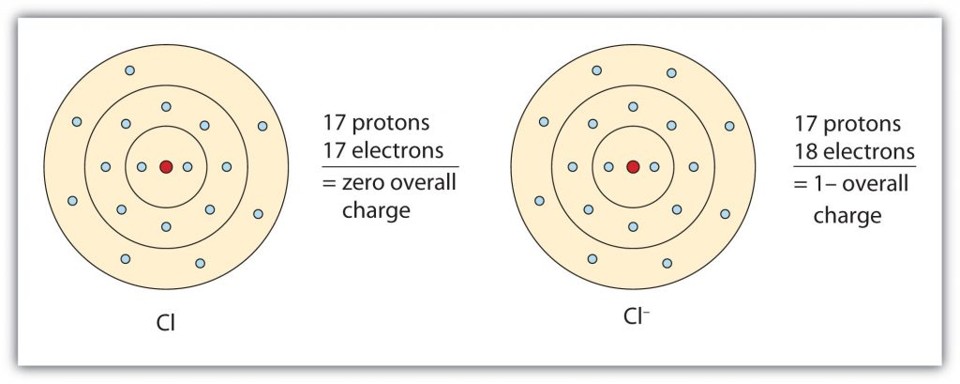
Figure \(\PageIndex{2}\): The Formation of a Chloride Ion. On the left, a chlorine atom has 17 electrons. On the right, the chloride ion has gained an extra electron for a total of 18 electrons and a 1– charge. Note that the chloride ion has now filled its outer shell and contains eight electrons, satisfying the octet rule.
Group VIA elements gain two electrons upon ionization, obtaining -2 charges and reaching the electron configurations of the noble gases that follow them in the periodic table. Whereas, Group VA elements gain three electrons, obtaining -3 charges and also reaching the electron configurations of the noble gases that follow in the periodic table.
When nonmetal atoms gain electrons, they often do so until their outermost principal energy level achieves an octet. This process is illustrated below for the elements fluorine, oxygen, and nitrogen.
\[ \Large\boldsymbol{ \begin{aligned} \mathrm{F} +\mathrm{e}^{-} &\quad\longrightarrow\quad \mathrm{F}^{-} \\[1.0em] 1s^{2}\,2s^{2}\,2p^{5} &\quad\longrightarrow\quad 1s^{2}\,2s^{2}\,2p^{6}\;(\mathrm{octet}) \end{aligned} } \]
\[ \Large\boldsymbol{ \begin{aligned} \mathrm{O} +2\mathrm{e}^{-} &\quad\longrightarrow\quad \mathrm{O}^{2-} \\[1.0em] 1s^{2}\,2s^{2}\,2p^{4} &\quad\longrightarrow\quad 1s^{2}\,2s^{2}\,2p^{6}\;(\mathrm{octet}) \end{aligned} } \]
\[ \Large\boldsymbol{ \begin{aligned} \mathrm{N} +3\mathrm{e}^{-} &\qquad\longrightarrow\qquad \mathrm{N}^{3-} \\[1.0em] 1s^{2}\,2s^{2}\,2p^{3} &\qquad\longrightarrow\qquad 1s^{2}\,2s^{2}\,2p^{6}\;(\mathrm{octet}) \end{aligned} } \]
Isoelectronic Species
Notice something interesting about sodium and chlorine, and the other ions that we've been discussing?
Although sodium loses an electron and chlorine gains an electron, both achieve stable electron configurations by attaining a full outer electron shell.
Atoms or ions that possess the same number and arrangement of electrons are called isoelectronic.
For example, each of the following species contains 10 electrons and has the same electron configuration as Neon: N³⁻, O²⁻, F⁻, Ne, Na⁺, Mg²⁺, and Al³⁺. Although these species have identical electron configurations, they are not the same element because they contain different numbers of protons. Figure 3.2.3 shows the neon isoelectronic series.

Figure \(\PageIndex{3}\): The Neon Isoelectronic Series. Each species contains ten electrons and therefore has the same electron configuration as neon. Although they are isoelectronic, they remain different elements because each contains a different number of protons.
This illustrates an important principle:
The number of protons determines an element's identity. The number of electrons determines its electrical charge.
Thus, sodium ions are chemically very different from neon atoms, even though they are isoelectronic. Likewise, the other members of the neon isoelectronic series have different identities, chemical properties, and biological roles because each contains a different nucleus.
Using the Periodic Table to Predict Ions
Fortunately, you do not need to memorize every common ion. The periodic table provides a simple way to predict how many electrons an atom is likely to gain or lose.
Figure 3.2.4 illustrates a useful way to visualize this idea by imagining the periodic table rolled into a cylinder so that the metals and nonmetals wrap around toward the noble gases.
Notice the pattern:
- Metals "walk backward" by losing the fewest electrons necessary to reach the preceding noble gas.
- Nonmetals "walk forward" by gaining the fewest electrons necessary to reach the following noble gas.
Rather than memorizing individual ions, think about which noble gas configuration an atom is trying to achieve.

Figure \(\PageIndex{4}\): Rolling the periodic table into a cylinder highlights a simple trend in ionic bonding. One way to visualize ion formation is to imagine rolling the periodic table into a cylinder so that the main-group metals and nonmetals wrap toward the noble gases. Main-group metals generally become more stable by losing the fewest electrons necessary to reach the preceding noble gas, while main-group nonmetals become more stable by gaining the fewest electrons necessary to reach the following noble gas. The resulting ions are isoelectronic with the noble gas shown in the center column, meaning they have the same number and arrangement of electrons. Although these ions share the same electron configuration, they remain different elements because protons determine identity, whereas electrons determine charge. The "rolling the periodic table into a cylinder" visualization was inspired by a teaching analogy developed by Dr. Ray Dandeneau.
- Main-group atoms tend to gain or lose the fewest electrons necessary to achieve the electron configuration of the nearest noble gas. This simple principle explains why many ions form predictable charges and provides a powerful way to understand ionic bonding.
Chemistry Connection
Hydrogen: A Special Case
Hydrogen occupies Group 1 but is not an alkali metal. Because it contains only one energy level, hydrogen follows the duet rule rather than the octet rule.
Depending on the atoms with which it interacts, hydrogen may:
- lose one electron to form H⁺, or
- gain one electron to form H⁻ (the hydride ion).
The H⁺ ion is especially important in biology because acids donate hydrogen ions in aqueous solution. We will revisit hydrogen ions and their role in acid-base chemistry later in this textbook.
- Cations form when an atom loses one or more electrons.
- The resulting cation has the electron configuration of the noble gas atom in the row above it in the periodic table.
- Anions form when an atom gains one or more electrons.
- The resulting anion has the electron configuration of the noble gas atom in the same row of the periodic table
Ions of Transition Metals
The transition metals are an interesting and challenging group of elements. They have perplexing patterns of electron distribution that don’t always follow the electron filling rules. Predicting how they will form ions is also not always obvious.
Transition metals belong to the d-block, meaning that the d-subshell of electrons is in the process of being filled with up to ten electrons. Many transition metals cannot lose enough electrons to attain a noble-gas electron configuration. In addition, the majority of transition metals are capable of adopting ions with different charges. Iron, which forms either the Fe2+ or Fe3+ ions, loses electrons as shown below.
\[ \Large\boldsymbol{ \begin{aligned} \mathrm{Fe} &\quad\longrightarrow\quad \mathrm{Fe}^{2+} +2\mathrm{e}^{-} \\[1.0em] [\mathrm{Ar}]\,3d^{6}\,4s^{2} &\quad\longrightarrow\quad [\mathrm{Ar}]\,3d^{6} \end{aligned} } \]
\[ \Large\boldsymbol{ \begin{aligned} \mathrm{Fe} &\quad\longrightarrow\quad \mathrm{Fe}^{3+} +3\mathrm{e}^{-} \\[1.0em] [\mathrm{Ar}]\,3d^{6}\,4s^{2} &\quad\longrightarrow\quad [\mathrm{Ar}]\,3d^{5} \end{aligned} } \]
According to the Aufbau process, the electrons fill the 4s sublevel before beginning to fill the 3d sublevel. However, the outermost s electrons are always the first to be removed in the process of forming transition metal cations. Because transition metals have two valence electrons, the charge of 2+ is a very common one for their ions. This is the case for iron above. In addition to the 2+ state, iron can also form a 3+ cation. This is because a half-filled d subshell (d 5) is particularly stable, which is the result of an iron atom losing a third electron.

Figure \(\PageIndex{5}\): Iron Compounds and the Formation of Rust. (A). Rust is a complex combination of oxides of iron, among them iron (III) oxide, Fe2O3. (B) Iron (II) sulfate, FeSO4 is an example of a compound that contains iron in the 2+ cationic state. It has been known since ancient times as green vitriol and was used for centuries in the manufacture of inks.
Some transition metals that have relatively few d electrons may attain a noble gas electron configuration. Scandium is an example.
\[ \Large\boldsymbol{ \begin{aligned} \mathrm{Sc} &\quad\longrightarrow\quad \mathrm{Sc}^{3+} +3\mathrm{e}^{-} \\[1.0em] [\mathrm{Ar}]\,3d^{1}\,4s^{2} &\quad\longrightarrow\quad [\mathrm{Ar}] \end{aligned} } \]
Others may attain stable configurations with a full d-subshell, such as zinc and copper.
\[ \Large\boldsymbol{ \begin{aligned} \mathrm{Zn} &\quad\longrightarrow\quad \mathrm{Zn}^{2+} +2\mathrm{e}^{-} \\[1.0em] [\mathrm{Ar}]\,3d^{10}\,4s^{2} &\quad\longrightarrow\quad [\mathrm{Ar}]\,3d^{10} \end{aligned} } \]
\[ \Large\boldsymbol{ \begin{aligned} \mathrm{Cu} &\quad\longrightarrow\quad \mathrm{Cu}^{+} +\mathrm{e}^{-} \\[1.0em] [\mathrm{Ar}]\,3d^{10}\,4s^{1} &\quad\longrightarrow\quad [\mathrm{Ar}]\,3d^{10} \end{aligned} } \]
The resulting configuration above, with 18 electrons in the outermost principal energy level, is referred to as a pseudo noble-gas electron configuration. It gives particular stability to the Zn2+ and Cu+ ions.
Figure 3.2.6 depicts the most common ionic states of the elements and shows the two most common ionic states for elements that can form more than one ion.

Figure \(\PageIndex{6}\): Common Ionic States of the Elements. For elements that have more than one common ionic state, both states are listed. Note that when mercury carries a +1 charge, it forms an uncommon polyatomic ionic state, Hg22+ where two Hg atoms share electrons and then each also have a +1 charge state (see section XX for more details about polyatomic ions and Hg22+). For the printable PDF version of this table (with the common polyatomic ions), click the link below:
Periodic Table with Ions
- Transition metal ion formation is more complex than simple cation formation
- Transition metal ions often involve rearrangements of both d and s electrons to accomodate different ionic states
This page titled 3.2: Ions and the Periodic Table was last modified on Tue, 11 Aug 2026 18:40:48 GMT and is shared under a CC BY-NC-SA 4.0 license and was authored, remixed, and/or curated by Hadeel Abozenadah, Adam Bishop, Scott Bitner, Kaysha Lehman and Patricia Flatt.
The book could not be loaded just now.