Opening the book…
- To describe the physical properties of ionic compounds.
Physical Properties of Ionic Compounds
Melting Point
Most ionic compounds are solids because of the many simultaneous attractions between cations and anions that occur; ionic crystals are therefore very strong. The process of melting an ionic compound requires the addition of large amounts of energy to break all of the ionic bonds in the crystal. For example, sodium chloride has a melting temperature of about 800oC. As a comparison, the molecular compound water melts at 0 °C.
The figure below shows just a few examples of the color and brilliance of naturally occurring ionic crystals. The regular and orderly arrangement of ions in the crystal lattice is responsible for the various shapes of these crystals, while transition metal ions give rise to the colors.

Solubility in Water
Most ionic compounds dissolve in water; the ions in the solid separate and disperse uniformly throughout the solution. This process represents a physical change known as dissociation. Under most conditions, ionic compounds will dissociate nearly completely when dissolved, and so they are classified as strong electrolytes.
Dissociation equation of solid NaCl in water:
NaCl(s) → Na+(aq) + Cl–(aq)

While they are atoms, most metals are visible. You are aware that lead is a gray, solid metal.

When lead becomes a cation, it becomes invisible and can become water-soluble. If lead ions enter a drinking water system, one would not be able to detect them visually. For years, lead pipes were installed to transport water to consumers in many countries, including the United States. If corrosive water were to enter a lead-based pipe, it would produce soluble lead ions. These charged species could be ingested unknowingly by community residents. Watch the video below and note how lead has affected the city of Flint, Michigan.
Video \(\PageIndex{1}\): Poisoned Water
Conductivity
Another characteristic property of ionic compounds is their electrical conductivity when melted or dissolved in water. While distilled water does not conduct electricity, water with dissolved ionic compounds conduct electricity and can create a hazardous situation for humans, leading to electrocution.
The figure below shows three experiments in which two electrodes that are connected to a light bulb are placed in beakers containing three different substances.
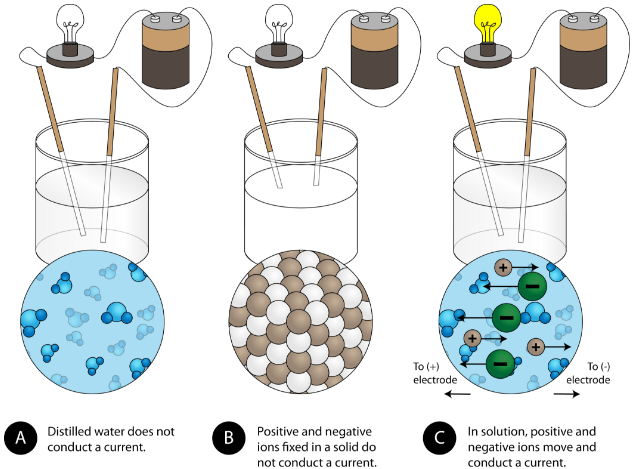
In the first beaker, distilled water does not conduct an electric current because it is a molecular compound. In the second beaker, solid sodium chloride also does not conduct a current when it is in the solid state as the solid crystal does not allow the ions to move between the electrodes. Mobile charged particles are required for the circuit to be complete and the light bulb to light up. In the third beaker, the NaCl has been dissolved in the distilled water. Now the crystals have been dissolved, and the individual positive and negative ions can move. Melting an ionic compound also frees the ions to conduct a current.
Write the dissociation equation of solid NH4NO3 in water.
- Answer
-
NH4NO3(s) → NH4+(aq) + NO3–(aq)
Encountering Ionics in the Home
There are many real-world applications of ionic compounds. For example, sodium chloride (table salt) is used to season food. Consuming large amounts of sodium ions (regardless of whether it is from sodium chloride, sodium glutamate, or sodium benzoate) can lead to cardiovascular and kidney problems. The American Heart Association recommends that individuals limit their sodium intake to less than 2300 mg per day. Watch the video below to obtain more information about sodium:
People who still want to season their food without sodium can opt to use potassium chloride, a table salt substitute. Unfortunately, this compound can taste extremely bitter. For this reason, some table salt substitutes will contain a mixture of both of these compounds.
Real-world applications of specific polyatomic ions

Ionic compounds that contain certain polyatomics can have a variety of applications. The table below gives a sample of where you might encounter polyatomic ions. For this class, it is important to match a polyatomic with its application or stated property.
| Polyatomic Ion | Uses/Facts |
|---|---|
| Carbonates and Bicarbonates CO32-/HCO3- | Short-term antacids, act as bases (high pH) |
| Nitrates NO3- | Fertilizers, explosives, and preserved meats (mutagen and probable carcinogen)(a suspected cause of migraines) |
| Nitrites NO2- | Preservative for meats (mutagen and probable carcinogen)(a suspected cause of migraines) |
| Phosphates PO43- | Fertilizers (gives the green color to plants, if not present in sufficient amounts plants will die) |
| Alkali Hydroxides OH- | Very corrosive bases, found in dry batteries, soaps, Drano, and oven cleaner |
| Sulfites SO32- | Preservative found in dried fruit and red wine (possible allergen) |
| Cyanides CN- | Poison used in Tylenol Murders and Jim Jones cases. Smells like almonds |
Click on the video below to watch a short production of how cyanide affected the United States in 1982. After viewing, note how drug packaging changed following this event.
Figure \(\PageIndex{5}\): Tylenol 1982 Murders - PR Strategy
Key Takeaways
- Ionic compounds have high melting points.
- Ionic compounds are hard and brittle.
- Ionic compounds dissociate into ions when dissolved in water.
- Solutions of ionic compounds and melted ionic compounds conduct electricity, but solid materials do not.
- An ionic compound can be identified by its chemical formula: cation+anion.
Contributors and Attributions
- CK-12 Foundation by Sharon Bewick, Richard Parsons, Therese Forsythe, Shonna Robinson, and Jean Dupon.
This page titled 4.6: Characteristics of Ionic Compounds was last modified on Thu, 31 Jul 2025 00:06:32 GMT and is shared under a CC BY 3.0 license and was authored, remixed, and/or curated by Sol Parajon Puenzo (Cañada College) .
The book could not be loaded just now.