Opening the book…
- Define phase.
- Describe the types of intermolecular forces possible between atoms or molecules in condensed phases (dispersion forces, dipole-dipole attractions, and hydrogen bonding)
- Identify the types of intermolecular forces experienced by specific molecules based on their structures.
Phase of the Matter
A phase is a certain form of matter that includes a specific set of physical properties. That is, the atoms, the molecules, or the ions that make up the phase do so in a consistent manner throughout the phase. Science recognizes three stable phases: the solid phase, in which individual particles can be thought of as in contact and held in place; the liquid phase, in which individual particles are in contact but moving with respect to each other; and the gas phase, in which individual particles are separated from each other by relatively large distances. Not all substances will readily exhibit all phases. For example, carbon dioxide does not exhibit a liquid phase unless the pressure is greater than about six times normal atmospheric pressure. Other substances, especially complex organic molecules, may decompose at higher temperatures, rather than becoming a liquid or a gas.
Which phase a substance adopts depends on the pressure and the temperature it experiences. Of these two conditions, temperature variations are more obviously related to the phase of a substance. When it is very cold, H2O exists in the solid form as ice. When it is warmer, the liquid phase of H2O is present. At even higher temperatures, H2O boils and becomes steam. Pressure changes can also affect the presence of a particular phase (as we indicated for carbon dioxide), but its effects are less obvious most of the time. We will mostly focus on the temperature effects on phases. Most chemical substances follow the same pattern of phases when going from a low temperature to a high temperature: the solid phase, then the liquid phase, and then the gas phase. However, the temperatures at which these phases are present differ for all substances and can be rather extreme. Table \(\PageIndex{1}\) shows the temperature ranges for solid, liquid, and gas phases for three substances. As you can see, there is extreme variability in the temperature ranges.
| Substance |
Melting point (Solid to Liquid) |
Boiling Point (Liquid to Gas) |
|---|---|---|
| hydrogen (H2) | −259°C | −253°C |
| water (H2O) | 0°C | 100°C |
| sodium chloride (NaCl) | 801°C | 1413°C |
| The melting point of a substance is the temperature that separates a solid and a liquid. The boiling point of a substance is the temperature that separates a liquid and a gas. | ||
What accounts for this variability? Why do some substances become liquids at very low temperatures, while others require very high temperatures before they become liquids? It all depends on the strength of the intermolecular forces (IMF) between the particles of substances and the kinetic energies (KE) of its molecules. Substances that experience strong intermolecular interactions require higher temperatures to become liquids and, finally, gases. Substances that experience weak intermolecular interactions do not need much energy (as measured by temperature) to become liquids and gases and will exhibit these phases at lower temperatures.

Intermolecular Forces
Molecules or molecular compounds are made of nonmetals connected via a covalent bond. The bonding between atoms in the individual molecule is a covalent bond. The attractive forces between the molecules are called intermolecular forces (IMF).
The covalent bonds hold atoms together in molecules and polyatomic ions. Intermolecular forces hold molecules together in a liquid or solid. Intermolecular forces are generally much weaker than covalent bonds. For example, it requires 927 kJ to break both O–H bonds in 1 mol of water, but it takes only about 41 kJ to overcome the intermolecular attractions and convert 1 mol of liquid water to water vapor at 100°C. Despite this seemingly low value, the intermolecular forces in liquid water are among the strongest such forces between molecules known. Changes between the solid, liquid, and gaseous states almost invariably occur for molecular substances without breaking covalent bonds.
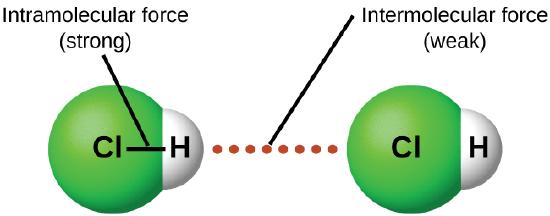
In this section, we will discuss the types of IMF in molecular compounds (from weakest to strongest):
- London dispersion forces
- Dipole-dipole interactions
- Hydrogen bonding
- Ion-Dipole
- Ionic Bond
London Dispersion Forces
Dispersion Forces (also called London Forces) are the weakest intermolecular forces. It results from the instantaneous dipole and induced dipole of the molecules. For nonpolar molecules, the constant shifting and distortion of electron density leads to a short-lived dipole at a given moment, which is called an instantaneous dipole. Such temporary dipoles will induce the electrons in a neighboring molecule to get distorted as well, and to develop a corresponding transient dipole of its own, which is the induced dipole. These rapidly fluctuating, temporary dipoles thus result in a relatively weak electrostatic attraction between the species—a so-called dispersion force like that illustrated in Figure \(\PageIndex{3}\).
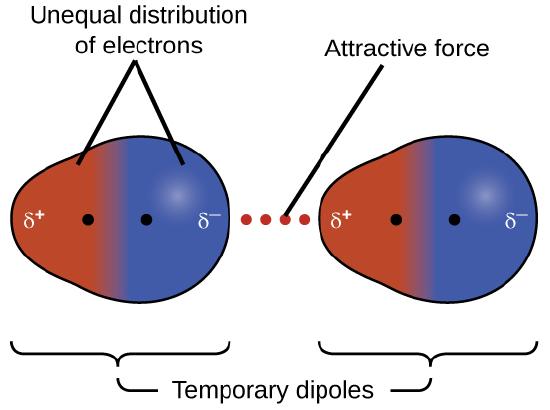

Ultimately, all nonpolar molecules are attracted to each other; however, considering that the dipole is in place for a short time, the interaction is weak. Since it applies to all types of molecules (it is the only intermolecular force for nonpolar molecules), dispersion forces are also the most fundamental intermolecular force.
Non-polar Molecules with non-polar bonds experience no other type of intermolecular interaction than dispersion forces. For Molecules with polar bonds, where the covalent bonds are oriented in space in such a way that the effect of the polar bonds in the molecules cancel each other out, the individual bonds are polar, but due to molecular symmetry, the overall molecule is nonpolar. Such molecules only experience London Forces. Carbon dioxide (CO2) and carbon tetrachloride (CCl4) are examples of such molecules (Figure \(\PageIndex{4}\)).

The Magnitude of Dispersion Forces
depends on two factors:
- Larger and heavier atoms and molecules. The relative polarizability of electrons. The simple understanding of polarizability is how easily the electrons get distorted. For larger atoms, there are more electrons in a larger space, therefore the electrons are more loosely held and more easily polarized, so the dispersion force is stronger. Generally, the larger the molar mass of the molecule, the stronger the dispersion force.
- The relative surface area of the molecule. Molecules with longer, flatter, or cylindrical shapes have a greater surface area compared to the bulky, branched molecules, and therefore have a stronger dispersion force. Taking the two constitutional isomers of C4H10, butane, and isobutane, as an example, the dispersion force of butane is stronger than that of isobutane. Figure \(\PageIndex{5}\).

Substances that experience only dispersion forces are typically soft in the solid phase and have relatively low melting points. Examples include waxes, which are long hydrocarbon chains that are solids at room temperature because the molecules have a high number of electrons.
Order the following hydrocarbons from weakest to strongest total intermolecular force: C2H6, C3H8, and C4H10.
- Answer
-
All of these compounds are nonpolar and exhibit only London dispersion forces; the larger the molecule, the stronger the dispersion forces. The ordering from weakest to strongest total intermolecular force is therefore
C2H6 < C3H8 < C4H10.
Dipole-Dipole Forces
A covalent bond that has an unequal sharing of electrons is called a polar covalent bond. A covalent bond that has an equal sharing of electrons is called a nonpolar covalent bond. The charge separation in a polar covalent bond is not as extreme as is found in ionic compounds, but there is a related result: oppositely charged ends of different molecules will attract each other. This type of intermolecular interaction is called a dipole-dipole interaction. Most molecules with polar covalent bonds experience dipole-dipole interactions. HF is an example of a polar molecule, also known as a dipole.

Polar molecules have a partial positive charge on one side and a partial negative charge on the other side of the molecule—a separation of charge called a dipole. Consider a polar molecule such as hydrogen chloride, HCl. In the HCl molecule, the more electronegative Cl atom bears the partial negative charge, whereas the less electronegative H atom bears the partial positive charge. An attractive force between HCl molecules results from the attraction between the positive end of one HCl molecule and the negative end of another. This attractive force is called a dipole-dipole attraction—the electrostatic force between the partially positive end of one polar molecule and the partially negative end of another, as illustrated in Figure \(\PageIndex{7}\).
Hydrogen Bonding Intermolecular Forces
Molecules with hydrogen atoms bonded to electronegative atoms such as O, N, and F tend to exhibit unusually strong intermolecular interactions due to a particularly strong type of dipole-dipole attraction called hydrogen bonding. The large difference in electronegativity between the H atom (2.1) and the atom to which it is bonded (4.0 for an F atom, 3.5 for an O atom, or 3.0 for a N atom), combined with the very small size of a H atom and the relatively small sizes of F, O, or N atoms, leads to highly concentrated partial charges with these atoms. Because the hydrogen atom does not have any electrons other than the ones in the covalent bond, its positively charged nucleus is almost completely exposed, allowing strong attractions to other nearby lone pairs of electrons.
Despite use of the word “bond,” keep in mind that hydrogen bonds are intermolecular attractive forces, not intramolecular attractive forces (covalent bonds). Hydrogen bonds are much weaker than covalent bonds, but are generally much stronger than other dipole-dipole attractions.
Examples of hydrogen bonds include HF⋯HF, H2O⋯HOH, and H3N⋯HNH2, in which the hydrogen bonds are denoted by dots. Figure \(\PageIndex{9}\) illustrates hydrogen bonding between water molecules. The physical properties of water, which has two O–H bonds, are strongly affected by the presence of hydrogen bonding between water molecules. Most molecular compounds that have a mass similar to water are gases at room temperature. However, due to the strong hydrogen bonds, water molecules are able to remain condensed in the liquid state.
A hydrogen bond is an intermolecular attractive force in which a hydrogen atom, that is covalently bonded to a small, highly electronegative atom, is attracted to a lone pair of electrons on an atom in a neighboring molecule. Figure \(\PageIndex{10}\) shows how methanol (CH3OH) molecules experience hydrogen bonding. Methanol contains both a hydrogen atom attached to O; methanol can thus form hydrogen bonds by acting as either a hydrogen bond donor or a hydrogen bond acceptor (lone pair). The hydrogen-bonded structure of methanol is as follows:

Ion-Dipole
Ion-dipole force is not a common intermolecular force, however it is a type of important force that is responsible for the interaction between ions and other polar substance. A simple example is the dissolving of an ionic solid, or salt, in water. When table salt (NaCl) is dissolved in water, the interactions between the ions and water molecules are strong enough to overcome the ionic bond that holds the ions in the crystal lattice. As a result, the cations and anions are separated apart completely, and each ion is surrounded by a cluster of water molecules. This is called a solvation process. The solvation occurs through the strong ion-dipole force. Lots salts, or ionic compounds, are soluble in water because of such interactions.

Ionic Bond
The strongest force between any two particles is the ionic bond, in which two ions of opposing charge are attracted to each other. Thus, ionic interactions between particles are another type of intermolecular interaction. Substances that contain ionic interactions are relatively strongly held together, so these substances typically have high melting and boiling points. Sodium chloride (Figure \(\PageIndex{12}\)) is an example of a substance whose particles experience ionic interactions (Table \(\PageIndex{1}\)). These attractive forces are sometimes referred to as ion-ion interactions.

Applications of Intermolecular Forces in Biology
Folding Proteins
These interactions are common in proteins and contribute to the protein's folding. Ion-ion interactions are called salt bridges.

Figure \(\PageIndex{13}\): A protein strand in blue folds into a compact structure via ionic interactions called salt bridges.
Hydrogen Bonding and DNA
Deoxyribonucleic acid (DNA) is found in every living organism and contains the genetic information that determines the organism’s characteristics, provides the blueprint for making the proteins necessary for life, and serves as a template to pass this information on to the organism’s offspring. A DNA molecule consists of two anti-parallel chains of repeating nucleotides, which form its well-known double helical structure, as shown in Figure \(\PageIndex{14}\).

Each nucleotide contains a (deoxyribose) sugar bound to a phosphate group on one side, and one of four nitrogenous bases on the other. Two of the bases, cytosine (C) and thymine (T), are single-ringed structures known as pyrimidines. The other two, adenine (A) and guanine (G), are double-ringed structures called purines. These bases form complementary base pairs consisting of one purine and one pyrimidine, with adenine pairing with thymine, and cytosine with guanine. Each base pair is held together by hydrogen bonding. A and T share two hydrogen bonds, C and G share three, and both pairings have a similar shape and structure Figure \(\PageIndex{15}\)

The cumulative effect of millions of hydrogen bonds effectively holds the two strands of DNA together. Importantly, the two strands of DNA can relatively easily “unzip” down the middle since hydrogen bonds are relatively weak compared to the covalent bonds that hold the atoms of the individual DNA molecules together. This allows both strands to serve as templates for replication.
Geckos have an amazing ability to adhere to most surfaces. They can quickly run up smooth walls and across ceilings that have no toe-holds, and they do this without having suction cups or a sticky substance on their toes. And while a gecko can lift its feet easily as it walks along a surface, if you attempt to pick it up, it sticks to the surface. How are geckos (as well as spiders and some other insects) able to do this? Although this phenomenon has been investigated for hundreds of years, scientists only recently uncovered the details of the process that allows geckos’ feet to behave this way.
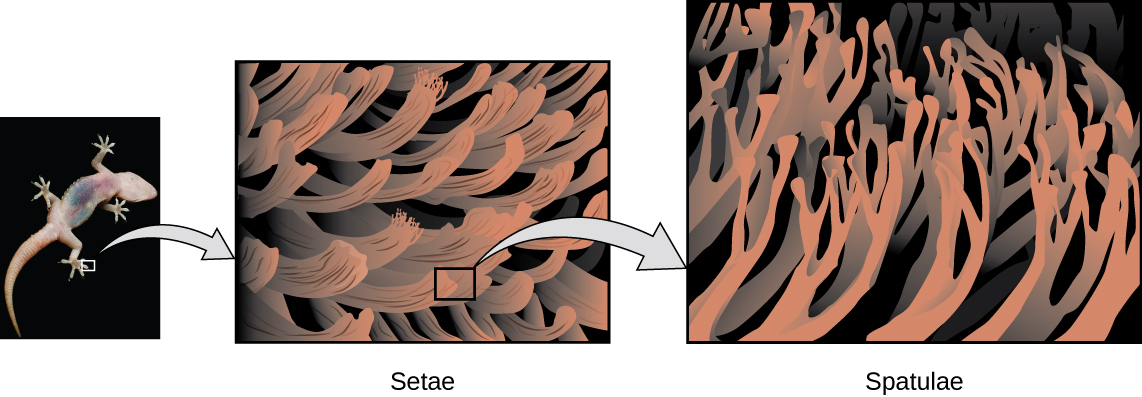
Geckos’ toes are covered with hundreds of thousands of tiny hairs known as setae, with each seta, in turn, branching into hundreds of tiny, flat, triangular tips called spatulae. The huge numbers of spatulae on its setae provide a gecko, shown in Figure \(\PageIndex{16}\), with a large total surface area for sticking to a surface. In 2000, Kellar Autumn, who leads a multi-institutional gecko research team, found that geckos adhered equally well to both polar silicon dioxide and nonpolar gallium arsenide. This proved that geckos stick to surfaces because of dispersion forces—weak intermolecular attractions arising from temporary, synchronized charge distributions between adjacent molecules. Although dispersion forces are very weak, the total attraction over millions of spatulae is large enough to support many times the gecko’s weight.
In 2014, two scientists developed a model to explain how geckos can rapidly transition from “sticky” to “non-sticky.” Alex Greaney and Congcong Hu at Oregon State University described how geckos can achieve this by changing the angle between their spatulae and the surface. Geckos’ feet, which are normally nonsticky, become sticky when a small shear force is applied. By curling and uncurling their toes, geckos can alternate between sticking and unsticking from a surface, and thus easily move across it. Further investigations may eventually lead to the development of better adhesives and other applications.
Exercises
Considering CH3OH, C2H6, Xe, and (CH3)3N, which can form hydrogen bonds with themselves? Draw the hydrogen-bonded structures.
Given: compounds
Asked for: formation of hydrogen bonds and structure
Strategy:
- Identify the compounds with a hydrogen atom attached to O, N, or F. These are likely to be able to act as hydrogen bond donors.
- Of the compounds that can act as hydrogen bond donors, identify those that also contain lone pairs of electrons, which allow them to be hydrogen bond acceptors. If a substance is both a hydrogen donor and a hydrogen bond acceptor, draw a structure showing the hydrogen bonding.
Solution:
A Of the species listed, xenon (Xe), ethane (C2H6), and trimethylamine [(CH3)3N] do not contain a hydrogen atom attached to O, N, or F; hence they cannot act as hydrogen bond donors.
B The one compound that can act as a hydrogen bond donor, methanol (CH3OH), contains both a hydrogen atom attached to O (making it a hydrogen bond donor) and two lone pairs of electrons on O (making it a hydrogen bond acceptor); methanol can thus form hydrogen bonds by acting as either a hydrogen bond donor or a hydrogen bond acceptor. The hydrogen-bonded structure of methanol is as follows:

Considering CH3CO2H, (CH3)3N, NH3, and CH3F, which can form hydrogen bonds with themselves? Draw the hydrogen-bonded structures.
- Answer
-
CH3CO2H and NH3;

What intermolecular forces, besides dispersion forces, if any, exist in each substance? Are any of these substances solids at room temperature?
- potassium chloride (KCl)
- ethanol (C2H5OH)
- bromine (Br2)
Solution
- Potassium chloride is composed of ions, so the intermolecular interaction in potassium chloride is ionic forces. Because ionic interactions are strong, it might be expected that potassium chloride is a solid at room temperature.
- Ethanol has a hydrogen atom attached to an oxygen atom, so it would experience hydrogen bonding. If the hydrogen bonding is strong enough, ethanol might be a solid at room temperature, but it is difficult to know for certain. (Ethanol is actually a liquid at room temperature.)
- Elemental bromine has two bromine atoms covalently bonded to each other. Because the atoms on either side of the covalent bond are the same, the electrons in the covalent bond are shared equally, and the bond is a nonpolar covalent bond. Thus, diatomic bromine does not have any intermolecular forces other than dispersion forces. It is unlikely to be a solid at room temperature unless the dispersion forces are strong enough. Bromine is a liquid at room temperature.
What intermolecular forces, besides dispersion forces, if any, exist in each substance? Are any of these substances solids at room temperature?
- methylamine (CH3NH2)
- calcium sulfate (CaSO4)
- carbon monoxide (CO)
- Answer
-
a. dipole-dipole, hydrogen bonding
b. ionic forces (solid at room temperature)
c. dipole-dipole
Identify the most significant intermolecular force in each substance.
- C3H8
- CH3OH
- H2S
Solution
a. Although C–H bonds are polar, they are only minimally polar. The most significant intermolecular force for this substance would be dispersion forces.
b. This molecule has an H atom bonded to an O atom, so it will experience hydrogen bonding.
c. Although this molecule does not experience hydrogen bonding, the Lewis electron dot diagram and VSEPR indicate that it is bent, so it has a permanent dipole. The most significant force in this substance is dipole-dipole interaction.
Identify the most significant intermolecular force in each substance.
- HF
- HCl
- Answer
-
a. hydrogen bonding. b. dipole-dipole interactions.
This page titled 9.2: Introduction to Intermolecular Forces was last modified on Mon, 04 Aug 2025 19:51:32 GMT and is shared under a CC BY-NC-SA 4.0 license and was authored, remixed, and/or curated by Sol Parajon Puenzo (Cañada College) via source content that was edited to the style and standards of the LibreTexts platform.
The book could not be loaded just now.