Opening the book…
- To learn how alkane molecules can have branched chains and recognize compounds that are isomers.
Structural Isomers
The structure of C4H10 can be written as a string of four carbon atoms in a row,
–C–C–C–C–
and then adding enough hydrogen atoms to give each carbon atom four bonds:

The compound butane has this structure, but there is another way to put 4 carbon atoms and 10 hydrogen atoms together. Place 3 of the carbon atoms in a row and then branch the fourth one off the middle carbon atom:

Now we add enough hydrogen atoms to give each carbon four bonds:

Compare the 3D models of butane and 2-methylpropane in Figure \(\PageIndex{1}\).

The structure of 2-methylpropane shows a continuous chain of three carbon atoms only, with the fourth attached as a branch off the middle carbon atom of the continuous chain, which is different from the structures of butane (compare the two structures in Figure \(\PageIndex{1}\).
Unlike C4H10, the compounds methane (CH4), ethane (C2H6), and propane (C3H8) do not exist in isomeric forms because there is only one way to arrange the atoms in each formula so that each carbon atom has four bonds.
Conformers: Same Molecule with different folding
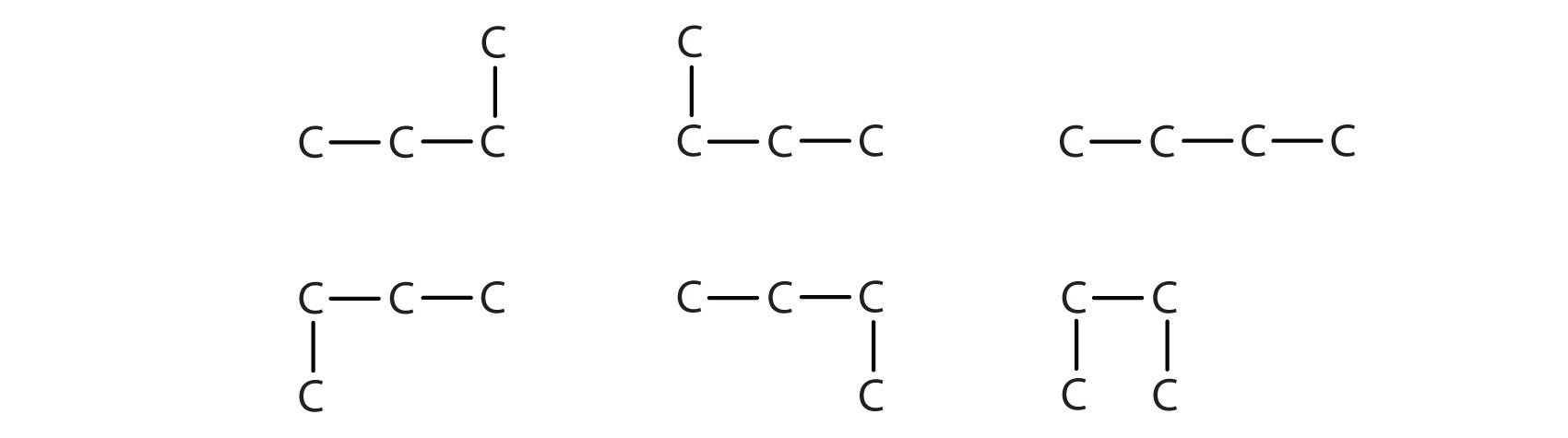
Notice that C4H10 is depicted with a bent chain in Figure \(\PageIndex{1}\). The four-carbon chain may be bent in various ways because the groups can rotate freely about the C–C bonds. However, this rotation does not change the identity of the compound. It is important to realize that bending a chain does not change the identity of the compound; all of the following represent the same compound, butane:
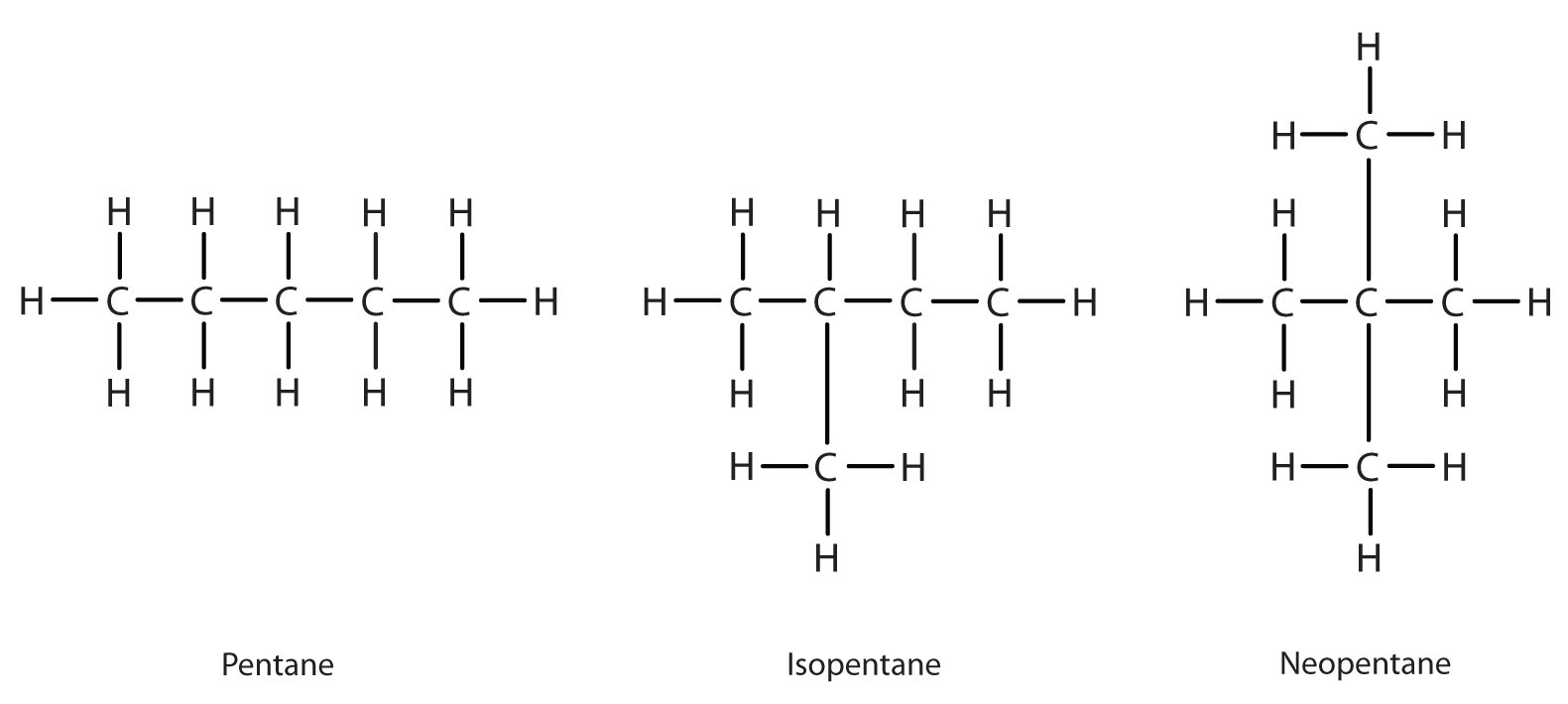
Next beyond C4H10 in the homologous series is pentane. Each compound below has the same molecular formula: C5H12. The compound at the far left is pentane because it has all five carbon atoms in a continuous chain. The compound in the middle is 2-methylbutane (also called isopentane); it has a one CH3 branch off the second carbon atom of the continuous chain. The compound at the far right, discovered after the other two, is 2,2-dimethylpropane. Its common name is neopentane (from the Greek neos, meaning “new”). Although all three have the same molecular formula, they have different properties, including boiling points: pentane, 36.1°C; isopentane, 27.7°C; and neopentane, 9.5°C. You will learn more about naming in the next few sections and throughout the next few chapters of this book.
The ultimate condensed formula is a skeletal structure, in which carbon atoms are implied at the corners and ends of lines, and each carbon atom is understood to be attached to enough hydrogen atoms to give each carbon atom four bonds. For example, we can represent pentane (CH3CH2CH2CH2CH3) and isopentane [(CH3)2CHCH2CH3] as follows:

A continuous (unbranched) chain of carbon atoms is often called a straight chain even though the tetrahedral arrangement about each carbon gives it a zigzag shape. Straight-chain alkanes are sometimes called normal alkanes, and their names are sometimes given the prefix n-. For example, butane can be called n-butane. We will not use that prefix here because it is not a part of the system established by the International Union of Pure and Applied Chemistry.
Draw an isomer of the following compounds.
a. 
b. 
- Answer
-
a. Move the chlorine to the second carbon atom to obtain an isomer. This is the only isomer possible for this compound.

b. Move the oxygen to a different carbon atom to obtain an isomer. There are 2 other isomers possible.

This page titled 6.3: Structural Isomers- Branched-Chain Alkanes was last modified on Thu, 31 Jul 2025 00:06:37 GMT and is shared under a CC BY-NC-SA 4.0 license and was authored, remixed, and/or curated by Sol Parajon Puenzo (Cañada College) .
The book could not be loaded just now.