Opening the book…
Trigonometric trial wavefunction:
\[ \psi (r, \beta ) = \sqrt{ \dfrac{3 \beta ^3}{ \pi ^3}} \text{sech}( \beta r) \nonumber \]
Demonstrate the wavefunction is normalized.
\[ \int_{0}^{\infty} \psi (r, \beta )^2 4 \pi r^2 dr |_{simplify}^{assume,~ \beta >0} \nonumber \]
The terms contributing to the total electronic energy of the helium atom are the kinetic energy of each electron, each electronʹs interaction with the nucleus, and the interaction of the electrons with each other.
Calculate kinetic energy:
\[ 2 \int_{0}^{ \infty} \psi (r, \beta ) \left[ \frac{-1}{2r} \frac{d^2}{dr^2} (r \psi (r, \beta )) \right] 4 \pi r^2 dr |_{simplify}^{assume,~ \beta >0} \rightarrow \frac{1}{3} \beta ^2 \frac{12 + \pi^2}{ \pi^2} \nonumber \]
Calculate electron-nucleus potential energy:
\[ 2 \int_{0}^{ \infty} \psi (r, \beta ) \frac{-2}{r} \psi (r, \beta ) 4 \pi r^2 dr |_{simplify}^{assume,~ \beta > 0} \rightarrow (-48) \beta \frac{\ln(2)}{ \pi ^2} \nonumber \]
Calculate electron-electron potential energy:
\[ \int_{0}^{ \infty} \psi (r, \beta )^2 \left( \frac{1}{r} \int_{0}^{r} \psi (x, \beta )^2 4 \pi x^2 dx + \int_{r}^{ \infty} \frac{ \psi (x, \beta )^2 4 \pi x^2}{x} dx \right) 4 \pi r^2 dr \nonumber \]
Write the equation for the total electronic energy in terms of the variational parameter \( \beta\):
\[ E( \beta ) = \frac{1}{3} \beta ^2 \frac{12 + \pi ^2}{ \pi ^2} + (-48) \beta \frac{\ln(2)}{ \pi ^2} + \int_{0}^{ \infty} \psi (r, \beta )^2 \left( \frac{1}{r} \int_{0}^{r} \psi (x, \beta )^2 4 \pi x^2 dx + \int_{r}^{ \infty} \frac{ \psi (x, \beta )^2 4 \pi x^2}{x}\right) 4 \pi r^2 dr \nonumber \]
Minimize the energy with respect to the variational parameter \( \beta\).
\( \beta\) = 1 \( \beta\) = Minimize(E, \( \beta\) \( \beta\) = 1.902 E( \( \beta\) = -2.672
Compare the variational calculation to the Hartree-Fock limit: \(E_{HF} = -2.8617\)
\[ \frac{E_{HF} - E( \beta )}{E_{HF}} = 6.614 \nonumber \]
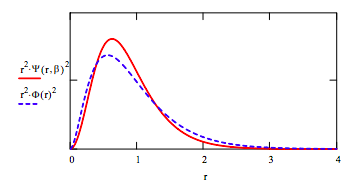
Compare optimized trial wavefunction with the Hartree-Fock wavefunction (see McQuarrie and Simon, page 283) by plotting the radial distribution functions.
\[ \Phi (r) = 0.75738\exp(1.430r) + 0.43658 \exp(-2.4415r) + 0.17295 \exp (-4.0996r) − 0.02730 \exp (-6.4843r) + 0.06675 \exp (7.97) \nonumber \]
This page titled 10.26: Trigonometric Trial Wavefunction for the Helium Atom was last modified on Wed, 11 Jan 2023 07:23:39 GMT and is shared under a CC BY 4.0 license and was authored, remixed, and/or curated by Frank Rioux via source content that was edited to the style and standards of the LibreTexts platform.
The book could not be loaded just now.