Opening the book…
The quantum mechanical interpretation of the single‐slit experiment is that position is measured at the slit screen and momentum is measured at the detection screen. Position and momentum are conjugate observables connected by a Fourier transform and governed by the uncertainty principle. Knowing the slit screen geometry makes it possible to calculate the momentum distribution at the detection screen.
The slit‐screen geometry and therefore the coordinate wavefunction is calculate as follows.
Slit width: \(w : = 2\)
Coordinate‐space wave function:
\[
\Psi(x, w) :=\text { if }\left[\left(x \geq-\frac{w}{2}\right) \cdot\left(x \leq \frac{w}{2}\right), 1,0\right]
\nonumber \]
\[
x :=\frac{-w}{2}, \frac{-w}{2}+.005 \ldots \frac{w}{2}
\nonumber \]

A Fourier transform of the coordinate‐space wave function yields the momentum wave function and the momentum distribution function, which is the diffraction pattern.
\[
\Phi\left(\mathrm{p}_{\mathrm{X}}, \mathrm{w}\right) :=\frac{1}{\sqrt{2 \cdot \pi \cdot \mathrm{w}}} \cdot \int_{-\frac{\mathrm{w}}{2}}^{\frac{\mathrm{w}}{2}} \exp \left(-\mathrm{i} \cdot \mathrm{p}_{\mathrm{X}} \cdot \mathrm{x}\right) \mathrm{d} \mathrm{x} \; \text{simplify} \rightarrow 2^{\frac{1}{2}} \cdot \frac{\sin \left(\frac{1}{2} \cdot w \cdot p_{x}\right)}{\pi^{\frac{1}{2}} \cdot w^{\frac{1}{2}} \cdot p_{x}}
\nonumber \]
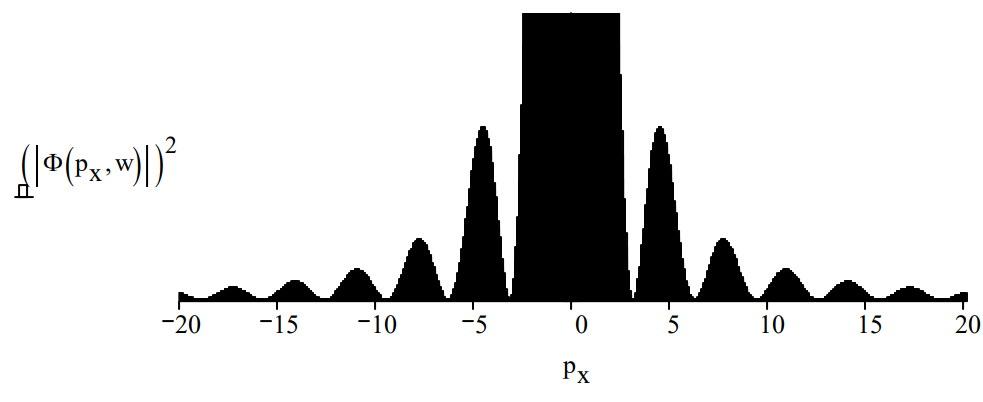
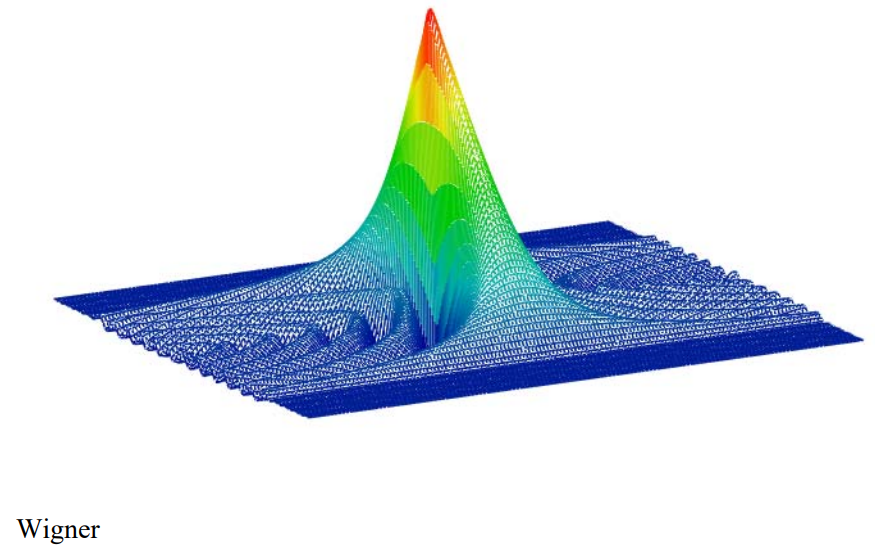
The Wigner function for the single‐slit screen geometry is generated using the momentum wave function. (Fifty is effectively infinity and is therefore as the limits of integration.)
\[
\mathrm{W}(\mathrm{x}, \mathrm{p}) :=\frac{1}{2 \cdot \pi} \cdot \int_{-50}^{50} \overline{\Phi\left(\mathrm{p}+\frac{\mathrm{s}}{2}, \mathrm{w}\right)} \cdot \exp (-\mathrm{i} \cdot \mathrm{s} \cdot \mathrm{x}) \cdot \Phi\left(\mathrm{p}-\frac{\mathrm{s}}{2}, \mathrm{w}\right) \mathrm{ds}
\nonumber \]
The single‐slit Wigner function is displayed graphically.
\[
\mathrm{N} :=150 \quad \mathrm{i} :=0 \ldots \mathrm{N} \qquad \mathrm{x}_{\mathrm{i}} :=-1.5+\frac{3 \cdot \mathrm{i}}{\mathrm{N}} \\ \mathrm{j} :=0 \ldots \mathrm{N} \qquad \mathrm{p}_{\mathrm{j}} :=-20+\frac{40 \cdot \mathrm{j}}{\mathrm{N}} \qquad \text{Wigner}_{i,j} : = W \left(x_{i}, p_{j}\right)
\nonumber \]
This page titled 1.63: The Wigner Function for the Single Slit Diffraction Problem was last modified on Wed, 11 Jan 2023 07:23:07 GMT and is shared under a CC BY 4.0 license and was authored, remixed, and/or curated by Frank Rioux via source content that was edited to the style and standards of the LibreTexts platform.
The book could not be loaded just now.