Opening the book…
Reduced mass: \( \mu\) = 1
Angular momentum: L = 0
Integration limit: rmax = 6
Force constant: k = 1
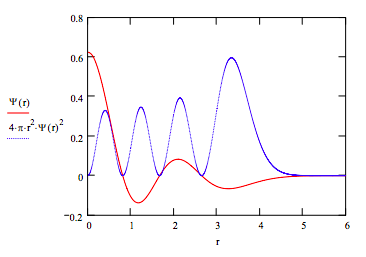
Solve Schrödinger's equation numerically. Use Mathcad's ODE solve block:
Given
\[ \frac{-1}{2 \mu} \frac{d^2}{dr^2} \psi (r) - \frac{1}{r \mu} \frac{d}{dr} \psi (r) + \bigg[ \frac{L(L +1)}{2 \mu r^2} + \frac{1}{2} kr^2 \bigg] \psi (r) = E \psi (r)~~~ \psi (.001) = 1~~~ \psi '(.001) = 0.1 \nonumber \]
\[ \psi = Odesolve (r, r_{max}) \nonumber \]
\[ \psi (r) = \left( \int_{0}^{r_{max}} \psi (r)^2 4 \pi r^2 dr \right) ^{ \frac{-1}{2}} \psi (r) \nonumber \]
Energy guess: E = 7.5
This page titled 9.20: Numerical Solutions for the Three-Dimensional Harmonic Oscillator was last modified on Wed, 11 Jan 2023 07:23:44 GMT and is shared under a CC BY 4.0 license and was authored, remixed, and/or curated by Frank Rioux via source content that was edited to the style and standards of the LibreTexts platform.
The book could not be loaded just now.