Opening the book…
\( \lambda = \frac{h}{mv}\) de Broglie's hypothesis that matter has wave-like properties.
\(n \lambda = 2 \pi r\) The consequence of de Broglie's hypothesis; an integral number of wavelengths must fit within the circumference of the orbit. This introduces the quantum number which can have values 1, 2, 3...
\(mv = \frac{nh}{2 \pi r}\) Substitution of the first equation into the second equation reveals that linear momentum is quantized.
\( T = \frac{1}{2} mv^2 = \frac{n^2 h^2}{8 \pi^2 m_e r^2}\) If momentum is quantized, so it kinetic energy.
\(E = T + V = \frac{n^2 h^2}{8 \pi^2 m_e r^2} - \frac{e^2}{4 \pi \varepsilon_0 r}\) Which means that total energy is quantized.
Below the ground state energy and orbit radius of the electron in the hydrogen atom is found by plotting the energy as a function of the orbital radius. The ground state is the minimum in the curve.
Fundamental constants: electron charge, electron mass, Planck's constant, vacuum permitivity.
\[ \begin{matrix} e = 1.6021777 (10)^{-19} \text{coul} & m_e= 9.10939 (10)^{-31} \text{kg} \\ h = 6.62608 (10)^{-34} \text{joule sec} & \varepsilon_0 = 8.85419 (10)^{-12} \frac{ \text{coul}^2}{ \text{joule m}} \end{matrix} \nonumber \]
Quantum number and conversion factor between meters and picometers and joules and atto joules.
\[ \begin{matrix} n = 1 & pm = 10^{-12} m & \text{ajoule} = 10^{-18} \text{joule} \end{matrix} \nonumber \]
\[ \begin{matrix} r = 20 pm,~20.5 pm .. 500 pm & T(r) = \frac{n^2 h^2}{8 \pi^2 m_e r^2} & V(r) = - \frac{e^2}{4 \pi \varepsilon_0 r} & E(r) = T(r) + V(r) \end{matrix} \nonumber \]
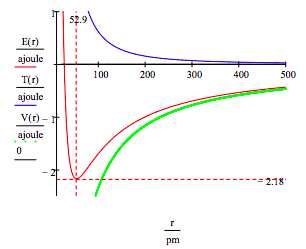
This figure shows that atomic stability involves a balance between potential and kinetic energy. The electron is drawn toward the nucleus by the attractive potential energy interaction (~ ‐1/R), but is prevented from spiraling into the nucleus by the extremely large kinetic energy (~1/R2) associated with small orbits.
Prepared by Frank Rioux.
This page titled 2.1: The de Broglie-Bohr Model for the Hydrogen Atom was last modified on Wed, 11 Jan 2023 07:23:23 GMT and is shared under a CC BY 4.0 license and was authored, remixed, and/or curated by Frank Rioux via source content that was edited to the style and standards of the LibreTexts platform.
The book could not be loaded just now.