Opening the book…
Momentum‐space wave functions frequently are most easily obtained by the Fourier transform of the already available position‐space wave function. For the particle in a one‐dimensional box the Fourier transform is given by the following equation:
\[
\Phi(n, p, a) :=\frac{1}{\sqrt{2 \cdot \pi}} \int_{0}^{a} \exp (-i-p-x) \cdot \sqrt{\frac{2}{a}} \cdot \sin \left(\frac{n \cdot \pi \cdot x}{a}\right) d x
\nonumber \]
Evaluation of this integral yields:
\[
\Phi(\mathrm{n}, \mathrm{p}, \mathrm{a}) :=\mathrm{n} \cdot \sqrt{\mathrm{a} \cdot \pi} \cdot\left[\frac{1-(-1)^{\mathrm{n}} \cdot \exp (-\mathrm{i} \cdot \mathrm{p} \cdot \mathrm{a})}{\mathrm{n}^{2} \cdot \pi^{2}-\mathrm{a}^{2} \cdot \mathrm{p}^{2}}\right]
\nonumber \]
Choose box dimension: \(\mathrm{a} :=1\)
The momentum‐space probability distribution functions, |\(\Phi\)(n,p)|2, for the n = 1, 4, 6, 8 and 10 energy levels of the particle in a one‐dimensional box are displayed below. They show the probability that the particle will be found to have various momentum values in an experimental measurement. The distribution functions are offset by small increments for clarity presentation.
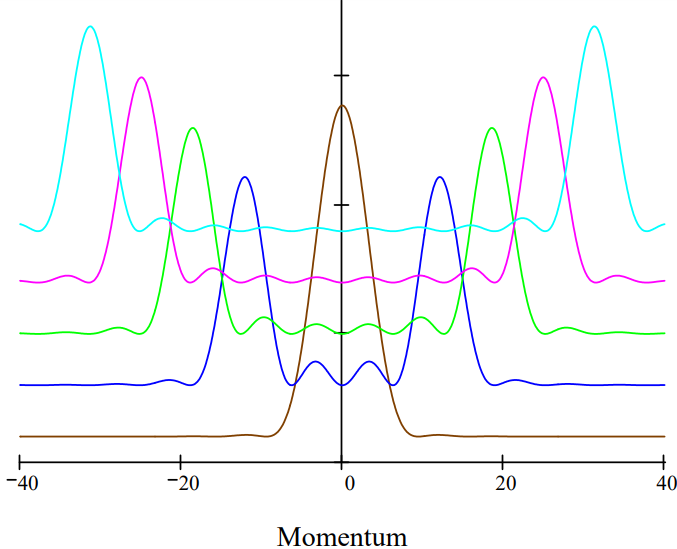
This figure illustrates the correspondence principle. As the n quantum number increases th momentum distribution appears more classical. For example, for n = 10 the momentum distribution has principle maxima around \(\pm\) 30, suggesting a particle moving to the right and left with a specific momentum. This effect becomes more pronounced with higher n‐values.
This page titled 1.75: Momentum Wave Functions for the Particle in a Box was last modified on Wed, 11 Jan 2023 07:23:08 GMT and is shared under a CC BY 4.0 license and was authored, remixed, and/or curated by Frank Rioux via source content that was edited to the style and standards of the LibreTexts platform.
The book could not be loaded just now.