Opening the book…
This exercise deals with a variational treatment for the ground state of the simple harmonic oscillator which is, of course, an exactly soluble quantum mechanical problem.
The energy operator for a harmonic oscillator with unit effective mass and force constant is:
\( H = \frac{-1}{2} \frac{d^2}{dx^2} \blacksquare + \frac{x^2}{2} \blacksquare\)
The following trial wavefunction is selected:
\[ \psi (x, \beta ) = \frac{1}{1 + \beta x^2} \nonumber \]
The variational energy integral is evaluated (because of the symmetry of the problem it is only necessary to integrate from 0 to ∞, rather than from ‐∞ to ∞:
\( E( \beta ) = \dfrac{ \int_{0}^{ \infty} \psi (x, \beta ) \frac{-1}{2} \frac{d^2}{dx^2} \psi (x, \beta ) dx + \int_{0}^{ \infty} \psi (x, \beta ) \frac{x^2}{2} \psi (x, \beta ) dx}{ \int_{0}^{ \infty} \psi (x, \beta )^2 dx} |^{assume,~ \beta > 0}_{simplify} \rightarrow \frac{1}{4} \frac{ \beta ^2 + 2}{ \beta}\)
The energy integral is minimized with respect to the variational parameter:
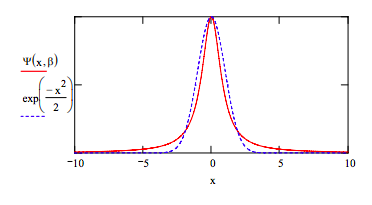
\( \beta \) := 1 \( \beta \) := Minimize (E, \( \beta\)) \( \beta\) = 1.414 E( \(\beta\)) = 0.707
The % error is calculated given that the exact result is \(0.50 E_h\).
\( \frac{E( \beta ) - 0.5}{0.5} = 41.421\)%
The optimized trial wavefunction is compared with the SHO ground-state eigenfunction.
Now a second trial function is chosen:
\( \psi (x, \beta ) := \frac{1}{(1 + \beta x^2)^2}\)
Evaluate the variational energy integral:
\( E( \beta ) := \frac{ \int_{0}^{ \infty} \psi (x, \beta ) \frac{-1}{2} \frac{d^2}{dx^2} \psi (x, \beta ) dx + \int_{0}^{ \infty} \psi (x, \beta ) \frac{x^2}{2} \psi (x, \beta ) dx}{ \int_{0}^{ \infty} \psi (x, \beta )^2 dx} |^{assume,~ \beta > 0}_{simplify} \rightarrow \frac{1}{10} \frac{7 \beta ^2 + 1}{ \beta}\)
Minimize the energy integral with respect to the variational parameter:
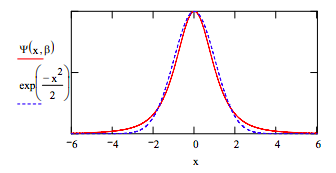
\( \beta \) := 1 \( \beta \) := Minimize (E, \( \beta\)) \( \beta\) = 0.378 E( \(\beta\)) = 0.529
Calculate the % error given that the exact result is 0.50 Eh.
\( \frac{E( \beta ) - 0.5}{0.5} = 5.83\)%
The optimized trial wavefunction is compared with the SHO ground-state eigenfunction.
Suggestion: Continue this exercise with the following trial wavefunction and interpret the improved agreement with the exact solution.
\( \psi (x, \beta ) - \frac{1}{(1 + \beta x^2)^n}\)
where n is an integer greater than 2.
This page titled 10.17: Variation Method for the Harmonic Oscillator was last modified on Wed, 11 Jan 2023 07:23:38 GMT and is shared under a CC BY 4.0 license and was authored, remixed, and/or curated by Frank Rioux via source content that was edited to the style and standards of the LibreTexts platform.
The book could not be loaded just now.