Opening the book…
- Identify the major classes of hormones on the basis of chemical structure.
- Know the function of the common hormones.
Glands of the Endocrine System
The endocrine system is a network of glands that release chemical messenger molecules into the bloodstream. The messenger molecules of the endocrine system are called endocrine hormones. The major glands of the endocrine system are shown in Figure \(\PageIndex{1}\).
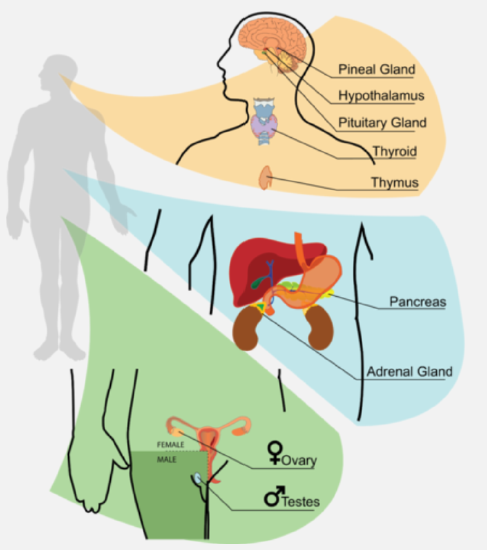
Although a given hormone may travel throughout the body in the bloodstream, it will affect the activity only of its target cells; that is, cells with receptors for that particular hormone. Once the hormone binds to the receptor, a chain of events is initiated that leads to the target cell’s response. Hormones play a critical role in regulating physiological processes through their effects on target cell responses. These responses contribute to human reproduction, growth, and development of body tissues, metabolism, fluid, and electrolyte balance, sleep, and many other body functions. The major hormones of the human body and their effects are identified in Table \(\PageIndex{1}\).
| Endocrine gland | Associated hormones | Chemical class | Effect |
|---|---|---|---|
| Pituitary | Growth hormone (GH) | Protein | Promotes growth of body tissues |
| Prolactin (PRL) | Peptide | Promotes milk production | |
| Thyroid-stimulating hormone (TSH) | Glycoprotein | Stimulates thyroid hormone release | |
| Adrenocorticotropic hormone (ACTH) | Peptide | Stimulates hormone release by adrenal cortex | |
| Follicle-stimulating hormone (FSH) | Glycoprotein | Stimulates gamete production | |
| Luteinizing hormone (LH) | Glycoprotein | Stimulates androgen production by the gonads | |
| Antidiuretic hormone (ADH) | Peptide | Stimulates water reabsorption by the kidneys | |
| Oxytocin | Peptide | Stimulates uterine contractions during childbirth | |
| Thyroid | Thyroxine (T4), triiodothyronine (T3) | Amine | Stimulate basal metabolic rate |
| Calcitonin | Peptide | Reduces blood Ca2+ levels | |
| Parathyroid | Parathyroid hormone (PTH) | Peptide | Increases blood Ca2+ levels |
| Adrenal (cortex) | Aldosterone | Steroid | Increases blood Na+ levels |
| Cortisol, corticosterone, cortisone | Steroid | Increase blood glucose levels | |
| Adrenal (medulla) | Epinephrine, norepinephrine | Amine | Stimulate fight-or-flight response |
| Pineal | Melatonin | Amine | Regulates sleep cycles |
| Pancreas | Insulin | Protein | Reduces blood glucose levels |
| Glucagon | Protein | Increases blood glucose levels | |
| Testes | Testosterone | Steroid | Stimulates the development of male secondary sex characteristics and sperm production |
| Ovaries | Estrogens and progesterone | Steroid | Stimulate the development of female secondary sex characteristics and prepare the body for childbirth |
Types of Hormones
The hormones of the human body can be divided into two major groups based on their chemical structure. Hormones derived from amino acids include amines, peptides, and proteins. Those derived from lipids include steroids (Figure \(\PageIndex{2}\)). These chemical groups affect a hormone’s distribution, the type of receptors it binds to, and other aspects of its function.

Amine Hormones
Hormones derived from the modification of amino acids are called amine hormones. Typically, the original structure of the amino acid is modified such that a –COOH, or carboxyl, group is removed, whereas the −NH3+, or amine, group remains.
Amine hormones are synthesized from the amino acids tryptophan or tyrosine. An example of a hormone derived from tryptophan is melatonin, which is secreted by the pineal gland and helps regulate circadian rhythm. Tyrosine derivatives include the metabolism-regulating thyroid hormones, as well as the catecholamines, such as epinephrine, norepinephrine, and dopamine. Epinephrine and norepinephrine are secreted by the adrenal medulla and play a role in the fight-or-flight response, whereas dopamine is secreted by the hypothalamus and inhibits the release of certain anterior pituitary hormones.
Peptide and Protein Hormones
Whereas the amine hormones are derived from a single amino acid, peptide and protein hormones consist of multiple amino acids that link to form an amino acid chain. Peptide hormones consist of short chains of amino acids, whereas protein hormones are longer polypeptides. Both types are synthesized like other body proteins: DNA is transcribed into mRNA, which is translated into an amino acid chain.
Examples of peptide hormones include antidiuretic hormone (ADH), a pituitary hormone important for fluid balance, and atrial natriuretic peptide, which is produced by the heart and helps lower blood pressure. Some examples of protein hormones include growth hormone, which is produced by the pituitary gland, and follicle-stimulating hormone (FSH), which has an attached carbohydrate group and is thus classified as a glycoprotein. FSH helps stimulate the maturation of eggs in the ovaries and sperm in the testes.
Steroid Hormones
Hormones are chemical messengers that are released in one tissue and transported through the circulatory system to one or more other tissues. One group of hormones is known as steroid hormones because these hormones are synthesized from cholesterol, which is also a steroid. There are two main groups of steroid hormones: adrenocortical hormones and sex hormones.
Adrenocortical hormones
The adrenocortical hormones, such as aldosterone and cortisol (Table \(\PageIndex{1}\)), are produced by the adrenal gland, which is located adjacent to each kidney. Aldosterone acts on most cells in the body, but it is particularly effective at enhancing the rate of reabsorption of sodium ions in the kidney tubules and increasing the secretion of potassium ions and/or hydrogen ions by the tubules. Because the concentration of sodium ions is the major factor influencing water retention in tissues, aldosterone promotes water retention and reduces urine output. Cortisol regulates several key metabolic reactions (for example, increasing glucose production and mobilizing fatty acids and amino acids). It also inhibits the inflammatory response of tissue to injury or stress. Cortisol and its analogs are therefore used pharmacologically as immunosuppressants after transplant operations and in the treatment of severe skin allergies and autoimmune diseases, such as rheumatoid arthritis
Sex Hormones
The sex hormones are a class of steroid hormones secreted by the gonads (ovaries or testes), the placenta, and the adrenal glands. Testosterone and androstenedione are the primary male sex hormones, or androgens, controlling the primary sexual characteristics of males, or the development of the male genital organs and the continuous production of sperm. Androgens are also responsible for the development of secondary male characteristics, such as facial hair, deep voice, and muscle strength. Two kinds of sex hormones are of particular importance in females: progesterone, which prepares the uterus for pregnancy and prevents the further release of eggs from the ovaries during pregnancy, and the estrogens, which are mainly responsible for the development of female secondary sexual characteristics, such as breast development and increased deposition of fat tissue in the breasts, the buttocks, and the thighs. Both males and females produce androgens and estrogens, differing in the amounts of secreted hormones rather than in the presence or absence of one or the other.
Sex hormones, both natural and synthetic, are sometimes used therapeutically. For example, a woman who has had her ovaries removed may be given female hormones to compensate. Some of the earliest chemical compounds employed in cancer chemotherapy were sex hormones. For example, estrogens are one treatment option for prostate cancer because they block the release and activity of testosterone. Testosterone enhances prostate cancer growth. Sex hormones are also administered in preparation for sex-change operations, to promote the development of the proper secondary sexual characteristics. Oral contraceptives are synthetic derivatives of the female sex hormones; they work by preventing ovulation.
Summary
- A hormone is any member of a class of signaling molecules, produced by glands in multicellular organisms to regulate physiology and behavior.
- The hormones of the human body can be divided into two major groups based on their chemical structure. Hormones derived from amino acids include amines, peptides, and proteins. Those derived from lipids include steroids.
- The two main groups of steroid hormones are adrenocortical hormones and sex hormones.
14.7: Hormones - The Regulators is shared under a CC BY-NC-SA 4.0 license and was authored, remixed, and/or curated by LibreTexts.
The book could not be loaded just now.