Opening the book…
Concepts & Vocabulary
Introduction
- Aromatic compounds don't typically undergo addition reactions.
- Aromatic compounds typically undergo substitution reactions.
3.1 Electrophilic Aromatic Substitution Reactions: Bromination
- Aromatic molecules only react with strong electrophiles.
- The first step in many electrophilic aromatic substitution mechanisms is activation or formation of the electrophile.
- The electrophilic aromatic substitution mechanism occurs in two steps. The first is addition of the electrophile to the ring and the second is elimination of a hydrogen from the ring to re-form the pi bond and restore aromaticity.
- In bromination of an aromatic ring, molecular bromine (Br2) is reacted with iron tribromide (FeBr3) to form the strongly electrophilic bromine cation and FeBr4. Following this, the aromatic ring is reacted with the bromine cation and adds to the ring to form a benzenonium cation. This molecule then reacts with one of the bromine atoms from FeBr4 to lose a hydrogen forming the product and HBr as well as reforming the iron tribromide.
3.2 Other Aromatic Substitutions
- Aluminum bromide (AlBr3) can be used in place of FeBr3 to create the bromine cation. Also the chlorides of alumnium and iron can also be used to create a chlorine cation which will also undergo electrophilic aromatic substitution.
- Reacting nitric acid and sulfuric acid forms nitronium (NO2+), which will react with aromatics for form nitro compounds.
- Sulfonation of aromatics can be accomplished by reacting with sulfur trioxide and sulfuric acid to yield sulfonic acids.
3.3 Alkylation and Acylation of Aromatic Rings - The Friedel-Crafts Reaction
- Friedel-Crafts reactions incorporate activation of alkyl and acyl halides by reacting them with a Lewis Acid catalyst, AlCl3.
- Friedel-Crafts alkylations allow for adding alkyl chains to aromatic rings.
- After activation with aluminum chloride, alkyl carbocations can undergo rearrangement if it leads to a more stable intermediate.
- Friedel-Crafts acylations add alkyl ketones to aromatic rings.
3.4 Substituent Effects in Substituted Aromatic Rings
- Aromatic inductive effects are caused by differences in electronegativity between atoms bonded to the ring and the ring carbons.
- Most common heteroatoms (N, O, halogens) donate electron density toward the ring inductively.
- Aromatic resonance effects are caused by conjugation of substituents with the pi bonds of the ring.
- Substituents that increase the electron density of the ring activate the ring (make more reactive) toward electrophilic substitution.
- Substituents that decrease the electron density of the ring deactivate the ring (make less reactive) toward electrophilic substitution.
3.5 An Explanation of Substituent Effects
- Steric effects can increase para substitution as ortho/para directors become larger.
- Activating groups are ortho/para (o, p) directors.
- Deactivating groups are meta directors.
- Alkyl groups inductively donate electron density to the ring making them o, p directors.
- Groups with an O or N attached to the aromatic ring are activators and o, p directors due to resonance.
- Groups with a pi bond attached to the aromatic ring are deactivators and m directors due to resonance.
- Halogens are o, p directors, but are deactivators.
3.6 Trisubstituted Benzenes: Additivity of Effects
- When there is more than one group attached to an aromatic ring, these groups may reinforce directing effects (cooperative) or have opposing directing effects (non-cooperative).
3.7 Nucleophilic Aromatic Substitution
- Highly activated aromatic rings can react with strong nucleophiles through a substitution mechanism.
- The mechanism typically begins with addition of a nucleophile followed by elimination of a leaving group.
3.8 Benzyne
- Under highly reactive conditions, a mechanism that begins with elimination for form a benzyne molecule intermediate followed by addition of a nucleophile resulting in nucleophilic aromatic substitution.
3.9 Reduction of Aromatic Compounds
- Catalytic hydrogenation (H2 and a catalyst) can be used to reduce many aromatic side-chains.
- Nitro groups can be selectively reduced to amines with SnCl2 and HCl or with Fe and HCl.
- Carbonyls adjacent to the ring can be reduced by either Clemmensen reduction (Zn(Hg) and HCl.
- Birch reductions can reduce aromatic rings.
3.10 Synthesis of Polysubstituted Benzenes
- Multistep synthesis requires a combination of forward (from the starting material) and backward (from the target compound) thinking.
3.11 Basicity of Arylamines
- Nitrogen atoms as part of aromatic rings are less basic than methylamine.
- The basic lone pair on the nitrogen is to some extent tied up in – and stabilized by – the aromatic p system.
- This effect is accentuated by the addition of an electron-withdrawing groups.
- Imines are somewhat basic, which can be explained using orbital theory and the inductive effect: the sp2 orbitals of an imine nitrogen are one part s and two parts p, meaning that they have about 67% s character.
Skills to Master
- Skill 1 Write detailed electrophilic aromatic substitution mechanisms (halogentation, nitration, sulfonation, Friedel-Crafts alkyation and acylation).
- Skill 2 Write detailed mechanisms for formation of reactive electrophiles.
- Skill 3 Predict and explain rearrangements that can occur during Friedel-Crafts alkylation.
- Skill 4 Explain activation and deactivation of aromatic rings toward electrophilic aromatic substitution.
- Skill 5 Explain ortho, para vs. meta directing during electrophilic aromatic substitution reactions.
- Skill 6 Combine activation and deactivation and directing effects to predict products of reactions of substituted aromatic molecules.
- Skill 7 Write detailed nucleophilic aromatic substitution mechanisms through addition-elimination.
- Skill 8 Write detailed nucleophilic aromatic substitution mechanisms through benzyne elimination-addition.
- Skill 9 Draw products of oxidation of aromatic molecules.
- Skill 10 Draw products of reduction of aromatic side-chains.
- Skill 11 Draw mechanisms for reduction of aromatic rings.
- Skill 12 Solve multistep synthesis problems incorporating directing effects and side-chain reactions.
- Skill 13 Propose a synthesis of benzene derivates using diazonium coupling reactions.
- Skill 14 Be able to predict the product formed when pyrrole is subjected to an aromatic electrophilic substitution.
- Skill 15 Write the detailed mechanism for the electrophilic aromatic substitution of pyrrole to account for the fact that substitution takes place at C2 rather than C3.
- Skill 16 Explain why pyridine undergoes electrophilic substitution much less readily than does benzene.
Summary of Reactions
Electrophilic Aromatic Substitution
An electrophilic aromatic substitution reaction takes place in two steps-initial reaction of an electrophile, E+, with the aromatic ring, followed by loss of H+ from the resonance-stabilized carbocation intermediate to regenerate the aromatic ring.
Many variations of the reaction can be carried out, including halogenation, nitration, and sulfonation. Friedel–Crafts alkylation and acylation reactions, which involve reaction of an aromatic ring with carbocation electrophiles, are particularly useful. They are limited, however, by the fact that the aromatic ring must be at least as reactive as a halobenzene. In addition, polyalkylation and carbocation rearrangements often occur in Friedel–Crafts alkylation.

Nucleophilic Aromatic Substitution
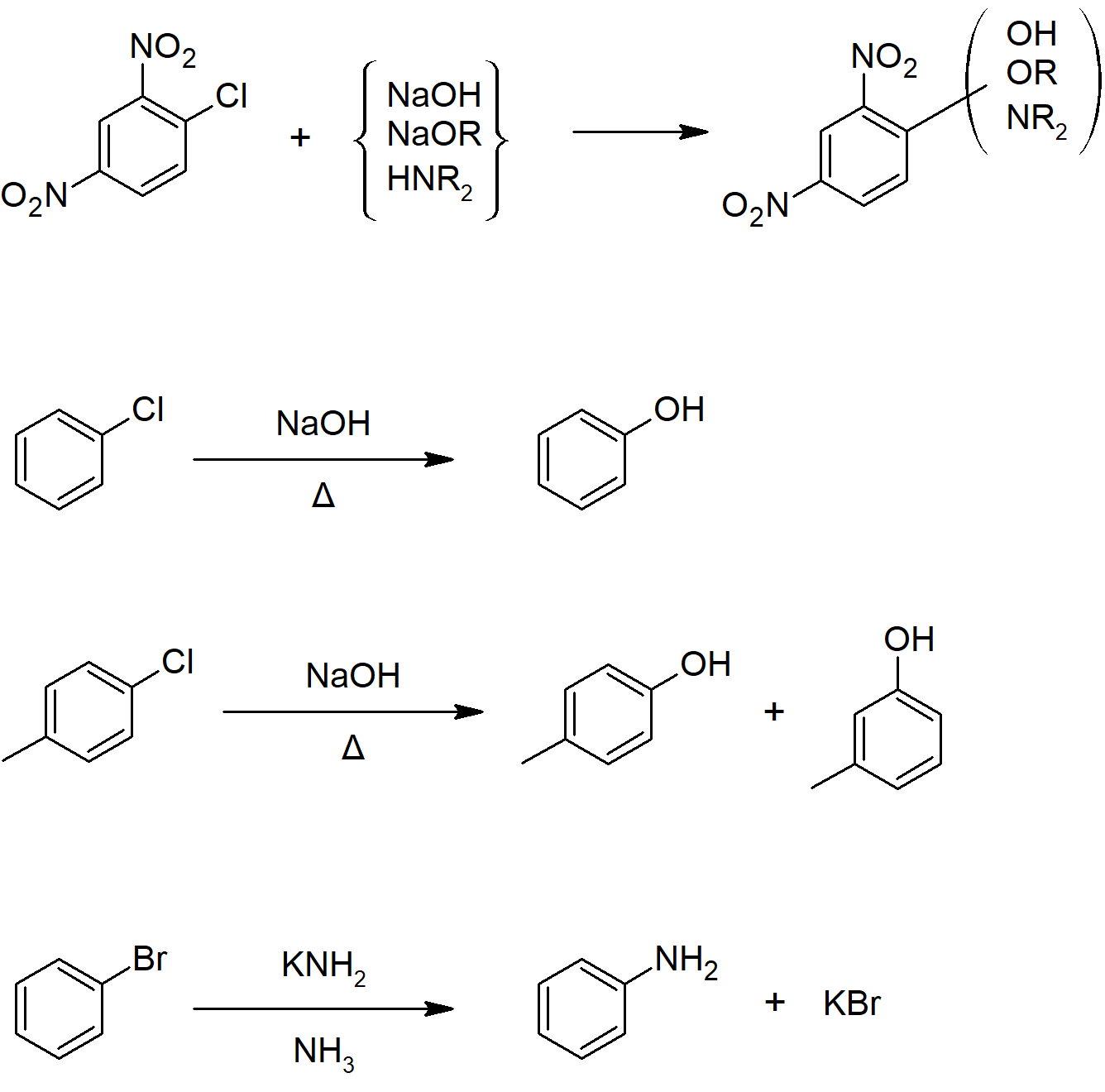
Halobenzenes undergo nucleophilic aromatic substitution through either of two mechanisms. If the halobenzene has a strongly electron-withdrawing substituent in the ortho or para position, substitution occurs by addition of a nucleophile to the ring, followed by elimination of halide from the intermediate anion. If the halobenzene is not activated by an electron-withdrawing substituent, substitution can occur by elimination of HX to form benzyne, followed by the addition of a nucleophile.
Other Reactions
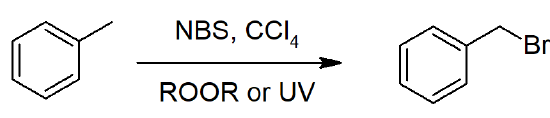
Benzylic Bromination of Alkylbenzene
Reduction of Nitro Group

Amine Reactions


This page titled 3.S: Chemistry of Benzene - Electrophilic Aromatic Substitution (Summary) was last modified on Tue, 17 Feb 2026 02:17:29 GMT and is shared under a CC BY-NC-SA 4.0 license and was authored, remixed, and/or curated by Sol Parajon Puenzo (Cañada College) .
The book could not be loaded just now.